
The most sophisticated investors in private markets aren’t simply chasing returns; they’re engineering them. Finding alpha in private markets is not a matter of luck or broad market exposure. It requires a disciplined combination of strategic insight, rigorous due diligence, and active portfolio management that public markets simply cannot replicate.
That challenge is well understood. Private markets present a distinct set of complexities: limited transparency, the absence of standardized benchmarks, and structural dynamics that can make performance attribution genuinely difficult. For institutional investors and high-net-worth individuals operating within Luxembourg’s regulated financial environment, these obstacles are not abstract concerns. They are practical barriers to informed decision-making.
This article addresses those barriers directly. It outlines the core strategies that experienced practitioners use to identify, measure, and maximize alpha across private equity and venture capital allocations. You’ll gain a clearer framework for evaluating investment opportunities, a more grounded understanding of how professional management contributes to outperformance, and the analytical foundation needed to approach private market decisions with greater confidence.
Key Takeaways
- Alpha in private markets is fundamentally distinct from its public market equivalent, requiring a different analytical framework and a more disciplined approach to opportunity assessment.
- Finding alpha in private markets demands a structured combination of rigorous due diligence, market research, and data-driven analysis rather than broad exposure or passive allocation.
- Real-world private equity case studies demonstrate that consistent outperformance is attributable to specific, repeatable strategies rather than favorable market conditions alone.
- Integrating multiple investment strategies and maintaining disciplined diversification across private market allocations are essential components of a sustainable alpha-generation framework.
- Investors seeking to enhance their private market performance will find actionable guidance here, including concrete next steps and resources to refine their current approach.
What is Alpha in Private Markets?
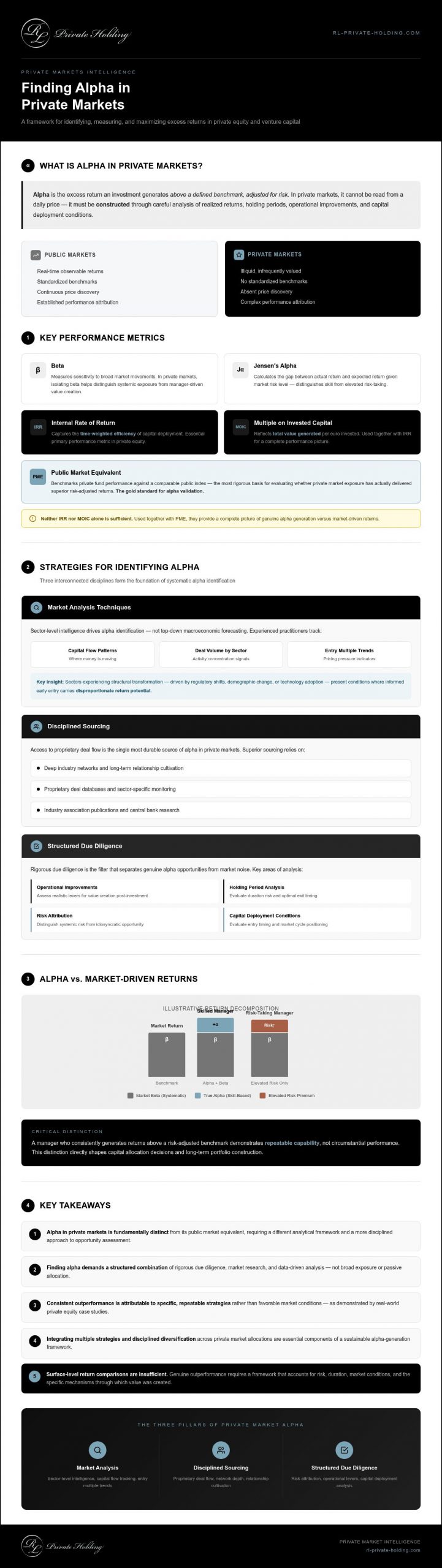
Alpha, at its most fundamental level, represents the excess return an investment generates above a defined benchmark, adjusted for risk. In public markets, this concept is relatively straightforward to quantify: returns are observable in real time, benchmarks are standardized, and performance attribution follows established conventions. Private markets operate under an entirely different set of conditions, and that distinction matters considerably for anyone serious about finding alpha in private markets.
Unlike listed equities, private market investments are illiquid, infrequently valued, and subject to a range of structural factors that complicate direct performance comparison. The absence of continuous price discovery means that alpha in private equity or venture capital cannot be read from a daily closing price. It must be constructed through careful analysis of realized returns, holding periods, operational improvements, and the specific conditions under which capital was deployed and ultimately returned.
The Importance of Alpha in Private Markets
For institutional investors, family offices, and sophisticated allocators operating within Luxembourg’s regulated financial environment, alpha is not a theoretical construct. It is the primary justification for accepting the illiquidity premium that private markets demand. When evaluating fund managers, alpha serves as the clearest signal of genuine skill versus market-driven returns. A manager who consistently generates returns above a risk-adjusted benchmark demonstrates repeatable capability, not circumstantial performance. This distinction directly shapes capital allocation decisions and long-term portfolio construction.
Key Concepts Related to Alpha
Several analytical frameworks are essential to understanding alpha in a private market context:
- Beta: Beta measures a portfolio’s sensitivity to broad market movements. In private markets, beta is harder to isolate but remains relevant when assessing how much of a fund’s return reflects systemic exposure versus manager-driven value creation.
- Jensen’s Alpha: Developed by economist Michael Jensen, this metric calculates the difference between a portfolio’s actual return and its expected return given its level of market risk. Applied to private equity, it helps distinguish skill-based outperformance from returns that simply reflect elevated risk-taking.
- Internal Rate of Return (IRR) and Multiple on Invested Capital (MOIC): These are the primary performance metrics in private equity. IRR captures the time-weighted efficiency of capital deployment, while MOIC reflects total value generated per euro invested. Neither alone is sufficient; used together, they provide a more complete picture of alpha generation.
- Public Market Equivalent (PME): PME benchmarks private fund performance against a comparable public index, offering a more rigorous basis for evaluating whether private market exposure has actually delivered superior risk-adjusted returns.
Finding alpha in private markets demands fluency across all of these metrics. Surface-level return comparisons are insufficient. Genuine outperformance requires a framework that accounts for risk, duration, market conditions, and the specific mechanisms through which value was created.
Strategies for Identifying Alpha Opportunities
Identifying alpha before it becomes consensus is the defining challenge of private market investing. The framework for doing so systematically rests on three interconnected disciplines: rigorous market analysis, disciplined sourcing, and structured due diligence. Each reinforces the others, and weakness in any one area compromises the integrity of the whole.
Market Analysis Techniques
Effective market analysis in private markets begins with sector-level intelligence rather than top-down macroeconomic forecasting. Experienced practitioners track capital flow patterns, deal volume by sector, and entry multiple trends to identify where pricing pressure is building and where genuine opportunity remains underappreciated. Sectors experiencing structural transformation, whether driven by regulatory shifts, demographic change, or technology adoption, frequently present conditions where informed early entry carries disproportionate return potential.
The analytical toolkit for this work includes proprietary deal databases, industry association publications, central bank research from institutions such as the Banque centrale du Luxembourg, and sector-specific advisory reports. Cross-referencing multiple data sources, rather than relying on any single provider, produces a more defensible view of where alpha potential is concentrated. Emerging sectors worth monitoring within the European context include sustainable infrastructure, digital financial services, and healthcare technology, all of which have attracted increasing institutional attention across Luxembourg’s investment landscape.
Sourcing and Due Diligence
Finding alpha in private markets is, in practice, largely a sourcing problem. The most attractive opportunities rarely surface through broadly distributed processes. They emerge from sustained relationships with founders, sector specialists, co-investors, and intermediaries who operate within specific ecosystems. Building that network requires consistent engagement over time, not transactional outreach at the point of deal activity.
Once a potential investment is identified, due diligence must extend well beyond financial statement review. A structured process typically encompasses the following:
- Commercial due diligence: Validating market size assumptions, competitive positioning, and customer concentration through independent reference checks and primary research.
- Management assessment: Evaluating the depth and track record of the leadership team, including their capacity to execute through operational complexity.
- Legal and structural review: Examining ownership structures, regulatory compliance, and any contingent liabilities that could affect return profiles.
- Technology and data analysis: Applying analytical tools to assess operational efficiency, unit economics, and scalability indicators that may not be visible in headline financials.
Technology has materially improved the quality of this process. Platforms that aggregate alternative data, automate document review, and model scenario outcomes allow investment teams to process more information with greater precision than was possible a decade ago. That said, technology augments judgment; it does not replace it.
Professional management remains central to the entire framework. The consistent application of these disciplines across a portfolio, rather than selectively on individual transactions, is what separates systematic alpha generation from isolated success. Investors seeking a structured approach to private market allocation can explore how private equity investment management supports this process at the portfolio level.
Case Studies: Successful Alpha Generation in Private Equity
Theory only carries so far. The clearest evidence for what actually drives outperformance in private markets comes from examining specific investment histories, analyzing the decisions made at each stage, and understanding why some approaches produced durable alpha while others fell short. Finding alpha in private markets is ultimately a discipline learned through pattern recognition, and case studies provide the most concentrated source of those patterns.
In-Depth Analysis of Selected Case Studies
Consider the experience of a mid-market buyout fund that acquired a fragmented industrial services business across Northern Europe. The fund’s thesis was not predicated on favorable market conditions or financial engineering alone. The investment team identified a sector where operational management was inconsistent across regional operators, customer retention was poor due to service quality variance, and no dominant platform had yet consolidated the market. Entry was negotiated at a conservative multiple, and the value creation plan centered on three specific levers: standardizing service delivery protocols, implementing centralized procurement to reduce input costs, and executing a disciplined add-on acquisition strategy to build geographic density.
Over a five-year holding period, EBITDA expanded substantially through a combination of organic improvement and strategic bolt-on acquisitions. The exit multiple exceeded the entry multiple, not because the market re-rated the sector, but because the business had been fundamentally transformed. The alpha generated here was entirely attributable to active management and pre-defined operational execution, not to macroeconomic tailwinds.
A contrasting example involves a growth equity investment in a European software-as-a-service business where the fund entered at an elevated revenue multiple during a period of broad sector enthusiasm. The underlying technology was credible, but the due diligence process underweighted customer churn data and overestimated the speed of enterprise sales cycles. When growth decelerated, the exit environment had also contracted. The investment returned capital but generated no meaningful alpha. The lesson is precise: entry discipline and rigorous commercial validation are not optional components of the process.
Key Takeaways from Case Studies
Across both outcomes, several factors emerge as consistent determinants of alpha generation:
- Entry valuation discipline: Overpaying at entry compresses the margin for error regardless of operational quality.
- Pre-defined value creation plans: Funds that enter with specific, measurable operational objectives outperform those relying on market appreciation.
- Management team depth: The capacity of the leadership team to execute through complexity is frequently the single most consequential variable.
- Exit pathway clarity: Investments with multiple credible exit routes, whether strategic sale, secondary buyout, or public listing, preserve optionality and protect return profiles.
Active management runs through every successful case. Passive capital allocation into private markets, without the operational engagement and portfolio monitoring that professional managers provide, consistently underdelivers against the illiquidity premium investors accept. The evidence across market cycles reinforces a straightforward conclusion: finding alpha in private markets is a function of process, not circumstance.
Integrating Strategies for Enhanced Alpha Generation
No single investment strategy holds a monopoly on alpha. The most consistently successful private market allocators construct portfolios that draw on multiple complementary approaches simultaneously, balancing the return profiles of buyout, growth equity, and venture capital exposure against one another while maintaining the discipline to avoid overconcentration in any single thesis. Finding alpha in private markets at the portfolio level, rather than the individual transaction level, requires this kind of structural intentionality from the outset.
The Role of Diversification in Achieving Alpha
Diversification in private markets operates differently from its public market equivalent. Because private assets are illiquid and valued infrequently, the correlation benefits that diversification provides are not always visible in the short term. Over a full investment cycle, however, portfolios that span multiple geographies, sectors, and fund vintages demonstrate materially more stable return profiles than concentrated allocations.
A well-constructed private equity portfolio might combine exposure across the following dimensions:
- Stage diversification: Balancing early-stage venture capital with mid-market buyouts and growth equity to capture different risk-return profiles across the business lifecycle.
- Sector diversification: Distributing capital across sectors with low return correlation, such as healthcare technology, industrial services, and financial infrastructure, to reduce the impact of sector-specific downturns.
- Vintage year diversification: Committing capital across multiple fund vintages to smooth the J-curve effect and reduce exposure to any single entry-point environment.
- Geographic diversification: Within the European context, extending allocations across multiple jurisdictions reduces regulatory concentration risk while broadening the opportunity set.
Balancing these dimensions requires active portfolio construction, not passive accumulation. Each allocation decision should be evaluated not only on its standalone merits but on how it interacts with existing exposures.
Collaborative Investment Approaches
Co-investments and strategic partnerships represent one of the most underutilized mechanisms for enhancing alpha generation. When institutional investors co-invest alongside a lead manager on a specific transaction, they gain direct exposure to a carefully selected asset, often at reduced fee structures, while benefiting from the lead manager’s proprietary due diligence and sector expertise.
The advantages extend beyond economics. Collaborative structures allow investors to access opportunities that would not surface through standard fund allocation channels. Strategic alliances with sector-focused advisors, regional operating partners, and specialist intermediaries expand the sourcing network in ways that a single investment team cannot replicate independently. Combined expertise consistently produces more rigorous investment decisions than any single perspective allows.
Finding alpha in private markets through integrated, collaborative strategies is a discipline that rewards sustained commitment and experienced partnership. Investors looking to build a more structured approach to private market allocation are encouraged to explore how private equity investment management can support a diversified, multi-strategy portfolio framework.
Next Steps for Investors Seeking Alpha
Understanding the principles behind finding alpha in private markets is a necessary foundation. Acting on that understanding requires a structured sequence of practical decisions. For investors operating within Luxembourg’s regulated financial environment, the transition from conceptual clarity to portfolio action is where genuine competitive advantage is either built or lost.
Assessing and Refining Investment Strategies
The most productive starting point is an honest evaluation of your existing portfolio. This means examining not just headline returns but the mechanisms behind them. Ask whether outperformance in previous cycles was attributable to manager skill, favorable entry conditions, or broad sector appreciation. The distinction matters considerably for forward-looking allocation decisions.
A structured portfolio review should address the following:
- Performance attribution: Separate manager-generated returns from market-driven gains using PME analysis or comparable benchmarking tools.
- Concentration risk: Identify unintended overexposure to specific sectors, geographies, or vintage years that may amplify downside in a contracting environment.
- Due diligence consistency: Assess whether your current investment process applies the same analytical rigor across all commitments or selectively on higher-profile transactions.
- Goal alignment: Set measurable return targets, defined by IRR thresholds and MOIC expectations, that are calibrated to realistic market conditions rather than peak-cycle assumptions.
Refining strategy is not a one-time exercise. It should be embedded as a regular discipline within your portfolio management cycle, ideally reviewed on an annual basis against evolving market conditions.
Resources for Ongoing Education
Private markets evolve continuously, and sustained outperformance requires sustained learning. Several resources provide reliable, institutionally grounded perspectives on private equity and venture capital dynamics:
- Publications: The European Investment Fund’s research series, the Luxembourg Private Equity and Venture Capital Association (LPEA) publications, and Preqin’s annual global reports offer data-driven analysis specific to the European private markets landscape.
- Industry events: The LPEA’s annual summit and associated workshops provide direct access to practitioners, fund managers, and regulatory perspectives relevant to Luxembourg-based investors.
- Professional networks: Engaging with peer allocators through structured forums accelerates pattern recognition and surfaces deal flow that wouldn’t otherwise reach a single investment team.
Building a network of professionals who are genuinely focused on alpha generation, rather than broad market participation, sharpens both sourcing capability and analytical judgment over time.
For investors seeking structured guidance on private equity investment management and venture capital funding, RL Private Holding brings established expertise and a proven presence within Luxembourg’s financial landscape. Engaging with experienced professionals who understand the specific regulatory and market conditions of this environment provides a meaningful advantage when finding alpha in private markets demands more than general knowledge. Exploring how private equity investment management can support your portfolio construction is a practical and well-grounded next step.
Building a Sustainable Edge in Private Markets
Finding alpha in private markets is not a single decision; it’s a discipline built through consistent process, rigorous analysis, and experienced partnership. The evidence presented throughout this article points to the same conclusion: durable outperformance comes from disciplined sourcing, structured due diligence, and active portfolio management, not from broad market exposure or favorable timing.
Three principles stand out as particularly consequential for investors moving forward. Entry valuation discipline protects returns before a single operational decision is made. Diversification across stages, sectors, and vintages stabilizes portfolio performance across full market cycles. And professional management, applied consistently rather than selectively, is what separates systematic alpha generation from isolated wins.
For investors ready to translate these principles into portfolio action, working with specialists who bring established expertise in venture capital and private equity investment management provides a meaningful structural advantage. RL Private Holding combines a proven track record with a focused commitment to maximizing investor returns within Luxembourg’s regulated financial landscape.
Explore RL Private Holding’s investment strategies and discover how we can help you find alpha.
Frequently Asked Questions About Finding Alpha in Private Markets
What is alpha in private markets?
Alpha in private markets represents the excess return generated above a risk-adjusted benchmark, attributable specifically to manager skill rather than broad market conditions. Unlike public markets, where alpha can be observed through daily price movements, private market alpha must be constructed through analysis of realized returns, operational improvements, and the specific mechanisms through which value was created over a holding period.
How can I measure alpha for my investments?
The most reliable approach combines several complementary metrics. Internal Rate of Return and Multiple on Invested Capital capture time-weighted efficiency and total value generated respectively, while the Public Market Equivalent benchmark allows direct comparison against a relevant public index. No single metric is sufficient on its own; using them together produces a more complete and defensible picture of whether genuine outperformance has occurred or whether returns simply reflect elevated risk-taking.
What strategies can help me find alpha in private equity?
Finding alpha in private markets consistently requires three interconnected disciplines: disciplined entry valuation, pre-defined operational value creation plans, and rigorous sourcing through sustained relationships rather than broadly distributed processes. Funds that enter with specific, measurable improvement objectives tied to EBITDA expansion, cost reduction, or market consolidation outperform those relying on sector appreciation. Entry discipline and commercial validation are non-negotiable components, not optional enhancements.
Are there risks associated with seeking alpha in private markets?
Several distinct risks accompany private market alpha-seeking strategies. Illiquidity risk means capital is locked up for extended periods, typically five to ten years, with limited ability to exit early. Valuation risk arises from infrequent pricing, which can obscure deteriorating fundamentals until a realization event. Concentration risk, where overexposure to a single sector or vintage year amplifies downside, is particularly relevant for investors who haven’t structured their portfolios across multiple dimensions simultaneously.
How do I know if my investment manager is generating alpha?
Start by separating manager-generated returns from market-driven gains using PME analysis benchmarked against a comparable public index. A manager genuinely generating alpha will demonstrate consistent outperformance across multiple fund vintages and market cycles, not just during periods of broad sector appreciation. Evaluate whether their value creation plans were pre-defined at entry and whether reported performance improvements are attributable to specific operational actions rather than multiple expansion alone.
What role does diversification play in finding alpha?
Diversification in private markets stabilizes portfolio performance across full investment cycles rather than eliminating individual investment risk. Distributing capital across fund stages, sectors with low return correlation, multiple vintage years, and different geographies reduces the impact of any single adverse outcome. The key distinction from public market diversification is that correlation benefits aren’t always visible in the short term due to infrequent valuations, but they become material over a complete market cycle.
Can individual investors find alpha in private markets?
Individual investors can access private market alpha, but the structural requirements are demanding. Meaningful deal flow, rigorous due diligence capability, and sustained manager relationships are prerequisites that most individuals cannot replicate independently. High-net-worth individuals operating within Luxembourg’s regulated financial environment typically access private market alpha most effectively through established investment management structures, such as those offering private equity investment management or venture capital funding, where professional oversight is embedded in the process from sourcing through exit.