

A disappointing quarter is not, by itself, a case for a turnaround. For investors asking what to do when a portfolio company is underperforming, the first priority is to establish whether weaker results reflect temporary market pressure, operational problems, excessive leverage, or a combination of factors. Acting before the evidence is clear can misdirect resources; waiting too long can narrow the available choices.
Incomplete reporting and differing expectations among investors, the board, and management can make that assessment harder. A disciplined response starts with reliable information and a shared view of the company’s position, risks, and objectives. It then connects each intervention to accountable owners, measurable indicators, and a defined review period.
This guide explains how to distinguish symptoms from underlying causes, align stakeholders around a fact-based diagnosis, and develop a time-bound recovery plan. It also sets out decision points for continuing the plan, adjusting it, or escalating the response when results do not meet expectations. The aim is not to prescribe a turnaround in every case, but to make the next decision deliberate and evidence-led.
Key Takeaways
- Define underperformance against the approved plan, relevant operating indicators, and the investment rationale, rather than treating one missed target as conclusive.
- To determine what to do when a portfolio company is underperforming, examine demand, pricing, costs, operations, leadership, liquidity, and execution before selecting an intervention.
- Compare response options by the evidence required, expected disruption, accountable owner, and point at which progress will be reviewed.
- Keep the initial recovery plan focused on a manageable number of high-impact actions, each with a clear owner and measurable milestone.
- Use governance records and decision gates to assess results objectively and determine whether to continue, adjust, or escalate the response.
Fixing Underperformance: Start With the Evidence
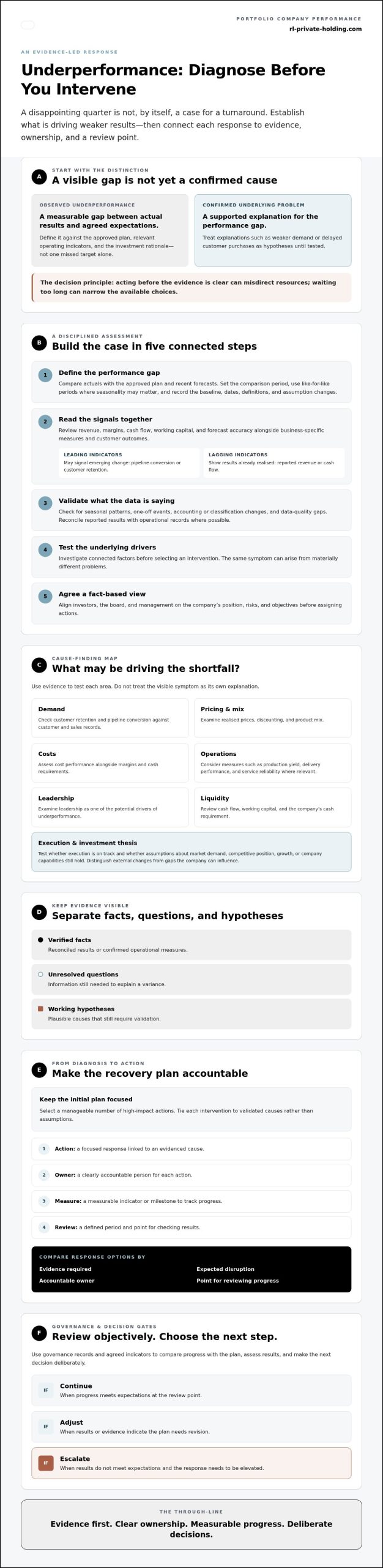
Missed targets create pressure to act, but one weak reporting period does not establish why results have deteriorated or whether the shortfall will persist. Begin by defining the gap: compare actual performance with the company’s approved plan, relevant operating indicators, and investment rationale. The relationship between an investor and a backed business is central to the term Portfolio company, but its performance must be assessed against the company’s own objectives and evidence.
Observed underperformance is a measurable gap between actual results and agreed expectations; a confirmed underlying problem is a supported explanation for that gap. The distinction matters. A revenue shortfall may be clear in the accounts, while its cause, such as weaker demand or delayed customer purchases, remains a hypothesis until tested.
Set the comparison period before interpreting results. Review actuals against the approved plan and recent forecasts, using like-for-like periods where seasonality may affect performance. For a persistent shortfall, examine results over a period suited to the business’s reporting cadence and operating cycle. Record the baseline, dates, definitions, and changes in assumptions so later reviews use a consistent reference point.
Which performance signals should trigger a closer review?
Start with revenue, margins, cash flow, working capital, and forecast accuracy. A revenue variance has different implications from margin compression or a growing cash requirement, so assess the measures together rather than relying on one headline figure. Add indicators suited to the business model and customer outcomes, such as renewal rates and service reliability, or production yield and delivery performance.
Separate leading indicators, which may signal emerging change, from lagging indicators, which show results already realised. Pipeline conversion or customer retention can inform expectations; reported revenue and cash flow confirm what has occurred. Neither category is sufficient alone. Investigate whether an early warning is translating into financial impact and whether financial results are masking operational deterioration.
How can investors avoid reacting to a misleading snapshot?
Validate the information before deciding what it means. Check for seasonal patterns, one-off events, accounting or classification changes, and gaps in data quality. Reconcile reported results with operational records where possible, and identify whether revised assumptions explain differences between actuals and the latest forecast.
Maintain a short evidence log that separates:
- Verified facts: reconciled results or confirmed operational measures.
- Unresolved questions: information still needed to explain a variance.
- Working hypotheses: plausible causes that require validation.
This structure helps investors answer what to do when a portfolio company is underperforming without confusing a visible symptom with a proven cause. It also gives the next review a clear basis for testing whether the initial interpretation holds.
Diagnose Why a Portfolio Company Is Underperforming Before Prescribing a Fix
Once a variance is established, determine what is driving it. Examine demand, pricing, costs, operations, leadership, liquidity, and execution as connected factors. A fall in revenue, for example, may reflect weaker customer retention, lower pipeline conversion, discounting, or a shift in product mix. Each explanation points to a different response, so test possible causes rather than treating the visible symptom as its own explanation.
Test the investment thesis as well. The original assumptions about market demand, competitive position, growth, or the company’s capabilities may no longer hold. Distinguish changes in external conditions from gaps the company can influence, and assess whether its current resources and operating model remain suited to the opportunity.
Corrective action should follow validated causes, not assumptions, because the same symptom can arise from materially different problems. A cause-and-evidence matrix helps keep this distinction clear:
- Demand: Test changes in customer retention and pipeline conversion against customer and sales records.
- Pricing and mix: Check realised prices, discounting, and product or service mix alongside revenue.
- Costs and cash: Review gross margin, operating expenses, cash conversion, and working-capital movements together.
- Operations and execution: Compare delivery, capacity, or quality measures with plans and operational reports.
- Leadership and liquidity: Assess decision-making responsibilities, forecast reliability, and near-term cash requirements using current evidence.
For each potential cause, record the observed symptom, supporting evidence, alternative explanations, and information still required. This prevents an initial interpretation, such as “costs are too high,” from becoming a conclusion before cost categories and operational drivers have been examined.
How should financial and operating drivers be tested?
Trace revenue changes through retention, pipeline conversion, pricing, and product mix, then compare the findings with gross margin and operating expenses. Follow the effect through cash conversion and working capital: reported growth may not translate into available cash if collections slow or inventory builds. Test management’s explanations against source data, customer evidence, and operating reports. Where records conflict, identify and resolve the discrepancy before relying on an explanation to support a decision.
How do market conditions differ from execution issues?
Assess sector demand, competitive shifts, customer concentration, and supplier exposure alongside internal performance. External pressure may explain part of a variance, but execution, pricing, or resource allocation may still be controllable. State where evidence is incomplete and specify what would reduce uncertainty, such as customer feedback, segmented sales data, or supplier information. This helps investors distinguish external constraints from company-specific issues without overstating certainty.
For broader context on RL Private Holding’s diversified portfolio, see its portfolio perspective.
Compare Response Options for an Underperforming Portfolio Company
The appropriate response depends on the cause, its severity, and the company’s capacity to address it. A focused operational change may be proportionate when evidence points to a limited, controllable issue. A broader strategic review may be necessary if the investment thesis has changed or several drivers are deteriorating. The question of what to do when a portfolio company is underperforming should be answered by matching the response to the evidence, not by applying the same intervention in every situation.
Use a time-limited recovery effort to test whether defined actions can improve agreed indicators. This is not the same as deciding to restructure the company or dispose of the investment. Those are separate strategic decisions to consider through the appropriate governance processes.
| Response option | Evidence threshold | Likely disruption | Owner | Review point |
|---|---|---|---|---|
| Targeted operational changes | A verified, addressable driver with a clear link to performance | Limited if confined to a specific process or priority | Executive accountable for the relevant function | At the milestone set for the expected operating outcome |
| Revised forecasts | Current assumptions no longer reflect actual trading or market conditions | Low operational disruption, with implications for planning and resource allocation | Management, reviewed with the board | After updated assumptions and forecasts are tested against actual results |
| Management support | A defined capability or execution gap that can be addressed with additional support | Variable, depending on the scope and responsibilities agreed | Management and the board, with roles documented | Against agreed deliverables and decision rights |
| Broader strategic review | Repeated execution barriers, material changes to the thesis, or issues spanning multiple drivers | Potentially substantial, as priorities or direction may change | Board and investors through established governance | At a formal decision gate after the relevant analysis |
When is a focused operational plan proportionate?
Choose targeted action when validated evidence identifies a small number of addressable drivers. Each initiative should specify its measurable outcome, accountable executive, required resources, and review milestone. For example, if customer losses are concentrated in one segment, a retention initiative may be more appropriate than a company-wide cost programme. Avoid adding actions that compete with immediate operating priorities or lack a clear connection to the diagnosis.
When should investors reassess strategy or leadership?
Repeated forecast misses, unresolved execution barriers, or a changed investment thesis warrant a broader review. Assess management capability against the specific requirements of the proposed plan, rather than making personnel decisions based on a single poor result. Document the evidence, alternatives, and decision rights through established governance processes.
Intervention need not undermine trust. Collaborative governance means agreeing on objectives, information requirements, responsibilities, and escalation points while preserving management’s authority over agreed operating decisions. Clear boundaries reduce conflicting instructions and make accountability more consistent. For general information about RL Private Holding’s investment activities, see private equity investment management.
Build a Time-Bound Recovery Plan With Clear Accountability
A recovery plan should turn the diagnosis into a limited set of actions that can be assessed against evidence. For investors considering what to do when a portfolio company is underperforming, a written sequence helps align management, the board, and investors around priorities without creating an unmanageable list of initiatives.
- Confirm the baseline. Record the current position, approved plan, latest forecast, relevant operating measures, and assumptions behind each comparison.
- Agree priorities. Select a manageable number of high-impact initiatives directly linked to validated causes. Defer actions that do not address the diagnosis or would compete with immediate operating priorities.
- Assign owners. Name one accountable executive for each initiative and document dependencies, decision rights, and who must be consulted or informed.
- Resource the actions. Specify required people, time, information, and other resources. Identify material risks or trade-offs before implementation begins.
- Set milestones and review results. Define dated checkpoints, the evidence expected at each one, and how results will inform the next decision.
Use both leading and lagging indicators. A leading measure, such as pipeline conversion, may indicate whether an action is taking effect; a lagging measure, such as realised revenue or cash flow, confirms outcomes after they occur. Choose measures and milestone dates that fit the company’s operating cycle. No universal threshold determines success for every business.
A recovery plan becomes testable when every action has an accountable owner, measurable evidence, and a scheduled review date.
What should each recovery initiative specify?
For each initiative, record the root cause it addresses, the action to be taken, the accountable owner, key dependencies, required resources, and expected evidence of progress. Clarify whether management can decide and act, whether board approval is required, or whether investors hold a decision right under the applicable governance arrangements. Document material risks, including the possibility that an action could disrupt other priorities.
How often should progress and escalation be reviewed?
Set the review cadence according to cash runway, operating volatility, and the time needed for actions to produce observable results. Reporting should concisely compare actual performance with the forecast and plan, show milestone status, and identify corrective actions or unresolved constraints. Agree in advance what evidence supports continuing, adjusting, or escalating the response. A missed milestone may call for investigation; repeated misses or worsening liquidity may justify a more substantial review.
RL Private Holding’s stated areas include private equity investment management. Explore private equity investment management to learn more about the firm’s investment activities.
Use Governance and Decision Gates to Determine the Next Step
A recovery plan needs defined decision gates so that continued investment of time and resources is based on results, not optimism or the amount already committed. For investors deciding what to do when a portfolio company is underperforming, each gate should assess progress against agreed milestones and test whether the assumptions behind the plan remain valid.
Management, the board, and investors should maintain a consistent record of the evidence reviewed, assumptions considered, and decisions made. This record supports continuity when circumstances or participants change and helps distinguish a deliberate change in direction from an informal shift in expectations. At each gate, the evidence may support continuing the plan, changing its scope, or assessing broader alternatives. The process should not predetermine the outcome.
What evidence should inform each decision gate?
Review verified operating results, the company’s cash position, forecast reliability, and progress against each initiative. Revisit key assumptions and record material developments since the prior review, including missed milestones or new constraints. Then document the decision, its rationale, the person responsible for follow-through, and the next review date. If the evidence is incomplete, specify what information is missing and how it will be obtained before reaching a consequential conclusion.
A decision record can use a consistent format:
- Continue: Milestones are being met, or evidence supports allowing more time for actions to produce measurable results.
- Adjust: Progress is insufficient, but the diagnosis still holds and a defined change could address the gap.
- Escalate: Results, liquidity, or changed assumptions call for a broader review under established governance processes.
These are decision paths, not automatic rules. A missed milestone should prompt examination of its cause and consequences, rather than an assumption that the entire plan has failed.
How should portfolio-level oversight remain disciplined?
Company-level decisions should also be considered in the context of the wider portfolio where relevant. Assess whether risks are concentrated or whether dependencies between businesses could affect the choices available. Share information through established governance and reporting channels, while maintaining appropriate confidentiality and respecting the company’s decision rights.
RL Private Holding is a diversified investment holding company that manages a portfolio of businesses across areas including technology, real estate, asset management, private equity, and venture capital. For broader context on portfolio oversight, see its private equity investment management framework.
Disciplined oversight does not require a predetermined intervention. It requires decisions that are documented, proportionate to the evidence, and revisited at defined intervals. Explore RL Private Holding.
Make the Next Decision Evidence-Led
Effective oversight begins by distinguishing a measurable performance gap from a confirmed underlying problem. A careful diagnosis helps investors and management identify whether the drivers are external, operational, financial, or connected to the investment thesis before deciding on a response.
For those assessing what to do when a portfolio company is underperforming, the practical priorities are clear: match actions to validated causes, limit the initial plan to focused initiatives, and give each action an accountable owner, measurable milestones, and a review date. At each decision gate, assess actual progress and updated assumptions to determine whether to continue, adjust, or consider broader alternatives. This creates a disciplined process without presuming a single outcome.
RL Private Holding manages a diversified portfolio of businesses, with stated investment areas that include private equity and venture capital. To learn more about the firm, explore RL Private Holding.
Underperformance need not dictate the decision. With reliable evidence, clear accountability, and consistent governance, stakeholders can make the next step more deliberate and keep their focus on the company’s long-term prospects.
Frequently Asked Questions
What is the first step when a portfolio company is underperforming?
Confirm the performance gap against the approved plan, recent forecasts, and relevant operating indicators before choosing an intervention. When deciding what to do when a portfolio company is underperforming, first check that financial and operational reports are complete, comparable, and accurate. Identify the period affected and note any seasonality, one-off events, or accounting changes that could distort results. This establishes a dependable baseline and prevents an isolated variance from being mistaken for a persistent problem.
How do you identify the root cause of poor company performance?
Trace the shortfall through its possible financial, operational, and market drivers, then test each explanation against reliable evidence. For revenue weakness, examine customer retention, pipeline conversion, pricing, and product mix. Review gross margin, operating expenses, cash conversion, and working capital together. Compare management’s explanations with source data, customer feedback, and operating reports. Separate verified facts from open questions and working hypotheses so assumptions do not become conclusions without validation.
Should investors replace management when a portfolio company misses its targets?
Not solely because the company missed a target. First determine whether the shortfall reflects external conditions, a correctable execution issue, or a capability gap that management cannot address. Assess leadership against the specific requirements of the company’s priorities and recovery plan, using documented results rather than a single reporting period. If a leadership change is under consideration, use established governance processes, clarify decision rights, and consider the transition’s effect on operational continuity and accountability.
How long should a portfolio company recovery plan take?
Set the plan’s duration according to the company’s cash position, operating cycle, and the time needed for actions to produce observable results. Avoid applying a universal timeframe. Define dated milestones and review them at a cadence that reflects business volatility and liquidity. Leading indicators can show whether actions are taking effect, while lagging measures confirm outcomes. If evidence is insufficient at a review point, specify what additional information is needed and when it will be assessed.
What KPIs should investors monitor in an underperforming portfolio company?
Choose indicators that connect the diagnosed causes to financial outcomes. Common measures include revenue, gross margin, operating expenses, cash flow, working capital, and forecast accuracy. Add business-specific indicators, such as customer retention, pipeline conversion, delivery performance, or production yield, where relevant. Monitor leading indicators for early signs of change and lagging indicators to confirm realised results. Define each measure consistently, with a baseline and review period, so comparisons remain meaningful.
When should investors consider a broader strategic review?
Consider a broader review when repeated forecast misses, unresolved execution barriers, worsening liquidity, or material changes to the investment thesis suggest that a focused plan may not address the company’s position. Reassess both the assumptions behind the strategy and the company’s capabilities. Document the evidence, alternatives, and implications through established governance channels. A review should clarify available choices and decision criteria; it need not predetermine whether the company continues its current course.
How can a board support a struggling portfolio company without undermining management?
The board can support management by agreeing on priorities, information requirements, decision rights, and escalation points, while leaving agreed operating decisions with the responsible executives. Set a consistent reporting cadence and focus discussions on milestones, constraints, and decisions requiring board input. Avoid conflicting instructions from individual investors or directors. Record decisions and assumptions, assign follow-up owners, and review progress against the same measures so management receives clear, coordinated oversight.
To discuss RL Private Holding’s private equity investment management, venture capital funding, or other investment activities, contact RL Private Holding.