

Revenue is not the only evidence venture capitalists consider. Founders asking how to get venture capital funding without revenue can build a case with a working prototype, early users, pilot customers or a growing waiting list. At the seed stage, investors primarily assess the idea and team, along with the market opportunity and potential to scale.
Fundraising can be demanding: founders often meet with dozens of firms before receiving a term sheet. A clear investment case keeps those conversations focused on what the business has validated, what it still needs to prove and how capital would help it make progress.
This guide explains how to prepare a pitch and data room that make early evidence useful to investors, identify venture capitalists whose focus fits your company, and approach them with a disciplined fundraising plan. It also covers due diligence, valuation and dilution, and term-sheet provisions that can affect control and future financing. The aim is to help you decide whether venture capital suits your company’s stage and capital needs, then prepare with a clear account of the opportunity and its risks.
Key Takeaways
- Build an investment case around validated demand, the problem you solve and a credible path to scale, rather than treating revenue as the only proof of potential.
- Organise your pitch and data room so investors can assess the opportunity, the team, key assumptions and how capital will be used.
- Prioritise venture capitalists whose investment focus and strategic contribution fit your company’s stage and goals.
- Review governance provisions and the full terms alongside valuation, so you understand how financing may affect ownership and decision-making.
- Match the fundraising route to your development needs, and consider whether pre-seed or seed capital is appropriate before approaching investors.
Pitch-deck content and supporting data room
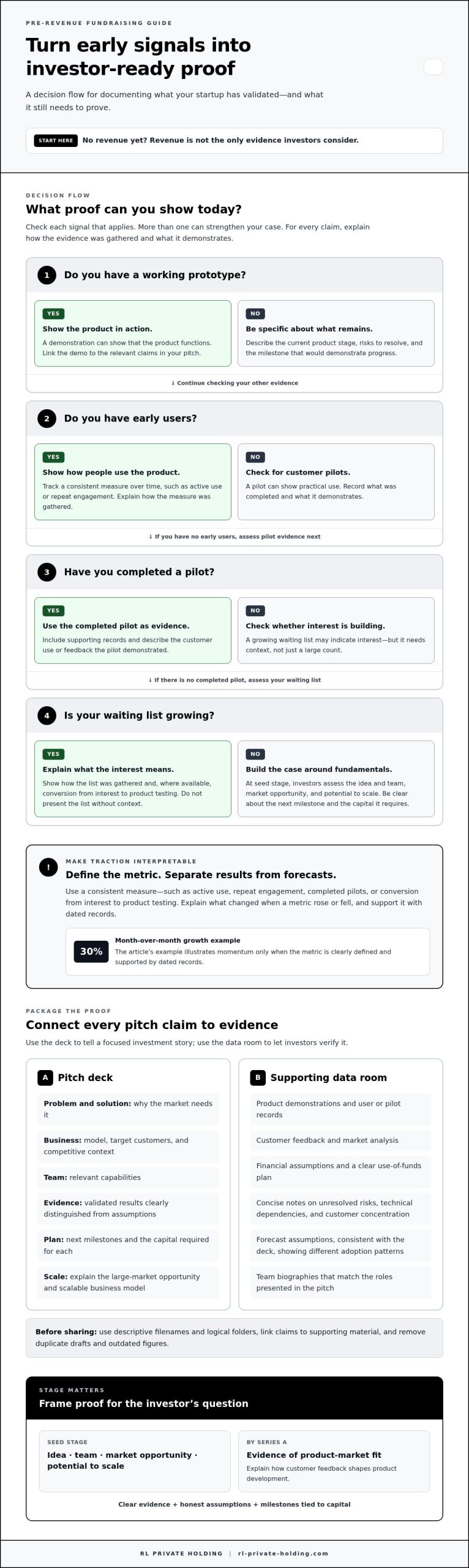
Pre-revenue investors assess your idea and team, the market opportunity, and the potential to scale. Show traction through a working prototype, early users, pilot customers or a growing waiting list, and organise the supporting evidence so investors can assess your claims.
-
Assemble the Pitch Deck
Build the deck around the customer problem, your solution and why the market needs it. Explain the business model, target customers, competitive context and the team’s relevant capabilities. Without sales, distinguish validated evidence from assumptions. A completed pilot, for example, is evidence; a forecast of future contracts is not.
Set out the next milestones and link each to the capital required. Describe the product’s current stage, the risks to resolve and the evidence that would demonstrate progress. Venture capitalists generally look for a scalable business model and a large market. By Series A, they look for evidence of product-market fit, so explain how customer feedback shapes product development.
-
Show Pre-Revenue Traction
Document user activity and customer commitment rather than presenting a large waiting list without context. A working prototype shows that the product functions; early users can reveal how people engage with it. Pilot customers can demonstrate practical use, while a growing waiting list may indicate interest. Explain how each signal was gathered and what it demonstrates.
Use a consistent measure over time, such as active use, repeat engagement, completed pilots, or conversion from interest to product testing. A startup example with 30% month-over-month growth can illustrate momentum, but only if the metric is clearly defined and supported by dated records. Separate observed results from projections, and explain what changed when the metric rose or fell. This makes traction interpretable, not merely impressive.
-
Prepare the Supporting Data Room
Organise the data room so investors can trace each claim in your deck to supporting material. Include product demonstrations, user and pilot records, customer feedback, market analysis, financial assumptions and a clear use-of-funds plan. Use descriptive filenames and logical folders. For example, a claim about repeat use should link to records showing that activity.
Prepare concise explanations of unresolved risks, including technical dependencies, customer concentration and the steps needed before launch. Keep the forecast consistent with the deck, label assumptions and show how different adoption patterns affect the plan. Ensure team biographies match the roles presented in the pitch. Before sharing access, remove duplicate drafts and outdated figures so diligence starts with a coherent account.
Choosing and approaching venture capitalists
Pre-revenue startups can also consider angel investment, grants, customer-funded development, or venture debt. B2B customers may fund development or implementation when a product addresses an urgent problem; venture debt generally depends on venture backing and credible progress toward further equity.
For a venture round, assess investor fit before sending a pitch. The right match depends on your stage, market, funding purpose and the contribution you need beyond capital.
-
Choose Venture Capitalists
Identify firms whose investment focus matches your sector, stage and business model. Review their stated interests and previous investments, then compare these with your product and milestones. A firm focused on a different stage may not be suitable, even if it invests in your industry.
Assess what each investor could contribute beyond financing. Venture capitalists may offer strategic guidance, mentoring, operational input and access to partnerships, customers, talent or further investors. Decide which capabilities address a specific need. Do not select a firm solely for its name or perceived profile.
-
Approach Venture Capitalists
Prepare a concise, tailored introduction for each selected firm. Explain why its investment focus fits your company, what you have validated and which milestone the proposed financing would support. Address the partner or investment team whose remit most closely matches your business. A generic pitch gives investors little reason to prioritise your opportunity.
Use a clear sequence: introduce the company, state the customer problem, present your strongest evidence and make a specific request for a meeting. Have the deck and supporting material ready for follow-up. Founders often meet with dozens of firms before receiving a term sheet, so record each contact, response and next action.
-
Build a Disciplined Outreach Plan
Group suitable firms by investment fit and approach them in a deliberate order. Track introductions, meetings, requested information and follow-up dates in one record. After each discussion, note the questions raised and refine your explanation without changing the underlying facts. This helps reveal recurring concerns and keeps later conversations consistent.
Allow for months of meetings and follow-ups. Keep operating plans realistic during fundraising, and do not treat investor interest as committed capital. Share material updates that change the investment case, such as a completed pilot or a new strategic partnership. Direct, accurate communication helps investors assess your progress and ability to execute.
-
Compare Funding Routes
Match the financing route to the company’s immediate need. Angel investors can provide early equity; grants may suit eligible work in areas such as sustainability, health, or environmental protection. For B2B products, customer-funded development can validate demand while supporting implementation.
Consider venture debt in context. Startup lenders assess the venture capital already invested, the progress made with it and the prospects for raising further equity. A pre-revenue company’s traction or intellectual property may inform that assessment, but debt creates repayment obligations and does not replace a credible financing plan.
Diligence, term sheets, and negotiation
Be ready to support every claim with consistent records, then assess the proposed terms as a complete package. A term sheet usually sets out the main investment terms before due diligence and is mostly non-binding.
- Map each pitch-deck claim to evidence before diligence begins. For a prototype, organise product materials and development records; for pilot customers, keep agreements, feedback and progress reports together. Reconcile forecasts with their underlying assumptions, and ensure descriptions of customers, product status and milestones match across documents.
Identify unresolved issues early, such as technical dependencies, intellectual property ownership or customer commitments that remain informal. Explain each issue directly and describe the action planned to address it. If an investor asks how you measured a milestone, provide the underlying records rather than relying on a revised summary.
-
Prepare for Diligence
Assign someone to manage investor requests and maintain one current set of documents. Record what was requested, who supplied it and whether it answers the question. Organise sensitive information and share materials through controlled access. This reduces conflicting versions and helps founders respond accurately as diligence proceeds.
Expect questions about the team, product, market, financial assumptions and risks. Answer directly, distinguish completed work from plans, and correct inconsistencies promptly. Do not present a forecast as a customer commitment or a pilot as recurring revenue. Investors use diligence to test whether the opportunity matches the evidence.
- Review the term sheet line by line before treating it as a final agreement. It usually identifies the proposed investment, valuation, security, governance arrangements and conditions for closing. Because it is mostly non-binding, distinguish commercial intentions from provisions that may bind the parties, and understand what remains subject to definitive agreements.
Compare the proposal with your funding objective. Consider whether the capital supports your planned milestones and whether the proposed structure leaves room for future financing. Keep a written list of open points, the rationale for each requested change and the trade-offs you could accept.
-
Negotiate the Terms
Prioritise terms by their effect on ownership, decision-making and future fundraising, rather than focusing only on headline valuation. Venture capitalists often take an active role in company decisions and may secure board seats. Clarify how governance rights work and which decisions require investor involvement.
Negotiate with specific alternatives. For example, explain why a proposed approval right could delay an operational decision, then suggest a narrower scope. Keep discussions consistent among founders and document agreed revisions before signing. Obtain qualified legal advice on the final documents, especially provisions affecting control, transfer rights and future share issues.
- Before accepting, compare the final documents with the negotiated term sheet. Confirm that the investment amount, ownership structure, governance provisions and closing conditions align. Ensure all founders understand their obligations and that the company can meet each condition. This final comparison helps prevent a mismatch between the commercial agreement and the documents that implement it.
Equity, valuation, and dilution
Raising before revenue means exchanging ownership before sales can validate the company’s value. It can also give investors influence over decisions. Series A startups typically give up 15% to 25% equity, so weigh the capital and expertise against dilution and governance.
-
Assess the Company Valuation
Build a valuation case from evidence, not revenue multiples your startup cannot yet support. Set out the market opportunity, product progress, team capabilities and milestones the investment would fund. Explain the assumptions behind your projections, including how the company expects to acquire customers and develop a repeatable business model.
Compare investor proposals by their full terms, not valuation alone. A higher pre-money valuation may look attractive, but a larger option pool or stronger investor rights can affect founders’ eventual ownership. Use a cap table to model each proposal and show how ownership changes after the current financing and a possible future round.
-
Understand Equity and Dilution
Calculate the ownership offered before accepting a financing amount. Series A startups typically give up 15% to 25% equity; Series B startups give up 10% to 20%; Series C and later startups give up 5% to 15%. These ranges are stage-specific reference points, not a substitute for examining your company’s proposed terms.
Model dilution across successive rounds. Selling equity now reduces founders’ percentage ownership, and later financing can reduce it further. Compare each founder’s remaining share with the company’s capital needs and the milestones expected from the investment. A financing that enables meaningful progress may justify dilution; capital without a clear use can weaken the founders’ position.
- Evaluate the governance attached to the equity. Venture capitalists often take an active role in company decision-making and may secure board seats. Review voting rights, board composition, investor approval rights and provisions that could affect future financing or operations. Understand both the ownership percentage surrendered and which decisions may require investor agreement.
Consider the trade-off in practical terms. An investor may provide strategic guidance and access to networks, while also expecting a voice in significant decisions. For example, distinguish routine operating choices from major corporate actions in the proposed governance framework. Negotiate clear boundaries that preserve effective oversight without creating avoidable delays.
- Prepare a scenario comparison before negotiating. Put the proposed valuation, investment amount, ownership issued and governance terms side by side. Then model a lower valuation with less dilution against a higher valuation with broader investor rights. This shows which structure best supports the next milestones, rather than letting one headline figure determine the decision.
Include future financing in your planning. Series B and Series C dilution ranges illustrate how ownership changes as companies raise successive rounds. Consider how the current structure affects founder incentives and the company’s ability to attract later investors. Use the comparison to explain which terms matter most and where you can compromise.
Fundraising for pre-seed and seed startups
Startups can raise venture capital before generating revenue. At these early stages, investors assess the idea, team, market opportunity and evidence of traction.
-
Assess Pre-Revenue Fundraising
Identify what your company can prove before seeking capital. A working prototype, early users, pilot customers or a growing waiting list can demonstrate traction without sales. Explain what each signal shows, who provided the feedback and how it informs the next product decision.
Connect the evidence to your investment case. At seed stage, investors primarily assess the strength of the startup’s idea and team. They also look for a large market and potential to scale. Show how your team understands its customers and can turn early validation into a repeatable business.
-
Plan a Pre-Seed Fundraise
Set a specific objective for a pre-seed round, such as completing a prototype or testing an initial use case. Pre-seed venture capital rounds typically involve €50,000 to €500,000, with startups typically giving up 5% to 10% equity. Use these ranges as context, then build the proposed amount around the milestones it must fund.
Prepare a staged plan showing how capital will advance product development, user testing and the next financing case. For example, link prototype completion to a defined test with early users. Avoid raising money without a clear purpose or promising milestones that depend on untested assumptions.
-
Plan a Seed Fundraise
Use a seed round to move from initial validation toward stronger evidence of demand and execution. Seed venture capital rounds typically involve €500,000 to €2 million, with startups typically giving up 10% to 20% equity. The proposed amount should correspond to the company’s operating plan and next meaningful milestones.
Present the progress already achieved, then explain what further capital will enable. A startup with pilot customers, for example, can show what the pilots established and what remains before broader adoption. Keep the forecast, use of funds and product roadmap aligned so investors can assess one coherent plan.
- Compare pre-seed and seed financing against your company’s evidence, not just its preferred label. A prototype with a defined testing plan may support a pre-seed case; demonstrated user engagement or pilot results may strengthen a seed case. Either way, show how the requested capital advances the business and how you will measure progress.
Before approaching investors, model the ownership impact alongside the milestones. For example, compare the proposed equity range with the amount needed to reach the next stage. A carefully scoped round links financing, execution and future fundraising, rather than treating capital raised as the sole measure of progress.
RL Private Holding: Venture Capital Funding
RL Private Holding provides Venture Capital Funding for businesses seeking investment to advance their growth plans. It may be a relevant next step when your company has defined its funding needs, identified the milestones capital would support and prepared to discuss its market opportunity, team and evidence of demand.
Before approaching an investment partner, clarify the capital required, its intended use, and the ownership and governance terms you are prepared to consider. This preparation helps frame a focused discussion about whether venture capital aligns with your company’s objectives and stage. RL Private Holding also provides Private Equity Investment Management, Real Estate Asset Management and Wealth Management Services.
Contact RL Private Holding to discuss your venture capital funding needs.
Set a Clear Direction for Your Next Stage
Choosing how to get venture capital funding without revenue begins with deciding what your company needs to prove next. Define the milestone that would strengthen the business, the resources required to reach it and the evidence that would show progress. This discipline can help you decide whether to pursue investment now or first build stronger validation.
For founders considering an investment relationship, RL Private Holding provides Venture Capital Funding and Private Equity Investment Management. Its Real Estate Asset Management offering serves a distinct investment context. Align any discussion with your company’s objectives and the role external capital would play in its development.
Contact RL Private Holding to discuss venture capital funding in relation to your company’s plans. A deliberate next step can turn preparation into a focused conversation, and help you move forward with greater clarity.
Frequently Asked Questions
How hard is it to get VC funding?
Getting VC funding is demanding, particularly before revenue provides evidence of customer demand. Founders often meet with dozens of firms before receiving a term sheet. The challenge is not just securing interest, but finding investors whose focus fits the company’s stage and market. Make the process more targeted by treating investor fit, supporting evidence and a clear funding objective as essential screening criteria.
How should I approach a VC for funding?
Approach a venture capitalist with a tailored explanation of why your company fits their investment focus. Briefly describe the customer problem, what your team has established and what the proposed investment would enable. For example, explain how a pilot informed a product decision rather than simply stating that a pilot exists. Request a meeting, then record follow-up questions and agreed next steps.
What can the VC bring to the table outside of just the money?
A venture capitalist may provide strategic guidance, mentoring and help with operational decisions. Their network can also help a startup reach potential partners, customers, talent and further investors. The value depends on the company’s needs. For example, a founder preparing to enter a new market may benefit from investor introductions, while a team refining operations may value practical strategic input. Clarify which contributions matter to your plan.
What is venture capital funding?
Venture capital is investment provided to companies with the potential to grow substantially. In exchange, investors typically receive an ownership interest and may participate in governance. Unlike a conventional loan, it does not involve repayment obligations. Venture capitalists generally invest with a future liquidity event in mind, often within a decade. Consider those return expectations alongside your growth strategy and ownership structure.
How do I create a compelling pitch deck for a pre-revenue startup?
A practical step in how to get venture capital funding without revenue is to make the investment case clear. Establish the customer problem, explain the product, define the target market and show why your team can execute. Distinguish observed evidence from projections. A prototype demonstration can show how the product works, for example, while customer interviews can document the problem. Close with the milestones the investment would support.
How much funding can a pre-revenue startup raise and at what valuation?
Typical pre-seed rounds involve €50,000 to €500,000, while seed rounds involve €500,000 to €2 million. These ranges indicate stage conventions, not a guaranteed amount. Valuation depends on factors such as the team, market opportunity, product progress, investor interest, and proposed terms. Build the funding request from the milestones and operating plan, then assess ownership alongside valuation.
What are typical pre-seed and seed round terms for startups without revenue?
Pre-seed startups typically raise €50,000 to €500,000 and give up 5% to 10% equity. Seed startups typically raise €500,000 to €2 million and give up 10% to 20% equity. These are broad reference ranges, not fixed terms for every company. Review valuation together with governance provisions, investor rights, and the effect of future financing before agreeing to a structure.
How do I find and approach venture capital investors for an early-stage startup?
If you are considering how to get venture capital funding without revenue, start by identifying firms that invest in your sector and stage. Assess whether their stated focus aligns with your business model, then prepare an individual introduction explaining the fit and requesting a meeting. Track outreach and responses systematically. Founders often meet dozens of firms before receiving a term sheet, so disciplined follow-up helps manage the process.