

The decisive work in venture capital due diligence often begins before the first investor request. Preparing for a VC due diligence process means bringing financial records, legal documents, market evidence and operational information into a clear, consistent format, with one person coordinating responses. A comprehensive review commonly takes 30-90 days, depending on the business and the investor’s requirements.
Investors examine both the opportunity and how the company is managed. For a Luxembourg-based startup, preparing for a VC due diligence process means presenting its financial position and compliance materials clearly and keeping the review organised. This guide explains how to prepare financial statements and forecasts, assemble legal and intellectual property documents, anticipate investor questions, and coordinate responsibilities and timelines. The goal is a practical plan that helps founders address gaps early and respond with accurate, consistent information.
Key Takeaways
- Keep financial statements accurate and accessible, and aim to complete monthly closes within 10-15 business days.
- Prepare cash flow forecasts for 12-18 months and reconcile bank statements with the financial records investors review.
- Organise corporate records, contracts, compliance documents and intellectual property filings, with clear evidence that the company owns its work.
- Build concise, evidence-based answers on product differentiation, market potential, customer growth and operational risks.
- Assign one person to coordinate document requests and responses; comprehensive reviews commonly take 30-90 days, depending on business complexity and investor requirements.
Accounting infrastructure and monthly financial closes
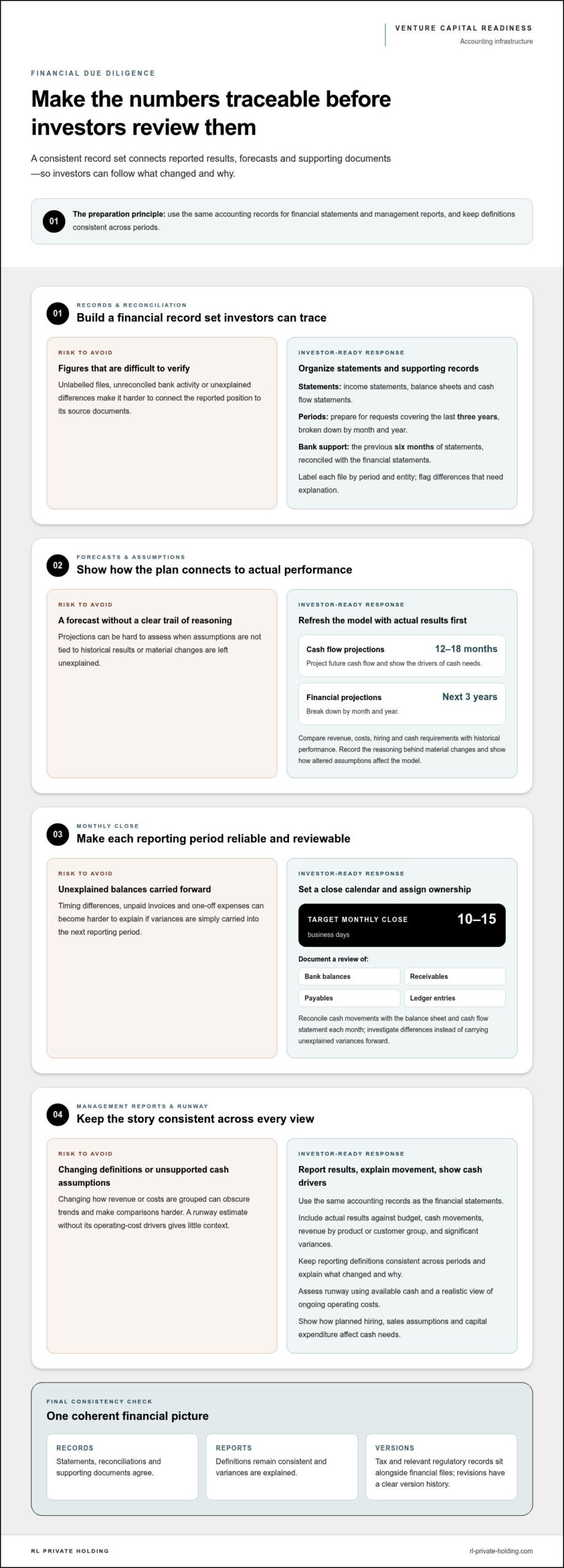
Build reliable accounting records before investors assess capital needs, performance, and financial risks. A consistent closing process makes the figures easier to trace and explain.
-
Organize Financial Records
Collect income statements, balance sheets, cash flow statements, tax records, and bank statements in a structured folder. Investors may request financial statements for the last three years, broken down by month and year, as well as bank statements for the previous six months reconciled with those statements. Label each document by period and entity, and flag any differences that need explanation.
-
Review Projections and Financial Metrics
Update the financial model with actual results before refreshing assumptions. Prepare cash flow projections 12-18 months into the future, and financial projections for the next three years, broken down by month and year. Compare projected revenue, costs, hiring, and cash requirements with historical performance. Record the reasoning behind material changes, so an investor can assess how the model responds to altered assumptions.
-
Prepare Financial Statements and Reports
Prepare management reports from the same accounting records as the financial statements. Include actual results against budget, cash movements, revenue by product or customer group, and significant variances. These views help explain what changed and why. Keep reporting definitions consistent across periods. Changing how revenue or costs are grouped can obscure trends and make comparisons harder for investors.
- Set a close calendar and assign responsibility for each account reconciliation. Aim to complete monthly financial closes within 10-15 business days, with a documented review of bank balances, receivables, payables, and ledger entries before reports are circulated.
- Reconcile cash movements with the balance sheet and cash flow statement each month. Investigate timing differences, unpaid invoices, and one-off expenses rather than carrying unexplained variances into the next reporting period.
- Assess runway using available cash and a realistic view of ongoing operating costs. Show how planned hiring, sales assumptions, and capital expenditure affect cash needs instead of presenting a forecast without explaining its drivers.
- Check that accounting records, management reports, and supporting documents tell the same story. Organise tax and relevant regulatory records alongside the financial files, and maintain a clear version history whenever figures are revised.
Legal compliance, contracts, and intellectual property
For a Luxembourg startup, map the regulations that apply to its activities and markets, then assemble corporate records, tax filings, contracts, and intellectual property evidence. Keep tax returns and filings accessible and reconcilable with the company’s reported position.
-
Review Regulatory and Privacy Compliance
List the regulatory requirements connected to the venture’s activities, products, and operating markets. Assess privacy practices against applicable rules, including GDPR where relevant, and document how customer information is handled. Investors may examine compliance with local regulations, so identify responsible owners and retain evidence of internal processes. A written policy alone does not prove that the practices are followed.
-
Compile Corporate Legal Records
Collect incorporation records, shareholder information, board materials, and signed corporate decisions in one indexed folder. Due diligence may include board and shareholder meeting minutes and actions from the last three years. Match these records against the current ownership position and agreements. If a decision changed share rights or company authority, make its approval and supporting documents easy to find.
-
Organize Compliance Documentation
Gather tax returns, regulatory filings, licences, permits, and insurance policies as compliance documentation. Organise each file by issuing body, coverage period, and renewal status so reviewers can trace its relevance. For example, pair a permit with the activity it covers and link tax filings to the corresponding company records. Clearly separate expired or superseded documents from current materials.
- Review customer, supplier, employment, founder, and consultant contracts for signatures, amendments, and outstanding obligations. Investors examine contracts, employee arrangements, pending litigation, and regulatory compliance to assess legal risks. Summarise material commitments, termination rights, disputes, and unusual revenue terms. Flag unresolved inconsistencies for legal review instead of describing an obligation differently across documents.
- Trace intellectual property from creation to company ownership. Investors may verify patents, trademarks, and copyrights, and review employee, founder, and consultant invention agreements from the company’s inception. Confirm that assignments and transfer agreements cover work completed by freelancers. Check that registrations are not held in a founder’s name when the company relies on the intellectual property for its product or commercial position.
- Create an internal compliance register linking each obligation to an owner, evidence file, and review process. Include tax filings, permits, insurance policies, privacy procedures, and contract approvals. A legal adviser can review corporate governance, intellectual property, contracts, and regulatory compliance, and identify liabilities. Use the register to track corrective actions and retain evidence of completion.
- Prepare a concise disclosure log for legal issues that could affect the investment opportunity. Record each issue, its relevant documents, business impact, and the steps taken to address it. Include litigation or contract disputes, explaining their relationship to operations or revenue with consistent facts. Transparent disclosure gives investors a clearer basis for assessing risk than incomplete or conflicting explanations.
Investor questions about product, competition, risks, and growth
Prepare evidence connecting the startup’s product, market position, operating model, and growth assumptions. Investors assess both the substance of answers and how the team responds to requests.
- Explain the customer problem, product, and business model with specific examples. Show who uses the product, why they choose it, and what evidence supports continued demand. Connect product capabilities to customer needs rather than relying on broad claims. Investors commonly assess the management team, market potential, product or service, customer need, and business model.
- Map the competitive landscape and define the company’s differentiation. Compare product features, pricing approach, distribution, and customer segments with relevant alternatives. Explain barriers to entry and where competitors may respond. Support market estimates with current data, and distinguish the total addressable market from the portion the startup can realistically serve. TAM represents the opportunity if a company captures 100% of its market.
- Document potential risks alongside practical mitigations. Use scenario planning and stress testing to show how changes in sales, customer retention, or supply availability could affect the business. For example, explain how the team would respond if a major customer delayed a purchasing decision. Investors need candid disclosures, not forecasts that conceal weak assumptions or operational dependencies.
- Prepare team members for investor interviews by assigning topics to people with direct knowledge. The founder can explain strategy, a product lead can discuss development priorities, and a commercial lead can explain customer acquisition. Show how sales processes, marketing, and customer success can support growth at scale. Describe operational bottlenecks involving supply chains, technology systems, or customer support as well.
- Coordinate responses to each investor request. Assign one person to track questions, deadlines, document versions, and the responsible subject-matter owner. Give thorough, direct answers and link supporting evidence to each response. If an earlier answer changes, explain why and provide the corrected information. Investors assess both the quality of the information and the team’s responsiveness.
- Assess a prospective investor as a long-term partner, not only as a source of capital. Discuss how the investor approaches strategic decisions, difficult periods, and future growth expectations. After investment, regular updates and monitoring can help identify changing risks and priorities. Establish a clear reporting cadence and share material developments consistently, including setbacks that affect the business plan.
How do you help startups prepare for due diligence?
VCs assess founders’ relevant experience, commitment, team capability, and references. They may interview key employees and examine organisational risks. Common warning signs include inconsistent information, unresolved legal issues, unsupported growth claims, unclear ownership, and slow or incomplete responses.
Build a checklist around the fund’s mandate and the company’s evidence, not a generic document inventory. Venture capital reviews often examine a range of business, financial, legal, team, and operational considerations.
-
Create a Tailored Due Diligence Checklist
Map each request to an owner, evidence file, and response status. Include financial documentation, legal compliance, intellectual property, market analysis, team information, and operational risks. Briefly explain what each item demonstrates, such as customer contracts supporting demand. Leave room to record investor follow-up questions so the checklist reflects the actual diligence process rather than remaining a static template.
-
Adapt the Checklist to the Funding Stage
Prioritise evidence that matches the startup’s maturity and funding purpose. An early-stage company can emphasise its product, customer need, founding team, and market assumptions. A company with established sales should also explain revenue quality, customer retention, and how its operating model can scale. At either stage, connect the requested funding to specific business priorities and explain the underlying assumptions.
-
Assemble Due Diligence Binders
Organise documents into clearly named folders that follow the checklist categories. Assign one person to coordinate the files, keep them current, and maintain consistent versions. Add an index showing each document’s name, period covered, and responsible owner. Before sharing a file, confirm that it answers the request and contains no conflicting figures or unexplained gaps. This structure helps the team respond without duplicating work.
-
Prepare for VC Screening and Business Checks
Assess whether the opportunity fits the fund’s preferred business stage, geographic region, deal size, and industry sector. Some venture funds review opportunities only when referred by a trusted source. Prepare a concise explanation of the company’s market, product, competitive position, growth potential, and operating model. A strong case cannot overcome a mismatch with the fund’s mandate, so identify fit before investing time in a detailed review.
- Prepare founders and employees for interviews by assigning topics to people with first-hand knowledge. Investors may examine professional backgrounds, relevant experience, past successes, lessons from failures, and the founder’s commitment. Give participants a shared account of the strategy and key risks, while leaving room for direct, candid answers.
- Use concerns raised by one investor group to improve the checklist for later discussions. Track recurring questions about the cap table, customer evidence, team responsibilities, or operational bottlenecks. Resolve factual inconsistencies and document mitigation plans before the same concerns recur. Clear ownership, credible evidence, and prompt responses demonstrate disciplined preparation during the funding review.
Due diligence timelines and project management
Comprehensive startup due diligence commonly takes 30-90 days, depending on business complexity and investor requirements. Treat that period as a managed review, with clear owners, dependencies, and decision points. Founders preparing for a VC due diligence process should plan for parallel workstreams, not a single sequence of document requests.
- Divide the review into financial, legal, market, team, and operational workstreams. Assign one person to coordinate responses and maintain a central request log. For each request, record its owner, status, supporting document, and dependencies. This gives founders a single view of outstanding analysis and helps distinguish urgent items from work that can proceed later.
- Set the working schedule around the investor’s requested materials and decision process. A study of 700 firms found that typical venture capital deals once took 83 days to complete, while comprehensive startup due diligence commonly takes 30-90 days. Use these figures as context rather than a fixed timetable, because complexity and investor requirements affect the pace.
- Identify dependencies before setting internal milestones. A valuation discussion may rely on updated financial projections, while legal review may require complete corporate records. Mark which deliverables can proceed in parallel and which depend on earlier analysis. If a document is delayed, notify the coordinator promptly and explain which workstream or decision it affects.
- Maintain a live request tracker and update it whenever investors ask for more information. Use statuses such as open, in preparation, submitted, and follow-up required. Link each response to its supporting document and identify who approved it. A central record helps the startup respond promptly without circulating conflicting versions across investor discussions.
- Schedule internal reviews around investor decision points. Check that financial, legal, market, and operational responses remain consistent before submission. If a customer forecast changes, update every analysis that depends on it, including cash flow assumptions. Record the change and the reasoning so investors can understand its effect on growth plans and valuation discussions.
- Prepare for the transition from due diligence to investment terms. A positive business due diligence outcome should lead to a term sheet. Be ready to discuss valuation, warranties, and indemnities, while tracking open issues and agreed follow-ups. For founders preparing for a VC due diligence process, assigning an owner to every open point can keep the next stage organised.
- Close each review cycle by recording investor concerns and the actions taken. Use recurring questions to identify missing evidence, unclear explanations, or operational bottlenecks. This record can inform later investor discussions and ongoing updates. It also helps the team distinguish newly raised concerns from items already addressed, reducing duplicate work as the review continues.
For a discussion of investment priorities alongside diligence planning, discuss your investment priorities.
RL Private Holding: Venture Capital Funding
RL Private Holding offers Venture Capital Funding to businesses seeking investment to support their development and growth. Founders can consider this next step after organising their financial, legal, and commercial materials and clarifying their capital requirements and business priorities.
A clear diligence file helps structure a discussion about the company’s position, funding objectives, and growth plans. It also offers a practical basis for considering whether venture funding fits the business’s current needs. RL Private Holding also offers Private Equity Investment Management, Real Estate Asset Management, and Wealth Management Services, each serving distinct investment and asset management needs.
Contact RL Private Holding to discuss Venture Capital Funding in relation to your company’s investment objectives.
Turn preparation into a considered investment decision
Preparing for a VC due diligence process is more than an exercise in assembling documents. It is an opportunity to consider what kind of capital and partnership best supports the company’s next stage. Use investor discussions to clarify strategic priorities, define the role you expect an investor to play, and assess how funding fits your longer-term plans.
RL Private Holding offers Venture Capital Funding, alongside Private Equity Investment Management and Real Estate Asset Management. These offerings address distinct investment needs, so the right next step depends on your company’s objectives and the type of capital under consideration. A focused discussion can help frame those objectives and assess whether Venture Capital Funding aligns with the opportunity.
Contact RL Private Holding to discuss your investment objectives. With a clear view of the company’s priorities, founders can approach the next stage with greater purpose and make informed decisions about the path ahead.
Frequently Asked Questions
What Makes Venture Capital Due Diligence Unique?
VC due diligence verifies information about the company and assesses its capacity to grow. Investors first consider whether the opportunity fits their fund’s mandate, then assess market potential, team capability, operational scalability, and investment risks. Startups therefore need to connect evidence to a forward-looking case. For example, explain how product differentiation supports customer demand and how the operating model can support expansion.
What is VC due diligence, and why is it important?
VC due diligence is an investor’s review of a startup before deciding whether to invest. It verifies the company’s claims, examines its operations and market, and assesses financial and legal risks, valuation, and growth potential. For founders, the process can reveal where evidence or explanations need improvement. A clear response to a concern such as customer concentration helps investors understand both the exposure and its business context.
What documents do venture capital investors request during due diligence?
Investors commonly request financial records, tax filings, corporate documents, contracts, intellectual property records, and market materials. They may also ask for a capitalization table covering shares, options, SAFEs, and convertible notes, as well as customer contracts and invoices for top clients in an enterprise sales model. Keep a document index that identifies each file’s period, owner, and purpose. This makes it easier to respond when a request concerns a specific investment assumption.
How should a startup prepare its financial statements and forecasts for VC due diligence?
Prepare financial statements that reconcile with supporting records, then show how forecasts follow from actual business performance. Investors may request income statements, balance sheets, and cash flow statements for the last three years, broken down by month and year. They may also request financial projections for three years, broken down by month and year. Explain key assumptions, such as expected customer conversions, and show how a changed assumption affects cash requirements.
What legal and corporate records do VCs review before investing?
VCs may examine incorporation and ownership records, shareholder and board decisions, contracts, tax returns, regulatory filings, permits, and insurance policies. They may request board and shareholder meeting minutes and actions from the last three years. Ensure the capitalization table aligns with underlying share, option, SAFE, and convertible note records. Organise documents so investors can trace who approved a decision and how it affected company ownership or authority.
What intellectual property, technology, and cybersecurity checks do VC investors conduct?
Investors may verify patents, trademarks, and copyrights, then examine whether founder, employee, and consultant agreements assign relevant inventions to the company. They may also review data management and security practices to understand cybersecurity exposure, as well as disaster recovery planning. Prepare a concise inventory linking each core product component to its owner, relevant agreement, and supporting record. For technology risks, explain how the company identifies vulnerabilities and maintains access to essential systems.
What customer, revenue, and product metrics should startups prepare for investor diligence?
Prepare evidence that connects customer activity to revenue and product use. Depending on the business model, this can include customer contracts and invoices for top enterprise clients, booking history and projections, and accounts receivable details identifying amounts more than 90 days past due. Define each metric consistently and state its reporting period. For example, distinguish signed contracts from recognised revenue, so investors can assess customer demand without confusing bookings with realised sales.
How long does VC due diligence take and what are the typical stages?
Comprehensive startup due diligence commonly takes 30-90 days, depending on business complexity and investor requirements. Typical stages include initial screening, business and financial analysis, legal review, team discussions, and investment terms. The sequence can overlap: an investor may examine market evidence while reviewing financial assumptions. Delays often depend on unresolved questions, document dependencies, and the pace of responses. After a positive business due diligence outcome, the next step should be a term sheet.