

Startups do not always have to choose between selling equity and taking on debt. Venture capital and venture debt can be combined, with debt often following an equity round to add funding without further dilution. The right balance in venture capital vs venture debt for startups depends on repayment capacity, ownership priorities and the milestones the funding is meant to support.
It is understandable to focus on the cash available now, but the financing structure also affects future cash flow, founder ownership and obligations to investors or lenders. Venture capital generally means giving investors an ownership stake; venture debt requires repayment of principal and interest under agreed terms.
This comparison explains how the options differ in cost, repayment, flexibility and covenants, and how each can affect runway. It also outlines when combining them may make sense and offers a practical way to compare financing with your startup’s stage and growth plans.
Key Takeaways
- Combining equity and debt can add capital while limiting further ownership dilution, but venture debt typically follows venture capital backing rather than replacing it.
- Match financing to your startup’s stage, growth plans and cash-flow profile: equity avoids scheduled loan repayments, while debt requires a plan to meet them.
- Compare the full debt structure, including interest, fees, repayment timing and any warrants that could create dilution.
- Review covenants, collateral requirements and default consequences alongside the headline loan terms, since they can affect operational flexibility.
- Assess whether debt can extend runway to a specific milestone without creating repayment pressure that the business cannot support.
Can you as a startup combine venture capital and venture debt?
Yes. Startups can combine venture capital and venture debt, usually relying on equity backing to support debt eligibility and using debt to add capital without further dilution. To pursue venture debt, prepare financial statements, cash-flow analysis and other reports, then review the lender’s proposed repayment terms. Luxembourg startups can consider both equity rounds and venture debt as financing structures.
Equity Backing and Debt Eligibility
Venture debt lenders commonly consider venture capital backing when assessing early-stage startups. An existing equity round can signal investor support, while the lender separately reviews income statements, cash flow and other reports to assess repayment capacity. Without venture capital backing, debt may be a less direct route for a startup. Equity funding, by contrast, raises capital by issuing ownership shares and does not create scheduled loan repayments.
Debt Sizes Relative to Equity Raised
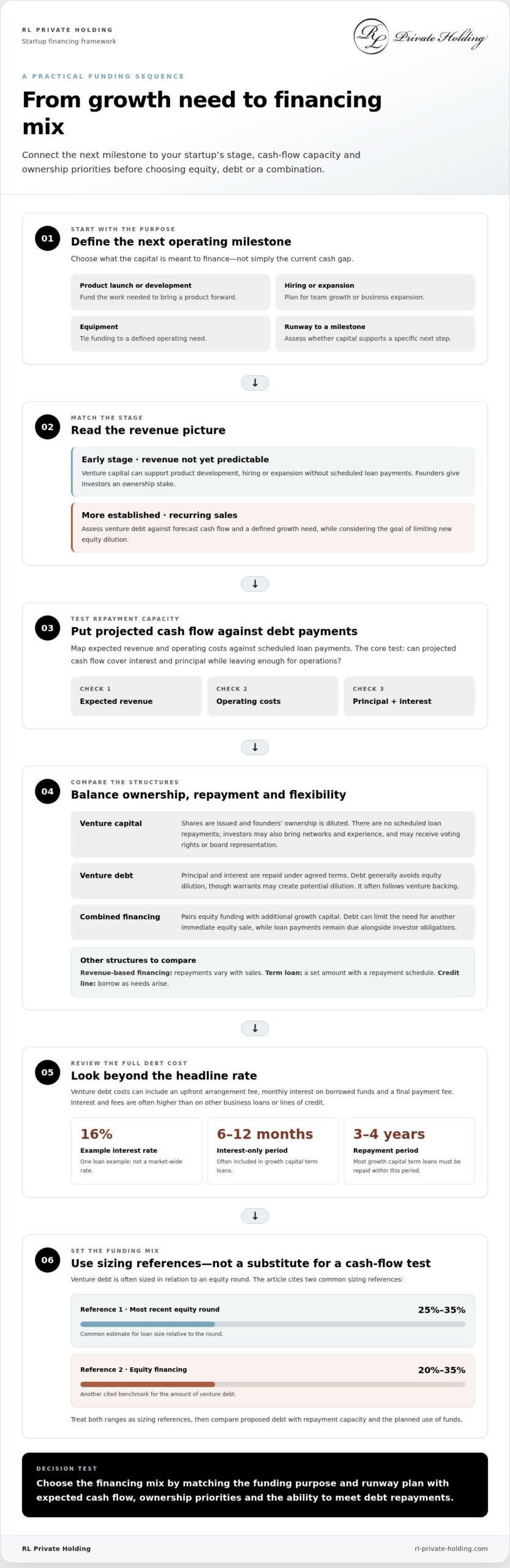
Venture debt is often sized in relation to an equity round, rather than assessed as an isolated funding target. Common estimates place loans at 25% to 35% of a company’s most recent equity round; another benchmark puts the amount at 20 to 35 percent of the equity financing. Treat these ranges as sizing references, then compare the proposed debt with the startup’s repayment capacity and planned use of funds.
Complementary Funding and Equity Tradeoffs
Equity and debt can serve different purposes across funding rounds. Venture capital can finance product development, scaling or team expansion, while later venture debt may add capital without another immediate equity sale. Equity requires no scheduled principal repayment, but dilutes ownership and gives investors a stake in the business. Investors may also contribute networks and experience, while receiving voting rights or board representation.
| Financing option | Ownership and dilution | Repayment | Typical role |
|---|---|---|---|
| Venture capital | Shares are issued; founders’ ownership is diluted. | No immediate loan repayment. | Funds growth and may add investor expertise. |
| Venture debt | Generally avoids equity dilution, though warrants may create potential dilution. | Principal and interest are repaid under agreed terms. | Adds capital, often after venture backing. |
| Combined financing | Debt can limit the need for further equity issuance. | Loan payments remain due alongside investor obligations. | Pairs equity funding with additional growth capital. |
Choose a financing mix by matching the funding purpose and runway plan with expected cash flow, ownership priorities and the ability to meet debt repayments.
Choosing financing based on startup stage and growth plans
Funding should support the next operating milestone, not simply fill the company’s current cash gap. A startup developing its first product may need capital before revenue becomes predictable, while a business with recurring sales can assess debt against forecast cash flow. In Luxembourg, compare the ownership issued, repayment capacity and purpose of the funding.
At an early stage, venture capital can support product development, hiring or expansion without scheduled loan payments. It may also bring investor experience and networks, but founders exchange ownership for that capital. A startup with more established revenue may consider venture debt for a defined growth need while limiting new equity dilution. The key test is whether projected cash flow can cover interest and principal while leaving enough for operations.
Other financing options may suit different revenue patterns. Revenue-based financing links repayments to revenue, so payment amounts vary with sales, which can make planning difficult when income is volatile. A term loan provides a set amount with a repayment schedule, while a credit line lets a business borrow as needs arise. Venture debt may use either structure, but covenants and fees remain part of the decision.
Venture debt costs can include an upfront arrangement fee, monthly interest on borrowed funds and a final payment fee. Interest and fees are often higher than those on other business loans or lines of credit. One venture-debt loan example uses a 16% interest rate; it is an example, not a market-wide rate. Growth capital term loans often include a 6- to 12-month interest-only period, and most must be repaid within three to four years.
Before choosing a structure, prepare a concise funding plan and test it against operating forecasts:
- Define the milestone the capital will finance, such as product launch, expansion or equipment.
- Map expected revenue and operating costs against scheduled loan payments.
- Compare the ownership impact of equity with the repayment burden and fees of debt.
- Assess whether a term loan or credit line better fits the timing of planned spending.
Choose venture capital when growth requires substantial funding before predictable revenue, and repayment capacity is not yet established. Consider debt when cash flow can support scheduled payments and the capital has a clear use. Founders assessing an equity-led approach can review venture capital funding as one financing path.
What to consider when thinking about repayments and flexibility?
Venture debt requires scheduled repayment of principal and interest, while equity financing exchanges ownership for capital. Warrants give lenders the option to buy future shares at a fixed price. Covenants set required metrics or milestones, and missing them can trigger default consequences.
Repayment Obligations and Ownership Dilution
Debt repayments affect founders through company cash flow, while equity financing affects them through ownership dilution. Venture debt is commonly repaid over 24 to 36 months, and growth capital term loans often start with a 6- to 12-month interest-only period. Founders need to model payments against cash forecasts, since principal and interest remain payable under the agreed terms.
Equity investors do not require scheduled loan repayments, but receive a stake in the business. Debt can preserve more ownership, although warrants may create potential dilution if exercised. Compare the cost of those possible shares with the cash burden of repayments. For example, a startup expecting revenue to arrive later may find fixed payments harder to manage than a planned equity round.
Cost, Speed, and Founder Control
Venture debt interest and fees are often higher than those for other business loans or credit lines, reflecting lender risk. Costs may include an upfront arrangement fee, monthly interest and a final payment fee. A venture debt process typically takes about three months, while equity fundraising can be lengthy and complex. Both routes require preparation, but their financial obligations differ.
Debt lenders do not acquire equity, and venture debt may allow founders to retain more operational control without board oversight. Equity investors, by contrast, may receive voting rights and board representation. Their involvement can bring experience and networks, but founders should consider governance and reporting expectations alongside dilution. Control depends on negotiated rights, not simply on whether funding is labelled debt or equity.
Assess the full repayment schedule before accepting a loan. Venture debt terms can generally last up to 3 years, and missed covenants may lead to default consequences. Review the metrics, milestones, collateral provisions and remedies in the agreement, then test whether the business can meet payments under less favourable revenue conditions. This separates a manageable financing commitment from one that could restrict operating flexibility.
For founders, compare the alternatives across four practical questions:
- Cash flow: Can forecast revenue cover principal and interest on schedule?
- Ownership: How much dilution could equity or warrants create?
- Governance: What voting, board or information rights accompany equity?
- Flexibility: Which covenants, milestones or default terms constrain decisions?
The better structure is the one whose repayment or ownership cost fits the company’s cash forecast and growth plan. A startup with predictable revenue can weigh debt’s cash obligations against retaining equity; a business with uncertain receipts may prioritise avoiding fixed repayments.
Venture debt covenants and default risks
Venture debt can preserve equity ownership, but its contract may restrict financial and operating decisions. Lenders may require collateral and covenants tied to milestones or specified metrics. Before signing, map each requirement against the company’s forecast. If revenue targets or other conditions are missed, the agreement may allow consequences that include default.
These terms matter because debt creates fixed repayment obligations, even when a startup’s liquidity tightens. A lender may review income statements, cash-flow analysis and other reports to assess repayment capacity. After funding, founders need to track the indicators specified in the covenants. For example, a cash-flow shortfall can threaten both scheduled payments and compliance with a financial threshold.
The structure also affects who bears risk if the company fails or exits. Venture debt is typically a senior secured loan, so lenders rank ahead of equity holders for repayment in liquidation. That priority can reduce what remains for shareholders. Debt investors receive repayment and interest rather than the ownership upside sought by equity investors, who generally look to a future sale, acquisition or public listing for liquidity.
Interest and fees can make debt more costly than other business loans or credit lines, while covenants add operating constraints. Review the agreement in stages: identify reporting duties, list each financial metric, note the collateral, then map the remedies for missed tests. This clarifies whether the financing supports the operating plan or could create pressure during slower growth.
- Metric covenants: Identify the exact measure, reporting period and required threshold.
- Milestone covenants: Match each deadline to product, sales or financing plans.
- Collateral: Determine which company assets secure repayment obligations.
- Default terms: Understand the consequences attached to a missed payment or covenant.
Early-stage companies should weigh these risks against the funding purpose. Debt may extend runway or finance capital expenses, but repayment is still required. Predictable cash flow that covers scheduled payments is an important suitability factor. If forecasts depend on uncertain revenue or a future financing round, fixed obligations can increase liquidity risk.
Creditworthiness is another consideration. Timely repayment can help a business build creditworthiness and support access to future debt financing. That potential benefit depends on disciplined payment management, not simply on taking a loan. Before deciding whether debt’s limited dilution justifies its contractual risks, compare the use of funds, interest burden, covenant requirements and repayment schedule.
Extending runway to a milestone or cash-flow positive status
Venture debt can extend runway for a defined milestone, such as an equipment purchase, expansion or bridge to a later equity round. Its usefulness depends on whether projected cash flow can support repayment while the startup works toward that milestone.
Extending Cash Runway
Debt financing adds cash without immediately selling more ownership, but it also creates payments that reduce future liquidity. A startup nearing profitability might use the funds to complete a specific expansion, while a company with unpredictable receipts could face repayment pressure before reaching its target. Model planned spending, operating cash needs and loan payments together, rather than treating the loan as extra runway without obligations.
Runway and Fundraising Assessments
Lenders assess income statements, cash-flow analysis and other reports to determine repayment capacity. They also consider whether the funding purpose connects to a credible milestone or future financing plan. This is different from relying on a fundraising target alone: venture capital fundraising can be lengthy and complex, so a debt plan should account for the possibility that a new round takes longer than expected.
Build the runway case around a specific operating outcome. Identify the milestone, estimate the cash needed to reach it, and compare forecast receipts with debt payments throughout the period. For example, a startup financing an equipment purchase should include the cost in its cash plan and assess whether expected operating cash can still cover scheduled payments. Include collateral and contractual covenants in the financing review, as they also affect risk.
A practical assessment can be organised around these steps:
- Define the milestone: State whether debt will fund equipment, expansion, an acquisition or a bridge to another equity round.
- Forecast cash flow: Use income statements and cash-flow analysis to test repayment capacity against expected receipts and operating costs.
- Assess fundraising reliance: Separate payments the business can meet from those dependent on a future equity raise.
- Review loan conditions: Include collateral, covenants and repayment terms in the runway plan.
The key distinction is between extending the time available and improving the company’s ability to fund itself. Debt can provide cash runway, but it does not itself make a startup cash-flow positive. A plan to reach profitability should show how revenue and costs are expected to change as the milestone is achieved, then test whether scheduled payments remain manageable during that transition.
Use venture debt when the capital has a defined purpose and cash flow can support repayment. If the plan depends on a future round, account for fundraising delays in the forecast rather than treating that capital as assured. Base the decision on the milestone’s contribution to operations, payment capacity and the consequences of missing targets.
RL Private Holding: Venture Capital Funding
RL Private Holding offers Venture Capital Funding for startups assessing equity financing as part of their growth plans. This may suit a company that needs capital to develop its product, expand its team or pursue growth before predictable cash flow can support scheduled debt payments.
Venture capital raises funds in exchange for an ownership stake, so founders should weigh the capital required against dilution and investor involvement. Before pursuing this route, define the funding need, the milestone it will support and the ownership implications, alongside any alternatives. This gives founders a clearer basis for discussing whether equity financing fits the company’s stage and objectives.
If your startup is considering an equity-led funding approach, contact RL Private Holding to discuss Venture Capital Funding.
Set Your Financing Priorities for the Next Stage
Start by defining what the business needs its capital to achieve, then measure each financing option against that objective. A decision about venture capital vs venture debt for startups should account for more than immediate funding: consider how the structure affects future ownership, cash flow and strategic choices as the company develops.
RL Private Holding offers Venture Capital Funding and Private Equity Investment Management, alongside Real Estate Asset Management. For founders considering an equity route, the discussion can focus on how the capital requirement and growth plan align with an ownership-based investment. A concise outline of the intended use of funds, anticipated milestones and current financing priorities can help make that discussion focused and productive.
Contact RL Private Holding to discuss your financing priorities and consider the next step with a clear view of the company’s objectives. A deliberate financing decision can support a more coherent path forward.
Frequently Asked Questions
Dilutive and non-dilutive funding: What’s the difference?
Dilutive funding gives an investor an ownership stake, while non-dilutive funding does not ordinarily issue shares. Venture capital is dilutive because founders exchange equity for investment. Venture debt is generally non-dilutive, although a lender’s warrant may create potential dilution later. When comparing proposals, assess both the shares transferred today and any contractual right to acquire shares in the future.
How is it structured?
Venture capital is an investment in company shares, with the agreement setting out ownership and investor rights. Venture debt is borrowing, often structured as a term loan or credit line, with repayment terms and covenants. When reviewing either option, map the funding amount to its intended use, then examine the associated rights, payment triggers and restrictions before accepting capital.
Venture debt and equity: How do these financing options work together?
The two can be sequenced, with equity supporting the company’s financing base and debt providing additional capital for a defined need. For example, a startup could raise equity to fund product development, then use debt for equipment or a planned expansion. This can reduce the need for another share issuance, but founders should test whether operations can cover loan payments without relying entirely on a future equity round.
What should you consider before choosing venture debt?
Start with the use of funds, then assess cash-flow forecasts, repayment dates, interest, fees, collateral, covenants and default consequences. The loan should support an operating plan that can meet payments under weaker revenue conditions, not only in the expected case. Identify which assets secure the loan and how a missed milestone or reporting requirement could affect the company’s options.
What are the cost of capital differences?
Debt costs include interest and fees, while equity has no scheduled loan repayment but transfers ownership and part of the company’s future upside. A fair comparison considers cash cost and dilution together. For debt, include arrangement charges, interest and any final payment fee. For equity, consider the value of the stake issued and the rights investors receive, including governance or approval rights.
What is the difference between venture capital and venture debt for startups?
The central difference in venture capital vs venture debt for startups is what the company gives in return. Venture capital raises funds by selling ownership shares, while venture debt is a loan that must be repaid with interest. Equity investors may contribute experience and networks; lenders focus on repayment and contractual protections. The choice depends on funding purpose, ownership priorities and the startup’s ability to service debt.
How do venture capital and venture debt compare in cost and dilution?
Venture capital creates dilution when shares are issued, but does not require loan payments on a fixed schedule. Venture debt generally avoids immediate share issuance, yet interest, fees and repayments affect cash available for operations. Warrants can also introduce potential dilution. Compare the equity stake and investor rights with the total debt burden, including payments during periods when revenue or fundraising progress falls below plan.
What funding stages and company profiles are best suited to venture capital versus venture debt?
Venture capital can suit an early-stage company that needs substantial funding before it has predictable revenue to support borrowing. Venture debt is more suitable for a startup with venture backing and a credible repayment plan, particularly when it needs capital for a defined growth objective. A company nearing profitability should test cash flow against scheduled payments; a company still proving demand may prioritise equity, which requires no loan repayments.