

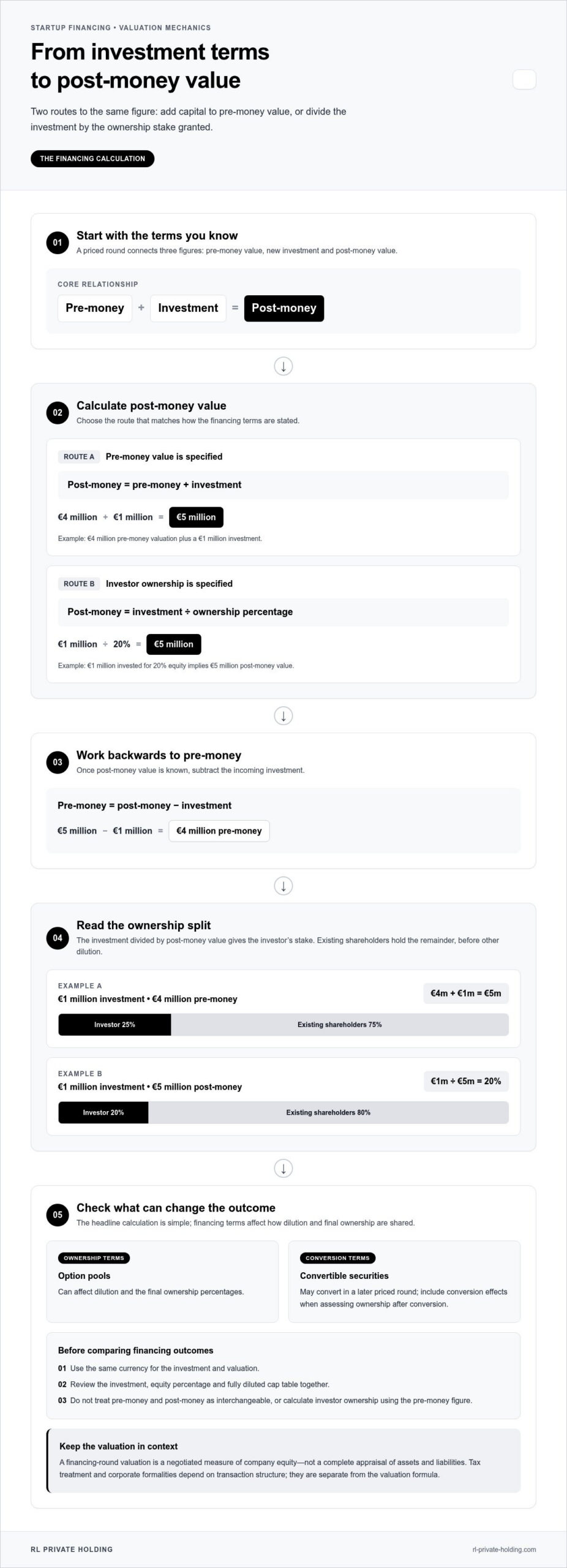
The headline valuation is only part of the financing picture. For calculating post-money valuation for a startup, add the new investment to the pre-money valuation: a €1 million investment at a €4 million pre-money valuation gives a €5 million post-money valuation. The new investor owns 20%, while existing shareholders retain 80%.
The calculation is simple, but the result depends on what the financing terms include. Option pools, convertible securities and the ownership percentage granted can all affect the outcome and how dilution is shared.
This article explains how pre-money and post-money valuation relate, how to calculate post-money value from either the investment or the equity offered, and which terms can change the effective outcome. It also explains why a financing-round valuation is a negotiated measure of a company’s equity, not a complete appraisal of its assets and liabilities.
Key Takeaways
- Distinguish the company’s value before new capital from its value after the financing closes; the difference is the investment raised.
- Use the investor’s ownership percentage to derive the implied post-money value, then assess how the financing terms affect that stake.
- Account for option pools and convertible securities, since they can alter dilution and the effective share price.
- Evaluate valuation alongside the company’s funding stage, comparable rounds and growth prospects to understand the terms’ broader implications.
What Is Pre-Money Valuation?
Pre-money valuation is a startup’s estimated equity value before it receives new capital in a priced financing round. Post-money valuation is its equity value after the investment. The distinction matters because the investor’s ownership is calculated against the post-money figure, not the pre-money figure.
For example, a €3 million pre-money valuation followed by a €1 million investment produces a €4 million post-money valuation. Divide the investment by the post-money value: €1 million ÷ €4 million equals 25% ownership. Existing shareholders retain 75%, before accounting for other securities or changes to the share pool.
Another cap table example starts with a €5 million post-money valuation and a €1 million investment. The investor owns 20%, while existing shareholders collectively retain 80%. These figures show how investment size and the agreed equity stake represent the same financing terms from different directions.
To calculate post-money value from an investment and equity stake, divide the investment by the ownership percentage granted. If an investor contributes €1 million for 20% equity, the implied post-money valuation is €5 million. Subtract the investment to derive the €4 million pre-money valuation.
Common mistakes include treating pre-money and post-money values as interchangeable, or dividing the investment by the pre-money figure to calculate the new investor’s ownership. Overlooking option pools or convertible securities is another pitfall, as both can affect dilution and final ownership percentages.
In Luxembourg, the calculation is the same: divide the investment by the post-money ownership share, or add the investment to the pre-money value. Tax treatment and corporate formalities depend on the transaction’s structure; they are separate from the valuation calculation and are not inputs to the formula.
These calculations describe a negotiated equity value, not an exact appraisal of assets and liabilities. For a priced round, compare the agreed investment, equity percentage and fully diluted cap table to see how ownership changes after funding.
Post-money valuation formula
The formula depends on whether the financing terms specify a pre-money value or the investor’s ownership percentage. Both methods connect the capital invested with the equity issued. Using a consistent method for calculating post-money valuation for a startup helps founders compare terms clearly.
Pre-Money Valuation Formula
Calculate pre-money valuation by subtracting the new investment from post-money valuation: pre-money valuation = post-money valuation − investment. This gives the company’s estimated equity value before the financing round and provides both parties with a shared basis for reviewing the proposed share price.
Pre-Money and Post-Money Formula Relationship
Post-money valuation equals pre-money valuation plus investment, while pre-money valuation equals post-money valuation minus investment. These inverse calculations connect the three figures. The investor’s €1 million then represents 10% of that total.
If the investor’s equity percentage is known, divide the investment by that percentage: post-money valuation = investment ÷ ownership percentage. This method helps founders assess terms presented as an ownership stake rather than a pre-money figure.
When calculating post-money valuation for a startup, use the same currency for the investment and valuation, and apply the percentage granted to the investor. Before accounting for other dilution, existing shareholders’ combined ownership is the remainder.
Convertible financing can complicate the calculation because securities may convert in a later priced round. A valuation cap may be pre-money or post-money, and the future round determines the actual pricing. Include the conversion effects when assessing ownership after conversion.
Founders considering investment structures can explore venture capital funding in relation to financing needs and ownership implications.
Pre-money and post-money valuation definitions
Pre-money and post-money valuations describe a company’s equity at different points in a financing round. Knowing the difference helps founders assess how new capital changes ownership and the cap table.
Pre-Money Valuation Definition
Pre-money valuation is the estimated equity value immediately before a startup receives new investment in a priced round. It matters because investors use it to assess the financing terms and price new shares. For example, a €3 million pre-money valuation describes the company before the incoming capital is added. It is an agreed equity measure, not an exact appraisal of every asset and liability.
Post-Money Valuation Definition
Post-money valuation is the company’s equity value after a priced financing round is completed. It matters because an investor’s ownership percentage is measured against this value, which includes the new investment. For example, if an investment represents 20% of post-money equity, existing shareholders collectively retain 80%, before other dilution. The calculation connects capital raised with the resulting ownership structure.
Both figures are equity valuations. They express the value investors are willing to assign in exchange for a specified investment and ownership stake, but do not by themselves represent a complete valuation of the company’s assets and liabilities. When comparing offers, founders should distinguish the financing valuation from a broader assessment of the business.
The relationship is captured by a simple formula: post-money valuation equals pre-money valuation plus the investment amount. Rearranged, pre-money valuation equals post-money valuation minus the investment. To identify the value attributed to the company before funding, subtract the incoming capital from the agreed post-money figure.
Ownership offers another way to interpret the result. Divide the investment by post-money valuation to calculate the investor’s share; divide pre-money valuation by post-money valuation to calculate existing shareholders’ combined share. These calculations clarify how shares are allocated, although options and convertible securities can change the cap table and dilution.
Factors affecting post-money valuation
The financing formula gives a headline figure, but several terms influence ownership and effective value. These include the funding stage, comparable rounds, option pools and convertible securities.
SAFE and Convertible Note Effects
A SAFE or convertible note can defer the final share price, making post-money valuation harder to assess until a later priced round. In pre-seed and seed financing, investors may provide capital in exchange for these securities rather than preferred stock. The securities convert into equity in a later priced round; a valuation cap may be pre-money or post-money, and the later round’s pricing determines the actual conversion.
For founders, this distinction matters because conversion shares add dilution beyond the new cash investment. When assessing ownership after conversion, include the convertible amount and applicable cap rather than treating the priced-round investment as the only change.
Option Pool Effects
An option pool reserves shares for employee equity compensation, and its placement affects dilution. If an increase is included in the pre-money share count, the new investors are not diluted by it; founders bear the resulting reduction in ownership. An increase after the financing round dilutes all stockholders, including new investors.
A larger pool also lowers the price per share and increases investor ownership. The pool percentage is therefore a pricing term, not just an administrative detail.
Funding stage also affects the valuation investors may consider. Pre-seed and seed startups typically have lower valuations than later-stage companies. Series A often follows product and business-model development, while Series B and C commonly support expansion after the company demonstrates traction and progress toward scalability.
Comparable startup rounds provide another reference point. Assess deals closed in the preceding six to 12 months, considering industry, region and company stage. A valuation that rises faster than the business’s growth can make subsequent fundraising harder and increase down-round risk. Compare the headline figure with dilution, pool terms and conversion mechanics before assessing what founders retain.
RL Private Holding: Venture Capital Funding
RL Private Holding provides Venture Capital Funding for businesses seeking investment to support growth. After assessing a proposed post-money valuation, founders can consider whether the investment amount, equity offered and resulting dilution fit their financing objectives.
This is a relevant next step when a startup is preparing a funding round and needs to assess its investment structure alongside the headline valuation. The agreed figure is only part of the decision: ownership allocation, conversion terms and option pools also shape the resulting cap table. RL Private Holding’s Venture Capital Funding supports this financing need, while Private Equity Investment Management may be relevant to broader investment considerations.
To discuss venture capital funding in relation to your financing objectives, visit rl-private-holding.com.
Put Your Financing Decision Into Motion
A disciplined approach to calculating post-money valuation for a startup supports a more considered financing decision. Assess what the proposed capital will enable, how the ownership structure fits the company’s plans, and whether the terms remain appropriate as the business develops. Valuation is one part of the decision, not a substitute for a clear investment strategy.
For businesses considering investment, RL Private Holding offers Venture Capital Funding, Private Equity Investment Management and Real Estate Asset Management. These offerings address distinct investment needs, from venture financing to managing private equity and real estate assets.
To discuss your investment objectives and potential next steps, contact RL Private Holding. A considered financing decision can provide a sound basis for the company’s next stage of development.
Frequently Asked Questions
How is a private company valued?
Private companies can be valued using discounted cash flow or comparable company analysis. Discounted cash flow estimates value from projected future cash flows, adjusted to reflect their present value. Comparable analysis considers similar businesses, often using measures such as EBITDA and accounting for industry and region. The appropriate method depends on the company’s financial profile, the available data and the purpose of the valuation.
What Is a Startup Valuation?
A startup valuation estimates a young company’s equity value at a particular point in its development. In a financing discussion, it helps founders and investors compare the proposed investment with the ownership stake offered. The estimate may reflect revenue, growth prospects, market opportunity, team capability and financing terms. It is a negotiated measure, not necessarily an appraisal of every company asset.
What are the Funding Rounds in Venture Capital (VC)?
Venture capital rounds generally progress from pre-seed and seed to Series A, followed by later expansion or growth rounds. Pre-seed and seed funding may involve friends, family and angel investors. Series A commonly marks institutional financing as a startup develops its product and business model. Series B and C often support expansion after traction, while Series D may fund growth ahead of a potential major exit.
Why Does Valuation Matter?
Valuation matters because it shapes the ownership investors receive and the dilution existing shareholders experience. It also influences future financing: if growth fails to keep pace with an inflated valuation, a subsequent round may be harder to secure and the risk of a down round may rise. Founders should assess the full term sheet, including option-pool size, liquidation preferences, participation rights and anti-dilution provisions, rather than judging an offer by its headline valuation alone.
What is post-money valuation in a startup financing round?
Post-money valuation is the company’s equity value after a priced financing round is completed. It provides a reference point for assessing the new investor’s ownership and existing shareholders’ combined position. The figure reflects the agreed financing terms, not a complete appraisal of assets and liabilities. For convertible securities, the eventual share price depends on the later priced round and the conversion terms.
How do you calculate post-money valuation from pre-money valuation and investment amount?
Add the new investment to the pre-money valuation to calculate post-money valuation. First, identify the agreed pre-money figure and the capital entering the priced round. Then add the amounts in the same currency and on the same valuation basis. If the round includes convertible securities or an option-pool adjustment, consider their effects separately when assessing dilution and the resulting ownership structure.