

A forecast that only proves the upside is not decision-ready. Building a financial model for a Series A round means forecasting monthly for 24 to 36 months, then annually through year five, while linking the income statement, balance sheet and cash flow statement. It should include a base case, an upside case and a downside case so that funding needs and runway can be assessed under different conditions.
A Series A model should explain how the business plans to grow and show what happens when assumptions change. This article covers the components investors and management need to understand, how operating drivers flow through the financial statements, and how scenario analysis can reveal financial pressure before it constrains decisions.
The discussion covers revenue and cost assumptions, cash requirements, model structure and sensitivity testing. It also shows how a disciplined model can inform decisions about hiring, investment and when to raise, with risk assessment built into the forecast rather than treated as an afterthought.
Key Takeaways
- Make core assumptions explicit and test them against company history and relevant benchmarks before relying on the forecast.
- Build revenue from operational drivers, then connect hiring and operating expenses to the activity required to support growth.
- Compare base, upside and downside cases, including how weaker revenue affects cash needs and the timing of a funding shortfall.
- Use the model to assess decisions such as hiring and investment, and identify which assumptions create the greatest financial risk.
Should the financial model tie to the three core financial statements?
Yes. A three-statement model dynamically links the income statement, balance sheet and cash flow statement. It shows how operating assumptions affect profitability, working capital and cash availability.
Core Assumptions and Benchmark Validation
Core assumptions are measurable inputs that drive the forecast, including pricing, sales volume, growth and margin. They matter because small changes can alter the capital required to execute the plan. Separate operating drivers from calculated outputs, then record the rationale and evidence for each input. A 5% market-growth assumption can illustrate a broad forecast belief, while a 12% growth rate should have a clear explanation. Compare projected margins with actual performance and relevant benchmarks. An 80% gross margin forecast following a historical 45% margin warrants cross-validation, not automatic acceptance.
Assumptions Across Investor Materials and Statements
Alignment means using the same operating assumptions in the model and investor materials, then linking them across all three financial statements. Inconsistent claims about growth, hiring or margins can make the funding plan hard to interpret. Connect revenue drivers to the income statement, then forecast related balance-sheet items such as accounts receivable, accounts payable and loans. Carry retained earnings forward from the previous period and add current-period net income. Link ending cash to the balance sheet so the cash flow statement reconciles with the funding narrative.
Historical Data and Forecasting Assumptions
Historical data helps distinguish observed performance from forecast assumptions. Use three to five years of financial history, or as much as the business has, to identify trends and seasonality. A three-statement model should use at least three years of historical statements to establish baseline assumptions. With a shorter operating history, use available actuals and state the basis for forward-looking estimates. Compare forecasts with actual results as they arrive, and revise drivers when evidence changes. Forecast accounts receivable, accounts payable and other balance-sheet items consistently. Finally, check that assets equal liabilities plus equity in every period, so the model’s balance check equals zero.
What should a Series A financial model template include?
A useful model connects revenue drivers, operating costs, cash flow and equity financing in a single forecast. Clear schedules make it easier to test performance against plan and explain changes.
Revenue, Cost, and Operating Expense Forecasts
A revenue and cost forecast translates operating activity into financial results, helping teams assess whether growth plans are sustainable. For SaaS, an ARR waterfall calculates ending ARR from beginning ARR, new-logo ARR and expansion ARR, less contraction ARR and churn ARR. Forecast operating expenses separately, including headcount, marketing, professional fees and general costs. This shows which expenses support revenue and which assumptions drive margins.
Automated reporting can connect actual results to forecast assumptions and flag variances. Update the model monthly, then show budget-versus-actual differences in euros and percentages. Explain what changed, why, and what the variance means for the plan. A revenue forecast should reflect factors that shape sales, such as pricing, volume and seasonality, so variance analysis identifies operational causes rather than unexplained totals.
Cash Flow Forecasts and Runway
A cash flow forecast tracks cash receipts and payments by period, while runway estimates how long available cash can fund operations. Project customer collections, payroll, supplier payments, taxes and planned investment in the cash flow statement. Divide available cash by monthly net burn for a simple runway estimate; where cash flows vary, identify the month when the balance reaches zero. Series A capital is typically sized to provide 18 to 24 months of runway, so test how hiring and collection timing affect that period.
Startup Valuation and Dilution Estimates
A valuation and dilution schedule shows how a proposed financing changes company value and ownership. Calculate post-money valuation by adding the new investment to the pre-money valuation; estimate new-investor ownership by dividing investment by post-money valuation. Then model how issued equity affects existing shareholders, including any option-pool adjustment. These are linked assumptions, not standalone outputs: changing the capital sought or pre-money valuation changes the ownership outcome. For an investment perspective, review equity funding considerations alongside the operating forecast.
Scenario planning and sensitivity analysis
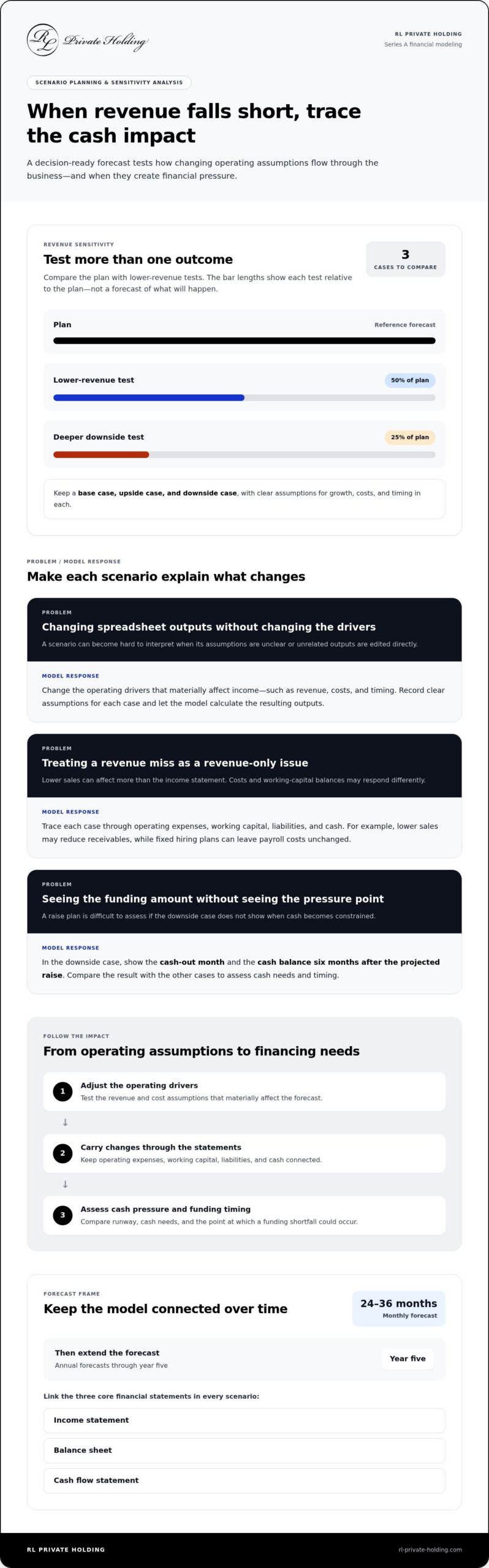
Scenario planning tests how different operating conditions affect revenue, cash and financing needs. A useful forecast includes base, upside and downside cases, each with clear assumptions for growth, costs and timing.
Build cases by changing the drivers that materially affect income, rather than editing unrelated spreadsheet outputs. For example, test revenue at 50% or 25% of plan, then trace the effect through operating expenses, working capital, liabilities and cash. Keep accounting relationships intact in every case: a lower sales forecast may reduce receivables, while fixed hiring plans could keep payroll costs unchanged. This shows which costs can adjust and which cannot.
For a Series A downside case, test performance at 50% of plan. Show the resulting cash-out month and the cash balance six months after the projected raise. This connects the funding decision to the business’s operating response. If the downside case reaches a cash constraint earlier, management can assess whether to reduce spending, delay expansion or revise hiring assumptions before committing to the plan.
Sensitivity analysis changes one assumption at a time, such as conversion, pricing, churn or hiring pace, while holding other inputs constant. The resulting effect on cash or income shows which drivers need closer attention. Scenario analysis combines related changes, such as slower growth and delayed customer payments, to examine their cumulative effect. Use both: sensitivity tests reveal exposure to individual inputs, while scenarios show how risks can interact.
Variance analysis compares actual results with the relevant case. If revenue falls below the base forecast, identify whether volume, price or timing caused the gap, then update the affected assumptions instead of applying a broad adjustment. Recalculate the linked statements and confirm the spreadsheet’s balance checks still work. This ties downside planning to operating evidence rather than allowing a more favourable case to obscure emerging pressure.
Financial models as tools for decision support and risk assessment
A financial model is useful when it connects operating inputs to decisions, not simply when it produces projections. Start by defining its business purpose, such as assessing whether planned hiring remains affordable if growth slows.
Begin with a needs assessment: specify the decision, forecast period, information required and how results will be measured. For example, a three-year strategic-planning question needs drivers that connect hiring, revenue and cash flow across that period. This focus keeps the spreadsheet relevant to management and investor decisions.
Keep the model dynamic, with formulas linking inputs to outputs and financial statements. A change in customer growth should flow through revenue, working capital and cash, rather than requiring manual edits across multiple schedules. Clear formulas let users trace how a revised assumption affects a decision. Separate input cells from calculations, label assumptions and retain error checks so users can distinguish a changed forecast from a broken formula.
Prioritise the drivers that explain the most variance. A model does not need 200 individual assumptions when 20 key drivers explain 90% of its variance. For each key input, record its rationale and identify the decision it influences. If slower customer acquisition extends the time before revenue arrives, management can assess hiring pace or other commitments against projected cash flow.
Use outputs to set decision thresholds, not to suggest certainty. For example, identify the cash balance or runway level that would prompt management to defer discretionary spending or revisit the financing plan. Compare actual results with the forecast, investigate material variances and update the relevant inputs. This makes risk assessment an operating discipline: management can see which assumptions are under pressure and what actions remain available.
For an investment-management perspective on assessing assumptions and portfolio decisions, explore investment management considerations.
RL Private Holding: Venture Capital Funding
RL Private Holding provides Venture Capital Funding for businesses considering external capital to support growth. A financial model can help founders show how funding needs relate to operating plans, cash flow and downside risks. It also gives management a structured basis for discussing how capital could advance the company’s objectives.
When your scenario analysis is ready and you are considering venture funding as part of a Series A plan, RL Private Holding can discuss your capital needs. The company also provides Private Equity Investment Management, Real Estate Asset Management and Wealth Management Services for distinct investment needs. The right discussion depends on the purpose of the capital and the business context. Be ready to explain the forecast’s key assumptions, funding requirements and risks so the conversation can focus on the decisions behind the model.
Contact RL Private Holding to discuss Venture Capital Funding.
Make the model part of the next decision
Building a financial model for a Series A round should establish an ongoing management practice, not end with a completed spreadsheet. Assign responsibility for key assumptions, record why they change and connect each revision to a decision. This keeps the model useful as actual performance develops and priorities shift.
Before the next planning discussion, identify which indicators would prompt a change in hiring, spending or expansion. Give each trigger a clear owner and agreed response. This makes the forecast a shared reference for evaluating trade-offs, rather than a document revisited only during fundraising. A thoughtful funding discussion can then address both the company’s ambitions and the risks revealed by its model.
For a discussion about capital and investment considerations, contact RL Private Holding. A disciplined model can help you approach the next stage with greater clarity and purpose.
Frequently Asked Questions
How detailed should the assumptions tab be in a startup financial model?
For building a financial model for a Series A round, make the assumptions tab clear enough for another reader to trace each material input to its rationale. Keep core assumptions focused, with definitions, units, timing and ownership. For example, distinguish price changes from customer-volume growth rather than combining them in one revenue input. Note the evidence, dependencies and conditions that would prompt an update.
How do I model revenue for a SaaS company at the Series A stage?
Model SaaS revenue from customer activity and contract terms rather than relying on a single growth percentage. Separate new customers from renewals, upgrades, downgrades and cancellations, then account for contract start dates and revenue recognition. A cohort view can show whether growth comes from acquisition or expansion. Keep billings and cash collection distinct from recognized revenue: prepayments affect cash timing without changing the service period.
What are the most common mistakes founders make in fundraising financial models?
Common errors include unsupported growth assumptions, inconsistent figures across materials, broken formulas, and expenses that omit hiring or payment timing. For example, treating a signed contract as immediate cash can overstate liquidity if payment arrives later. Changing revenue without adjusting related costs or working capital is another warning sign. Label inputs clearly, test formulas and reconcile model outputs with actual results.
What scenarios do Series A investors expect to see modeled?
Investors commonly expect base, upside and downside cases, with the downside showing how management might respond to weaker performance. Include operational consequences, such as changes to hiring, delayed expansion or earlier cash pressure. Keep each case internally consistent and identify the assumptions driving the differences. This gives the financing discussion a practical basis beyond a single projected outcome.
What should a Series A financial model include?
Building a financial model for a Series A round means connecting operating forecasts with financial statements, cash flow, financing assumptions and a capitalization table. Include a hiring schedule that links roles and start dates to payroll, plus a budget-versus-actual view for management follow-up. These schedules help separate operating performance from financing effects. A concise dashboard can present decision-relevant outputs without requiring readers to inspect every worksheet.
How to forecast revenue, customers, and expenses for a startup?
Forecast customer numbers from acquisition channels, conversion steps, sales capacity and purchasing patterns. Translate activity into revenue using pricing, contract timing and renewal behaviour. Estimate expenses from the resources needed to deliver and sell the product, including role start dates and supplier payment schedules. Separate recurring costs from discretionary spending, then compare actual results with the assumptions behind each line to see whether variances reflect demand, timing or execution.