

A larger allocation to alternatives does not automatically make a portfolio more diversified. The endowment model of investing explained in practical terms begins with its broader aim: combine public markets with private equity, venture capital, real estate and other less-liquid assets, while aligning investments with long-term spending needs. It is an investment framework, not a fixed portfolio recipe.
The approach is often associated with large university funds, whose scale and long horizons can support substantial private-market investments. But its principles of diversification and disciplined asset allocation can also inform smaller portfolios, even when access to alternatives and the capacity to manage illiquidity differ.
This article explains how alternative investments can contribute to the model, the benefits and trade-offs of diversification, and why small and large endowments may apply the same principles differently. It also considers how the Yale approach became influential and what its lessons mean for investors managing long-term capital.
Key Takeaways
- Assess diversification across asset classes and markets as a portfolio-level strategy, rather than judging it by the number of investments alone.
- Account for scale when applying endowment principles: smaller funds may face different constraints around access, liquidity and investment management.
- Use strategic asset allocation to connect long-term investment objectives with spending needs and a disciplined rebalancing approach.
- Evaluate private equity and hedge funds for their potential portfolio role alongside their liquidity and implementation demands.
Diversification across asset classes and markets
The endowment model combines public and private investments across asset classes and markets. Yale’s example illustrates how allocations can extend beyond listed shares and bonds.
Public and Private Asset Exposure
Public and private asset exposure means holding investments traded on public markets alongside interests in privately held businesses. Their market access, valuation and liquidity differ: public equities can generally be traded on exchanges, while private equity and venture capital involve companies outside public markets. Combining them can broaden exposure across sectors and stages of business development, rather than concentrating returns in listed companies alone.
Illiquidity Premium in Private Markets
The illiquidity premium is the potential additional return investors seek for holding assets that cannot be readily sold. Private equity, venture capital and some real estate investments can tie up capital for extended periods, so investors need to align private-market commitments with spending needs and other obligations. The premium is a rationale for accepting reduced liquidity, not a separate asset class or a guaranteed return.
Diversification Across Asset Classes
Asset-class diversification distributes capital among investments with different economic exposures, such as equities, fixed income, real estate and natural resources. Yale’s example allocation under David Swensen included 10% in real estate and 5% in natural resources. Those holdings added exposures beyond public equities and bonds. The objective is a meaningful mix, not simply a larger number of investments or sectors.
Markets and asset classes can behave differently across periods, so allocations influence how portfolio returns respond to changing conditions. Yale’s endowment had over half of its assets in private equity and venture capital by 2020, illustrating the scale private markets can hold in a large institutional portfolio. That example also shows why public and private exposures should be assessed together, including their differing liquidity and investment horizons.
How do small endowments differ from large endowments?
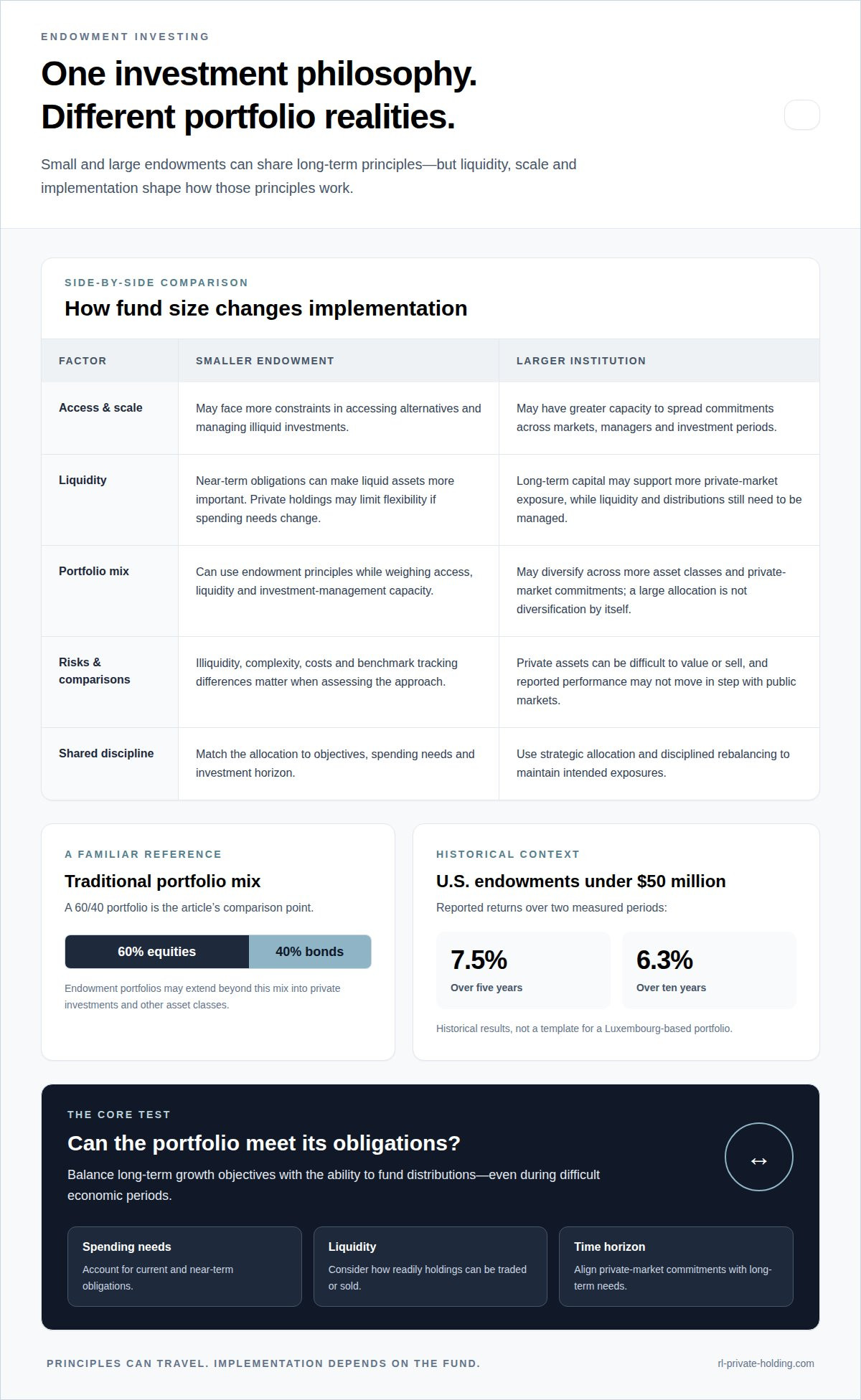
Small and large endowments share long-term investment principles, but their portfolios can differ in liquidity, diversification and implementation. Key risks and criticisms include illiquidity, complexity, costs and tracking error, particularly when private assets are difficult to value or sell. These exposures can cause performance to diverge from a traditional public-market benchmark.
A 60% equities and 40% bonds portfolio provides a familiar comparison. Endowment portfolios may extend beyond this mix into private investments and other asset classes. For a smaller fund, the key question is whether its capital, spending requirements and investment horizon can support less-liquid holdings. A larger institution may have greater capacity to spread commitments across markets, managers and investment periods. The principles can travel across fund sizes; implementation does not.
Portfolio volatility needs to be considered alongside liquidity. Public assets are generally easier to trade, while private holdings may offer less flexibility if spending needs change. A fund with near-term obligations may therefore give greater weight to liquid assets. Its outlook depends on balancing long-term growth objectives with the ability to meet distributions during difficult economic periods.
Costs and tracking error can also differ from those of a conventional 60/40 benchmark. Private investments involve different structures and valuation practices, so reported results may not move in step with public markets. Comparing portfolios requires attention to asset classes, liquidity, fees and the periods measured, rather than returns alone. For perspective, U.S. endowments with assets under $50 million returned 7.5% over five years and 6.3% over ten years. Those figures describe historical results, not a template for a Luxembourg-based portfolio.
What Are the Benefits of the Endowment Model?
The model allocates capital strategically across public and private markets, using asset classes suited to long-term objectives. Investors in Luxembourg can apply its principles through a portfolio that combines public-market investments with private-market exposure. The model itself is not a single investment product.
Strategic Asset Allocation
Strategic asset allocation sets a portfolio’s long-term mix of investments according to its objectives, spending needs and investment horizon. It matters because allocation shapes exposure to growth, income and potential losses across market conditions. More than 90% of a portfolio’s return variability can be attributed to asset allocation. A disciplined policy therefore gives investors a framework for maintaining their intended exposures instead of reacting to short-term market changes.
Diversification is one potential benefit of the framework, but it depends on how asset classes interact and on the portfolio’s objectives. Endowment-style investors may have a multi-decade or multi-generational horizon, allowing strategic decisions to reflect long-term capital needs. Allocation still requires attention to liquidity and spending demands, since growth-oriented assets may not be readily available when distributions are due.
Yale-Inspired Asset Allocation
Yale-inspired allocation refers to a strategic mix associated with the endowment’s approach under David Swensen. In the cited example, Yale allocated 30% to equities, 5% to fixed income, 20% to real assets, 30% to private equity and 10% to hedge funds. Domestic equities represented 15% of the portfolio. These figures illustrate one institution’s allocation, not a universal template.
Foundation size also influences implementation. In 2025, the largest private foundations allocated 52% of portfolios to alternative strategies, compared with around 22% for the smallest. Those allocations show how institutional capacity can shape diversification across public markets and private investments. For investors assessing the approach, the central benefit is a strategic structure that links growth objectives with a deliberate mix of assets.
Alternative investments, including private equity and hedge funds
Alternative investments extend an endowment portfolio beyond publicly traded shares and bonds. Private equity invests in privately held businesses, venture capital backs companies at earlier stages, and hedge funds use varied investment strategies. Real estate is another alternative, with returns influenced by property markets and asset management. Each category creates different exposures, but none eliminates volatility or guarantees growth.
The investment horizon is a central consideration. Private-market assets can take time to mature, and investors may not be able to sell them quickly when capital is needed. This illiquidity can be part of the investment rationale, but it also makes cash-flow planning and the pace of commitments important. A portfolio with significant private-market exposure must account for both potential opportunities and the timing of distributions.
Historical performance can help explain the model’s appeal without settling whether an allocation is suitable. McKinsey says the buyout segment has historically delivered higher returns than public markets over both 10- and 25-year periods. This comparison describes past results, not a forecast. Outcomes depend on investment selection, entry valuations, management and eventual exits.
Implementation also takes time. Building a diversified private-markets program can take the better part of a decade, while private-equity and venture-capital distributions, exits and fundraising have slowed markedly since 2021. Those conditions can affect how quickly capital returns and how new commitments are paced. Listed private-equity proxy vehicles offer a different route, but they are not identical to direct private-market investments; listed vehicles are often more than 90% correlated with small-cap equity factors.
The practical takeaway is to assess alternatives by role, liquidity and horizon, rather than by label alone. For a portfolio incorporating private-market exposure, explore private equity investment management as a relevant part of investment planning.
RL Private Holding
RL Private Holding supports investors assessing private-market exposure as part of a broader investment strategy. Its Private Equity Investment Management and Real Estate Asset Management offerings are relevant when decisions involve private businesses or property assets. Venture Capital Funding addresses investment in earlier-stage companies, while Wealth Management Services support broader portfolio considerations.
The endowment model’s principles do not require every investor to adopt a university fund’s allocation. The appropriate mix depends on investment objectives, liquidity needs and time horizon. RL Private Holding’s investment and wealth management offerings provide a relevant starting point for discussing how these factors relate to your capital.
Contact RL Private Holding to discuss your investment objectives and portfolio considerations.
Put a Long-Term Investment Approach Into Practice
With the endowment model of investing explained in relation to your objectives, the next step is to consider how its principles fit your capital, liquidity needs and investment horizon. This framework supports deliberate portfolio decisions, rather than prescribing a fixed allocation to copy. Start by considering the role each investment should play and how it fits your broader strategy.
RL Private Holding offers Venture Capital Funding, Private Equity Investment Management and Real Estate Asset Management for investors considering these areas. These offerings provide a basis for discussing private-market exposure and investment priorities, without assuming that every endowment-style allocation suits every investor.
Contact RL Private Holding to discuss your investment approach and consider how a long-term strategy can reflect your objectives. A disciplined next step begins with a clear view of the decisions your portfolio needs to support.
Frequently Asked Questions
What is the endowment model of investing?
The endowment model of investing is designed to manage capital for long-term growth and ongoing spending needs. Rather than relying only on publicly traded shares and bonds, an endowment-style portfolio can include private investments and real assets. The approach is a framework, not a standard product. Its allocation reflects the investor’s objectives, liquidity requirements and investment horizon.
What is the Yale endowment model and who developed it?
The Yale endowment model refers to the investment approach associated with David Swensen, who became the endowment’s chief investment officer in 1985. Under his leadership, Yale used a diversified portfolio with substantial alternative investments. Swensen led Yale’s endowment from 1985 to 2021. The approach influenced other institutional investors, but Yale’s portfolio reflects its own scale, objectives and governance.
What are typical endowment model allocations to public equities, private equity, hedge funds, and real assets?
There is no single allocation that defines every endowment portfolio. One Yale example assigned 30% to equities, 30% to private equity, 10% to hedge funds and 20% to real assets, alongside 5% to fixed income. The figures illustrate one institutional allocation, not a universal template. Investors should interpret categories and weights in relation to the portfolio’s objectives and liquidity needs.
What returns have endowment-model portfolios achieved compared with traditional 60/40 portfolios?
Yale’s endowment delivered an average annual return of 11.3% over the 20 years to 30 June 2021. That figure alone doesn’t establish how the model performed against a traditional 60/40 portfolio over the identical period. A meaningful comparison must use the same dates, return calculation and benchmark, while accounting for differences in asset mix and liquidity.
How do illiquidity and capital calls affect endowment-model investors?
Illiquidity limits an investor’s ability to sell a private-market holding quickly. A capital call is a request from an investment manager for committed funds to be provided. Investors therefore need enough liquid capital to meet calls and other obligations without relying on asset sales. The timing of calls and distributions can vary, making cash-flow planning important alongside assessing the investment’s intended horizon.
How can individual investors implement an endowment-style portfolio?
Individual investors can adapt the principles by setting a target mix based on their objectives, spending needs and ability to hold less-liquid assets. A practical approach is to establish a liquid portfolio foundation, then assess whether private investments suit the remaining capital and time horizon. Rebalancing annually or when allocations move beyond chosen portfolio bands can help keep the mix aligned with the intended strategy.