

Accessing top-quartile PE funds requires more than finding managers with strong past results. To understand how to get access to top-quartile PE funds, assess each general partner’s investment approach and execution, as well as the quality and prospects of its portfolio companies. Build diversification across managers, investment styles and geographies rather than relying on a single fund or strategy.
Past performance can inform your assessment, but it cannot replace scrutiny of how a manager sources, selects and develops investments. Consider the strength of individual companies, the consistency of the investment process and the fit with your wider portfolio when evaluating an opportunity.
This guide explains how to assess general partners and portfolio companies, compare the main routes to private equity fund access, and plan diversification within a long-term allocation. Use it as a framework for evaluating opportunities against your objectives, resources and investment horizon.
Key Takeaways
- Assess a fund’s commitment threshold and fee structure together to understand the capital and costs involved.
- Determine how investor status and the fund’s structure affect eligibility for private equity opportunities in Luxembourg.
- Compare access through private banks, wealth managers, platforms and direct commitments based on the support and portfolio reach each route provides.
- Evaluate general partners and portfolio companies, then diversify across managers, investment styles and geographies.
What are the minimum investment amounts and fees for top-quartile PE funds?
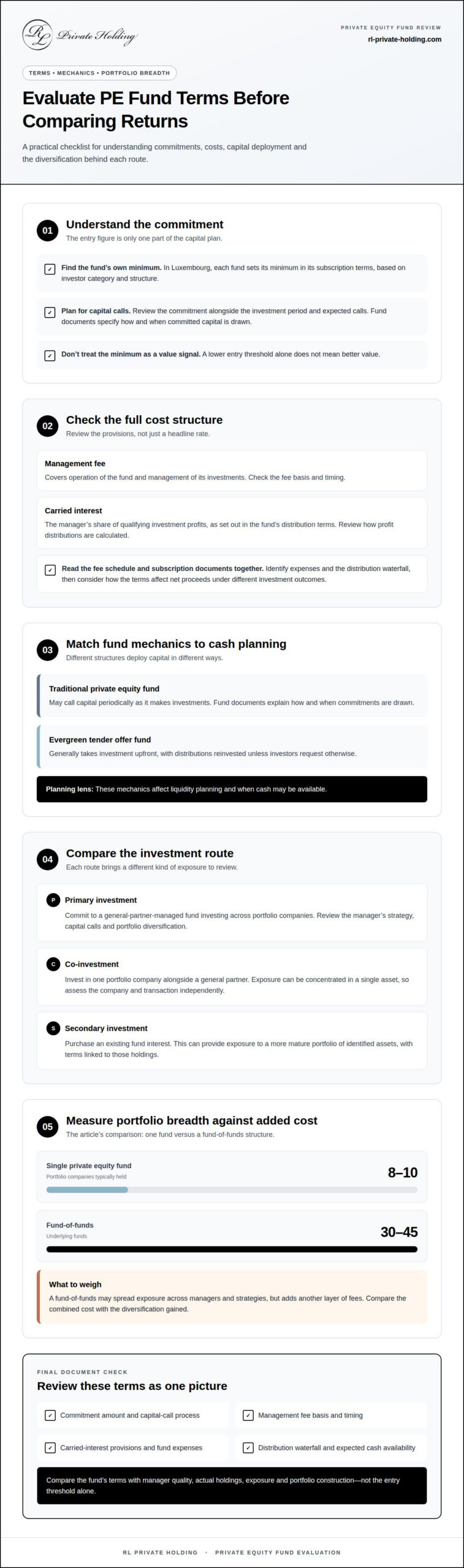
A fund commitment is the capital an investor agrees to provide to a private equity fund. In Luxembourg, each fund sets its own minimum in its subscription terms, based on the investor category and structure. Assess this alongside the investment period and expected capital calls, not as a standalone entry figure. The fund documents specify how and when committed capital is drawn.
A management fee covers the operation of the fund and management of its investments. Carried interest is the manager’s share of qualifying investment profits, as set out in the fund’s distribution terms. Both affect net returns, so review the full fee provisions rather than relying on a headline rate. Check the fee basis, timing, expenses and calculation of profit distributions.
Fund documents also explain how capital is deployed. A traditional private equity fund may call capital periodically as it makes investments. An evergreen tender offer fund generally takes investment upfront, with distributions reinvested unless investors request otherwise. These mechanics affect liquidity planning and when cash may be available.
- Primary investment: A commitment to a general-partner-managed fund that invests across portfolio companies. Review manager strategy, capital calls and portfolio diversification.
- Co-investment: An investment in one portfolio company alongside a general partner. It can concentrate exposure in a single asset, so assess the company and transaction independently.
- Secondary investment: The purchase of an existing fund interest. It can provide exposure to a more mature portfolio of identified assets, with terms linked to those holdings.
A fund’s portfolio size also affects diversification. A single private equity fund typically holds 8 to 10 portfolio companies, while a fund-of-funds can provide exposure to 30 to 45 underlying funds. That broader structure may spread exposure across managers and strategies, but it adds another layer of fees. Compare the combined cost with the diversification gained.
For a sound comparison, read the subscription documents and fee schedule together. Identify the commitment amount, capital-call process, management fee basis, carried-interest provisions, fund expenses and distribution waterfall. Then consider how those terms affect net proceeds under different investment outcomes. A lower entry threshold alone does not mean better value.
Fees cannot be assessed separately from manager quality and portfolio construction. Compare the general partner’s investment approach with its actual holdings, including how each company was sourced, is managed and is expected to realise value. A disciplined review of net returns, exposure and fund terms is central to choosing among private equity opportunities.
What investor accreditation or eligibility rules apply to PE fund access in Luxembourg?
Investor eligibility means the conditions an investor must meet to subscribe to a particular fund. In Luxembourg, start with the fund’s offering and subscription documents. They describe eligible investor categories, admission requirements and any restrictions attached to the vehicle. The same investor may qualify for one fund but not another because their terms differ.
Accreditation is a classification used in some markets or offerings for investors who meet specified criteria. It is not a universal Luxembourg qualification for every private equity fund. “Qualified Purchaser” is a US category, so that label alone does not establish eligibility for a Luxembourg fund. Focus on the vehicle’s stated criteria and applicable investor status.
Review the fund documents in sequence. First, identify the investor categories the fund accepts. Then determine whether the subscriber is an individual, company, partnership, foundation or another legal entity. Finally, check for additional conditions applying to that investor type, such as a minimum commitment, transfer restrictions or representations required at subscription.
Investor classification describes how a fund or intermediary records an investor for a specific offering. Depending on the structure, it may affect access, disclosures or subscription procedures. Do not infer classification from wealth or investment experience alone. The relevant documents and onboarding process explain what information supports the classification.
Prepare a consistent subscription file. It may include investor identification, entity details, ownership information and evidence supporting statements in the subscription documents. For example, a family investment company should ensure that its signatory authority and ownership records align with the subscribing entity. Inconsistencies can delay processing, even when the investment strategy otherwise fits.
- Read the eligibility wording: Find the precise investor categories and conditions in the fund’s offering documents.
- Match the subscriber: Use the same individual or legal entity throughout the application and supporting records.
- Review representations: Understand the statements made about status, authority, and investment before signing.
- Check transfer provisions: Identify whether a later transfer of the fund interest is restricted by the documents.
Eligibility and suitability are separate questions. A fund may admit an investor whose liquidity needs, time horizon or concentration limits make the commitment unsuitable for their broader portfolio. Consider these factors alongside the fund’s strategy and expected capital calls. For Luxembourg investors, first establish the vehicle’s criteria, then align the subscription and investor records with those terms.
What are the main routes to PE fund access: private banks, wealth managers, platforms, or direct investment
A private bank may provide clients with access to private equity opportunities. Investors exploring how to get access to top-quartile PE funds can use an existing banking relationship to learn about available funds and their subscription processes. Options depend on the bank’s offering and each fund’s admission terms. Identify whether an opportunity is a primary fund, a secondary interest or a co-investment, as each provides different exposure.
A wealth manager advises on how investments fit within a broader portfolio. This route can help you consider private equity alongside other assets, liquidity needs and long-term objectives. A useful discussion covers your time horizon, capacity to meet capital calls and preferred exposure across managers, styles and geographies. Allocation advice does not establish a fund’s performance ranking.
A private equity platform is an intermediary or investment structure through which investors can access selected private market funds. Its offering may organize fund access and administration, while the underlying exposure depends on the managers and assets selected. A fund-of-funds, for example, can provide exposure to 30 to 45 underlying private equity funds. Assess whether that breadth suits the portfolio and whether an additional fee layer is justified by its structure.
Direct investment means committing to a general partner’s fund without using a pooled access vehicle. It gives the investor exposure to a specific fund and its terms. Building broader exposure through direct commitments requires separate manager-selection and allocation decisions. Investors are also responsible for assessing each fund’s strategy, documents, capital-call obligations and contribution to portfolio diversification.
The routes differ in the support, selection and involvement they offer. A private bank or wealth manager can frame private equity within a broader financial plan. Platforms and fund-of-funds structures can organize exposure across underlying investments. Direct commitments provide a fund-level position but require deliberate choices across managers and strategies. The right route depends on your objectives, resources and desired level of oversight.
- Define the objective: Decide whether you seek broad fund exposure, a particular manager or a single-company co-investment.
- Map existing exposure: Review the portfolio’s current manager, strategy and geographic concentrations.
- Compare structures: Consider underlying holdings, fee layers, capital-call processes and liquidity terms.
- Assess the investment process: Examine sourcing, active management and portfolio implementation alongside reported performance.
When considering how to get access to top-quartile PE funds, remember that the access route is only one part of the decision. Due diligence on the general partner and its portfolio companies remains essential, as does understanding how the commitment fits your wider investment plan.
RL Private Holding
RL Private Holding provides investment management and wealth management services for investors assessing private equity opportunities. Its services can connect fund-access decisions with broader portfolio considerations, including manager selection, investment strategy and exposure across asset classes. This perspective is useful when evaluating how private equity fits alongside other commitments and long-term objectives.
Through Private Equity Investment Management, Real Estate Asset Management and Wealth Management Services, RL Private Holding addresses distinct parts of an investment portfolio. The right focus depends on your priorities and the role private markets are intended to play. Discussing these priorities can help clarify your next steps.
Contact RL Private Holding to discuss your private equity investment objectives and portfolio needs.
Turn your assessment into an investment plan
Deciding how to get access to top-quartile PE funds is only the beginning. Translate your investment objectives into a clear allocation framework: define the role private equity should play, the liquidity you need to retain and the exposure you are prepared to accept across managers, strategies and geographies. This makes it easier to assess each prospective commitment against your wider portfolio.
A written framework also supports consistent decisions as new opportunities arise. It can guide due diligence, clarify which risks need closer attention and help distinguish a fund’s historical ranking from the quality of its investment process. Treat the framework as a working investment discipline, and revisit it as your objectives and portfolio change.
RL Private Holding can discuss how private market investments relate to your broader investment priorities. Arrange a conversation with RL Private Holding to consider a considered path forward.
Frequently Asked Questions
What does top-quartile performance mean for private equity funds?
Top-quartile performance means a fund ranks within the highest quarter of a relevant peer group. Rankings compare funds within a vintage year, commonly using internal rate of return and investment multiples. The comparison group and measurement method matter: a ranking is meaningful only when the funds are reasonably comparable. It describes historical relative performance, not future results.
How can individual investors access top-quartile private equity funds?
For an individual, access to top-quartile PE funds depends on eligibility and available investment routes. A private bank, wealth manager or eligible platform may provide access; a fund-of-funds can pool exposure across managers, while a direct commitment focuses on a specific fund. When deciding how to get access to top-quartile PE funds, compare the fund’s terms and portfolio fit with your ability to meet capital calls.
How can investors evaluate a PE fund’s track record and verify top-quartile claims?
Ask how the ranking was calculated, which vintage year and peer group it uses, and whether returns are gross or net of fees. Compare internal rate of return with investment multiples, as each describes performance differently. Examine realised and unrealised investments separately, and assess losses as well as successful exits. Review the manager’s explanation of results and whether the same investment team led the relevant funds.
What steps should a Luxembourg investor take to get access to a reputable PE fund?
First, match your investor category and subscribing entity to the fund’s admission criteria. Then assess the general partner’s investment process, portfolio-company outcomes and performance record against a relevant benchmark. Review the subscription and fund documents for capital-call, transfer and distribution provisions. Finally, compare the proposed commitment with your existing private-market exposure and liquidity needs before subscribing.