

A strong headline return is not, by itself, a reason to choose a private equity firm. Evaluating a private equity firm’s track record means examining how returns were generated, which team members contributed, and whether the investment process can be repeated. Look for alignment between the firm’s performance, valuation discipline, operating approach, investment strategy, and your objectives.
Past performance matters, but it needs context. Realized and unrealized investments tell different parts of the story, while clear attribution helps distinguish a repeatable team process from results driven by a few deals or individuals.
This article explains how to assess a firm’s management team, valuation policies, operating performance, and credibility with limited partners. You’ll learn what each measure reveals, how to interpret the evidence together, and why consistency across investment records, fund materials, and references matters when comparing firms.
Key Takeaways
- Compare a firm’s results with investments of similar sector, size, geography, and vintage, then examine how each deal was sourced and who led it.
- Assess whether the investment team’s experience, collaboration, and value-creation approach can support repeatable results beyond individual dealmakers.
- Review valuation methods alongside revenue, EBITDA growth, and margins to distinguish reported portfolio values from underlying operating progress.
- Evaluate LP credibility through consistent fund materials, clear performance attribution, credible succession planning, and evidence that each fund commitment is underwritten on its own merits.
What private equity firm should you choose?
Choose a firm whose investment strategy, team, and approach to working with portfolio companies fit your objectives. Evaluate its track record in context rather than treating headline returns as a complete measure.
Track Record Across Investment Dimensions
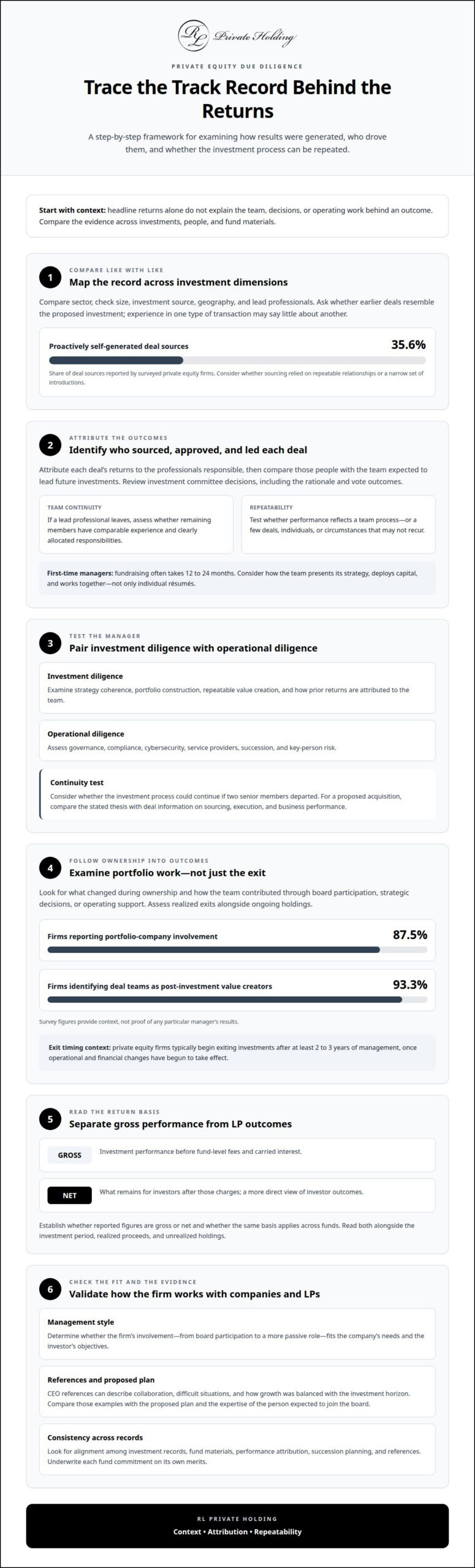
A firm’s track record across investment dimensions shows where, how, and through whom its results were generated. Compare sector, check size, investment source, geography, and lead professionals to judge whether earlier deals resemble the proposed investment.
For example, experience leading technology acquisitions may say little about minority investments in real estate. Proactively self-generated opportunities accounted for 35.6% of deal sources reported by surveyed private equity firms. Consider whether sourcing relied on repeatable relationships or a narrow set of introductions. Then attribute each deal’s returns to the professionals responsible, including whether those people will lead future investments.
Investment and Operational Due Diligence
Investment and operational due diligence are complementary evaluations of a private equity manager. Investment diligence examines strategy coherence, portfolio construction, repeatable value creation, and how prior returns are attributed to the team.
Operational diligence assesses governance, compliance, cybersecurity, service providers, succession, and key-person risk. Consider whether the investment process could continue if two senior members departed. For a proposed acquisition, compare the firm’s stated thesis with underlying deal information, including sourcing, execution, and business performance. This analysis helps distinguish a consistent investment structure from results shaped by individual circumstances.
Investor Involvement and Management Style
Investor involvement describes how a firm works with portfolio companies after investing, from board participation to a more passive ownership role. Assess which approach fits the company’s needs and the investor’s stated objectives.
CEO references can explain how the firm handled difficult situations, collaborated with management, and balanced growth with its investment horizon. A prospective portfolio company can also assess who would join its board and what that person contributes. Compare the firm’s examples with its proposed plan: a hands-on approach should link specific expertise to identifiable business needs. Access to a network alone does not show how an investor supports revenue growth or operational change.
Gross and Net Private Equity Returns
Gross returns measure investment performance before fund-level fees and carried interest, while net returns reflect what remains for investors after those charges. Net performance therefore provides a more direct view of investor outcomes.
When comparing firms, establish whether each reported figure is gross or net and whether the same basis applies across funds. A gross result shows how investments performed before charges, but not the amount ultimately allocated to limited partners. Examine both measures alongside the investment period, realized proceeds, and unrealized holdings. This distinction gives LPs a clearer basis for assessing returns against their objectives.
Evaluating a private equity firm’s management team
Assess whether the people responsible for past results remain involved and whether the strategy can be repeated. Team changes, deal sourcing, and strategy shifts affect how much earlier performance reveals about a future private equity fund. Evaluating a private equity firm’s track record also means understanding which professionals shaped outcomes and whether their expertise remains available.
Portfolio Management and Exits
Portfolio management and exits describe how the team supports an investment after acquisition and realizes its value. Both matter because operational execution and exit decisions shape portfolio outcomes.
Among surveyed private equity firms, 87.5% reported involvement in portfolio companies, while 93.3% identified deal teams as post-investment value creators. These figures provide context, not proof of a particular manager’s results. Examine how the team contributes to portfolio company management, such as appointing board members, supporting strategic decisions, or addressing operating challenges.
Private equity firms typically begin exiting investments after at least 2 to 3 years of management, once operational and financial changes have begun to take effect. Assess realized exits alongside ongoing holdings. Evaluating a private equity firm’s track record requires examining what changed during ownership and how the team’s actions contributed, rather than presenting the exit alone.
Team Changes, Deal Sourcing, and Strategy
Team changes, deal sourcing, and strategy show who generated performance and whether the same investment process remains in place. They matter because prior returns may depend on professionals or methods that no longer define the firm.
Compare the current team with the professionals who sourced, approved, and managed earlier deals. Review investment committee decisions, including their rationale and vote outcomes, to understand how the firm reaches conclusions. If a lead professional leaves, assess whether the remaining members have comparable experience and clearly allocated responsibilities.
For first-time managers, fundraising often takes 12 to 24 months. Selection should therefore consider how the team presents its investment strategy, deploys capital, and works together, not just its members’ individual résumés. Deal sourcing also matters: assess whether opportunities arise through a repeatable process aligned with the fund’s mandate. If a manager changes sectors, geography, or transaction type, treat earlier results as less directly comparable until the revised approach has a relevant record.
Reviewing valuation policies and operating performance
Valuation policies show how a manager measures portfolio holdings, while operating metrics indicate whether businesses are improving. Read them together: a rising valuation without corresponding progress in revenue, EBITDA, or margins warrants closer analysis.
For Luxembourg and EU funds, reporting and marketing requirements depend on fund structure, manager status, and investor audience. Assess whether materials state the performance basis, explain valuation methods, and present risks consistently. Compare disclosures across pitch materials and fund reporting. This helps identify whether a stated return reflects realized proceeds, unrealized valuations, or both, without assuming the same presentation applies to every fund.
A consistent valuation policy explains the methods used for comparable companies, cash-flow projections, and changes in assumptions. Among surveyed private equity firms, 81.4% used comparable companies to calculate terminal value. That approach still requires scrutiny: examine the selected peer group, financial period, and adjustments. For example, a portfolio company growing revenue more slowly than its comparable companies may not support the same valuation assumptions. Compare EBITDA growth and margins as well as revenue; those operating measures can show whether value creation has support beyond a valuation adjustment.
Operating performance also depends on the firm’s internal operating model and infrastructure. Assess how the team identifies business problems, assigns operating expertise, and measures improvement across portfolio companies. A smaller manager may use external specialists rather than maintain every capability internally. The key test is whether responsibilities, data, and oversight support consistent execution. Review compliance processes, legal support, cybersecurity, service providers, and governance as part of operational diligence. During formation or fundraising, a founder’s stated model should align with the capabilities and controls described in fund materials.
Management fees, carried interest, and fund expenses reduce the capital ultimately available to investors, affecting net returns. Compare the governing documents’ descriptions of each charge, how expenses are allocated, and how carried interest is calculated. Assess these terms alongside gross performance to understand their effect on investor proceeds.
Establishing credibility with limited partners
Credibility with limited partners rests on performance evidence, consistent disclosures, and an investment process aligned with commitments. LPs assess both results and the people and systems responsible for producing them.
Fundraising and General Partner Track Records
A general partner’s track record combines prior investment outcomes with evidence of its ability to raise and steward capital. Fundraising claims alone do not establish execution or continuity.
LPs compare due diligence questionnaire responses with pitch materials, website language, data-room documents, regulatory filings, and reference calls. Conflicting accounts of a deal’s role, valuation, or realized status can weaken confidence. A first-time fund may gain validation from anchor limited partners, but its strategy and operating arrangements still require review. Fundraising history provides context; it does not replace assessment of the proposed fund.
Firm Fit and Partner Fit
Firm fit and partner fit assess whether the organization’s strategy and individual professionals suit an LP’s objectives. Both matter: a capable platform may still be a poor match for an investor’s mandate or horizon.
Assess sourcing, sector focus, deployment approach, and succession planning together. For an established firm, consider whether its succession plan remains credible across multiple fund cycles. Reference calls can clarify how partners communicate during difficult investments and whether their actions align with stated priorities. This direct evidence adds context to written performance claims.
Use reported returns as one input, not a standalone endorsement. Surveyed private equity firms reported a mean return of 1.3 times their investment and mean performance 2.7% above their benchmark. Those averages do not establish an individual firm’s results. Compare each manager’s record with its stated benchmark, attribution, and investment period.
Assess a fund re-up as a new underwriting decision, not an automatic renewal. Review whether the team, strategy, operating structure, and succession plan still support the next commitment. Consistency across LP materials and reference accounts helps show whether the firm’s presentation reflects its actual practices.
For investors considering property exposure within an allocation, explore real estate asset management as part of the portfolio review.
RL Private Holding: Private Equity Investment Management
RL Private Holding provides Private Equity Investment Management for institutional and private investors considering how private equity fits their investment objectives. After assessing a firm’s team, valuation discipline, operating record, and LP credibility, consider whether an investment approach aligns with your portfolio priorities and time horizon.
RL Private Holding also works across venture capital, real estate asset management, and wealth management. These offerings may be relevant when your investment considerations extend beyond private equity, but each serves a distinct purpose. A focused discussion can clarify which area best matches your objectives and the investment structure under consideration.
Contact RL Private Holding to discuss your private equity investment management requirements.
Define the investment decision ahead
Evaluating a private equity firm’s track record is most useful when it informs a clear decision: what role should private markets play in your portfolio, and what investment approach fits your objectives? Connect your assessment to your capital priorities, time horizon, and appetite for active involvement.
RL Private Holding’s investment activities span Private Equity Investment Management, Venture Capital Funding, and Real Estate Asset Management. These distinct approaches can address different portfolio needs, from private company investment to property exposure. A focused discussion can clarify which direction is relevant to your objectives.
Contact RL Private Holding to discuss your needs. A considered next step can bring greater clarity to your investment decision.
Frequently Asked Questions
How do you calculate a private equity firm’s net IRR and MOIC?
Net IRR is the discount rate that makes the investor’s net cash flows equal zero. Include the timing of capital contributions and distributions, plus remaining investment value where applicable, after fund-level fees and carried interest. Net MOIC divides the total value returned or remaining for investors by their contributed capital. For example, distinguish cash already distributed from unrealized value when interpreting the multiple.
How should private equity track records be benchmarked by vintage year and strategy?
Compare funds that began investing in similar periods and pursue comparable strategies. Vintage year helps account for different market conditions during fundraising and deployment; strategy distinguishes, for example, buyouts from venture capital. Then compare performance using the same return basis and measurement date. A broad private equity average may obscure differences in geography, company size, or investment approach, so peer-group fit matters.
How can investors verify a firm’s realized returns and audited track record?
Reconcile reported realized returns with fund financial statements, capital-account reporting, distribution records, and supporting transaction documents. Confirm that proceeds and invested capital use consistent definitions, and distinguish fund-level results from deal-level attribution. An audit can support the reliability of financial statements, but does not automatically establish every marketing claim or validate the contribution assigned to individual professionals. Review the auditor’s opinion and the reporting period.
What are DPI, RVPI, and TVPI, and how do they assess fund performance?
DPI is cumulative distributions divided by paid-in capital, showing how much capital has been returned. RVPI is the remaining portfolio value divided by paid-in capital, representing unrealized value. TVPI combines DPI and RVPI, capturing distributed and residual value together. For example, a fund with strong TVPI but low DPI still depends substantially on valuations and future exits to deliver its remaining proceeds.
How should unrealized investments and valuation marks be evaluated?
Assess unrealized holdings by examining the valuation method, underlying company performance, and evidence supporting key assumptions. Compare a company’s latest financial results with the data used in its mark, and consider whether comparable transactions remain relevant. Also review subsequent funding rounds or exits when available. A valuation is an estimate at a reporting date, so separate realized cash proceeds from unrealized portfolio value.
How can performance be compared across private equity funds and public markets?
Use a public market equivalent approach to compare private fund cash-flow timing with investment in a public index. The method assesses how the index would have performed against the fund’s contributions and distributions on corresponding dates. Keep currency, measurement period, and fee treatment consistent. Public indices provide context, but do not replicate private equity’s liquidity, investment selection, or valuation practices.