

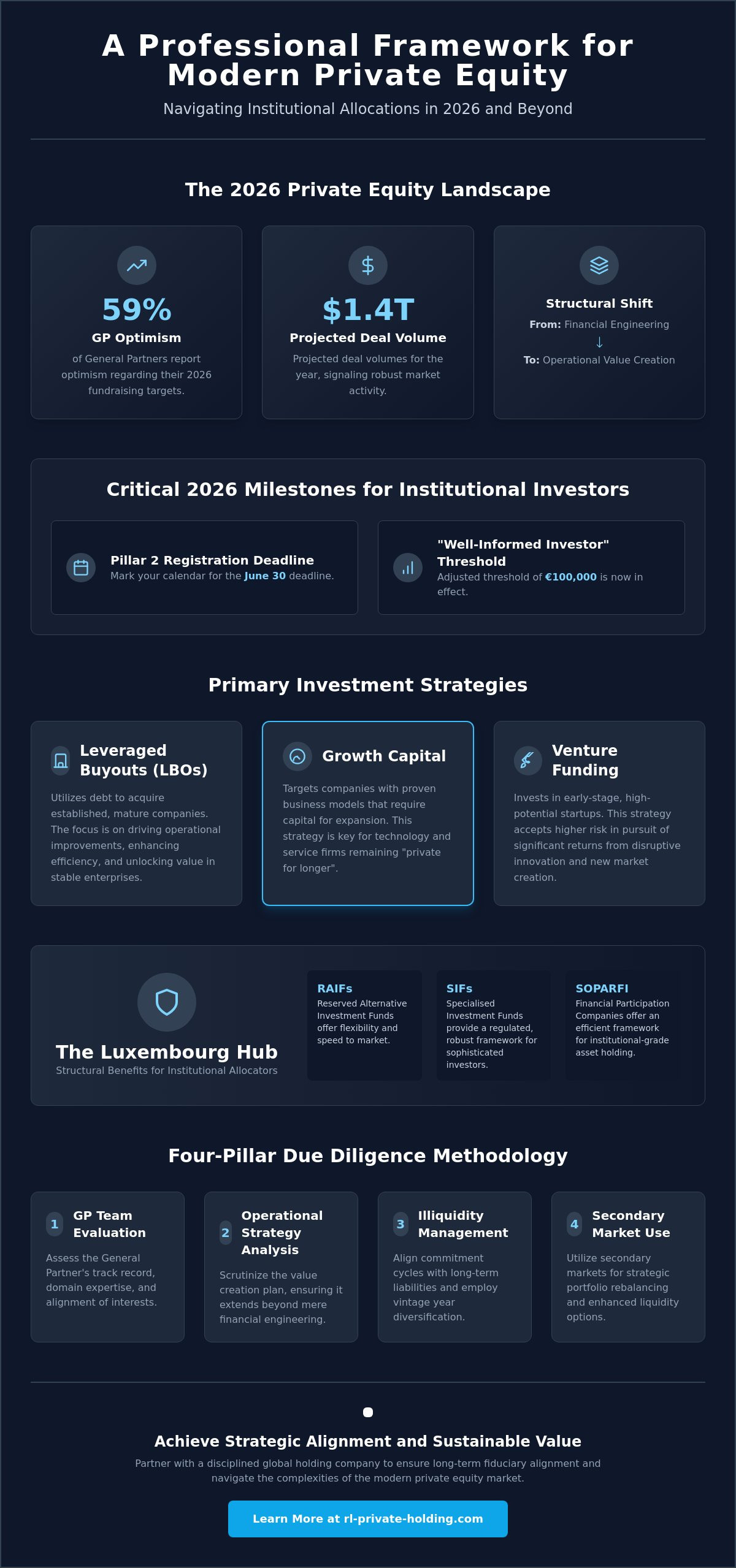
59% of General Partners report optimism regarding their 2026 fundraising targets, yet the technical requirements for private equity for institutional investors have reached a new level of complexity. While deal volumes are projected to hit $1.4 trillion this year, the shift from financial engineering toward operational value creation is now a structural reality. Institutional allocators understand that securing long-term returns requires more than just capital; it demands a precise alignment with evolving regulatory and fiscal frameworks.
This article provides a professional framework for managing the intricacies of modern private equity allocations. The following analysis offers a clear understanding of how to navigate opaque fee structures, calculate carried interest with precision, and utilize Luxembourg institutional structures like RAIFs and SIFs effectively. We also address critical 2026 milestones, including the June 30 Pillar 2 registration deadline and the adjusted €100,000 threshold for well-informed investors. This overview ensures your private equity strategy remains aligned with long-term fiduciary duties in a sophisticated global market.
Key Takeaways
- Analyze the strategic role of private equity for institutional investors within the endowment model to secure non-public capital appreciation.
- Identify the core differences between Leveraged Buyouts and Growth Capital to refine your portfolio’s risk-adjusted return profile.
- Examine the structural benefits of Luxembourg hubs, including the SOPARFI framework, for institutional-grade asset holding and cross-border efficiency.
- Adopt a four-pillar due diligence methodology to evaluate GP teams and operational strategies while managing illiquidity through secondary market participation.
- Assess the advantages of partnering with a disciplined global holding company to achieve long-term fiduciary alignment and sustainable value creation.
Defining the Institutional Role of Private Equity in Diversified Portfolios
Private equity for institutional investors is defined as a strategic asset class that focuses on long-term capital appreciation through the acquisition and management of non-public equity. This asset class has become a fundamental component of the “endowment model” of asset allocation. This model prioritizes a high exposure to illiquid assets to capture superior risk-adjusted returns over extended horizons. To understand the foundational mechanics, one might consult a resource like What is Private Equity? to see how the asset class has evolved from its niche origins into a global institutional staple. By 2026, market dynamics have shifted toward mid-market and growth equity strategies. These areas provide institutional allocators with more direct opportunities for operational value creation than the traditional mega-cap buyout sector. Institutional capital remains the essential driver of private market liquidity, as the scale provided by pension funds and sovereign wealth entities allows for the execution of large-scale transformations and infrastructure projects.
The Shift from Public to Private Markets
The landscape of global finance is currently defined by a notable decline in Initial Public Offerings (IPOs), leading to a “private for longer” environment for many high-performing companies. This trend allows management teams to focus on long-term strategic goals without the distractions of public market volatility or quarterly reporting requirements. For institutional allocators, this shift is critical. It provides access to growth-stage companies that are increasingly avoiding public listings until much later in their development cycles. This strategic choice dampens overall portfolio volatility and provides exposure to innovation that’s often absent from public indices. The liquidity premium in institutional private equity is the incremental return investors earn for committing capital to assets that can’t be immediately converted into cash.
Fiduciary Duty and Long-Term Capital Horizons
Institutional investors must align their private equity commitment cycles with the long-term liabilities of their respective organizations, such as pension payouts or endowment grants. This alignment requires a disciplined strategy focused on vintage year diversification. By committing capital consistently across different years, allocators avoid the risk of over-concentration in periods of high valuation. In 2026, regulatory scrutiny within European investment hubs has increased the focus on how fiduciary duties are managed. There is a clear expectation that institutional managers will demonstrate rigorous risk management and transparent reporting. Effective asset management now requires a sophisticated understanding of how private market structures interact with global regulatory standards, ensuring that long-term capital remains both protected and productive. It’s no longer enough to simply allocate; managers must actively oversee the alignment of every investment with the institution’s broader fiduciary mandate.
Primary Investment Strategies: LBOs, Growth Capital, and Venture Funding
Institutional portfolios rely on a diversified mix of strategies to balance yield, growth, and stability. Leveraged Buyouts (LBOs) remain the traditional cornerstone of private equity for institutional investors, utilizing debt to acquire established companies and drive operational improvements. The Institutional Limited Partners Association (ILPA) provides extensive documentation on how these structures align with the fiduciary requirements of limited partners. Private equity deal value reached $1.2 trillion in 2025, demonstrating the scale of capital currently deployed across these strategies. While buyouts focus on mature enterprises, growth capital has emerged as a vital strategy for capturing value in mature, non-public technology and service firms that require capital for expansion rather than a change in control.
Growth capital occupies the space between venture capital and buyouts. It targets companies with proven business models that need capital for geographic expansion or strategic acquisitions. This strategy is particularly effective in the technology sector, where companies remain private longer than in previous decades. For 2024 vintage funds, management fees averaged 1.74% for buyout funds and 1.93% for growth equity funds, reflecting the higher operational intensity of growth-oriented strategies. By 2026, the convergence of growth equity and late-stage venture capital has created a new category of mid-market growth that offers institutional investors a more predictable path to liquidity than early-stage venture funding. Understanding the specific levers that drive returns in these strategies is essential; a rigorous analysis of private equity value creation frameworks for institutional operational excellence provides the analytical foundation needed to distinguish managers who generate genuine alpha from those relying on financial engineering.
Venture Capital vs. Traditional Private Equity
Venture capital offers a distinct risk-return profile compared to traditional buyout strategies. While LBOs focus on cash flow stability and debt pay-down, venture capital seeks exponential growth in high-technology sectors. The J-curve effect is more pronounced in venture portfolios, as early-stage losses precede potential outsized gains. Institutional allocators must account for higher loss ratios in individual companies while seeking the power law returns where a small percentage of investments generate the vast majority of the fund’s total value. Technology venture capital serves as a critical diversifier, providing exposure to disruptive innovations that are inaccessible through public markets or traditional private equity.
Specialised Asset Classes: Real Estate and Infrastructure
Integrating physical assets into a private equity framework provides a robust hedge against inflation. Real estate asset management complements a broader portfolio by offering a combination of capital appreciation and consistent yield. Private real estate holdings often include contractual rent increases, which serve as a natural mechanism for preserving purchasing power in inflationary environments. Institutional investors often choose between direct investment models, which offer greater control, and indirect models through funds or holding companies. For those seeking a sophisticated partner in these markets, RL Private Holding maintains a disciplined approach to private equity and real estate management, ensuring alignment with long-term institutional objectives.
Structural Considerations for Institutional Allocators in Luxembourg
Luxembourg’s status as a global hub for private equity for institutional investors is rooted in its robust legal framework and historical stability. The jurisdiction provides a sophisticated environment for fund domiciliation, governed by the Alternative Investment Fund Managers Directive (AIFMD). This directive ensures a high level of institutional safety through standardized reporting and rigorous risk management protocols. A central component of this ecosystem is the SOPARFI (Société de Participations Financières). This structure serves as a fully taxable holding company that benefits from Luxembourg’s extensive network of double tax treaties and the participation exemption regime. It provides a transparent and stable vehicle for managing global assets, emphasizing governance and structural integrity over mere administrative convenience.
Institutional Investment Vehicles
Allocators must choose between several specialized structures depending on their regulatory needs and risk appetite. The SICAR (Investment Company in Risk Capital) requires a minimum capitalization of €1 million, while SIFs (Specialized Investment Funds) and RAIFs (Reserved Alternative Investment Funds) must reach a minimum of €1.25 million within 12 months of registration. A significant update for 2026 is the lowering of the “well-informed investor” threshold to €100,000, which increases accessibility for specific institutional sub-classes. While single-strategy funds offer focused exposure, a diversified holding company structure provides broader operational stability and improved tax neutrality for global capital. Entities subject to Pillar 2 rules must also remain mindful of the June 30, 2026, registration deadline to ensure full regulatory compliance within the European hub.
Fee Mechanics and Incentive Alignment
Transparency in fee structures is a primary concern for institutional allocators seeking to fulfill their fiduciary duties. Recent benchmarks show mean management fees of 1.74% for buyout funds and 1.93% for growth equity funds. These charges are typically calculated on the fund’s total committed capital during the investment period. Carried interest remains the primary mechanism for performance-based incentives, ensuring that the General Partner’s interests are tied to actual realized gains. GP-LP alignment is further strengthened through significant capital commitments from the managers themselves. This co-investment ensures that all parties share the same downside risks and upside potential. By prioritizing clear fee mechanics and rigorous governance, Luxembourg-based structures facilitate a disciplined approach to private equity for institutional investors, fostering long-term trust and performance consistency.
Due Diligence and Risk Mitigation in Private Market Allocations
Rigorous due diligence remains the primary defense against capital impairment in private markets. For those managing private equity for institutional investors, this process rests upon four essential pillars: Team, Track Record, Strategy, and Operations. While historical performance provides a baseline, the stability and cohesion of the investment team often dictate future success. In 2026, institutional allocators are increasingly focused on strategy sustainability, ensuring that a manager’s approach can withstand shifting interest rate environments and credit cycles. 53% of private equity professionals currently identify deteriorating credit quality as a significant risk, making a deep analysis of underlying portfolio leverage more critical than ever.
Managing illiquidity risk has evolved through the expansion of the secondary market. Transaction volumes in the secondary market reached a record $226 billion, providing a vital tool for GPs and LPs to manage portfolio concentration and liquidity needs. Valuation methodologies have also shifted toward the integration of real-time data. 31% of firms have now integrated AI into their due diligence processes to analyze market trends and company performance with greater speed. This technological adoption allows for more frequent valuation updates, bridging the gap between public and private market reporting cycles. Institutional partners also require comprehensive ESG and impact reporting to satisfy internal mandates and evolving disclosure requirements.
Operational Due Diligence (ODD)
Operational due diligence focuses on the firm’s internal infrastructure rather than its investment decisions. It involves a detailed evaluation of the back-office, governance frameworks, and third-party service provider relationships. In 2026, cybersecurity and data privacy have become non-negotiable requirements for institutional partners. EU regulatory standards now demand that Luxembourg-based entities demonstrate robust operational resilience and clear protocols for managing data breaches. This level of scrutiny ensures that the firm’s administrative capabilities are as disciplined as its investment strategy, protecting the institution from avoidable reputational or financial risks.
Portfolio Monitoring and Reporting
Effective risk management requires standardized reporting across diverse holdings. Institutional allocators need “look-through” transparency to understand their total exposure to specific sectors, geographies, or individual company risks. This transparency is essential for fulfilling fiduciary duties and maintaining a clear overview of the portfolio’s health. For a deeper analysis of these methodologies, you may review our guide on Private Equity Risk Management for Sophisticated Portfolios. Maintaining this level of oversight ensures that private equity for institutional investors remains a controlled and productive component of the broader asset allocation. To discuss how our disciplined framework can support your capital objectives, we invite you to contact our institutional team for a technical briefing.
Strategic Alignment: Selecting a Global Investment Holding Partner
The evolution of the private equity landscape in 2026 has transformed the relationship between allocators and fund managers. While traditional fund-by-fund allocation remains common, sophisticated entities are increasingly moving toward strategic partnerships with diversified global holding companies. This shift allows for a more integrated approach to capital deployment, where private equity for institutional investors is not managed in isolation but as part of a broader, multi-asset strategy. By utilizing a holding company structure, institutions can achieve greater operational efficiency and a more unified governance framework. This model is particularly effective when leveraging Luxembourg’s ecosystem, which provides the necessary legal certainty and fiscal transparency required for large-scale global capital deployment.
A significant advantage of this approach lies in the integration of real estate and private equity within a single holding framework. Most market participants continue to treat these as separate silos, often missing the synergies available through cross-sector data and shared operational expertise. A global partner that maintains a disciplined presence in both technology and real estate can better manage cross-sector volatility. This integrated view provides a more accurate assessment of the total portfolio liquidity and risk profile, ensuring that every asset contributes to the overarching fiduciary objective without the administrative friction typically associated with fragmented allocations.
Bespoke Institutional Wealth Management
For sovereign wealth funds and large-scale pension schemes, standard investment products often fail to meet specific liability profiles or ESG mandates. Bespoke institutional wealth management addresses this by providing customized portfolio construction that aligns with the unique time horizons of the allocator. Integrating Wealth Management Strategies for Institutional Investors into the private equity framework ensures that cash flow requirements are met while maintaining exposure to high-growth private markets. This level of customization is essential for maintaining the delicate balance between immediate liquidity needs and the long-term capital appreciation required to sustain an institutional legacy.
RL Private Holding’s Commitment to Excellence
RL Private Holding operates with a “silent giant” philosophy, characterized by stability, exclusivity, and a professional distance that respects the high-stakes nature of institutional finance. Our disciplined approach to tech, real estate, and private equity management focuses on institutional permanence rather than short-term market trends. This methodology ensures that our partners benefit from a steady hand in the background of major investments, where every decision is governed by rigorous risk management and a clear plan for value creation. Building a resilient institutional legacy through private markets requires a partner that prioritizes structural integrity and long-term strategic focus. We invite you to Explore our Institutional Private Equity and Asset Management services to learn how our framework supports sustainable growth in a complex global economy.
Advancing Institutional Fiduciary Excellence in 2026
The landscape of private equity for institutional investors has transitioned into a phase where operational discipline and structural precision are paramount. Success in this environment requires moving beyond traditional fund allocation toward a holistic framework that integrates diversified asset classes within a single, transparent holding structure. By prioritizing rigorous due diligence and leveraging the stability of Luxembourg’s regulatory ecosystem, allocators can effectively manage the complexities of modern illiquidity and valuation gaps. This disciplined approach ensures that capital remains aligned with long-term fiduciary mandates while capturing the growth potential of non-public markets.
RL Private Holding is headquartered in Luxembourg and maintains a global investment footprint across technology, real estate, and asset management. Our organization operates under sophisticated governance frameworks and AIFMD-compliant operational standards to protect institutional interests. We invite you to consult with our institutional investment specialists to discuss how our strategic framework can support your capital objectives. Building a resilient portfolio is a deliberate process that rewards professional distance and worldly expertise. We look forward to supporting your long-term vision.
Frequently Asked Questions
What are the primary benefits of private equity for institutional investors in 2026?
Private equity for institutional investors provides a premium over public markets by capturing value through active operational management and non-public growth. The primary benefit remains the asset class’s ability to dampen portfolio volatility while providing exposure to companies that choose to remain private for longer. This strategic choice allows allocators to bypass public market fluctuations and focus on long-term capital appreciation and consistent yield generation.
How does a Luxembourg SOPARFI structure benefit institutional allocators?
A Luxembourg SOPARFI structure serves as a sophisticated holding vehicle that offers institutional allocators significant fiscal stability and tax neutrality. It benefits from Luxembourg’s extensive network of double tax treaties and the participation exemption regime, which simplifies the management of global subsidiaries. This structure also ensures high standards of corporate governance and transparency, aligning with the stringent regulatory requirements of large-scale pension funds and sovereign wealth entities.
What is the typical allocation of private equity in a pension fund portfolio?
Typical allocations to private equity within pension fund portfolios generally range between 5% and 15%, depending on the specific liability profile and risk tolerance of the institution. Under the endowment model of asset allocation, some sophisticated funds have increased these commitments to higher levels to capture the liquidity premium. These allocations are usually spread across various vintage years to ensure consistent cash flow and to mitigate the risks associated with market timing.
How is carried interest calculated in institutional private equity agreements?
Carried interest is calculated as a share of the fund’s realized profits, typically set at 20% after the limited partners have received their initial capital plus a preferred return. This hurdle rate, often around 8%, ensures that the general partner only receives performance-based incentives once a minimum return threshold is met. This mechanism aligns the interests of the manager with those of the institutional investors by rewarding actual value creation and successful exits.
Can institutional investors access venture capital through a holding company structure?
Institutional investors can access venture capital funding through a diversified holding company structure, which provides a more stable entry point than individual fund commitments. This model allows for the integration of high-growth technology sectors alongside more stable assets like real estate. By utilizing a holding company, institutions benefit from centralized management and a unified risk profile, which simplifies the oversight of disruptive, early-stage investments within a broader private market strategy.
What are the liquidity risks associated with institutional private equity?
Liquidity risks in institutional private equity are primarily associated with the long-term lock-up periods, which often span ten years or more. Allocators must also manage the uncertainty of capital calls and the timing of distributions, which can fluctuate based on market conditions. While the growth of the secondary market has provided new avenues for exit, private equity remains an inherently illiquid asset class that requires careful cash flow planning and a disciplined commitment strategy.
How does RL Private Holding manage risk across its diversified portfolio?
RL Private Holding manages risk by maintaining a disciplined, cross-sector portfolio that includes technology, real estate, and private equity investment management. Our organization adheres to AIFMD-compliant operational standards, ensuring that every investment is subject to rigorous governance and risk monitoring. This multi-asset approach helps to mitigate sector-specific volatility and provides a stable foundation for global capital deployment, reflecting our commitment to institutional permanence and long-term fiduciary duty.
What due diligence protocols are essential for selecting a private equity firm in Luxembourg?
Essential due diligence protocols for selecting a firm in Luxembourg involve a comprehensive evaluation of the manager’s operational resilience and governance frameworks. Allocators should focus on the four pillars of Team, Track Record, Strategy, and Operations, while also conducting specialized operational due diligence. This includes verifying compliance with local regulatory requirements, such as Pillar 2 registration and minimum capitalization thresholds, to ensure the partner’s infrastructure can support large-scale institutional mandates.