

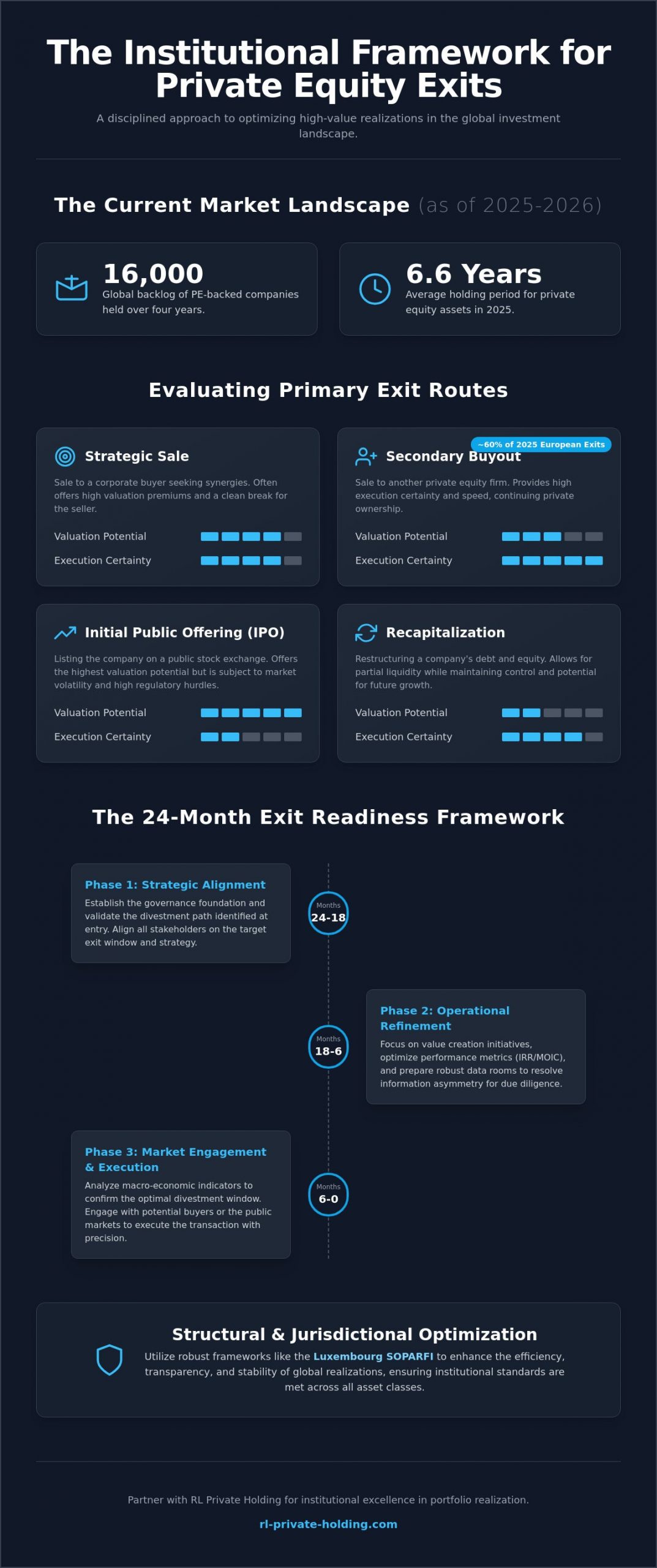
As of early 2026, an estimated global backlog of 16,000 private equity-backed companies have been held for longer than four years. This accumulation of aging assets underscores the inherent difficulty of securing liquidity in an environment where the average holding period reached 6.6 years in 2025. You likely recognize that a successful private equity exit strategy is no longer a mere transaction. It’s a multi-year governance process that requires meticulous alignment between structural efficiency and operational transparency to avoid valuation leakage during the due diligence phase.
This article provides a comprehensive institutional framework for evaluating, preparing, and executing high-value realizations within the global investment landscape. We offer clarity on the specific trade-offs between strategic sales and secondary buyouts, which accounted for approximately 60% of European exits in 2025. By following this repeatable template for exit readiness, firms can optimize performance-based carried interest and maintain stability despite market volatility. The following sections detail the technical preparations necessary to resolve information asymmetry and ensure institutional realization.
Key Takeaways
- Learn why identifying the potential divestment path during the due diligence phase is essential for validating the entire investment management lifecycle.
- Analyze the quantitative metrics of valuation potential versus execution certainty across the four dominant exit routes in the global market.
- Develop a disciplined 24-month operational template to refine your private equity exit strategy and capture immediate value before the transaction.
- Explore how to optimize the efficiency and stability of global realizations through robust jurisdictional frameworks such as the Luxembourg SOPARFI.
- Understand the institutional standards required to integrate private equity, venture capital, and real estate asset management for superior realization.
The Strategic Imperative of Private Equity Exit Planning
A successful investment is only truly realized upon its conclusion. Within the framework of professional private equity investment management, the exit serves as the ultimate validation of the entire investment lifecycle. RL Private Holding adheres to a disciplined “Exit-at-Entry” philosophy. This approach dictates that the viable divestment path must be identified and analyzed during the initial due diligence phase. Without a clearly defined private equity exit strategy established at the point of acquisition, the risk of structural misalignment increases significantly over the holding period. It’s a fundamental requirement for maintaining institutional gravity throughout the life of the asset.
The timing of a realization event directly dictates the performance metrics of a fund. The internal rate of return (IRR) remains highly sensitive to the duration of the holding period. Shortening the hold can amplify IRR, yet it may sacrifice the multiple of invested capital (MOIC) if the asset hasn’t reached its full operational maturity. Conversely, maintaining a hold for too long can lead to capital drag. The holding company acts as a steady hand, ensuring that institutional discipline is maintained. It prevents the operational drift that often occurs when management teams focus on growth at the expense of liquidity readiness. A structured approach to private equity exit strategies ensures that the firm remains prepared for a high-value realization at any point in the cycle.
Aligning Investment Horizon with Market Cycles
Effective realization requires a sober analysis of macro-economic indicators to forecast optimal divestment windows. Managers must analyze interest rate trends and sector-specific demand to avoid market volatility that could compromise a private equity exit strategy. In 2025, the average holding period for private equity assets reached 6.6 years. This extension demonstrates a collective shift toward waiting for favorable valuation environments. Balancing the immediate pressure for liquidity with the potential for further value creation is a core competency of sophisticated asset managers. Clear communication regarding these timelines helps manage the expectations of all stakeholders.
The Governance of Divestment
Governance is the bedrock of a successful realization. Establishing a dedicated exit committee within the firm allows for an objective assessment of market conditions and asset readiness. The board of directors maintains the final authority to approve the divestment strategy, ensuring it aligns with long-term fiduciary obligations. This structured approach provides the transparency that institutional and private investors require, especially during complex global transactions. By centralizing this authority, the firm ensures that every exit is executed with precision and professional distance.
Evaluating Primary Exit Routes: Trade-offs and Market Dynamics
Selecting the optimal divestment path is a function of both asset maturity and prevailing market liquidity. A sophisticated private equity exit strategy requires a rigorous decision matrix that weighs quantitative valuation potential against qualitative execution risks. While the ultimate objective is the maximization of the internal rate of return, the choice of route often involves balancing the speed of closing with the continuity of management. In the current global landscape, four dominant paths define the realization process: strategic sales, secondary buyouts, initial public offerings (IPOs), and recapitalizations.
Quantitative metrics usually prioritize valuation multiples and the multiple of invested capital (MOIC). However, execution certainty is an equally critical variable. For instance, trade sales to strategic acquirers accounted for approximately 60% of European private equity exits in 2025. This high proportion suggests that sellers are prioritizing the “clean break” and high valuation premiums offered by corporate buyers over the volatility of public markets. Firms seeking to optimize their portfolios must engage in disciplined private equity investment management to ensure assets are positioned correctly for these specific buyer profiles.
- Valuation Potential: Strategic sales and IPOs typically offer the highest multiples due to synergy premiums or public market appetite.
- Execution Certainty: Secondary buyouts and trade sales provide more predictable timelines and higher closing probabilities.
- Confidentiality: Secondary buyouts maintain the highest level of discretion; IPOs require total regulatory transparency.
- Management Continuity: Financial sponsors in secondary buyouts often require management to roll over equity, whereas strategic buyers may seek full integration.
Strategic Sales and Trade Buyers
Trade buyers often pay a “synergy premium” because they can integrate the portfolio company into existing operations to reduce costs or expand market share. This often results in a higher valuation than a financial sponsor can justify. However, this route carries the risk of sharing sensitive operational data with potential competitors during the due diligence phase. To mitigate this, deal structures should focus on a clean break, although earn-out arrangements are increasingly used to bridge valuation gaps in volatile sectors.
Initial Public Offerings (IPO) vs. Secondary Buyouts
The IPO remains the most prestigious realization route, providing significant liquidity and a public profile. It also introduces a heavy regulatory burden and subjects the firm to public market sentiment. In contrast, secondary buyouts (PE-to-PE) have become the default for mid-market assets. This trend is driven by the significant “dry powder” currently held by private equity firms globally. These secondary exits allow for a rapid transfer of ownership and provide the purchasing fund with a platform that has already undergone institutional professionalization.
The Exit Readiness Framework: A Multi-Year Operational Template
Institutional realization is rarely the result of a sudden market opportunity. It’s the product of a disciplined, multi-year operational template that begins long before the formal marketing process. A professional private equity exit strategy requires a structured 24-month countdown to ensure the portfolio company is positioned for maximum valuation. This timeline allows the firm to transition from long-term value creation to a focus on divestment readiness, ensuring that all operational and financial metrics are optimized for external scrutiny. During this period, the identification and execution of “quick wins,” such as margin expansion through pricing adjustments or cost rationalization, can significantly impact the final exit multiple.
Management alignment is a critical component of this framework. Incentivizing the C-suite for a successful transition ensures that the leadership team remains focused on the exit objectives while maintaining business continuity. This often involves the implementation of transaction-based incentive plans or equity rollover requirements that align management’s interests with those of the selling fund. Engaging external advisors early in the process is equally vital. These professionals provide an objective pre-exit audit and valuation analysis, helping to identify potential deal-breakers and mitigate information asymmetry before the formal due diligence phase begins.
Financial Integrity and Data Readiness
To pre-empt bidder objections and reduce the risk of valuation leakage, firms should develop a comprehensive “Sell-Side Due Diligence” report. This proactive approach allows the seller to control the narrative by standardizing KPIs and EBITDA adjustments across the entire holding period. Transparency is maintained by ensuring that the underlying IT and finance infrastructure can provide granular, high-quality data on demand. When a buyer can easily verify historical performance through a robust data room, the execution certainty of the private equity exit strategy increases, often leading to a more efficient closing process and reduced indemnity requirements.
Operational and Commercial Hardening
Operational hardening focuses on optimizing working capital and refining supply chain efficiencies to boost the overall valuation. This process includes the formalization of customer contracts and the rigorous protection of intellectual property to eliminate legal friction during the sale. These efforts ensure the business is perceived as a stable, standalone entity capable of immediate integration or independent operation. The EBITDA bridge serves as the core of the equity story, illustrating the precise transition from historical performance to future value potential. By clearly documenting how operational improvements have translated into financial growth, the firm provides a compelling justification for the desired exit multiple.
Structural and Jurisdictional Optimization for Divestment
The technical execution of a private equity exit strategy requires a sophisticated structural framework to ensure that capital is realized and distributed with maximum efficiency. While operational readiness addresses the value of the portfolio company, jurisdictional optimization protects that value during the transaction phase. Luxembourg remains the primary jurisdiction for institutional realization due to its robust legal framework and its alignment with European financial directives. Utilizing these structures allows for a predictable and stable environment during the complex process of cross-border divestment.
The SOPARFI (Société de participations financières) serves as a critical utility for global exits. This holding company structure is designed to facilitate the management of participations while offering significant advantages in terms of tax neutrality for institutional investors. By navigating the regulatory requirements of the CSSF and adhering to established financial directives, firms can ensure that the divestment process remains compliant and transparent. This structural integrity is essential for maintaining the professional distance and institutional gravity required in high-stakes asset management. Firms seeking to refine their approach to these complex structures often benefit from specialized private equity investment management to ensure every jurisdictional detail is optimized for realization.
Luxembourg as a Global Hub for Exit Execution
Luxembourg provides a stable legal ecosystem that is uniquely suited for complex private equity transactions. The jurisdiction offers access to a concentrated network of specialized legal and tax professionals who possess deep expertise in global realization frameworks. During the capital distribution phase, strict adherence to AML and KYC standards is non-negotiable. This rigorous compliance environment ensures that the distribution of proceeds meets all international regulatory expectations, providing a secure path for capital return to both private and institutional stakeholders.
Managing Carried Interest and Fee Distributions
Successful realization events trigger the distribution of performance-based incentives, commonly referred to as carried interest. The mechanics of these distributions must be governed by clear partnership agreements established at the point of entry. Governing the distribution of gains requires a methodical approach to ensure that all stakeholders receive their realized interest in a timely and transparent manner. Post-exit, management fee reconciliations must be conducted with precision. This final stage of the investment lifecycle reinforces the firm’s commitment to institutional excellence and disciplined financial reporting. It ensures that the exit is not just a conclusion but a professional validation of the entire holding period.
Institutional Excellence in Portfolio Realization
RL Private Holding views the finalization of an investment as a reflection of its organizational hierarchy and strategic focus. A disciplined private equity exit strategy isn’t a reactive response to market trends; it’s a calculated conclusion to years of institutional management. By maintaining a high degree of professionalism and objective distance, the firm ensures every realization event is executed with precision. This methodical approach provides a sense of stability and exclusivity for all stakeholders involved in the divestment process. The firm projects a quiet authority, suggesting an established presence that values factual presentation over speculative narratives.
The integration of Private Equity Investment Management, Venture Capital Funding, and Real Estate Asset Management creates a robust framework for global realization. This multi-sector scope enhances exit flexibility by allowing the firm to navigate varying market cycles across different asset classes with logical precision. A diversified global portfolio reduces exposure to localized volatility. It ensures divestment decisions are based on long-term value rather than short-term market pressures. This strategic focus reinforces the firm’s position as a steady partner in the global financial landscape, moving from a subject to its function with structural integrity.
The RL Private Holding Philosophy
The core philosophy prioritizes institutional gravity over the market hype often found in modern divestment narratives. There’s a total avoidance of trendy industry buzzwords in favor of a sober, factual presentation of an asset’s performance. The firm maintains a strategic focus on the technology and real estate sectors, where long-term growth is driven by structural fundamentals. By appearing as a “silent giant” in the background of major investments, the firm projects an image of reliability and professional distance. This persona is sophisticated and worldly, appealing to those who value a steady hand and a clear organizational plan.
Partnering for Strategic Exits
Partnering with a Luxembourg-headquartered entity offers a significant advantage for those managing the nuances of global investment structures. The firm provides a sophisticated bridge between local asset management and international capital markets, ensuring every private equity exit strategy is supported by a stable jurisdictional foundation. This worldly perspective is essential for delivering high-level Wealth Management Services and private equity solutions to an exclusive global clientele. The firm’s internal discipline ensures that the transitions between acquisition, holding, and divestment are smooth and functional. For those seeking a disciplined partner to manage the complexities of institutional realization, it’s essential to explore RL Private Holding’s investment management approach.
Advancing Toward Institutional Realization
Achieving institutional realization requires the seamless integration of operational hardening and jurisdictional precision. This guide has detailed how identifying the divestment path during the initial due diligence phase and maintaining a strict 24-month readiness template prevents valuation leakage. A robust private equity exit strategy isn’t merely a final transaction; it’s the culmination of disciplined governance and structural efficiency. Utilizing the stability of Luxembourg holding structures ensures that capital is returned with maximum transparency and tax neutrality for all stakeholders involved.
RL Private Holding maintains its headquarters in the Luxembourg global financial center, managing a diversified portfolio across technology, real estate, and private equity sectors. Our established expertise in institutional wealth management and venture capital provides the strategic focus necessary for managing complex realization events. This worldly perspective allows for a steady hand in the background of major global investments, prioritizing long-term stability over market volatility. We invite you to Consult with RL Private Holding on Strategic Investment Management to discuss how our framework for institutional realization can align with your portfolio objectives. We look forward to establishing a disciplined partnership.
Frequently Asked Questions
What is the most common private equity exit strategy in the current market?
Trade sales to strategic corporate acquirers remain the most prevalent exit route in the current global market. In 2025, these transactions represented approximately 60% of European private equity exits. This dominance is driven by the synergy premiums corporate buyers can offer and the high degree of execution certainty they provide. While IPOs and secondary buyouts are significant, the clean break associated with a trade sale often aligns best with fund lifecycle objectives.
How long does it typically take to prepare a portfolio company for exit?
A disciplined preparation phase typically spans 12 to 24 months before the formal divestment process begins. This timeline allows management teams to execute operational quick wins and ensure financial data integrity. Continuous exit readiness is becoming a standard institutional practice to capture favorable market windows as they arise. Starting this process early mitigates the risk of valuation leakage and ensures that the equity story is supported by historical performance data.
What is the difference between a trade sale and a secondary buyout?
The primary distinction lies in the profile of the acquirer and their underlying investment thesis. A trade sale involves a strategic corporate buyer who seeks to integrate the asset to achieve operational synergies. A secondary buyout occurs when one private equity firm sells a portfolio company to another financial sponsor. While trade sales often yield higher valuations due to synergies, secondary buyouts provide rapid liquidity and allow the purchasing firm to implement a new value creation plan.
How does a Luxembourg SOPARFI structure benefit the exit process?
The Luxembourg SOPARFI provides a robust framework for managing cross-border participations with significant tax neutrality. This structure ensures that capital gains realized upon divestment are protected under Luxembourg’s participation exemption regime, provided specific holding requirements are met. It offers institutional stability and aligns with European financial directives, making it a preferred vehicle for global investors. The SOPARFI’s regulatory transparency and legal certainty facilitate a smoother capital distribution phase following a successful private equity exit strategy.
What role does EBITDA play in determining the final exit valuation?
EBITDA serves as the fundamental baseline for calculating the enterprise value through the application of industry-specific multiples. During the realization phase, the EBITDA bridge becomes a critical component of the equity story, illustrating the transition from historical earnings to pro-forma profitability. Accurately adjusted EBITDA, which accounts for one-time costs and operational improvements, provides a transparent metric for buyers. This clarity reduces information asymmetry and supports the justification of a premium valuation multiple at the point of sale.
Can a private equity firm exit an investment during a market downturn?
Divestment remains possible during market downturns, although it often requires the use of alternative liquidity solutions. While IPO windows may close, trade sales to well-capitalized strategic buyers often persist. Additionally, the use of continuation vehicles or secondary sales has increased to provide liquidity when traditional routes are constrained. As of early 2026, firms are increasingly focused on operational value creation to maintain valuation levels even when market multiples experience contraction.
What are the primary risks involved in an Initial Public Offering (IPO) exit?
The IPO route introduces significant exposure to public market volatility and rigorous regulatory scrutiny. Sellers face the risk that unfavorable market sentiment may impact the final offering price or lead to a postponed listing. Furthermore, lock-up periods often prevent the immediate total realization of gains, requiring the firm to maintain a residual stake for several months. These factors, combined with high transaction costs and ongoing disclosure requirements, make the IPO a complex and often unpredictable realization path.
How is carried interest calculated and distributed following a successful exit?
Carried interest is a performance-based incentive calculated as a percentage of the realized capital gains, typically after a specified hurdle rate is achieved. Once the initial capital and the preferred return are distributed to investors, the remaining proceeds are allocated according to the partnership agreement. This distribution occurs after the final closing of the transaction and the reconciliation of all management fees. Maintaining transparency in these calculations is essential for preserving institutional trust and demonstrating the success of the private equity exit strategy.