

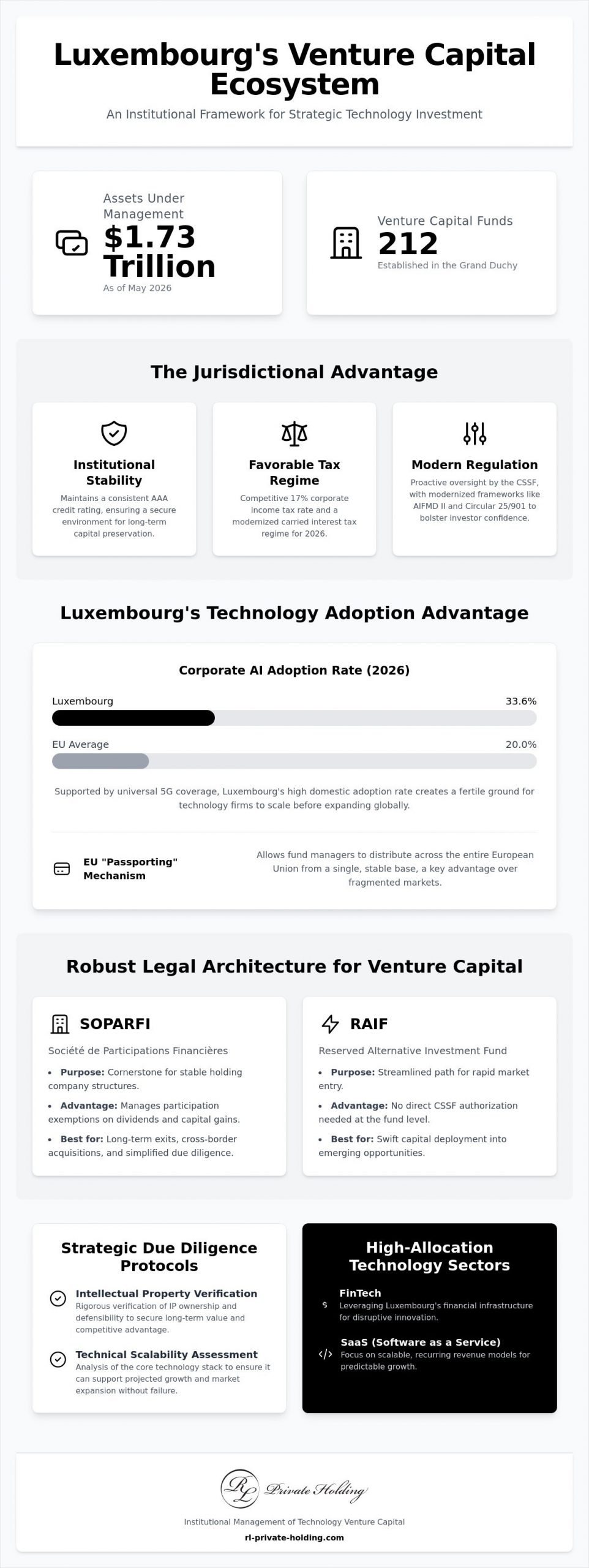
As of May 2026, the 212 venture capital funds established in the Grand Duchy have collectively managed over $1.73 trillion in assets, underscoring the central role of technology venture capital Luxembourg in the global financial system. Institutional investors often view the inherent volatility of the technology sector with caution, particularly when faced with the administrative burdens of cross-border compliance and risk mitigation. It’s a common perspective that while the potential for growth is substantial, the structural complexity of these investments requires a disciplined and methodical approach to asset management.
This analysis provides a formal evaluation of the Luxembourgish regulatory framework to support sophisticated portfolio diversification. We’ll detail the recent implementation of AIFMD II and the modernized carried interest tax regime effective for the 2026 tax year. The following sections outline a technical framework for assessing growth-stage opportunities and identifying stable structures, such as the Special Limited Partnership, to facilitate long-term capital preservation and strategic asset growth within a transparent environment.
Key Takeaways
- Understand how technology venture capital Luxembourg has evolved into a strategic asset class, bridging the gap between traditional fund management and proactive innovation.
- Evaluate the technical advantages of the SOPARFI and RAIF structures for establishing robust holding companies and achieving efficient market entry.
- Identify high-allocation opportunities within the FinTech and SaaS sectors by analyzing recurring revenue models and institutional infrastructure maturation.
- Implement rigorous strategic due diligence protocols that prioritize intellectual property verification and the technical scalability of the core technology stack.
- Discover how a disciplined private equity methodology can enhance venture capital outcomes by mitigating localized shocks through global portfolio diversification.
The Evolution of Technology Venture Capital within the Luxembourg Financial Ecosystem
The Luxembourg Financial Ecosystem has undergone a profound transformation, moving beyond its historical reputation as a center for fund administration to become a proactive nexus for high-growth capital. This shift isn’t merely a trend but a structural realignment toward the digital economy. Institutional investors now view technology venture capital Luxembourg as a core component of a sophisticated portfolio, offering a unique combination of innovation exposure and jurisdictional stability. The Grand Duchy’s ability to maintain a AAA credit rating while fostering a high-tech ecosystem provides a level of institutional gravity that few other jurisdictions can replicate.
Several macro-economic drivers have accelerated this evolution in 2026. While the European Central Bank raised key interest rates in June 2026, with the deposit facility reaching 2.25%, the focus in the venture space has shifted from speculative growth to capital efficiency and profitability. Luxembourg’s corporate tax environment remains competitive, with a 17% corporate income tax rate for companies exceeding €200,000 in taxable income. Furthermore, the CSSF continues to bolster investor confidence through modernized frameworks like Circular 25/901, which consolidates regulatory practices for specialized investment vehicles. This disciplined oversight ensures that risk mitigation remains a priority even within the volatile tech sector.
The Strategic Importance of Technology Allocation
Growth-stage technology assets serve as a critical hedge against the stagnation found in more traditional market segments. In 2026, institutional players have moved toward a “Value-Plus” investment model, where capital deployment is coupled with rigorous management discipline. This approach treats technology not as a speculative bet but as a strategic asset class defined by research-driven scalability. Technology venture capital Luxembourg is a disciplined investment vehicle designed to capture alpha through the deployment of capital into R&D-intensive enterprises within a transparent and highly regulated framework.
Luxembourg vs. Global Tech Hubs
When comparing the Grand Duchy to other hubs like London or Berlin, the primary advantage lies in seamless fund domiciliation and the “passporting” mechanism. This allows managers to distribute funds across the entire European Union from a single, stable base. Unlike fragmented markets, Luxembourg has integrated its digital strategy directly into its national economic policy. Statistics from 2026 indicate that 33.6% of businesses in Luxembourg have adopted artificial intelligence, a figure that is significantly higher than the EU average of 20.0%. This high rate of domestic adoption, supported by universal 5G coverage, creates a fertile environment for technology firms to scale before expanding globally. The integration of high-capacity digital infrastructure with sophisticated financial services makes the jurisdiction a preferred choice for long-term asset management.
Structural Foundations of Venture Capital and Private Equity in Luxembourg
The efficacy of technology venture capital Luxembourg depends largely on the selection of a robust legal architecture. Institutional investors require structures that balance operational speed with rigorous oversight. The SOPARFI (Société de Participations Financières) remains the cornerstone for holding company structures, providing a stable platform for cross-border technology acquisitions. It’s particularly effective for managing participation exemptions on dividends and capital gains, which is vital for long-term exits in the tech sector. This structure allows for a clear separation between the investment vehicle and the underlying assets, facilitating clean exits and simplified due diligence.
For those seeking rapid market entry, the Reserved Alternative Investment Fund (RAIF) offers a streamlined path. Unlike traditional regulated funds, the RAIF doesn’t require direct authorization from the CSSF at the fund level, provided it’s managed by an authorized Alternative Investment Fund Manager (AIFM). This structure allows for the swift deployment of capital into emerging opportunities without compromising institutional integrity. The Special Limited Partnership (SCSp) further complements this by providing a tax-transparent vehicle that mirrors the contractual flexibility of Anglo-Saxon models, making it a preferred choice for venture capital fund Luxembourg mandates.
Optimizing Investment Vehicles for Technology Portfolios
The choice between regulated and unregulated structures depends on the specific risk profile and investor base. Regulated vehicles like the SICAR (Investment Company in Risk Capital) are tailored for venture mandates, while unregulated SCSps offer greater contractual freedom. Tax neutrality is a primary consideration, as Luxembourg’s extensive treaty network protects returns from global technology exits. Governance is maintained through the mandatory appointment of a depositary and an independent auditor, ensuring that asset segregation and financial reporting meet international standards. This structural discipline is fundamental to maintaining investor trust in high-growth sectors.
Governance and Risk Mitigation
Transparency is a requirement in a volatile tech market. The implementation of AIFMD II in April 2026 introduced stricter requirements for liquidity risk management and enhanced reporting for loan origination funds. These updates ensure that even growth-stage technology assets are subject to institutional-grade oversight. Implementing robust valuation frameworks is essential for non-listed entities where traditional metrics often fail to capture the value of intellectual property. RL Private Holding applies these structures with a focus on discipline, ensuring that every mandate adheres to a high standard of private equity investment management. This methodology provides a stable foundation for navigating the complexities of the modern technology sector.
Identifying High-Growth Technology Sectors for Institutional Allocation
Institutional allocation within the technology venture capital Luxembourg space has shifted toward sectors that provide systemic infrastructure rather than mere consumer disruption. By June 2026, the maturation of FinTech has transformed it from a collection of agile startups into the foundational layer of global financial services. SaaS and enterprise software remain resilient despite the European Central Bank’s interest rate adjustments, with the deposit facility at 2.25% as of mid-2026. These sectors are valued for their recurring revenue models and capital efficiency. Investors are increasingly prioritizing growth-stage companies over early-stage ventures to mitigate exposure to initial R&D risks while capturing established market moats.
The emergence of DeepTech and GreenTech as sovereign-priority sectors in Europe has further diversified the investment landscape. These fields often require significant capital but offer defensible intellectual property and alignment with long-term policy goals. While early-stage investments carry higher volatility, growth-stage firms in these sectors benefit from a more established path to commercialization. This shift reflects a broader market trend moving away from pure revenue growth toward sustainable profitability and technical defensibility.
FinTech and Blockchain Infrastructure
Luxembourg’s early adoption of digital asset regulations has solidified its position as a primary hub for blockchain-integrated B2B services. The implementation of the Markets in Crypto-Assets (MiCA) regulation has provided the legal certainty required for institutional participation in payment rails and settlement systems. There’s a particular focus on companies that automate compliance and cross-border transactions. It’s anticipated that the total assets under management within the Luxembourgish FinTech sector will continue its upward trajectory through the end of 2026 as institutional infrastructure becomes more integrated. This growth is supported by a domestic ecosystem where 33.6% of businesses have already adopted artificial intelligence to enhance operational efficiency.
Sustainable Technology and the ESG Mandate
The integration of the Sustainable Finance Disclosure Regulation (SFDR) has made environmental and social governance a core component of technology fund management. GreenTech and Cleantech are no longer viewed as niche sub-sectors; they’re sovereign priorities across Europe. Identifying “Impact Alpha” involves locating ventures where environmental sustainability directly correlates with operational profitability. This alignment is critical for institutional portfolios that must meet strict ESG mandates while seeking competitive returns. By focusing on Cleantech and circular economy technologies, investors can access growth opportunities that are intrinsically linked to the continent’s transition toward a decarbonized economy.
Strategic Due Diligence Protocols for Technology Investments
Strategic due diligence within the framework of technology venture capital Luxembourg requires a transition from traditional financial auditing to a specialized technical interrogation. The complexity of growth-stage deals, which saw a median size of $10 million in the year leading to May 2026, necessitates a rigorous verification of intellectual property ownership and core stack scalability. Investors must look beyond the burn rate to evaluate unit economics and the viability of the path to profitability. This disciplined approach ensures that the capital deployed is protected by a defensible competitive moat in an increasingly globalized digital economy. It’s no longer sufficient to rely on high-level growth metrics; the underlying architecture must support long-term institutional objectives. Management assessment is equally vital. A leadership team’s capacity to execute at scale and manage a disciplined organizational hierarchy determines the success of the investment. Exit planning shouldn’t be an afterthought. Identifying potential acquirers or specific IPO windows early in the cycle allows for a more methodical approach to capital realization.
The Tech-Specific Due Diligence Checklist
A comprehensive audit must prioritize the software architecture and the identification of technical debt. High levels of technical debt can significantly impede future scalability and increase operational costs. Compliance with GDPR and ePrivacy standards is also mandatory to mitigate regulatory risks. The focus should remain on verifying proprietary source code, assessing cybersecurity posture, and evaluating product-market fit across diverse European jurisdictions. It’s a process that requires technical precision and a deep understanding of the digital landscape.
Valuation Methodologies for Private Tech Assets
In the 2026 market environment, hype-driven valuations have been replaced by fundamental-based models. Comparable company analysis remains a staple, but there’s an increased reliance on Discounted Cash Flow (DCF) applications for growth-stage tech. This shift reflects the broader move toward capital efficiency and sustainable profitability. Institutional investors seeking to secure their positions through rigorous wealth management services utilize these methodologies to ensure that valuations reflect intrinsic value. This objective approach provides a stable foundation for navigating the complexities of the modern technology sector.
RL Private Holding: Institutional Management of Technology Venture Capital
RL Private Holding manages technology venture capital Luxembourg mandates with the same institutional gravity applied to our private equity and real estate portfolios. This methodology prioritizes structural integrity over speculative momentum. We combine the innovation capture of venture capital with the rigorous risk mitigation protocols of private equity investment management. By June 2026, our firm has integrated the requirements of AIFMD II into our core operational framework, ensuring that all growth-stage assets are subject to the highest levels of transparency and liquidity risk management. This disciplined approach is essential for institutional investors who require stability in a volatile tech sector.
Our firm’s presence in the Luxembourgish financial ecosystem provides a distinct advantage. We leverage a network that includes 212 venture capital fund Luxembourg structures and over 700 startups to identify exclusive growth-stage opportunities. These deals, often characterized by a median size of $10 million in the first half of 2026, are vetted through our proprietary technical and financial audit protocols. We maintain a clear structure for management fees and performance incentives, ensuring that our interests remain aligned with those of our institutional partners. Transparency isn’t just a regulatory requirement; it’s a foundational principle of our asset management strategy.
Our Approach to Portfolio Diversification
Long-term wealth preservation is achieved through a multi-asset strategy that integrates technology venture capital Luxembourg with real estate asset management and traditional private equity. This diversification mitigates the impact of localized tech shocks and sector-specific volatility. Our Luxembourg headquarters serves as a hub for global scale and local expertise, allowing us to monitor 5G-enabled digital infrastructure and AI adoption rates, which reached 33.6% among local businesses by mid-2026. This data-driven perspective informs our allocation strategies and enhances the resilience of the portfolios we manage.
Partnering with RL Private Holding
Engaging with our venture capital mandates involves a methodical onboarding process designed for institutional investors. We maintain a professional distance and project a sense of institutional permanence that appeals to those who value long-term strategic focus. Our firm operates as a steady hand, providing the necessary oversight to navigate complex cross-border investment structures. For those seeking to integrate sophisticated technology assets into a broader portfolio, we invite you to contact our wealth management team for a confidential consultation regarding our current investment programs. This disciplined approach ensures that all capital deployment aligns with the overarching objectives of the portfolio.
Securing Institutional Growth through Strategic Alignment
The transition of the Grand Duchy into a specialized technology investment center provides a unique opportunity for institutional portfolio diversification. By utilizing robust structures like the SCSp and adhering to the updated AIFMD II requirements, investors can mitigate the risks associated with cross-border mandates. The focus has moved toward technical defensibility and capital efficiency, ensuring that technology venture capital Luxembourg remains a reliable asset class for long-term wealth preservation. It’s a disciplined environment where structural integrity is as vital as the innovation it supports.
RL Private Holding remains a steady partner for those seeking to navigate this complex landscape with professional distance. Our firm provides global portfolio management expertise and Luxembourg-based institutional governance, with a specialized focus on growth-stage technology and private equity. We invite you to Explore our institutional venture capital strategies at RL Private Holding to understand how our methodology supports strategic asset growth. Aligning with a worldly and highly organized partner ensures that your capital deployment remains secure within a globalized economy.
Frequently Asked Questions
What are the primary benefits of domiciling a technology venture capital fund in Luxembourg?
Luxembourg offers a AAA credit rating and unparalleled political stability, providing a secure foundation for technology venture capital Luxembourg funds. The jurisdiction’s primary advantage is the European passport, which allows managers to distribute funds to institutional investors across the entire EU from a single base. Additionally, an extensive network of double tax treaties facilitates efficient capital flows and protects returns during global technology exits.
How does the RAIF structure accelerate technology investment cycles?
The Reserved Alternative Investment Fund (RAIF) accelerates investment cycles by removing the requirement for direct fund-level authorization from the CSSF. This allows managers to launch new structures or sub-funds within weeks rather than months. Oversight is maintained through the mandatory appointment of an authorized Alternative Investment Fund Manager (AIFM), ensuring that speed doesn’t compromise institutional standards or governance.
Is technology venture capital suitable for conservative institutional portfolios?
Technology venture capital is suitable for conservative portfolios when it’s utilized as a diversification tool within a broader multi-asset strategy. Focusing on growth-stage companies with established unit economics reduces the risk profile compared to early-stage seed investments. Institutional frameworks in Luxembourg enforce risk-spreading rules that help protect capital against the inherent volatility of the technology sector.
What role does the CSSF play in overseeing venture capital activities?
The CSSF provides indirect oversight by regulating the managers and service providers who facilitate venture capital activities. Through Circular 25/901, released in December 2025, the regulator has modernized practices for specialized vehicles to ensure market integrity. This framework requires rigorous reporting and adherence to liquidity risk management standards under the 2026 implementation of AIFMD II.
How does RL Private Holding manage risk in growth-stage technology investments?
RL Private Holding manages risk by applying a disciplined private equity methodology to the venture capital space. We conduct deep technical audits to verify intellectual property ownership and assess the scalability of the core technology stack before deployment. Our global presence allows us to mitigate localized shocks by diversifying across different geographic tech hubs and sectors like FinTech and GreenTech.
Can institutional investors access European tech markets through a Luxembourg SOPARFI?
Institutional investors frequently use the SOPARFI structure to manage their interests in European technology markets. It functions as a sophisticated holding company that benefits from Luxembourg’s participation exemption on dividends and capital gains. This structure is ideal for consolidating various technology holdings into a single entity, providing a transparent framework for cross-border acquisitions and governance.
What are the typical investment horizons for technology venture capital in Luxembourg?
Investment horizons for technology venture capital typically range from five to ten years, aligning with the lifecycle of growth-stage companies. This duration allows for the maturation of the core technology and the execution of a clear exit strategy, such as an IPO or a trade sale. Long-term capital commitment is necessary to capture the value created during the enterprise scalability phase.
How does carried interest work in a Luxembourgish private equity structure?
Carried interest functions as a performance-based incentive for fund managers, representing a percentage of the fund’s realized profits. Effective from the 2026 tax year, Luxembourg has implemented a modernized carried interest regime to provide greater clarity and competitiveness for investment professionals. This reform ensures that incentives are structured according to institutional standards while maintaining a transparent tax framework for managers.