

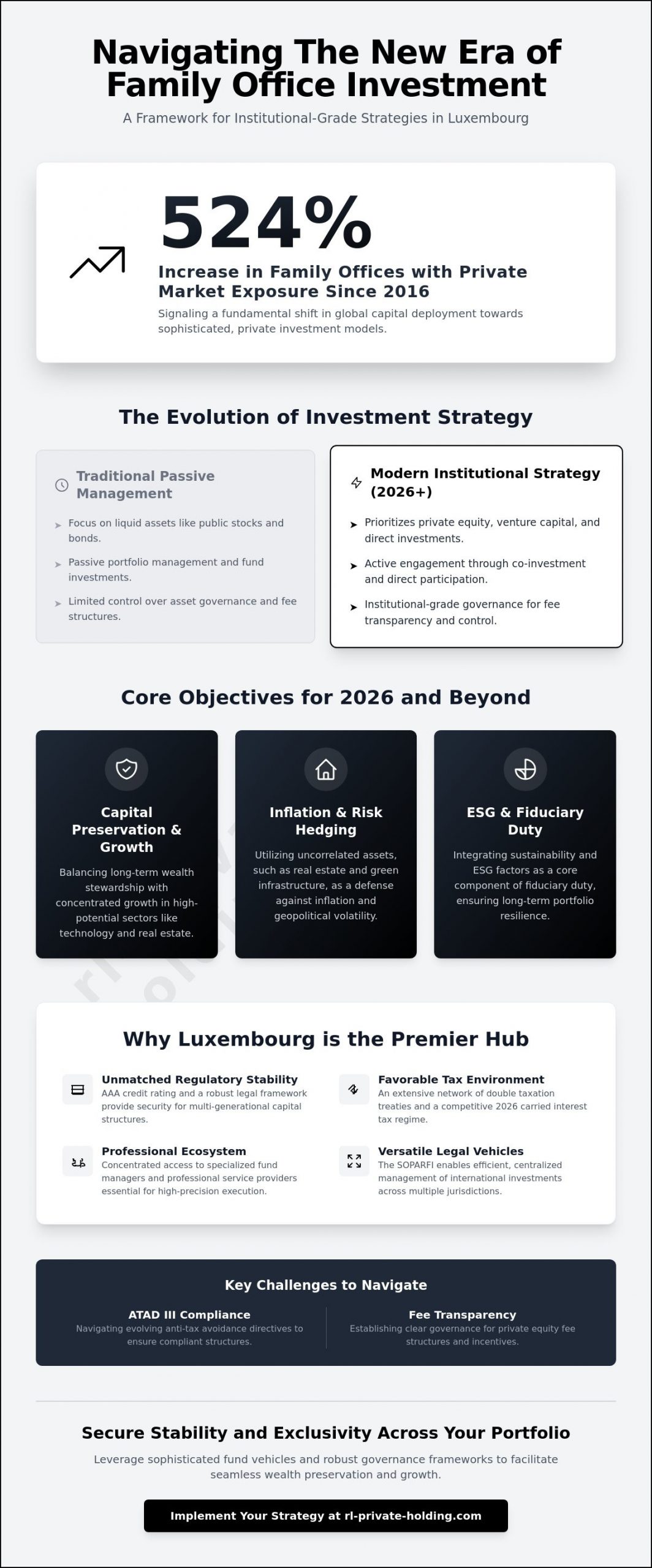
Since 2016, the number of family offices with exposure to private markets has increased by 524 percent, signaling a fundamental shift in how global capital is deployed. For principals and investment committees, implementing institutional-grade family office investment strategies Luxembourg is no longer optional for those seeking to maintain a competitive edge. However, this evolution brings significant challenges, including the complexity of ATAD III compliance and the lack of transparency often found in private equity fee structures.
This analysis provides a definitive framework for asset allocation, focusing on the integration of private equity and venture capital within a robust governance structure. You’ll find a detailed examination of the 2026 regulatory environment, including the new carried interest tax regime and strategic models designed for long-term stewardship. By aligning sophisticated management with the recent SARL incorporation reforms and participation exemptions, family offices can achieve both operational efficiency and sustainable wealth preservation. The following sections outline how to navigate these complexities with the precision required by the current financial landscape.
Key Takeaways
- Understand the 2026 evolution of the Luxembourg financial hub and the transition from passive management to institutional-grade private market engagement.
- Develop high-performance family office investment strategies Luxembourg by effectively incorporating private equity and venture capital into long-term asset allocation models.
- Establish transparent fee governance and performance-aligned incentive structures to ensure clarity and accountability within investment management operations.
- Leverage sophisticated fund vehicles and robust governance frameworks to navigate 2026 regulatory requirements and facilitate seamless wealth preservation.
- Evaluate the practical application of institutional-grade management to secure stability and exclusivity across a diversified global investment portfolio.
The Strategic Landscape of Family Office Investment Management in Luxembourg
Luxembourg enters 2026 as the preeminent jurisdiction for cross-border capital management. The complexity of global markets has necessitated a maturation of family office investment strategies Luxembourg. Modern entities have moved decisively beyond traditional liquid assets like public stocks and bonds. They now prioritize direct investment models and co-investment opportunities in private markets to capture alpha. This institutional approach allows for greater control over asset governance and fee structures. It also reflects a broader trend toward professionalization within the sector.
A modern family office operates with the discipline of a global private equity firm. The transition toward private markets is driven by the search for uncorrelated returns in an era of heightened public market volatility. Luxembourg’s enduring regulatory stability, backed by its AAA credit rating, provides the necessary security for these multi-generational capital structures. Its robust legal framework ensures that wealth preservation remains the primary objective even as portfolios become more aggressive in their search for growth. The jurisdiction’s extensive network of double taxation treaties further reinforces its position as a primary hub for international wealth stewardship.
The Evolution of Family Office Objectives in 2026
Wealth holders in 2026 are balancing the need for capital preservation with concentrated growth in technology and real estate. The allocation to uncorrelated asset classes has become a standard defense against inflationary pressures and geopolitical shifts. Additionally, sustainability and ESG integration are no longer secondary considerations. These factors are now viewed as core components of fiduciary duty, ensuring that long-term investments remain resilient against changing global standards and consumer expectations.
Luxembourg as a Global Financial Center for Sophisticated Capital
The Luxembourg ecosystem provides access to a concentrated network of professional service providers and specialized fund managers. This infrastructure is essential for executing family office investment strategies Luxembourg that require high levels of technical precision. The Luxembourg Stock Exchange offers a unique platform for providing visibility to private holdings when required. The Luxembourg SOPARFI functions as a versatile and efficient vehicle for the centralized management of international investment activities across multiple jurisdictions. This environment allows family offices to scale their operations while maintaining the discreet, authoritative presence required for high-stakes asset management.
Advanced Asset Allocation: The Role of Private Equity and Venture Capital
Institutional portfolios in Luxembourg have increasingly decoupled from public indices to seek higher risk-adjusted returns. Sophisticated family office investment strategies Luxembourg now rely on private equity as a primary driver of long-term alpha. This shift is supported by the 2026 tax regime for carried interest, which offers competitive effective rates for contractual participations. High-net-worth families are moving beyond passive fund investments toward direct participation. This allows for closer alignment with sectoral expertise and specific legacy objectives. The professionalization of these strategies ensures that capital is deployed with the same rigor found in major global investment firms.
Real estate asset management remains a critical component of this framework. It serves as a necessary hedge against inflationary pressures that may erode the purchasing power of liquid reserves. By diversifying across geographical regions and sector verticals, such as logistics and green infrastructure, offices ensure a resilient capital base. The legal clarity provided by Luxembourg’s Single Family Office law further enables the structuring of these diverse holdings under a single, transparent governance umbrella. This structured approach to real assets provides a stable foundation for more aggressive growth-oriented allocations.
Integrating Venture Capital into the Growth-Stage Portfolio
Venture capital funding provides a unique mechanism for capturing value within growth-stage technology firms. While many entities traditionally favored late-stage buyouts, the 2026 strategy emphasizes identifying technology-driven opportunities in fintech and healthtech earlier in the lifecycle. The risk-reward profile of direct venture investments requires a disciplined approach compared to fund-of-funds models. Successful integration involves a strategic focus on sustainable energy and digital infrastructure, sectors that offer significant scaling potential. Direct exposure allows families to leverage their own industry networks to support founders and drive operational success.
Private Equity Investment Management Principles
Effective private equity investment management requires active value creation. This is achieved through board representation and direct operational involvement in portfolio companies. It is no longer sufficient to be a silent partner. Establishing clear exit strategy frameworks is essential for meeting performance targets and managing the liquidity profile of the overall portfolio. Given the illiquid nature of private markets, maintaining a balanced maturity schedule across various vintages is a hallmark of a well-disciplined office. Those seeking to refine their approach to these asset classes often look to institutional private equity investment management to ensure professional-grade execution and long-term capital appreciation.
Evaluating Investment Management Fee Structures and Performance Incentives
In the current financial environment, fee governance has transitioned from a secondary administrative task to a primary strategic pillar. Sophisticated family office investment strategies Luxembourg now demand a level of transparency that mirrors institutional standards. This shift is driven by the need for absolute alignment between principals and managers. Opaque pricing models are being replaced by structures that clearly define how value is captured and shared. A disciplined approach to fee evaluation ensures that the majority of generated returns remain within the family’s capital base, supporting multi-generational wealth stewardship.
Performance alignment is further reinforced by the 2026 tax regime for private equity carried interest. With contractual carried interest taxed at approximately 11.45 percent, the regulatory framework encourages structures that reward long-term value creation. However, the complexity of alternative assets often masks underlying costs that can erode performance over time. These hidden expenses, including administration, custody, and transaction fees, must be identified and audited regularly. It’s essential to maintain a clear overview of the total cost of ownership across the entire portfolio to prevent the dilution of net returns.
Management Fees vs. Performance-Based Incentives
Industry benchmarks for recurring management fees in Luxembourg generally scale with the complexity of the asset classes under management. While traditional liquid portfolios may command lower base fees, private market allocations often require a more intensive management approach. Structuring performance fees to reward genuine alpha rather than market beta is a critical requirement. This is typically achieved through the implementation of:
- Hurdle Rates: Minimum return thresholds that must be surpassed before performance fees are triggered.
- High-Water Marks: Provisions ensuring that managers only receive incentives on new wealth created, preventing fees on recovered losses.
- Clawback Clauses: Mechanisms to retrieve previously paid incentives if subsequent performance falls below agreed benchmarks.
By adopting a performance-weighted model, principals ensure that the manager’s incentives are strictly tied to the delivery of superior results.
Negotiating Institutional-Grade Fee Agreements
Tiered fee structures are increasingly common for large-scale family office allocations. These models provide economies of scale, reducing the basis point cost as assets under management grow. The impact of co-investment rights on the overall effective fee rate is also a significant factor. Co-investments often allow families to bypass the traditional “two and twenty” model, significantly lowering the aggregate cost of private market exposure. The establishment of absolute fee transparency directly correlates with the preservation of long-term trust between the family office and its external asset management partners.
Governance and Wealth Preservation in the Luxembourg Regulatory Environment
A sophisticated investment framework is only as resilient as the governance structure that supports it. In 2026, family office investment strategies Luxembourg are increasingly defined by the integration of institutional-grade protocols within private wealth frameworks. This involves a transition from informal decision-making to structured oversight. The choice of fund vehicle is central to this effort. While the Specialized Investment Fund (SIF) remains a staple for those requiring direct oversight by the CSSF, the Reserved Alternative Investment Fund (RAIF) has become the preferred choice for family offices seeking rapid deployment and operational flexibility. By utilizing a RAIF, offices can maintain a professional fund structure without the need for direct product-level authorization, provided they appoint an authorized Alternative Investment Fund Manager (AIFM).
Risk management has evolved into a core pillar of capital preservation. This goes beyond simple market volatility monitoring. It encompasses legal, tax, and operational risks across a global portfolio. The 2026 regulatory environment requires a proactive stance on compliance, particularly regarding the Anti-Tax Avoidance Directive (ATAD) III. Entities must be prepared to provide evidence of economic substance within 60 days of a request from tax authorities to retain treaty benefits. This level of transparency is now a prerequisite for maintaining the AAA-rated stability that Luxembourg offers. Effective governance ensures that these regulatory obligations are met without compromising the agility of the investment committee.
Structural Governance for Multi-Generational Wealth
The implementation of a formal family council is essential for defining and maintaining an Investment Policy Statement (IPS). This document serves as the constitutional guide for all capital deployment. It ensures that the family’s values and long-term objectives are reflected in every transaction. Preparing the next generation is no longer a passive process. Many offices now involve younger members in venture capital and private equity committees to build technical expertise and institutional memory. Succession planning is treated as a strategic risk mitigation tool rather than a mere administrative necessity, ensuring that the transition of authority doesn’t disrupt the steady hand of wealth stewardship.
Compliance and Reporting in the 2026 Regulatory Landscape
Navigating AML and KYC requirements has become more complex as family office operations expand across multiple jurisdictions. The adoption of digital reporting tools is critical for real-time portfolio monitoring and meeting EU financial directives. Recent reforms, such as Bill of Law No. 8669, have streamlined the incorporation of private limited liability companies (SARL) by removing the requirement to pay the minimum share capital of €12,000 before incorporation. This flexibility allows for faster setup of underlying investment vehicles. However, the increased emphasis on substance means that the institutional approach must be backed by a demonstrable local presence and professional management. For those requiring a disciplined partner to manage these complexities, our wealth management services provide the institutional gravity necessary for global capital preservation.
Implementing Institutional-Grade Investment Strategies with RL Private Holding
RL Private Holding functions as a discreet, authoritative expert in the global investment landscape. We manage a diversified portfolio with the same institutional discipline required for modern family office investment strategies Luxembourg. Our approach focuses on the structural components of asset management, prioritizing stability and exclusivity over market hyperbole. By maintaining a sober and factual presentation of market opportunities, we provide a reliable framework for multi-generational wealth holders. This methodical focus allows us to navigate the complexities of cross-border capital deployment with precision and internal discipline.
Our expertise in venture capital funding and private equity investment management is rooted in a methodical evaluation of growth-stage technology and industrial sectors. We prioritize sectors such as fintech, healthtech, and digital infrastructure where we can apply active value creation through board representation and operational involvement. Similarly, our real estate asset management strategies utilize deep market insights to drive performance and ensure capital resilience against inflationary pressures. This commitment to “quiet authority” allows us to operate as a steady hand in the background of high-stakes global investments, providing the professional distance that sophisticated families value.
A Disciplined Approach to Growth and Preservation
Our investment philosophy centers on technology and real estate as the primary pillars of capital growth. We provide a steady hand in the background of complex transactions, ensuring that every deployment of capital is backed by rigorous analysis and institutional discipline. Alignment of interests is fundamental to our operation. We treat the capital of our partners with the same institutional focus as our own holdings, fostering a relationship based on professional distance and mutual discipline. This approach ensures that the strategic focus remains on long-term stewardship rather than short-term market volatility, allowing for the stable growth of private market exposure.
Next Steps for Family Office Principals
Transitioning to an institutional-grade framework requires a critical assessment of current portfolio structures. Principals should evaluate their existing allocations for efficiency and growth potential within the 2026 regulatory environment, including the impact of ATAD III and the new carried interest tax regime. Engaging with a partner that understands the nuances of the Luxembourg financial landscape is essential for maintaining a competitive edge in global markets. We invite you to review your current governance and asset allocation models to ensure they meet the standards of the modern landscape. To refine your approach to asset allocation and capture value in private markets, learn more about our specific methodology for Private Equity Investment Management.
Advancing Global Wealth Stewardship in 2026
The landscape of family office investment strategies Luxembourg has matured into a model defined by institutional discipline and structural transparency. Successfully navigating this environment requires a transition from traditional asset classes toward sophisticated private market participation. Principals must prioritize the implementation of robust governance frameworks that align with 2026 regulatory standards. It’s through these structures that capital is preserved across generations. By establishing clear fee incentives and leveraging flexible fund vehicles like the RAIF, offices can achieve operational efficiency while maintaining a competitive advantage in a volatile global market.
RL Private Holding remains a committed partner in this evolution. Headquartered in Luxembourg with a global investment reach, we manage a diversified portfolio across technology, real estate, and private equity. Our approach utilizes an institutional-grade asset management fees structure to ensure complete alignment with our partners’ long-term objectives. We invite you to Discover RL Private Holding’s Strategic Approach to Investment Management and strengthen your position in the global financial landscape.
The path toward sustainable wealth preservation is built on a foundation of professional-grade execution and strategic focus.
Frequently Asked Questions
What are the most common investment structures for family offices in Luxembourg?
Luxembourg provides several versatile vehicles, including the Specialized Investment Fund (SIF) and the Reserved Alternative Investment Fund (RAIF). The SOPARFI remains the most utilized holding company structure for international asset management. These entities are frequently employed to implement family office investment strategies Luxembourg that require cross-border efficiency. Recent reforms to the SARL incorporation process have further simplified the setup of underlying special purpose vehicles by removing the upfront capital payment requirement.
How do investment management fees typically differ between private equity and wealth management?
Private equity fees are generally structured around a base management fee and a performance-based incentive known as carried interest. Wealth management fees are typically calculated as a fixed percentage of total assets under management (AUM). While wealth management focuses on broad portfolio stewardship, private equity fee models are specifically designed to reward the generation of significant alpha. This alignment ensures that the manager’s incentives are tied to the actual value created over the investment horizon.
Can a family office in Luxembourg invest directly in venture capital?
Family offices frequently invest directly in venture capital to capture growth-stage value and maintain greater control over their holdings. This direct approach has supported the 524 percent increase in private market exposure observed since 2016. Direct investment requires more internal technical expertise and due diligence than a traditional fund-of-funds model. It allows the office to bypass layered fee structures and leverage its own industry networks to support portfolio companies.
What is the role of a SOPARFI in a family office investment strategy?
The SOPARFI serves as a robust holding vehicle for the centralized management of international investment activities. It is a fully taxable commercial company that benefits from Luxembourg’s extensive double taxation treaty network and the participation exemption regime. By holding a minimum 10 percent shareholding or a 1.2 million euro acquisition price for 12 months, the entity can eliminate taxation on qualifying dividends. This makes it an essential component for offices managing diverse global participations.
How does carried interest work in a private equity investment management context?
Carried interest functions as a performance-linked incentive that rewards managers for exceeding specific return benchmarks. Under the tax regime effective as of January 1, 2026, contractual carried interest is taxed at a maximum effective rate of approximately 11.45 percent. This mechanism is central to family office investment strategies Luxembourg because it aligns the manager’s interests with those of the family. It ensures that significant incentives are only paid when the portfolio achieves superior net returns. For a rigorous institutional analysis of how these mechanisms function, including waterfall calculations and the structural differences between American and European models, see our detailed guide on private equity carried interest and performance alignment.
What are the benefits of using a RAIF structure for family office asset allocation?
The RAIF structure offers rapid time-to-market because it doesn’t require direct authorization from the CSSF. It provides the same flexibility as a SIF but is regulated through its mandatory appointment of an authorized Alternative Investment Fund Manager (AIFM). This vehicle is particularly effective for offices that manage diverse asset classes across multiple compartments. It allows for professional-grade asset allocation while maintaining the operational agility required for competitive private market participation.
How has the Luxembourg regulatory environment for family offices changed in 2026?
The 2026 regulatory landscape is defined by the full implementation of ATAD III and the January 1 carried interest tax regime. Entities must now demonstrate clear economic substance to benefit from tax treaties and EU directives. Additionally, the corporate tax rate stands at 24.94 percent, and the SARL incorporation reform has increased flexibility for new setups. These changes emphasize the transition toward institutional-grade governance and the need for a demonstrable local presence in Luxembourg.
What is the importance of co-investment in a family office strategy?
Co-investment allows family offices to participate directly in specific deals alongside private equity sponsors or other institutional partners. This strategy reduces the aggregate fee rate by bypassing management fees on the co-invested portion of the capital. It also enables families to concentrate their capital in sectors where they possess deep industry knowledge or specific operational expertise. Co-investment has become a standard tool for offices seeking to enhance their net performance and direct influence.