

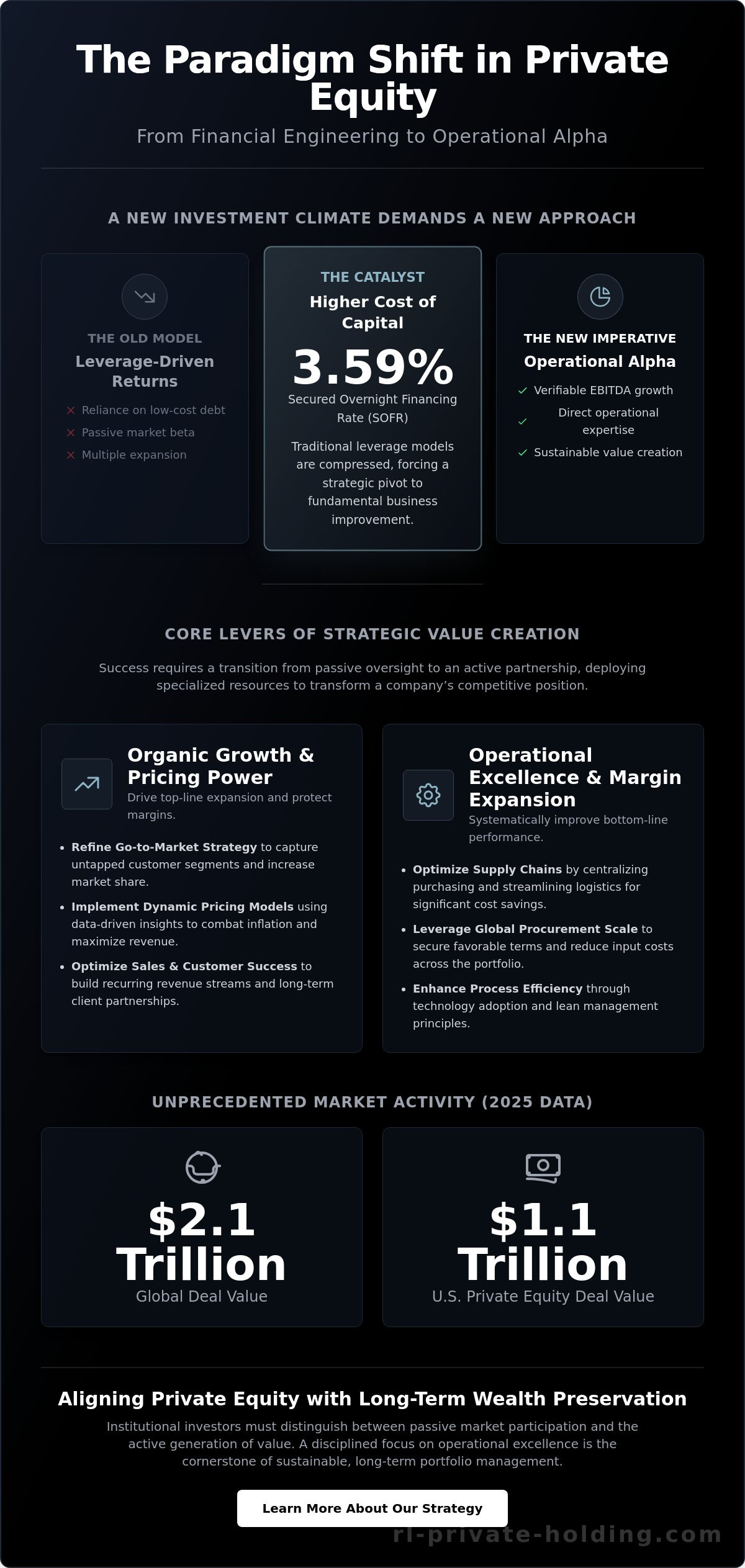
The traditional reliance on leverage and market beta has reached a point of diminishing returns in a climate where the Secured Overnight Financing Rate (SOFR) remains at 3.59%. Success in the current market depends entirely on a disciplined approach to private equity value creation that prioritizes structural operational improvement over tactical financial adjustments. You likely recognize that the complexity of modern portfolios often obscures the line between sustainable growth and temporary financial engineering. This creates significant uncertainty when evaluating which managers possess the genuine capability to navigate a shifting regulatory and economic landscape.
This article offers a comprehensive analysis of the strategic levers and operational frameworks required to drive institutional alpha. We’ll examine the specific mechanics of a Value Creation Plan (VCP) and provide a rigorous framework for assessing a General Partner’s operational excellence. This discussion outlines how to align investment strategies with long-term wealth preservation through a focus on verifiable, ground-level performance. By establishing these clear benchmarks, institutional investors can better distinguish between passive market participation and the active generation of value.
Key Takeaways
- Analyze the fundamental shift from leverage-driven returns to operational alpha within the current global financial landscape.
- Examine the core mechanics of private equity value creation, focusing on organic revenue expansion and systematic margin optimization.
- Evaluate the structural components of a Value Creation Plan (VCP) to ensure alignment between management and institutional objectives.
- Assess the operational depth of General Partners by auditing internal resource allocations and historical bridge analyses.
- Align private equity participation with broader wealth preservation goals through disciplined, long-term portfolio management.
The Paradigm Shift: From Financial Engineering to Operational Alpha
The private equity industry has undergone a fundamental transformation as the macroeconomic tailwinds of the previous decade have dissipated. Historically, What is Private Equity? was often defined by its ability to utilize low-cost leverage and benefit from persistent multiple expansion. Between 2010 and 2021, a significant portion of total shareholder return was attributable to these external factors rather than internal business improvements. However, the current environment, marked by a SOFR of 3.59% as of June 2026, has rendered these traditional levers insufficient for generating top-quartile returns.
In this context, private equity value creation now centers on the deliberate application of operational expertise to drive earnings growth. The record global deal value of $2.1 trillion in 2025 demonstrates that capital remains active, yet the path to exit has narrowed. Multiple expansion is no longer a reliable driver for institutional returns because exit valuations are increasingly scrutinized against fundamental performance metrics. Managers can’t rely on a rising tide to lift all ships. They must instead focus on the structural integrity and growth of the underlying asset.
The Impact of Capital Costs on Investment Strategy
Higher interest rates have fundamentally compressed traditional leverage models. When borrowing costs were lower, debt service was a secondary consideration in many investment theses. Today, the cost of capital requires a more rigorous focus on EBITDA growth as the sole sustainable path to valuation uplift. This shift has also influenced holding periods. As managers wait for operational improvements to materialize and market conditions to stabilize, the duration of investments has extended. These longer horizons necessitate a deeper level of operational involvement to maintain momentum. Strategic focus has moved from financial restructuring to the long-term health of the enterprise.
Return Dispersion and Manager Selection
There is clear evidence of widening performance gaps between managers who possess deep operational capabilities and those who remain focused on financial engineering. The correlation between specialized in-house operational teams and consistent outperformance has become a primary metric for institutional due diligence. Limited Partners are increasingly narrowing their rosters, concentrating capital with firms that demonstrate a repeatable process for business transformation. Operational Alpha is the excess return generated through direct business intervention and functional improvements within a portfolio company. By focusing on private equity value creation through this lens, sophisticated investors can better distinguish between passive market participation and active value generation.
The Four Core Levers of Strategic Value Creation
Effective private equity value creation relies on a multi-faceted approach that addresses both top-line expansion and bottom-line optimization. While financial engineering provides the structure, these four levers provide the substance of the investment thesis. Success requires a transition from passive oversight to active partnership. This involves the deployment of specialized resources to transform the target company’s competitive position. The $1.1 trillion in U.S. private equity deal value recorded in 2025 underscores the scale of capital currently seeking these operational improvements.
Organic Growth and Pricing Power
Generating top-line growth is a primary objective for any institutional portfolio. This process begins with a rigorous refinement of the go-to-market strategy to capture untapped customer segments. Sophisticated managers implement dynamic pricing models to combat inflationary pressures and protect margins. These models rely on data-driven insights rather than historical precedent. Optimizing the sales force and customer success functions ensures that growth is sustainable and rooted in recurring revenue. This structural shift moves the company away from transactional sales toward long-term client partnerships.
Operational Excellence and Margin Expansion
Margin improvement serves as a critical indicator of manager skill. Supply chain optimization and the utilization of global procurement scale are essential components of this effort. By centralizing purchasing and streamlining logistics, firms can achieve significant cost savings. Researchers have provided systematic evidence on value creation that highlights how margin expansion often provides a more reliable path to alpha than market-driven revenue growth alone. Reducing SG&A expenses without compromising growth potential requires a disciplined approach to organizational design. Effective talent management ensures that the right leadership is in place to execute these complex operational mandates.
Strategic M&A remains a powerful tool for achieving economies of scale. The ‘buy-and-build’ model allows firms to consolidate fragmented industries and create platform companies that command higher exit multiples. This strategy captures synergies that are unavailable to smaller, independent entities. Concurrently, digital transformation has become a non-negotiable aspect of modern private equity value creation. Leveraging AI and data analytics allows legacy business models to modernize their operations and improve decision-making accuracy. Sophisticated investors often seek private equity investment management partners who possess the technical infrastructure to execute these complex digital shifts. These technological integrations provide a transparent view of performance, allowing for real-time adjustments to the value creation plan.
Developing the Value Creation Plan (VCP): A Systematic Framework
The Value Creation Plan (VCP) serves as the foundational architecture for institutional investment success. It’s not merely a financial forecast but a detailed operational roadmap that dictates how a firm will transform an asset. This systematic framework ensures that private equity value creation is a deliberate process rather than an accidental outcome of market cycles. As the SEC increases its focus on valuation methodologies and disclosure accuracy in 2026, the rigor of these plans has become a regulatory necessity as much as a performance driver.
Pre-Deal Diligence and Hypothesis Testing
Operational excellence begins before the capital is deployed. Integrating operational experts into the pre-acquisition phase allows for the rigorous testing of investment hypotheses. This stage involves identifying immediate opportunities for margin improvement, often referred to as ‘low-hanging fruit,’ such as procurement consolidation or pricing adjustments. Assessing the existing management team’s capacity for rapid transformation is equally critical. If the leadership lacks the agility required for a high-stakes turnaround, the VCP must account for talent acquisition or organizational restructuring early in the holding period. This proactive approach mitigates the risk of operational drift after the deal closes.
Governance and Management Alignment
The first 100 days are vital for establishing a governance framework that prioritizes transparency and accountability. Designing incentive structures is essential to align management interests with long-term institutional goals. These incentives should be tied to specific operational milestones, not just the eventual exit valuation. The board’s role is to monitor the execution of the VCP without encroaching on day-to-day operations. It’s essential to recognize that a VCP is a living document that must adapt to macroeconomic shifts and competitive pressures. This flexibility allows the firm to pivot when market dynamics change while maintaining focus on the core value levers.
The distinction between the ‘Investment Professional’ and the ‘Operating Partner’ is becoming more pronounced as the industry matures. While the former focuses on deal sourcing and financial structuring, the latter is responsible for the ground-level execution of the VCP. This division of labor allows for specialized focus on operational KPIs. Tracking metrics such as customer acquisition costs, employee retention, and process automation rates provides a clearer picture of health than financial statements alone. Understanding this evolution is key to grasping the future of private equity. By prioritizing these operational levers, firms can ensure that private equity value creation remains a consistent driver of alpha in volatile markets.
Institutional Due Diligence: Evaluating GP Value Creation Capabilities
As institutional investors navigate a landscape defined by higher borrowing costs and longer holding durations, the scrutiny of a General Partner’s (GP) internal resources is no longer a peripheral concern. It’s the central pillar of the due diligence process. Limited Partners (LPs) are increasingly narrowing their manager rosters, concentrating capital with firms that demonstrate a repeatable, institutionalized approach to private equity value creation. This requires a transition from evaluating historical IRR in isolation to auditing the specific mechanisms that produced those returns.
The Operational Team Structure
A rigorous audit of the firm’s operational team structure reveals the actual depth of their intervention capabilities. Sophisticated LPs evaluate the ratio of operating partners to portfolio companies, looking for a balance that allows for meaningful engagement. A common benchmark in the current market is one operating partner for every three to five assets. The professional background of these individuals is equally telling. Firms that prioritize former CEOs and industry veterans over career consultants often possess a more practical understanding of ground-level execution. Additionally, the presence of specialized functional experts in areas such as digital infrastructure, human capital, and sales force optimization indicates a firm capable of addressing complex, multi-dimensional challenges.
Analyzing Past Performance Bridges
The performance bridge is the most objective tool for isolating a GP’s operational impact. By decomposing total shareholder return, investors can distinguish between value generated through multiple expansion, leverage, and EBITDA growth. In the 2026 market environment, top-tier firms now attribute more than 60% of their total returns to EBITDA growth. This statistic is a critical differentiator. It demonstrates that the GP is not merely a beneficiary of market cycles but an active driver of business health. LPs must further analyze whether this margin growth was achieved through sustainable revenue scaling or short-term cost-cutting that could jeopardize long-term enterprise value.
Repeatability is the hallmark of institutional excellence. A GP’s value creation playbook must be consistent across different sectors and vintage years to be considered a reliable engine of alpha. Transparency in reporting operational milestones to LPs has become a regulatory and competitive necessity. As the SEC focuses on valuation methodologies and disclosure accuracy in 2026, firms that provide clear, data-driven updates on VCP progress are better positioned to secure long-term commitments. For those seeking a disciplined partner in this space, engaging with a firm focused on private equity investment management ensures that operational rigor remains at the forefront of the investment strategy. Process defines performance. Data supersedes anecdote. By applying these standards, institutional investors can align their portfolios with managers who possess the genuine capacity for business transformation.
Strategic Portfolio Management: The RL Private Holding Perspective
Integrating private equity value creation into a broader diversified investment strategy requires a shift from tactical selection to structural alignment. Private equity acts as a core pillar for sophisticated institutional portfolios, providing non-correlated returns and long-term capital appreciation. This approach leverages global insights to identify cross-sector opportunities that might be overlooked by more specialized firms. By viewing each asset as part of a collective framework for wealth preservation, managers ensure that operational improvements contribute to the overall stability of the holding entity. It’s a method that prioritizes the long-term health of the entire organization over short-term fluctuations.
Holistic Asset Management for Institutional Growth
RL Private Holding manages a diversified portfolio with significant interests in sectors including technology and real estate. This breadth creates a synergy where the innovation found in venture capital funding informs the operational discipline required for private equity. For example, digital transformation strategies developed for high-growth firms can often be adapted to modernize legacy industrial assets. Maintaining institutional gravity throughout this process involves a sober, factual approach to investment management. Decisions are rooted in data rather than market sentiment. This ensures the firm remains a steady partner in the background of major global investments, focusing on structural integrity and organizational hierarchy.
Long-Term Value Realisation and Exit Excellence
The realization of value is not an afterthought. It’s a primary objective established during the pre-acquisition phase. Preparing portfolio companies for exit begins on day one of the investment period. This involves the continuous optimization of the business to ensure it remains attractive to a variety of buyers. The global private equity exit value hit a four-year high of $1.2 trillion in 2025, emphasizing the importance of exit readiness in a recovering market. Potential routes include a strategic sale, an IPO, or a secondary buyout. By maintaining a clear Value Creation Plan, firms provide prospective acquirers with transparent evidence of operational health and future growth potential. Identifying the right exit route requires a deep understanding of global market conditions and the specific needs of institutional capital.
A disciplined approach to asset management ensures that every operational lever contributes to the enduring strength of the portfolio. Institutional operational excellence isn’t achieved through rapid shifts in strategy. It’s the result of methodical execution and a focus on long-term wealth preservation. Discover our approach to institutional investment management at RL Private Holding.
Advancing Institutional Excellence Through Operational Discipline
The transition toward operational alpha represents a permanent evolution in the global investment landscape. Success in the current environment requires a departure from passive financial engineering in favor of a structured, multi-lever approach to private equity value creation. By establishing a rigorous Value Creation Plan and conducting deep due diligence on a manager’s operational team, institutional investors can secure sustainable returns that are independent of market volatility. This framework ensures that growth is driven by genuine business transformation rather than temporary leverage or multiple expansion.
RL Private Holding provides the specialized expertise necessary to navigate these complex structures. Our firm offers diversified global portfolio management across private equity, venture capital, and real estate, supported by institutional-grade wealth management and asset protection. We maintain a specific focus on Luxembourg-based investment structures to ensure the highest standards of regulatory compliance and transparency. Explore Strategic Investment Management with RL Private Holding to align your portfolio with a disciplined partner committed to long-term growth. We look forward to supporting your institutional objectives with clarity and professional rigor.
Frequently Asked Questions
What is the difference between financial engineering and value creation in private equity?
Financial engineering focuses on capital structure adjustments, while private equity value creation centers on fundamental business improvements. Engineering uses leverage and tax strategies to enhance shareholder returns through financial positioning. In contrast, operational value creation targets EBITDA growth through margin expansion and revenue scaling. This shift ensures that returns are generated by the asset’s performance rather than external market conditions.
How has the role of leverage changed in private equity value creation since 2024?
Leverage has moved from a primary driver of returns to a supporting tool due to the increased cost of capital. In the 2026 market, with the SOFR at 3.59%, firms can’t rely on cheap debt to inflate equity returns. Managers now focus on maintaining conservative debt levels to protect solvency. This allows them to allocate more resources toward operational improvements and organic growth as the main engines of alpha.
What are the most common operational levers used by top-tier GPs?
Top-tier managers utilize levers such as pricing optimization, supply chain consolidation, and digital transformation. These firms often deploy specialized operating partners to implement process automation and refine sales strategies. By focusing on these functional areas, GPs can drive margin expansion that is independent of broader economic cycles. These interventions provide a repeatable framework for enhancing the competitive position of portfolio companies.
How do institutional investors measure the success of a Value Creation Plan?
Institutional investors measure the success of a private equity value creation plan by tracking operational milestones alongside financial outcomes. Key metrics include EBITDA margin growth, net promoter scores, and process efficiency gains. These indicators provide a transparent view of the firm’s progress in transforming the business. Success is achieved when the GP meets specific operational targets defined in the initial 100-day plan.
What is a ‘Value Bridge’ and why is it critical for LP due diligence?
A value bridge is a financial tool that decomposes total shareholder return into its constituent parts. It separates the impact of market-driven multiple expansion from debt paydown and operational EBITDA growth. This analysis is critical for due diligence because it reveals the true source of a manager’s performance. LPs use this data to confirm that the GP possesses genuine business transformation capabilities rather than just market timing skills.
Can value creation strategies be applied to small and mid-cap companies?
Value creation strategies are particularly effective in the small and mid-cap segments due to the high potential for professionalization. Many companies in this range lack institutional-grade reporting and governance structures. By implementing standardized financial controls and optimizing sales functions, GPs can unlock significant value. The smaller scale of these businesses often allows for faster execution of the Value Creation Plan compared to mega-cap entities.
What is the typical timeframe for a Value Creation Plan to show results?
The timeframe for observing measurable results from a Value Creation Plan typically ranges from 18 to 36 months. While tactical improvements in procurement or pricing can yield immediate gains, structural shifts require more time. Digital transformations and organizational redesigns often take several years to reach full maturity. Most institutional managers design their operational roadmaps to align with a five-year investment horizon.