

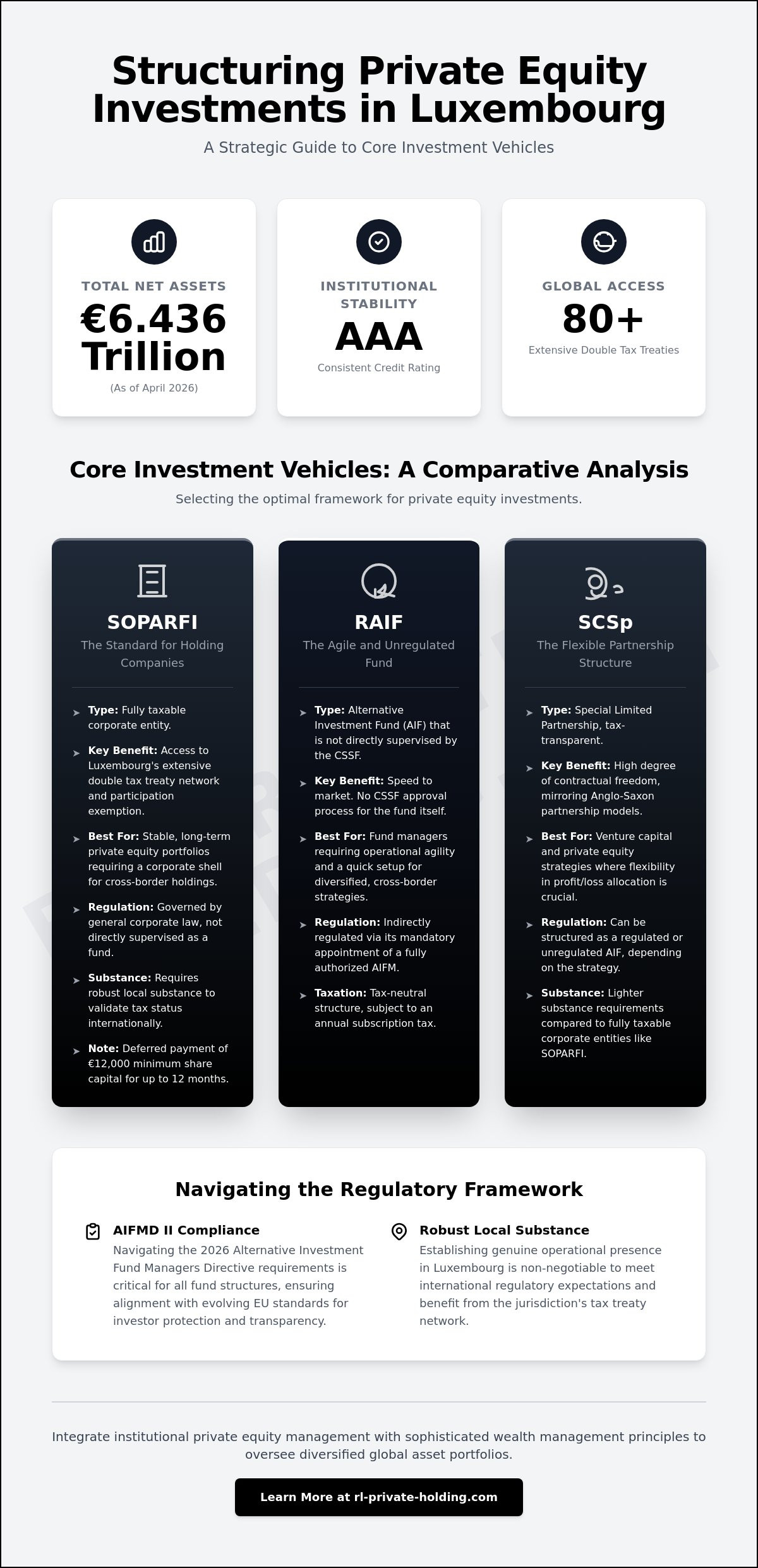
The choice of a jurisdiction is often reduced to a matter of tax efficiency, yet for institutional investors, the true value of Luxembourg lies in its ability to transform regulatory complexity into a strategic asset. As of April 2026, the total net assets of Luxembourg’s collective investment undertakings reached EUR 6.436 trillion, reflecting its position as a leading global hub for alternative assets. Effectively structuring private equity investments in Luxembourg requires more than just administrative compliance; it demands a precise alignment between legal architecture and long-term investment objectives.
Navigating the nuances of the SOPARFI, RAIF, and SCSp can be a complex undertaking for fund managers who must balance regulatory rigor with operational agility. It’s often difficult to ensure consistent tax neutrality across diverse cross-border jurisdictions while maintaining the flexibility required for venture capital and private equity strategies. This article provides a comprehensive reference on the strategic selection of Luxembourg investment vehicles. We’ll examine the functional dynamics of various structures and offer a framework for implementation that meets the exacting standards of institutional governance.
Key Takeaways
- Understand how Luxembourg’s AAA credit rating and its status as a premier global hub provide the institutional stability required for long-term capital preservation.
- Evaluate the technical distinctions between the SOPARFI, RAIF, and SCSp to determine the optimal framework for structuring private equity investments in Luxembourg.
- Identify the strategic advantages of Luxembourg’s extensive double tax treaty network and the participation exemption regime for global capital gains.
- Learn to navigate the 2026 AIFMD compliance requirements and the necessity of establishing robust local substance to meet international regulatory expectations.
- Explore the methodology for integrating institutional private equity management with sophisticated wealth management principles to oversee diversified asset portfolios.
The Strategic Significance of Luxembourg for Private Equity Structuring
Luxembourg is the leading destination for Alternative Investment Fund Managers (AIFMs) in Europe. Its success isn’t accidental. It’s the result of decades of deliberate policy and a commitment to financial excellence. The jurisdiction manages over EUR 6.4 trillion in net assets as of April 2026. This scale provides a level of liquidity and market depth that few other global centers can match. When structuring private equity investments in Luxembourg, institutional partners gain access to a framework designed for seamless cross-border capital flow.
Stability and Institutional Credibility
The Grand Duchy maintains a consistent AAA credit rating, a rare distinction that signals fiscal discipline and political continuity. In 2026, this stability remains a cornerstone for international fundraising. Institutional investors prioritize jurisdictions where the legal and fiscal rules are predictable. This reliability reduces the risk premium associated with long-term private equity cycles. A stable environment ensures that the structural integrity of a fund remains intact from inception through to the final exit.
The country’s economic model is built on being a neutral, efficient gateway for global capital. Much of Luxembourg’s finance-driven economy is centered on providing the infrastructure needed for complex investment vehicles. This specialization allows the nation to adapt quickly to new European directives, such as AIFMD II or the latest Pillar Two requirements. It doesn’t just follow EU law; it often sets the standard for how these regulations are implemented in a business-friendly manner.
The Ecosystem of Expertise
Success in private equity depends on the quality of the surrounding infrastructure. Luxembourg offers a dense network of specialized lawyers, auditors, and depositaries who understand the nuances of alternative assets. The Commission de Surveillance du Secteur Financier (CSSF) provides rigorous oversight while maintaining an open dialogue with industry participants. This balance ensures that funds are both compliant and operationally efficient. Access to a multilingual, technically proficient workforce further supports the management of global portfolios.
Choosing this jurisdiction is a statement of intent regarding institutional governance. It’s about more than just a tax-neutral environment. It’s about placing assets within a system that is recognized and respected by sovereign wealth funds and pension managers worldwide. Structuring private equity investments in Luxembourg provides the transparency and legal certainty that sophisticated limited partners expect. It’s a strategic decision that aligns the fund’s operational base with its global ambitions.
Core Investment Vehicles: Comparing SOPARFI, RAIF, and SCSp
Selecting an appropriate vehicle is a critical step in structuring private equity investments in Luxembourg. The jurisdiction offers a spectrum of entities that range from traditional corporate forms to highly flexible partnership structures. The OECD economic outlook for Luxembourg underscores the nation’s commitment to maintaining a competitive financial sector, which is reflected in the continued refinement of these vehicles. Each structure serves a specific purpose within an institutional framework, balancing regulatory oversight with the need for operational efficiency. For a detailed analysis of how these entities compare across investor profiles and asset classes, a comprehensive guide to Luxembourg investment fund structures provides essential clarity on selecting the optimal vehicle.
The SOPARFI: The Standard for Holding Companies
The Société de Participations Financières (SOPARFI) is the primary vehicle used for holding and financing activities. It’s a fully taxable entity, which allows it to benefit from Luxembourg’s extensive network of double tax treaties. This structure is particularly suited for private equity portfolios that require a stable corporate shell for cross-border transactions. As of June 2, 2026, new regulations allow for the deferred payment of the EUR 12,000 minimum share capital for an S.à r.l. for up to 12 months. This provides initial liquidity advantages for venture capital managers who need to deploy capital rapidly. Maintaining robust local substance is vital for a SOPARFI to ensure its tax status remains unchallenged in international jurisdictions.
The RAIF and SCSp: Modern Alternatives
The Reserved Alternative Investment Fund (RAIF) has transformed the landscape by offering a speed-to-market advantage. It isn’t subject to direct supervision by the CSSF, which significantly reduces the time required for fund launch. Instead, the RAIF is supervised through its authorized Alternative Investment Fund Manager (AIFM). This makes it an ideal choice for institutional investors who require a regulated environment without the delays of product-level approval.
The Special Limited Partnership (SCSp) provides a contractual flexibility that is highly attractive to managers from the US and UK. It’s a tax-transparent vehicle with no legal personality, allowing for a bespoke allocation of profits and losses. The SCSp is often the preferred choice when structuring private equity investments in Luxembourg for venture capital targets that require agile governance. For complex strategies, a hybrid approach is often employed, such as a RAIF holding various SOPARFIs to optimize global capital flows. Those seeking to optimize their portfolios often rely on professional private equity investment management to navigate these technical dynamics. This ensures the chosen structure remains aligned with institutional governance requirements.
Analyzing the Institutional Benefits of a Luxembourg Holding Company
The institutional utility of a Luxembourg holding company extends beyond mere legal existence. It serves as a sophisticated mechanism for capital preservation and global deployment. When structuring private equity investments in Luxembourg, the use of a Société de Participations Financières (SOPARFI) provides a robust platform that is recognized by international tax authorities and financial institutions alike. This recognition is fundamental for maintaining the integrity of cross-border investment flows and ensuring that value is not eroded by inefficient tax applications.
Tax Efficiency and Neutrality
The cornerstone of Luxembourg’s appeal for institutional investors is the participation exemption regime. This framework allows for the full exemption of dividends and capital gains on qualified participations, provided certain holding periods and ownership thresholds are met. It ensures that profits generated by subsidiaries can be repatriated and redeployed without incurring a second layer of taxation at the holding level. For venture capital exits, this neutrality is vital for maximizing the internal rate of return for limited partners.
A key component of this efficiency is Luxembourg’s private equity framework, which integrates an extensive network of double tax treaties. These agreements mitigate the risk of withholding taxes on income streams from foreign jurisdictions. Additionally, Luxembourg generally doesn’t impose withholding tax on arm’s length interest payments or liquidation proceeds. This creates a predictable environment for managing the lifecycle of an investment, from the initial injection of capital to the eventual realization of gains.
Operational Flexibility
Institutional managers require a vehicle that can accommodate a diverse range of asset classes. A Luxembourg holding company is capable of overseeing portfolios that include technology startups, infrastructure projects, and real estate assets within a single consolidated structure. This centralized oversight simplifies the administrative burden of managing global subsidiaries. It allows for a unified approach to governance and reporting, which is essential for meeting the transparency demands of modern investors.
The jurisdiction also facilitates efficient debt financing. Holding companies can be used to issue private or public debt, providing managers with the leverage needed to optimize their capital structures. This operational agility is particularly beneficial when structuring private equity investments in Luxembourg for complex, multi-layered deals. By leveraging these established corporate forms, firms can focus on their core mandate of asset management while relying on a stable and proven institutional framework.
Operational Governance and Regulatory Compliance Frameworks
Governance within the Grand Duchy has transitioned from a structural requirement to a primary driver of institutional trust. For fund managers, structuring private equity investments in Luxembourg involves a commitment to rigorous operational standards that satisfy both the CSSF and sophisticated limited partners. The 2026 regulatory environment places a premium on real management and effective oversight. This ensures that investment vehicles aren’t merely legal constructs but active participants in the global financial system.
Substance and Management
The definition of “adequate substance” has become more granular. It’s now centered on the quality of local decision-making and the physical presence of key personnel. Regulatory authorities expect that the core functions of a fund are performed within the jurisdiction. This includes risk management and the oversight of delegated activities. A law effective from late 2025 introduced enhanced digital procedures for company formation and more stringent checks for director disqualifications. These measures reinforce the integrity of the local corporate landscape. Independent directors are essential in this context. They provide the necessary distance and specialized expertise to handle complex conflicts of interest and ensure compliance with AIFMD requirements. Mitigating the risks associated with “shell company” designations is paramount for maintaining the tax and legal benefits of the structure.
Reporting and Transparency
Standardized reporting protocols are now a baseline expectation for institutional capital. Following a thematic review conducted through 2024 and 2025, the CSSF published a feedback report in June 2026 regarding valuation risks for illiquid assets. This report emphasizes the need for fund managers to implement robust valuation frameworks that align with International Private Equity and Venture Capital (IPEV) guidelines. It’s no longer enough to rely on periodic assessments; there must be a continuous and transparent process for determining fair value. Additionally, the integration of ESG reporting has become a core component of the institutional framework. Managers must disclose how sustainability risks are incorporated into their investment decisions. Those who prioritize these transparency standards are better positioned to attract long-term capital. If you’re looking to enhance your governance profile, professional private equity investment management provides the framework needed to meet these evolving international standards.
Strategic Oversight in Investment Management: The RL Private Holding Perspective
RL Private Holding approaches asset management with a focus on institutional permanence and structural precision. Our methodology involves the integration of diversified portfolios within a framework that prioritizes long-term governance over short-term gains. When structuring private equity investments in Luxembourg, we look beyond the initial incorporation phase. We view the choice of an investment vehicle as a foundational decision that dictates the operational agility and tax neutrality of the entire investment lifecycle. This perspective allows us to act as a steady hand in the background of major global transactions.
A Disciplined Approach to Asset Management
We manage complex portfolios across private equity, venture capital, and real estate. The synergy between these sectors is maintained through a unified management philosophy that emphasizes stability. Our approach to real estate asset management utilizes the same institutional rigor applied to our private equity investment management. This consistency ensures that diversified assets benefit from a centralized oversight model. By maintaining institutional gravity in venture capital funding, we provide early-stage companies with the structural maturity usually reserved for established corporate entities. This disciplined framework is a critical component of structuring private equity investments in Luxembourg for global institutional partners.
Integrating wealth management services with these private equity structures creates a comprehensive solution for asset preservation. It allows for the seamless transition of value across generations and jurisdictions. We focus on the structural components of the business, ensuring that the organizational hierarchy supports the firm’s strategic focus. This methodical alignment reduces friction and provides a clear path for capital deployment and repatriation.
The Future of Private Equity in Luxembourg
The global investment landscape in 2026 is characterized by increased regulatory scrutiny and a shift toward greater transparency. We anticipate that the CSSF’s focus on valuation risk for illiquid assets, highlighted in their June 2026 feedback report, will remain a permanent feature of the supervisory environment. Additionally, the requirement for Pillar Two registration by June 30, 2026, necessitates a proactive and highly organized approach to tax compliance. RL Private Holding remains committed to the Luxembourg financial center because of its proven ability to modernize its legal framework while preserving its core stability.
Investors seeking sophisticated management solutions must prioritize structures that can withstand evolving international standards. The 14.55% increase in total net assets of Luxembourg investment undertakings over the past 12 months reflects continued global confidence. As a disciplined global partner, we continue to leverage this framework to create strategic value. For those looking to align their portfolios with institutional governance, the next steps involve a detailed assessment of how these vehicles can best serve long-term objectives.
Advancing Institutional Governance in a Global Market
The evolution of Luxembourg’s financial landscape confirms its role as a permanent fixture for sophisticated capital. Selecting the appropriate vehicle, whether a SOPARFI for corporate holding or an SCSp for partnership flexibility, is a foundational step in establishing a resilient investment framework. This selection must be paired with robust operational substance and a commitment to transparent valuation protocols. When structuring private equity investments in Luxembourg, the objective is to create a structure that balances immediate market entry with long-term regulatory endurance.
RL Private Holding provides the institutional-grade governance and wealth management focus required to navigate this multi-layered environment. Headquartered in Luxembourg with a global investment reach, the firm offers diversified expertise across technology, real estate, and venture capital. Discover RL Private Holding’s approach to Private Equity Investment Management to learn how a disciplined partner can enhance portfolio stability. Establishing a steady hand in the background of your investments ensures that your strategic objectives remain aligned with the highest standards of global finance.
Frequently Asked Questions
What are the primary benefits of a Luxembourg SOPARFI for private equity?
The SOPARFI provides institutional investors with a fully taxable corporate vehicle that qualifies for Luxembourg’s extensive double tax treaty network. This status is essential for preventing tax leakage on cross-border income and capital gains. Managers often choose this structure for its participation exemption regime, which can exempt dividends and gains from qualified holdings of at least 10% or a value of EUR 1.2 million.
How does the Reserved Alternative Investment Fund (RAIF) differ from a SIF?
The primary distinction lies in the regulatory oversight mechanism. A Reserved Alternative Investment Fund (RAIF) isn’t subject to direct product-level supervision by the CSSF, whereas a Specialized Investment Fund (SIF) requires prior authorization. By utilizing an authorized Alternative Investment Fund Manager (AIFM), the RAIF achieves a significantly faster speed-to-market while maintaining an institutional-grade regulatory framework that appeals to global investors. Understanding how these vehicles compare within the broader spectrum of Luxembourg investment fund structures is essential for making an informed selection based on your distribution strategy and compliance requirements.
What are the substance requirements for a Luxembourg holding company in 2026?
Substance requirements in 2026 focus on the quality of local governance and physical presence. Entities must demonstrate that strategic decisions are made by qualified directors resident in Luxembourg. The law from December 19, 2025, introduced enhanced digital procedures for company formation, which supports the verification of director credentials. Also, entities subject to Pillar Two rules must register with tax authorities by June 30, 2026.
Can a Luxembourg structure be used for both venture capital and real estate?
Luxembourg structures are designed to accommodate a wide range of asset classes within a single framework. A RAIF or a SOPARFI can hold technology participations alongside commercial real estate assets, providing centralized administration for diversified portfolios. This versatility is a key advantage when structuring private equity investments in Luxembourg for multi-strategy institutional funds that require a unified approach to asset management.
How does Luxembourg’s tax treaty network benefit international PE investors?
Luxembourg’s network of over 80 double tax treaties provides international investors with protection against double taxation on dividends, interest, and royalties. These treaties often reduce withholding tax rates to zero or near-zero levels. This network creates a predictable fiscal environment that is critical for accurately modeling the internal rate of return on global private equity deals and ensuring long-term capital preservation.
What is the role of an AIFM in a Luxembourg private equity structure?
An Alternative Investment Fund Manager (AIFM) is responsible for the core functions of portfolio management and risk management. Under the AIFMD framework, the AIFM ensures that the fund complies with valuation, liquidity, and reporting standards. For structures like the RAIF, the presence of an authorized AIFM serves as the primary regulatory safeguard in lieu of direct product-level supervision by the CSSF.
How long does it typically take to set up an SCSp in Luxembourg?
Setting up a Special Limited Partnership (SCSp) can often be completed within a few weeks due to its contractual nature and the absence of a requirement for CSSF approval. Because it doesn’t have a separate legal personality, the partnership agreement can be tailored to the specific governance needs of the investors. This efficiency makes the SCSp a preferred choice for rapid capital deployment in venture capital and private equity.
Are there specific reporting requirements for institutional investors in Luxembourg?
Institutional investors must adhere to comprehensive disclosure standards, including periodic AIFMD reporting and the filing of annual audited accounts. The CSSF’s June 2026 feedback report specifically highlights the importance of robust valuation protocols for illiquid assets. Structuring private equity investments in Luxembourg requires implementing these reporting frameworks to ensure transparency and maintain compliance with the latest European financial directives and CSSF supervisory priorities.