

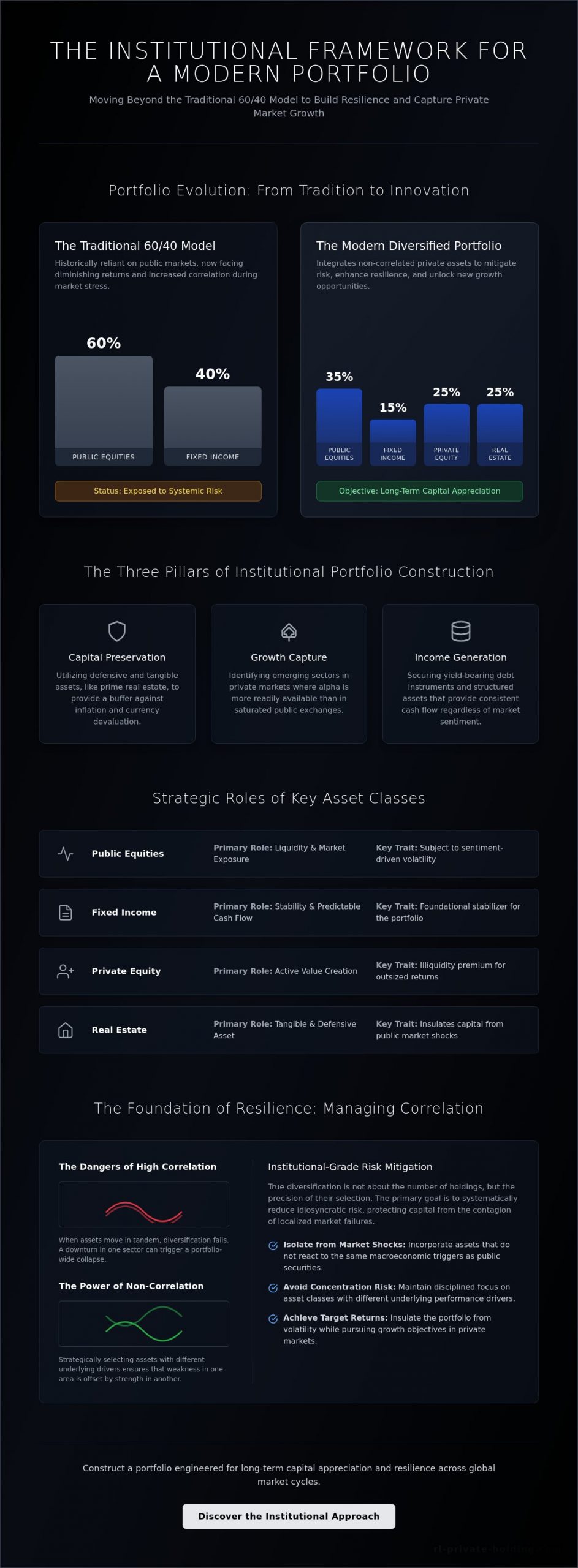
The traditional 60/40 allocation model, once considered the benchmark for capital preservation, has reached a point of diminishing returns in an environment defined by a 3.62% federal funds rate and persistent public market volatility. Sophisticated investors recognize that a reliance on public equities and bonds often leaves capital exposed to systemic risks that traditional hedging strategies can’t fully mitigate. This reality necessitates a transition toward a more robust wealth management diversified portfolio that incorporates non-correlated assets.
This article provides the institutional framework required to construct a sophisticated, multi-asset portfolio that balances traditional stability with the growth potential found in private markets. We’ll examine the strategic integration of private equity and real estate, alongside the disciplined allocation methodologies used by global entities to maintain resilience across market cycles. By understanding how to bridge the gap between public liquidity and private market growth, investors can establish a foundation for long-term capital appreciation that remains steady despite global uncertainty.
Key Takeaways
- Evaluate the strategic necessity of allocating capital across non-correlated asset classes to mitigate idiosyncratic risk while achieving target returns.
- Identify the specific roles of public equities and fixed income in providing a foundation of liquidity and predictable cash flow within a broader strategy.
- Discover the institutional framework for building a wealth management diversified portfolio that successfully integrates private equity and venture capital for value creation.
- Establish a clear investment mandate to determine the optimal allocation ratio between traditional assets and alternative market opportunities.
- Understand how a multi-sector approach incorporating real estate and private equity can enhance long-term portfolio resilience across global market cycles.
The Fundamentals of a Wealth Management Diversified Portfolio
A wealth management diversified portfolio is defined by the strategic allocation of capital across asset classes that exhibit low or negative correlation to one another. While retail approaches often focus on simply spreading investments across various public stocks, institutional-grade diversification requires a deeper understanding of how different instruments respond to macroeconomic shifts. The primary objective of this framework is the systematic reduction of idiosyncratic risk, ensuring that the performance of a single sector or asset doesn’t jeopardize the entire capital base. By focusing on the structural relationship between assets, investors can maintain a target rate of return while insulating themselves from localized market shocks.
Traditional models are currently undergoing a significant evolution. The historical reliance on public equities and sovereign bonds has faced challenges as correlations between these classes have tightened during periods of market stress. To achieve a target rate of return without incurring excessive volatility, sophisticated investors look toward Modern Portfolio Theory as a foundational starting point. However, they must also move beyond its basic applications to include private market alternatives that offer distinct risk-return profiles. Institutional-grade allocation isn’t just about the number of holdings; it’s about the precision of the selection process.
The Core Objectives of Portfolio Construction
Effective construction prioritizes three distinct pillars. Capital preservation is achieved through exposure to defensive and tangible assets, such as prime real estate, which provide a buffer against currency devaluation. Growth capture involves identifying emerging sectors in technology and private markets where alpha is more readily available than in saturated public exchanges. Finally, income generation is secured through yield-bearing debt instruments and structured real estate assets that provide consistent cash flow regardless of broader market sentiment. This balanced approach ensures the portfolio remains functional through various economic cycles.
Understanding Correlation and Risk Mitigation
True non-correlation is increasingly difficult to find in a globalized financial environment where liquidity flows can cause all public assets to move in tandem. Institutional managers analyze how asset classes react to inflation, interest rate shifts, and geopolitical events to ensure the portfolio remains resilient. Concentration risk is the primary threat to long-term wealth preservation. By maintaining a disciplined focus on asset classes with different underlying drivers, a firm can protect its capital from the contagion of localized market failures. This methodology moves beyond simple asset spreading and into the territory of strategic, institutional-grade risk management.
Selecting Asset Classes for Institutional-Grade Diversification
Constructing a resilient wealth management diversified portfolio requires a departure from the retail-centric focus on public securities. While public equities provide the necessary liquidity and broad market exposure required for operational flexibility, they’re often subject to sentiment-driven volatility. Fixed income instruments, currently influenced by a 3.62% federal funds rate, serve as a stabilizer and a source of predictable cash flow. These traditional assets provide a foundation, yet they rarely offer the non-correlated growth required for long-term resilience in a shifting economic landscape.
The inclusion of private equity and real estate is a strategic necessity for those seeking to insulate capital from public market fluctuations. Private equity investment management allows for direct engagement with companies at various growth stages, capturing value that’s often lost by the time a firm reaches an initial public offering. This approach shifts the focus from passive tracking to active value creation through operational efficiency and strategic oversight. By diversifying across these sectors, an entity can achieve a risk-return profile that public markets alone cannot provide.
Public vs. Private Market Allocations
The balance between public and private markets is defined by the illiquidity premium. Investors accept lower liquidity in private holdings in exchange for the potential for outsized returns and reduced exposure to daily price swings. Modern portfolios increasingly prioritize growth-stage technology investments through venture capital, identifying sectors that are reshaping the global economy. This strategic allocation ensures that capital isn’t merely preserved but actively deployed in high-growth environments. Those seeking to refine their current strategy may benefit from specialized wealth management services that prioritize institutional-grade asset selection.
Real Estate and Tangible Asset Management
Real estate serves as a critical hedge against inflation, providing tangible value that public equities can’t replicate. In periods of rising costs, the defensive characteristics of commercial and residential property assets offer a buffer through both capital appreciation and rental yield. Managed real estate structures provide exposure to large-scale developments without the operational burden of direct ownership. By integrating real estate asset management into a broader framework, an organization can achieve a level of stability that counters the inherent volatility of the equity markets. This multi-asset approach is fundamental to maintaining capital integrity across diverse economic landscapes.
The Strategic Role of Private Equity and Venture Capital
Private equity is frequently mischaracterized as a vehicle for high-risk speculation. In reality, it represents a disciplined approach to long-term value creation that is essential for any wealth management diversified portfolio aiming for resilience. While public markets are often driven by short-term sentiment and retail trading patterns, private equity investment management focuses on the fundamental health of an enterprise. This institutional approach prioritizes operational efficiency and strategic oversight, allowing for the transformation of businesses over a multi-year horizon. Professional management is critical during this process, particularly when navigating the complexities of private exits and strategic acquisitions.
Accessing these markets requires a shift in perspective from passive holding to active participation. The absence of daily price discovery in private markets isn’t a lack of transparency; it’s a structural advantage that prevents reactionary decision-making. By removing the pressure of quarterly reporting, firms can implement deep-seated changes that drive sustainable growth. This focus on structural integrity ensures that capital is deployed in a manner that favors long-term capital appreciation over temporary market fluctuations. It’s this methodical approach to asset management that distinguishes institutional-grade portfolios from standard retail models.
Venture Capital and Technology Growth
Technology remains the primary driver of portfolio alpha in the 21st century. Venture capital serves as a vital tool for accessing disruptive innovation in sectors such as artificial intelligence, biotechnology, and financial infrastructure. Managing the risk profile inherent in early-stage companies is achieved through diversified fund structures that spread exposure across various stages of development. The lifecycle of a venture investment is a calculated progression from initial funding to a successful realization event. This process requires a sophisticated understanding of market timing and sector-specific trends to ensure that disruptive potential translates into tangible returns.
Private Equity and Wealth Preservation
Private equity provides a robust shield for assets against the noise of daily public market sentiment. This insulation is particularly valuable during periods of global uncertainty, where public indices may experience sharp, irrational declines. The role of carried interest and performance-based incentives is fundamental to this asset class, as it aligns the interests of the manager and the investor toward a common outcome of capital growth. Private equity firms in Luxembourg utilize specific holding structures for tax and operational efficiency, providing a stable and regulated framework for managing complex international investments. This level of organizational precision is a hallmark of institutional wealth preservation strategies.
A Step-by-Step Framework for Portfolio Construction
The construction of a wealth management diversified portfolio is a methodical process that begins with a clearly defined investment mandate. This document serves as the structural foundation for all subsequent allocation decisions, ensuring that every deployment of capital aligns with the broader objectives of the entity. Unlike retail models that focus on arbitrary risk scores, an institutional framework prioritizes long-term capital requirements and liquidity needs. This process involves determining the optimal ratio between traditional public instruments and alternative asset classes, such as private equity and real estate.
Implementing a rigorous due diligence protocol is the next critical step. This involves a granular analysis of private market opportunities, assessing not only the potential for return but also the operational integrity of the underlying assets. A methodical rebalancing schedule must also be established. This ensures that the portfolio doesn’t drift from its target allocation as different asset classes experience varying rates of growth. Maintaining this discipline is essential for preserving the risk-return profile established at the outset of the investment cycle.
Defining the Investment Mandate
The investment mandate must align portfolio goals with the specific needs of institutional or private family wealth. Setting realistic return expectations requires a sober analysis of current market conditions, including the 3.62% federal funds rate as of June 2026. Risk tolerance parameters are defined by the capacity to absorb volatility without compromising the core capital base. Factoring in time horizons is essential, particularly when dealing with the illiquid nature of private equity commitments. These commitments often require a decade-long perspective to realize their full value creation potential.
Structuring for Global Efficiency
Selecting the appropriate legal and organizational structures is vital for managing global investments. Utilizing a Luxembourg-based holding company offers significant advantages for international asset management. The SOPARFI (Société de Participations Financières) structure, for instance, provides a robust framework for diversification while maintaining a high degree of regulatory compliance. Navigating the regulatory landscape of a global financial center requires a level of organizational precision that retail platforms cannot offer. This structural efficiency ensures that the portfolio remains resilient across multiple jurisdictions.
Establishing these frameworks requires professional oversight to ensure that the legal and financial components are perfectly synchronized. Organizations seeking to implement such a framework can explore wealth management services to align their capital with institutional standards. This disciplined approach to construction is what allows a portfolio to maintain its integrity through complex market cycles.
Strategic Asset Management: The RL Private Holding Approach
RL Private Holding operates with a philosophy of quiet authority, reflecting an established presence in the global financial landscape. This approach eschews the excitement of market speculation in favor of institutional gravity and understated confidence. A wealth management diversified portfolio managed under this framework is treated as a strategic ecosystem rather than a disparate collection of holdings. By prioritizing stability and exclusivity, the firm provides a steady hand in the background of major global investments; this ensures that capital remains resilient across varying economic cycles.
The firm’s methodology involves the seamless integration of technology, real estate, and private equity. This cross-sector approach allows for a more sophisticated understanding of value creation. For instance, the operational efficiency gained through growth-stage technology investments often directly benefits the management of tangible real estate assets. This isn’t the standard advisory model offered by retail banks; it’s a methodical, disciplined system designed for the complexities of global capital. Performance is measured with a focus on long-term strategic growth, maintaining a professional distance from the noise of public market volatility.
Leveraging a global presence allows the firm to identify exclusive investment opportunities that remain inaccessible to the broader public. By maintaining a disciplined approach to asset management fees and performance benchmarks, the firm aligns its interests with the long-term preservation of capital. This methodical focus on structural integrity is what defines the transition from simple asset spreading to true institutional-grade allocation.
Integrated Portfolio Management
The benefits of utilizing a single holding company to manage diverse business interests are substantial. This structure allows RL Private Holding to apply cross-sector expertise to every investment decision. When private equity investment management and real estate asset management are handled within the same institutional framework, the resulting synergy enhances risk mitigation. This integrated approach ensures that the portfolio maintains its structural integrity even when individual sectors face headwinds. It’s this level of organizational precision that provides the stability required for large-scale wealth preservation in a volatile global market.
Next Steps for Sophisticated Investors
Sophisticated investors must periodically evaluate their current asset allocation against institutional benchmarks to ensure they aren’t over-exposed to public market risks. The transition toward a comprehensive wealth management diversified portfolio requires a partner that understands the nuances of private market growth and global investment structures. Partnering with a firm that prioritizes long-term resilience over short-term gains is a critical step in securing a financial legacy. Investors are encouraged to contact professional managers to refine their global investment structure and align their capital with a framework built for permanent growth.
Establishing a Foundation for Permanent Global Growth
Building a wealth management diversified portfolio that withstands global volatility requires a shift from passive public tracking to active, multi-sector participation. The integration of private equity, venture capital, and real estate provides the non-correlated growth necessary for capital preservation in a complex economic landscape. By establishing a clear investment mandate and utilizing efficient structural frameworks, investors can insulate their capital from short-term market sentiment while capturing long-term value.
Headquartered in the Luxembourg global financial center, RL Private Holding provides the institutional gravity required to manage a diversified global portfolio across technology and real estate sectors. The firm’s expertise in private equity and venture capital management ensures that capital is deployed with precision and strategic focus. We invite you to explore the strategic investment approach of RL Private Holding to learn how our disciplined framework supports permanent growth. It’s a methodical process that rewards those who prioritize institutional-grade allocation and long-term strategic vision.
Frequently Asked Questions
What is the ideal percentage of alternative assets in a diversified portfolio?
The ideal allocation for alternative assets typically ranges from 20% to 50% of an institutional-grade wealth management diversified portfolio, depending on specific liquidity requirements and risk tolerance. This range allows for significant exposure to non-correlated growth while maintaining a foundation of public securities. UHNWIs often lean toward the higher end of this spectrum to capture the illiquidity premium. This methodical weighting ensures that the portfolio remains resilient even when public markets face systemic pressure.
How does private equity help in wealth preservation for UHNWIs?
Private equity facilitates wealth preservation by insulating capital from the daily volatility and sentiment-driven fluctuations of public stock exchanges. Because these investments are held for multi-year cycles, they allow for deep operational improvements and structural value creation within portfolio companies. This long-term focus prioritizes the fundamental health of the business over quarterly reporting pressures. It provides a more stable environment for capital appreciation while shielding assets from the irrationality of retail market movements.
Why is Luxembourg considered a premier hub for wealth management and investment structures?
Luxembourg is recognized as a premier hub due to its stable political environment, robust regulatory framework, and sophisticated investment vehicles such as the SOPARFI. The jurisdiction provides a neutral and highly efficient platform for managing cross-border assets and complex holding structures. Its position as a global financial center attracts top-tier legal and financial expertise. This makes it the preferred location for entities managing international private equity and real estate interests with a focus on institutional gravity.
What is the difference between diversification and asset allocation?
Asset allocation refers to the broad distribution of capital across different categories such as stocks, bonds, and alternatives. Diversification is the specific strategy used within those categories to reduce idiosyncratic risk by selecting non-correlated instruments. While allocation sets the macro-level structure of the capital base, diversification ensures that no single holding or sector can disproportionately impact performance. A successful wealth management diversified portfolio utilizes both concepts to balance target returns with systematic risk mitigation.
How often should an institutional-grade portfolio be rebalanced?
An institutional-grade portfolio is typically rebalanced on a methodical quarterly or semi-annual schedule to ensure holdings remain aligned with the target allocation. Frequent adjustments can lead to unnecessary transaction costs; however, infrequent rebalancing may allow the portfolio to drift into higher risk profiles as certain assets outperform others. This disciplined approach maintains the structural integrity of the investment mandate. It ensures that the portfolio remains functional and steady regardless of short-term market movements or localized shocks.
What role does venture capital play in a long-term wealth strategy?
Venture capital serves as a primary tool for accessing disruptive innovation and capturing alpha in high-growth technology sectors. By providing early-stage funding to companies with transformative potential, it allows for significant capital appreciation that is often unavailable in mature public markets. This asset class adds a growth-oriented dimension to a long-term strategy. It balances the defensive characteristics of more stable, tangible assets like real estate, ensuring the portfolio captures the primary drivers of the 21st-century economy.
How do management fees and carried interest impact portfolio net returns?
Management fees and carried interest are structural components designed to align the interests of investment managers with those of the investors. Management fees cover the operational costs of rigorous due diligence and asset oversight. Carried interest acts as a performance-based incentive that rewards successful value creation. When managed correctly, these fees ensure that the firm is focused on achieving outsized net returns. The manager’s compensation is directly tied to the success of the investment, creating a disciplined partnership.
Can real estate asset management provide a hedge against inflation?
Real estate asset management provides a robust hedge against inflation through both capital appreciation and the ability to adjust rental yields in response to rising costs. Tangible assets maintain intrinsic value during periods of currency devaluation, offering a level of security that paper assets often lack. This dual-income stream of rent and long-term appreciation makes real estate a critical component for maintaining purchasing power. It offers a defensive buffer that stabilizes the portfolio during periods of global economic uncertainty.