

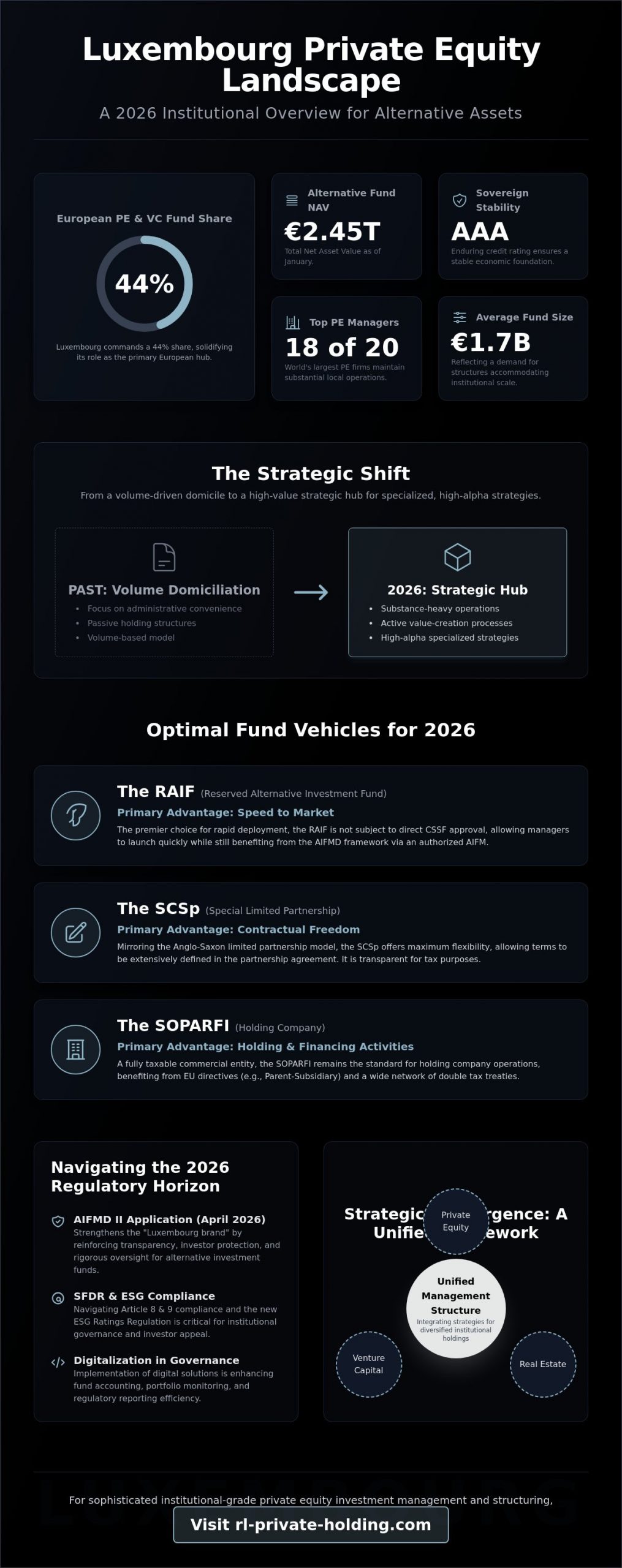
With Luxembourg commanding a 44% share of all European private equity and venture capital funds as of June 2026, the jurisdiction has solidified its role as the primary global hub for alternative assets. The total Net Asset Value of alternative funds domiciled here reached €2.45 trillion in January, reflecting a market that prioritizes structural integrity over mere administrative convenience. Professionals operating within the Luxembourg private equity landscape understand that success now depends on adapting to sophisticated regulatory shifts, such as the April 2026 application of AIFMD II and the new ESG Ratings Regulation.
It’s clear that managing cross-border structures requires a precise balance between tax efficiency and rigorous compliance. This article provides an institutional-grade examination of the structural, regulatory, and strategic trends defining the sector this year. We’ll analyze the optimal fund vehicles for 2026, including the new deferred share capital rules for SARLs and the nuances of the 2026 carried interest tax regime. This analysis will help you identify synergies between private equity and other institutional asset classes while ensuring long-term regulatory compliance in an increasingly complex environment.
Key Takeaways
- Analyze the transition of the Luxembourg private equity landscape from a volume-driven domicile to a strategic hub for specialized, high-alpha investment strategies.
- Evaluate the structural characteristics of the RAIF, SCSp, and SOPARFI to determine the most effective vehicle for diversified institutional holdings.
- Identify the strategic advantages of maintaining a multi-strategy framework that incorporates Venture Capital and Real Estate within a unified management structure.
- Navigate the complexities of SFDR Article 8 and 9 compliance while implementing digital solutions for enhanced institutional governance and fund accounting.
- Examine institutional allocation models that utilize private equity for wealth preservation and the current state of exit strategies in the secondary markets.
The Evolution of the Luxembourg Private Equity Ecosystem in 2026
By early 2026, the total net assets of regulated investment funds in Luxembourg surpassed the €5.765 trillion mark, signaling a period of significant institutional consolidation. This growth reflects a fundamental shift within the Luxembourg private equity landscape. The sector has transitioned from a model centered on volume-based domiciliation to one defined by specialized, high-alpha strategies. Global capital entering the European Union continues to flow through the Grand Duchy, which remains the primary gateway for international sponsors from the United States and Asia. The implementation of AIFMD II in April 2026 has further strengthened the “brand” of Luxembourgish funds, reinforcing a reputation for transparency and rigorous oversight that appeals to the world’s most sophisticated limited partners.
This evolution is not merely a matter of scale. It involves a qualitative change in how fund managers engage with the jurisdiction. Rather than utilizing Luxembourg for passive holding structures, firms are integrating local operations into their core value-creation processes. Managers are increasingly deploying capital into technology, media, and telecommunications (TMT) sectors, particularly businesses focused on artificial intelligence. This shift requires a level of technical due diligence and active portfolio monitoring that was less common in previous cycles. The trend is driven by a need for increased substance and a clearer alignment with European regulatory expectations.
Market Maturity and Institutional Stability
The Grand Duchy’s enduring AAA credit rating provides a foundation of stability that is increasingly rare in a volatile global economy. Luxembourg’s developed economy supports a financial services sector that accounts for a significant portion of its GDP, ensuring that the government remains committed to maintaining a competitive legal framework. It’s telling that 18 of the world’s 20 largest private equity fund managers maintain substantial operations here. These entities have moved beyond basic fund administration. They’ve established substance-heavy management offices that handle complex functions such as risk management, compliance, and portfolio valuation.
The 2026 Macro-Economic Context
The 2026 interest rate environment has necessitated a recalibration of leverage structures within Luxembourgish acquisition vehicles. While stabilizing rates have encouraged a rebound in M&A activity, the focus has shifted toward sustainable debt levels and operational improvements. The Commission de Surveillance du Secteur Financier (CSSF) continues to play a pivotal role, balancing a reputable regulatory environment with the flexibility required for innovative asset classes like private credit. In this context, the 2026 landscape is a substance-led strategic hub for alternative assets.
Structural Sophistication: Optimal Fund Vehicles for 2026
The selection of a vehicle within the Luxembourg private equity landscape is no longer a purely administrative decision; it’s a strategic maneuver influenced by the April 2026 application of AIFMD II. As the average size of a fund domiciled in Luxembourg reached €1.702 billion in 2025, the demand for structures that accommodate institutional scale has never been higher. Managers must now evaluate vehicles not just on speed, but on their ability to withstand the rigorous transparency requirements of the new regulatory environment. While the SOPARFI remains the standard for holding company operations, the choice between the RAIF and the SCSp remains the primary debate for fund initiation.
Luxembourg’s resilience as a jurisdiction is reinforced by its proactive legislative updates. For instance, the law effective June 2, 2026, which allows the deferred payment of the €12,000 minimum share capital for SARLs, has significantly accelerated the setup of acquisition vehicles. This practical flexibility, combined with the Grand Duchy’s established ecosystem, ensures it remains the preferred choice for sponsors who require sophisticated Private Equity Investment Management solutions. Institutional scale is further supported by SICAV and SICAF structures, which provide the robust governance frameworks necessary for multi-billion Euro allocations.
The RAIF: Speed to Market and Regulatory Efficiency
The Reserved Alternative Investment Fund (RAIF) continues to be a cornerstone for managers seeking rapid deployment without direct CSSF product approval. By utilizing a regulated Alternative Investment Fund Manager (AIFM), the RAIF maintains institutional trust while bypassing the lengthy authorization timelines associated with traditional SIFs. This structure is particularly effective for technology and growth-stage investments where deal speed is a competitive advantage. The RAIF’s ability to be launched in a matter of weeks, rather than months, aligns perfectly with the fast-paced requirements of the 2026 market.
The SCSp: Flexibility for Private Equity and Venture Capital
For those prioritizing contractual freedom, the Special Limited Partnership (SCSp) offers a framework that mirrors the familiarity of Delaware or Cayman structures. Industry insights from the Luxembourg Private Equity & Venture Capital Association confirm that the SCSp has become the vehicle of choice for US-based sponsors entering the European market. Its tax-transparent nature is highly valued by international institutional investors. Under the 2026 tax regime, the SCSp also facilitates the efficient management of carried interest, with participation carry being potentially tax-exempt if specific investment thresholds and holding periods are met.
Strategic Convergence: PE, VC, and Real Estate within a Holding Framework
The modern Luxembourg private equity landscape is characterized by the strategic convergence of formerly distinct asset classes. While historical models often treated venture capital, private equity, and real estate as siloed operations, the 2026 market favors an integrated approach. This evolution is supported by Luxembourg’s private equity hub, which provides the legal flexibility required to manage multi-strategy portfolios under a single holding framework. By consolidating these interests, institutional investors can better manage liquidity and capitalize on cross-sectoral synergies.
Risk mitigation is a primary driver for this consolidation. A unified structure allows for the balancing of long-term real estate yields against the higher-alpha potential of growth-stage venture capital. It’s a methodical way to ensure that the portfolio remains resilient against sector-specific volatility while maintaining exposure to high-growth opportunities in the European market. The shift toward multi-strategy holding companies reflects a broader trend of institutional maturity within the Grand Duchy.
The Integrated Investment Management Model
RL Private Holding operates at the intersection of these asset classes, utilizing a disciplined framework to oversee diverse holdings. The integration of Private Equity Investment Management with Real Estate Asset Management allows for a more sophisticated allocation of capital. For example, technology investments often serve as a catalyst for optimizing real estate portfolios through the implementation of smart-building solutions and data-driven management systems. This synergy enhances the overall ROI of the holding company. Managing liquidity across these asset lifecycles requires a steady hand and a clear plan. While venture capital may require longer horizons, the cash flow from established real estate assets provides the necessary stability to support growth-stage funding rounds.
Venture Capital in the Luxembourg Tech Corridor
Luxembourg has successfully positioned itself as a central node in the European tech corridor. In 2026, the focus has shifted toward growth-stage firms that require substantial Venture Capital Funding to scale internationally. There’s a clear trend of institutional dry powder being deployed into TMT sectors, particularly those involving artificial intelligence and software-as-a-service. Luxembourg’s solution to the European funding gap involves providing a stable, regulated environment where tech firms can access the capital they need without the volatility found in less established markets. This recovery in the tech sector is bolstered by a rebound in M&A activity, creating clear exit pathways for successful ventures. The synergy between growth-stage VC and traditional PE is now a defining feature of the local ecosystem.
Operational Excellence: ESG, Governance, and Digitalization
Operational excellence in the 2026 Luxembourg private equity landscape is no longer defined by administrative efficiency alone. Instead, it’s a matter of strategic governance and technological integration. The April 2026 application of AIFMD II has raised the bar for substance requirements, forcing managers to demonstrate genuine local decision-making and risk management capabilities. This shift ensures that Luxembourgish entities meet the latest OECD and EU standards, protecting the jurisdiction’s reputation as a secure harbor for global capital. High-performing funds now differentiate themselves through the quality of their independent directors and the depth of their board’s technical expertise.
The 2026 operational environment requires a shift from passive compliance to active strategic oversight. Managers who fail to integrate these standards into their core processes risk falling behind as limited partners increasingly favor jurisdictions with proven regulatory integrity. This focus on substance is a direct response to the evolving expectations of global tax authorities and financial regulators. By prioritizing governance, firms can ensure long-term stability and maintain the trust of institutional investors who value professional distance and disciplined management.
ESG as a Core Investment Thesis
Compliance with SFDR and Taxonomy regulations has matured beyond basic reporting. For Article 8 and 9 funds, the focus in 2026 is on active value creation through ESG data transparency. The implementation of the EU’s ESG Ratings Regulation in June 2026 provides a new framework for integrity in sustainability assessments, reducing the risk of greenwashing. These ratings now directly impact private equity exit valuations, as institutional buyers prioritize assets with verifiable sustainability credentials. ESG integration is a non-negotiable pillar of institutional fiduciary duty.
The Digital Transformation of Private Equity
Digitalization has fundamentally altered asset management workflows across the Grand Duchy. Fund managers are utilizing GenAI for predictive due diligence and real-time portfolio monitoring, allowing for faster and more accurate investment decisions. There’s also a growing focus on blockchain-based fund accounting to increase transparency and reduce reconciliation times. The impact of ELTIF 2.0 has catalyzed the retailization of private equity, requiring more robust digital interfaces and cybersecurity protocols to manage a broader investor base. This level of professional discipline is essential for maintaining the high standards expected in Wealth Management Services. Effective boards now prioritize cybersecurity and data privacy as central components of their fiduciary responsibility, ensuring the Luxembourg private equity landscape remains resilient against digital threats.
Institutional Allocation Strategies for the Next Decade
Institutional allocation for the 2026-2030 cycle requires a transition toward wealth preservation and long-term capital appreciation. Within the Luxembourg private equity landscape, sophisticated investors are increasingly viewing private equity not just as a high-growth vehicle but as a core component of structured Wealth Management Services. This approach prioritizes the stability of the Grand Duchy’s legal framework over short-term market volatility. The transition toward the end of the decade will likely focus on asset classes that demonstrate resilience and consistent yield, such as private credit and core-plus real estate. Such strategies are designed to withstand shifting macro-economic conditions while maintaining exposure to the European Union’s most promising sectors.
Exit strategies in 2026 have adapted to a more consolidated European market. While IPO activity has seen a measured recovery, strategic acquisitions and secondary market transactions remain the primary pathways for liquidity. The stabilization of interest rates in 2025 created a favorable environment for trade sales, as corporate buyers seek to integrate technology-driven portfolio companies. Success in these exits depends on rigorous governance protocols and a clear understanding of multi-jurisdictional regulatory requirements. Maintaining a disciplined approach to portfolio company monitoring ensures that assets are positioned for optimal valuation when the exit window opens.
Exit Strategy Frameworks
The secondary market has evolved into a sophisticated tool for liquidity management. Both LP-led and GP-led secondaries allow for the active rebalancing of portfolios without disrupting underlying asset growth. For portfolio companies nearing the end of their investment lifecycle, preparation for trade sales involves ensuring full compliance with the 2026 ESG Ratings Regulation and AIFMD II standards. Governance protocols must be established early to facilitate smooth transitions during strategic acquisitions, particularly when dealing with cross-border buyers from the US or Asia. This level of preparation is essential for protecting the interests of limited partners during complex divestment processes.
Partnering for Growth
Choosing a partner like RL Private Holding provides institutional investors with a steady hand in a complex market. A diversified holding partner offers the unique advantage of local Luxembourgish expertise combined with a global investment perspective. This dual focus is essential for executing the substance-heavy strategies required in the current regulatory environment. As the educational journey from structural awareness to strategic execution concludes, the emphasis remains on discipline, professional distance, and long-term value creation. Strategic success in the Luxembourg private equity landscape depends on the ability to align fund structures with the specific liquidity needs and risk profiles of institutional portfolios.
Strategic Execution in a Sophisticated Market
The 2026 Luxembourg private equity landscape has firmly transitioned into a strategic hub where substance and specialized expertise are the primary drivers of value. Successful institutional allocation now requires a deep understanding of the synergy between asset classes and the rigorous governance standards introduced by AIFMD II. By prioritizing structural sophistication and operational excellence, investors can ensure their portfolios remain resilient against global volatility and regulatory shifts. This year represents a pivotal moment for those who value stability and professional distance in their investment partnerships.
RL Private Holding is headquartered in the heart of the Luxembourg financial center and maintains a disciplined focus on managing a diversified global portfolio across private equity, venture capital, and real estate. Our firm provides the institutional-grade governance and wealth management expertise necessary to navigate this complex environment with precision and transparency. We invite you to Explore Strategic Investment Opportunities with RL Private Holding as you plan your next investment cycle. Aligning your strategy with a steady and experienced partner is the most reliable path to achieving long-term preservation and growth in the Grand Duchy.
Frequently Asked Questions
What makes the Luxembourg private equity landscape unique compared to other European hubs?
Luxembourg maintains a dominant 44% share of all European private equity and venture capital funds, supported by a stable AAA credit rating and a highly specialized ecosystem. This environment is characterized by a high concentration of global expertise, with 18 of the world’s 20 largest private equity managers maintaining substantial operations here. The jurisdiction offers a unique combination of political stability, a sophisticated legal framework, and a deep pool of professional service providers dedicated to alternative assets.
How has AIFMD II impacted private equity fund management in Luxembourg by 2026?
The AIFMD II directive, which began applying in April 2026, has introduced more stringent regulations regarding delegation, liquidity management, and reporting. These changes have necessitated a greater focus on local substance and risk management capabilities for alternative investment fund managers. While the core framework remains resilient, the Luxembourg private equity landscape has adapted by enhancing governance protocols to ensure full compliance with the directive’s updated transparency and oversight requirements.
What are the primary benefits of using a SOPARFI structure for a private holding company?
The SOPARFI remains the preferred vehicle for holding and financing activities due to its extensive access to Luxembourg’s wide network of double tax treaties. It provides a robust framework for participation exemption on dividends and capital gains, provided specific holding periods and ownership thresholds are met. Institutional investors utilize the SOPARFI for its flexibility in structuring international acquisitions and its compatibility with various fund vehicles like the RAIF or SCSp.
Can institutional investors combine venture capital and real estate within a single Luxembourg fund?
Institutional investors can utilize multi-strategy fund structures, such as the Reserved Alternative Investment Fund (RAIF), to combine venture capital and real estate assets within a single umbrella vehicle. This approach allows for the creation of distinct sub-funds, each with its own investment policy and asset class focus. This consolidation facilitates efficient capital allocation and liquidity management while providing a unified governance framework for diverse holdings across the private equity and real estate sectors.
What are the current substance requirements for private equity firms in Luxembourg?
Current substance requirements mandate that Luxembourg entities demonstrate genuine economic activity and local decision-making power to satisfy OECD and EU standards. This includes maintaining an appropriate number of local directors with relevant expertise and ensuring that key management decisions are documented and executed within the Grand Duchy. The 2026 regulatory environment places a higher premium on substance-heavy management, moving away from passive administrative structures toward active, operationally robust entities.
How does the RAIF structure facilitate faster time-to-market for fund managers?
The RAIF structure facilitates a significantly faster time-to-market by bypassing the requirement for direct product approval from the CSSF. Instead, the fund is regulated through its authorized Alternative Investment Fund Manager (AIFM), allowing for a launch within weeks rather than months. This efficiency is particularly valuable in 2026 for managers targeting fast-moving sectors like technology or private credit, where the ability to deploy capital quickly is a critical competitive advantage.
What role does ESG play in the valuation of Luxembourg-based private equity portfolios?
ESG considerations have become central to portfolio valuation following the application of the EU’s ESG Ratings Regulation in June 2026. Institutional buyers now prioritize assets with high ESG transparency, as these ratings are seen as a proxy for long-term operational resilience and risk management. Portfolios that demonstrate verifiable SFDR Article 8 or 9 compliance often command higher exit valuations in the secondary market compared to those with less rigorous sustainability reporting.
Why is Luxembourg considered the leading hub for cross-border fund distribution?
Luxembourg is the global leader in cross-border fund distribution due to its European Passport system, which allows funds to be marketed across the entire European Economic Area. The jurisdiction’s long-standing reputation for regulatory excellence and its extensive network of distribution partners make it the primary choice for international sponsors. By 2026, the Luxembourg private equity landscape continues to attract significant capital from the US and Asia, serving as the central node for global investment entering Europe.