

The strongest AI and machine learning investment opportunities extend beyond companies that build AI models. They also include the computing infrastructure and software that support them. In investment management, machine learning can help analyse information and develop strategies, but neither the technology nor its use makes future returns predictable.
AI’s growth potential is only one part of an investment decision. Consider how a business earns revenue from AI, what it costs to build and maintain its systems, and whether its valuation reflects expected growth. In investment management, machine learning is an analytical tool, not a substitute for judgment or a reliable forecast of market returns.
This article outlines the main drivers of AI investment, how machine learning is used in investment processes, and how investors can gain exposure to technology providers. It also examines risks such as volatile valuations and dependence on computing infrastructure, helping you weigh the potential against the limitations.
Key Takeaways
- Assess AI’s investment drivers across computing power, data and algorithms, rather than focusing only on companies that develop AI models.
- Understand how machine learning can support investment analysis and strategy development while recognising its limits in changing markets.
- Compare exposure to AI through semiconductors, cloud infrastructure and enterprise software, with attention to valuations and business risks.
- Explore whether RL Private Holding’s Venture Capital Funding is relevant to your investment objectives and approach.
AI’s investment drivers: computing power, data and algorithms
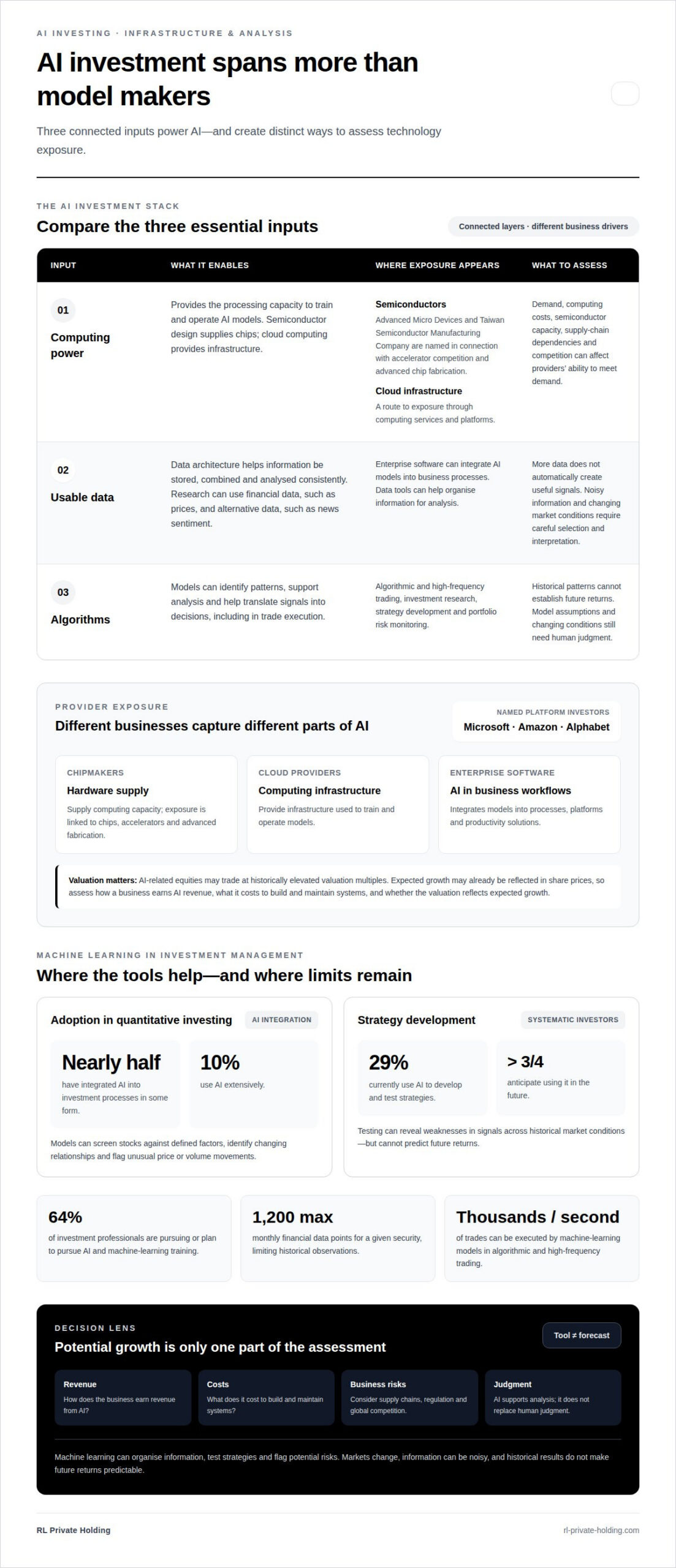
AI investment depends on three connected inputs: computing power, usable data and effective algorithms. Semiconductor design supplies processing capacity, while cloud computing provides infrastructure to train and operate models. Enterprise software can integrate those models into business processes. Alongside cybersecurity and robotics, these areas show why AI-related investment extends well beyond model developers.
Data architecture determines whether information can be stored, combined and analysed consistently. Investment research may draw on conventional financial data, such as prices, and alternative data, such as news sentiment. A model can process millions of data points, but volume alone does not produce useful signals. In financial markets, noisy information and changing conditions make careful selection and interpretation essential.
Algorithms also support trade execution. Machine-learning models can execute thousands of trades per second in algorithmic and high-frequency trading. They may identify complex patterns across price movements and news, then help translate signals into decisions. However, monthly data for a given security reaches at most 1,200 financial data points, limiting historical observations. The evolution of computing does not remove that constraint.
When assessing AI-related investment products in Luxembourg, consider their legal form, disclosures and distribution terms under the applicable EU and Luxembourg framework. AI exposure alone does not explain how a product is structured or governed.
For individual investors in Luxembourg, tax treatment depends on the investment and the type of return. Dividends, interest and gains from selling an investment may be treated differently, so the instrument and transaction both matter.
Key risks include elevated valuations, regulatory uncertainty, supply-chain dependencies and intensifying global competition. Semiconductor capacity and computing costs can affect providers’ ability to meet demand. Competitive pressure may challenge growth expectations, while changing rules can affect business models. Investors should weigh these factors when assessing potential returns and downside exposure.
AI and machine learning in investment management
Investment managers apply artificial intelligence to research, portfolio construction and risk monitoring. In quantitative investing, models can screen stocks against defined factors, identify changing relationships and flag unusual price or volume movements. Nearly half of quantitative investors have integrated AI into their investment processes in some form, while 10% use it extensively. For investors assessing AI and machine learning investment opportunities, this distinction shows how tools can support analysis without directing decisions.
Systematic investors also use advanced models to develop and test strategies. Currently, 29% use AI for this purpose, and more than three-quarters anticipate using it in the future. A model might compare a proposed strategy against historical market conditions, then assess how its signals behave across different assets. Testing can reveal weaknesses, but financial markets change, so historical patterns cannot establish future returns.
Alternative information can broaden research beyond company accounts and price histories. Natural-language tools can classify themes in earnings transcripts, news coverage and social media posts, helping analysts organise large volumes of text. A sentiment signal, for example, may prompt further review of a company’s disclosures. It is not, by itself, a reason to buy or sell a stock.
AI can also help monitor portfolio exposures by grouping assets with similar sensitivities or identifying concentrations across holdings. These applications can direct attention to potential risks, but portfolio managers still need to assess liquidity, investment objectives and model assumptions. AI and machine learning investment opportunities include analytical applications, yet these tools cannot consistently predict future returns. Combining data-led analysis with human judgment remains important, especially when conditions or objectives change.
Skills development is part of this adoption: 64% of investment professionals are pursuing or plan to pursue AI and machine-learning training. In 2022, 81% of institutional investors expressed greater interest in funds relying primarily on AI and big-data tools, while 87% said increased technology use made them trust their asset manager more. Investors considering how analytics relate to portfolio decisions can explore this investment management perspective.
Investing in AI technology providers
Investors can gain exposure to AI through companies that supply chips, cloud infrastructure and enterprise software. Each layer has distinct revenue drivers, competitive pressures and risks to assess.
Semiconductor businesses support the computing capacity AI systems require. Advanced Micro Devices and Taiwan Semiconductor Manufacturing Company are identified as growth opportunities through accelerator competition and advanced chip fabrication. Microsoft, Amazon and Alphabet are investing heavily in AI-enabled platforms and enterprise productivity solutions. Their exposure differs: chipmakers supply hardware, while cloud and software groups develop services and integrate AI into products.
Company Valuations and Growth Forecasts
Valuation compares a company’s market price with measures of its business and expected growth. Many AI-related equities trade at historically elevated valuation multiples, even as demand for computing infrastructure and intelligent automation points to potential long-term growth. Expectations may already be reflected in share prices. Research should therefore assess whether revenue models, competitive position and infrastructure spending support those expectations.
Building a Diversified AI Portfolio
A diversified AI portfolio spreads exposure across businesses with different roles in the technology chain. To compare companies, first group them into semiconductors, cloud infrastructure and enterprise software. Then assess each business model, competitive position and valuation. This approach can reduce dependence on a single segment, but it cannot eliminate investment risk. Reviewing how each holding affects overall exposure helps clarify risk management.
For example, comparing Advanced Micro Devices with Microsoft means comparing different sources of AI-related revenue, not interchangeable businesses. Chip fabrication and accelerator competition shape semiconductor providers, while cloud services and enterprise productivity solutions shape platform providers. A global portfolio may also face supply-chain dependencies, regulatory uncertainty and intensifying competition. These risks can affect growth expectations even as demand for AI applications continues.
Algorithms and artificial intelligence are changing investment research, but company analysis still depends on commercial fundamentals. Ask whether a provider can turn AI development into durable demand and whether its valuation reflects that opportunity. Comparing companies across semiconductors, cloud infrastructure and enterprise software helps distinguish infrastructure exposure from end-user applications, supporting more considered portfolio decisions.
What are the current valuations and growth forecasts for major AI companies?
AI-company valuation compares a share price with measures such as earnings, revenue and expected business growth. Many AI-related equities trade at historically elevated valuation multiples, while demand for computing infrastructure and intelligent automation suggests potential for sustained growth. The key question is whether future business performance can support the expectations already reflected in current prices.
Forecasts depend on more than demand for AI tools. For a chip provider, analysts consider fabrication capacity, customer demand and competition in accelerators. For a cloud platform, they examine infrastructure investment, adoption of AI-enabled services and enterprise spending. A company may benefit from wider adoption while facing substantial costs to build and operate the systems behind its services.
Growth estimates are therefore assumptions, not outcomes. The AI investment sector is expected to grow by 36.6% year-on-year until 2030, but that broad forecast does not establish the prospects of any individual company. Investors can compare a company’s expected growth with its valuation, revenue sources and ability to convert demand into sustainable earnings.
Competition can change the assumptions behind a valuation. A provider developing advanced chips may face new rivals, while an enterprise software firm must demonstrate customer adoption of its AI features. Supply-chain dependencies can constrain infrastructure expansion, and regulatory uncertainty may affect how providers develop or distribute products. These factors can alter forecasts even when overall demand for AI remains strong.
For a practical comparison, review each company’s growth drivers, costs, competitive position and valuation assumptions side by side. Then consider how the investment would affect portfolio concentration and risk management. An expected growth rate is most useful when paired with the conditions required to achieve it, rather than treated as a return forecast. To discuss broader portfolio considerations, explore investment strategy.
RL Private Holding: Venture Capital Funding
RL Private Holding provides Venture Capital Funding for investors considering exposure through private businesses rather than listed shares. This can be relevant when your analysis of AI providers leads you to consider private companies, alongside the valuation and broader risks discussed above.
For investors considering how private-market exposure fits within a broader investment approach, RL Private Holding also provides Private Equity Investment Management and Wealth Management Services. Real Estate Asset Management offers a separate area of investment focus. The relevant considerations depend on your objectives, preferred investment structure and risk tolerance.
Visit RL Private Holding to discuss how its investment offerings relate to your objectives.
Turn analysis into an investment perspective
Assessing AI and machine learning investment opportunities comes down to fit: how a potential exposure relates to your objectives, time horizon and tolerance for risk. Start by defining the role AI-related assets could play in a broader investment strategy, then distinguish direct exposure to technology providers from private-market considerations. This keeps decisions focused on portfolio purpose rather than market attention.
RL Private Holding offers Venture Capital Funding, Private Equity Investment Management and Real Estate Asset Management. These services may suit investors considering private businesses or broader asset allocation alongside public-market exposure. Begin by clarifying your objectives, preferred investment structure and how each option relates to your overall portfolio. This helps identify the considerations to address before making an investment decision.
Contact RL Private Holding to discuss how its investment offerings may relate to your goals. Contact RL Private Holding to take the next step and develop a considered investment perspective.
Frequently Asked Questions
What are the main ways to invest in AI and machine learning?
Investors can gain exposure through publicly traded technology companies, funds holding AI-related businesses or private-market investments. The right route depends on whether you prefer readily traded securities or a longer-term commitment to private companies. A fund may spread exposure across several providers, while buying an individual company’s shares concentrates risk in that business. Compare the investment structure, underlying holdings and liquidity before deciding.
Which publicly traded companies are leading in AI and machine learning?
Examples include Advanced Micro Devices and Taiwan Semiconductor Manufacturing Company in semiconductors, alongside Microsoft, Amazon and Alphabet in platforms and enterprise software. These companies represent different parts of the AI ecosystem, not a single comparable category. Review each company’s financial statements, customer concentration, capital requirements and competitive position to understand its exposure. Their inclusion is neither a ranking nor a forecast of investment performance.
How can investors access private AI startups and venture capital funds?
Investors typically access private AI businesses through venture capital funds or direct investments in private companies. Fund documents explain the investment mandate, commitment structure, holding period and withdrawal conditions. Direct investment requires assessing the company’s financing terms, business model and potential dilution. For founders seeking capital, RL Private Holding offers Venture Capital Funding. Choose a route that fits your objectives and ability to hold an illiquid investment.