

A strong product can still fail to meet a venture investor’s requirements for growth and scale. The common reasons VCs pass on an investment include a mismatch with the company’s stage, insufficient return potential, a limited or poorly timed market, and a business model that cannot scale efficiently. Investors also consider whether an exit could deliver a significant return within their typical 5-10-year investment horizon.
It’s understandable to focus on product quality and customer interest when assessing a venture. Both matter, but investors also need a credible path from demand to sustainable growth and returns.
This article explains how stage and risk shape investment decisions, why return potential and exit prospects matter, and how market size and timing affect the case. It also examines scalability, including how cash flow, margins, and operating costs influence whether a business can grow without costs rising at the same pace.
Key Takeaways
- Match the evidence a company can provide to its investment stage, including team capability and signs of product-market fit.
- Assess whether a credible exit path could convert the company’s growth into returns within an investor’s time horizon.
- Test the market case for both demand and timing, rather than relying on market size alone.
- Examine cash flow, margins and cost structure to determine whether growth can continue without costs rising at the same pace.
1. Early-stage versus later-stage risk
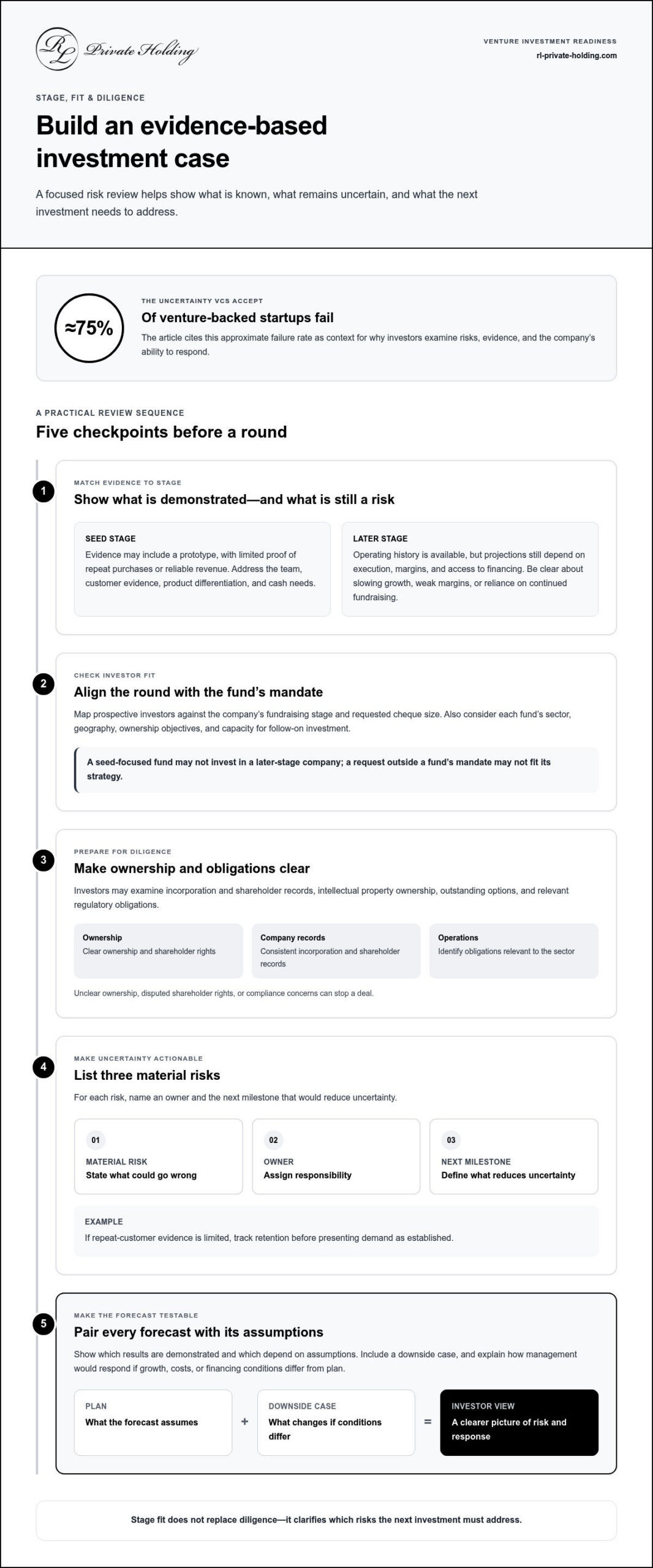
Early-stage and later-stage investments expose a fund to different uncertainties. At seed stage, investors may see a prototype but little evidence of repeat purchases or reliable revenue. They assess the team, customer evidence, product differentiation, and cash needs. Later-stage companies have more operating history, but projections still depend on execution, margins, and access to financing. The investment case should match the evidence available at the company’s stage.
Approximately 75 % of venture-backed startups fail, reflecting the uncertainty VCs accept in pursuit of returns. Early-stage risk can arise from untested demand, incomplete products, or a team still developing its operating model. Later-stage risk can include slowing growth, weak margins, or forecasts that rely on continued fundraising. A pitch should distinguish demonstrated results from assumptions, then show how management will test the largest uncertainties.
Legal, regulatory, or cap table issues can stop a deal if ownership is unclear, shareholder rights are disputed, or compliance concerns threaten the business model. Investors examine incorporation and shareholder records, intellectual property ownership, outstanding options, and relevant regulatory obligations. In Luxembourg, founders should keep company records consistent and identify the obligations that apply to their sector. These checks help investors understand who owns the business and what could constrain its operations.
The fundraising stage, cheque size, and fund thesis must also align. A seed-focused fund may not invest in a later-stage company, while a request outside its mandate may not fit its strategy. Funds also assess sector, geography, ownership objectives, and capacity for follow-on investment. Before starting a round, founders can map prospective investors against these criteria and avoid approaches that conflict with a fund’s stated focus.
Start risk management with a short, evidence-based review. Identify three material risks, assign an owner to each, and specify the next milestone that would reduce uncertainty. For example, a team with limited evidence of repeat customers can track retention before presenting demand as established. Pair every forecast with its assumptions and downside case. This helps investors assess how the company might respond if growth, costs, or financing conditions differ from plan. Stage fit does not replace diligence, but it clarifies which risks the next investment must address.
2. Exit strategy and investor returns
Venture capital funds typically have lives of 10 or more years. Yet VCs often seek significant returns within 5-10 years. A company needs a credible route from growth to liquidity. Common exits include mergers, acquisitions, and initial public offerings. If none fits the business, investors may struggle to see how returns materialise. A strong pitch identifies plausible buyers or public-market conditions, without treating an exit as certain.
Fund returns are unpredictable because a small number of investments can drive overall performance. One historical example illustrates the scale of possible outcomes: by 1999, Kleiner Perkins Caufield & Byers’ investment in Amazon had generated returns exceeding 55,000%. That outcome is exceptional, not a standard forecast. Investors therefore examine whether the company’s potential can meaningfully affect fund performance, while accounting for the probability and timing of weaker outcomes.
Valuation and deal terms shape the potential return for a given level of risk. A high entry valuation can leave less room for an investor’s stake to grow in value. Terms covering ownership, dilution, governance, and liquidation preferences also affect proceeds at exit. Founders should model how a sale at different values would distribute proceeds among shareholders, then explain how the proposed terms support alignment.
After a pass, founders can request concise feedback on the main reason for the decision. Ask whether the concern involved market timing, valuation, fund fit, or the exit case. Record the response, compare it with other investor feedback, and change the pitch only when evidence supports doing so. For example, if potential buyers are difficult to identify, strengthen the analysis of likely acquirers and strategic value. This turns a rejection into a specific improvement task.
Property-led ventures should also explain how underlying assets contribute to enterprise value and possible exit routes. Clear asset management planning can help frame how those assets support a business’s operating and investment case.
3. Market size and growth potential
A large market matters only if a company can reach its customers. VCs assess whether demand can support substantial growth and potential returns. Founders should define the target market, identify the buyers, and explain how the product reaches them. For a Luxembourg-based venture, a clear case might show how a defined local customer group connects to broader European demand. That expansion needs evidence, not just a large global market estimate.
Venture investments can produce returns of 10x, 50x, or even 100x, but those outcomes require room to grow. Investors compare the company’s likely share of its market with its valuation and execution risks. A business serving a narrow customer segment may struggle to support venture-scale growth, even with strong early sales. A focused initial market can still support an ambitious case if the company shows credible adjacent segments.
Build the market case on customer evidence. Show user growth, revenue, or partnerships, then explain what each signal demonstrates. Rising usage, for example, indicates engagement, while repeat purchases can point to sustained demand. Partnerships may show that established organisations see a practical use for the product. Connect each signal to the customer segment instead of presenting activity without context. A VC needs to understand whether demand is growing and why.
Timing matters as much as market size. In a saturated market, customer acquisition can be difficult. Enter too early, and buyers may not be ready or supporting infrastructure may be lacking. Founders can compare the product with existing alternatives, identify the unmet need, and explain what has changed to make adoption more plausible now. Economic and market conditions also affect potential returns, so projections should state their assumptions. In Luxembourg, a cross-border growth plan should clarify which customer groups come next and what evidence supports that sequence. A disciplined market narrative links customer demand to reachable growth instead of relying on headline market estimates alone.
4. Business scalability
A scalable company can increase revenue without costs rising at the same pace. VCs examine whether growth requires additional staff, equipment, or service hours for every new customer. A software company, for example, may serve more users through existing software after development. Support, hosting, and sales costs still matter. Investors look for evidence that additional revenue can outpace the resources needed to generate it.
Weak traction, limited revenue, or unclear product-market fit makes future growth harder to assess. Without repeat use, customer retention, or sales, a forecast may rely more on assumptions than observed demand. Investors then have less evidence that the product solves a lasting customer problem. Founders should separate actual results from projections and show how each signal, such as returning customers, supports a repeatable sales model.
Unit economics show whether each customer contributes to a sustainable model. If acquiring a customer costs more than the revenue that customer generates, expansion can increase losses instead of improving the business. VCs therefore scrutinise cash flow, margins, and projections. Founders can explain acquisition costs, customer revenue, delivery expenses, and the assumptions behind each measure. A clear path to stronger contribution margins matters more than growth presented without its costs.
Scalability also depends on operational capacity. A service business may need more employees for every new client, while a digital product can often add customers at lower incremental cost. Neither model is automatically stronger. Investors assess whether processes, staffing, technology, and customer support can handle expansion without eroding quality or margins. For a Luxembourg venture planning cross-border growth, explain how delivery and customer support will adapt across markets.
Prepare a simple operating model before seeking investment. Show how revenue, cash flow, and margins respond as customer demand grows, then identify the constraint that could slow expansion. For example, if onboarding requires substantial staff time, describe how the process could become more efficient. This analysis helps distinguish a business that merely grows from one that can scale sustainably. To discuss investment decisions through a growth and operating-model lens, explore investment management.
RL Private Holding: Venture Capital Funding
RL Private Holding provides Venture Capital Funding for businesses seeking investment to support development and growth. The factors above can help founders assess whether their company’s stage, market opportunity, return potential, and scalability align with venture capital expectations. A strong investment case connects customer demand to a viable growth model and explains the risks that remain.
Founders can use this framework to prepare for an investment discussion, clarify funding objectives, and identify the evidence behind their plans. Venture capital may not suit every business model or funding need, so the proposed approach should reflect the company’s objectives and growth strategy.
Contact RL Private Holding to discuss Venture Capital Funding in relation to your business’s investment requirements.
Prepare for a more focused investment discussion
Understanding the common reasons VCs pass on an investment can help founders turn investor scrutiny into a clearer funding strategy. Next, assess whether the company’s priorities call for external capital, longer-term investment management, or a different approach to its assets. The decision should reflect the business’s objectives and the role investment can play in achieving them.
RL Private Holding offers Venture Capital Funding, Private Equity Investment Management, and Real Estate Asset Management. These services address distinct investment needs, from funding business growth to managing private equity investments and real estate assets. Consider which need is most relevant before starting a discussion.
Contact RL Private Holding to discuss your investment requirements and potential next steps. A disciplined approach can help you present your objectives with greater clarity and move forward with confidence.
Frequently Asked Questions
What are the most common reasons venture capitalists pass on a startup investment?
VCs often pass when a startup’s funding needs, ownership structure, or growth profile does not fit their investment mandate. Other common reasons VCs pass on an investment include unclear customer demand, limited differentiation, or an inability to explain how capital will be used. Founders can strengthen their pitch by supporting each claim with evidence, such as customer interviews, signed contracts, or a clear breakdown of planned spending.
How often do VCs reject startups because of market size or growth potential?
There is no single rejection frequency because funds assess market potential against their own investment strategies and return objectives. A market may seem too small to one fund but suit another focused on a specialist sector. Founders can make the opportunity easier to assess by defining the buyer, showing how the company can reach more customers, and explaining which adjacent customer groups could support expansion.
Why do VCs pass on startups due to founder or team concerns?
VCs may hesitate if founders lack relevant expertise, divide responsibilities poorly, or struggle to make decisions together. A technical product, for example, may need commercial leadership to build customer relationships and sales capability. Founders can address concerns by clarifying each person’s role, describing how key decisions are made, and identifying experience gaps alongside a credible plan to fill them.
What competitive and market risks lead VCs to reject a startup?
Investors may pass if established competitors can copy the offer, control customer access, or respond quickly with lower prices. Demand may also be difficult to sustain when buyers have little reason to change existing habits. Founders should map direct alternatives, explain why customers would switch, and show how the company can protect its position through specialised expertise, customer relationships, or defensible intellectual property.