

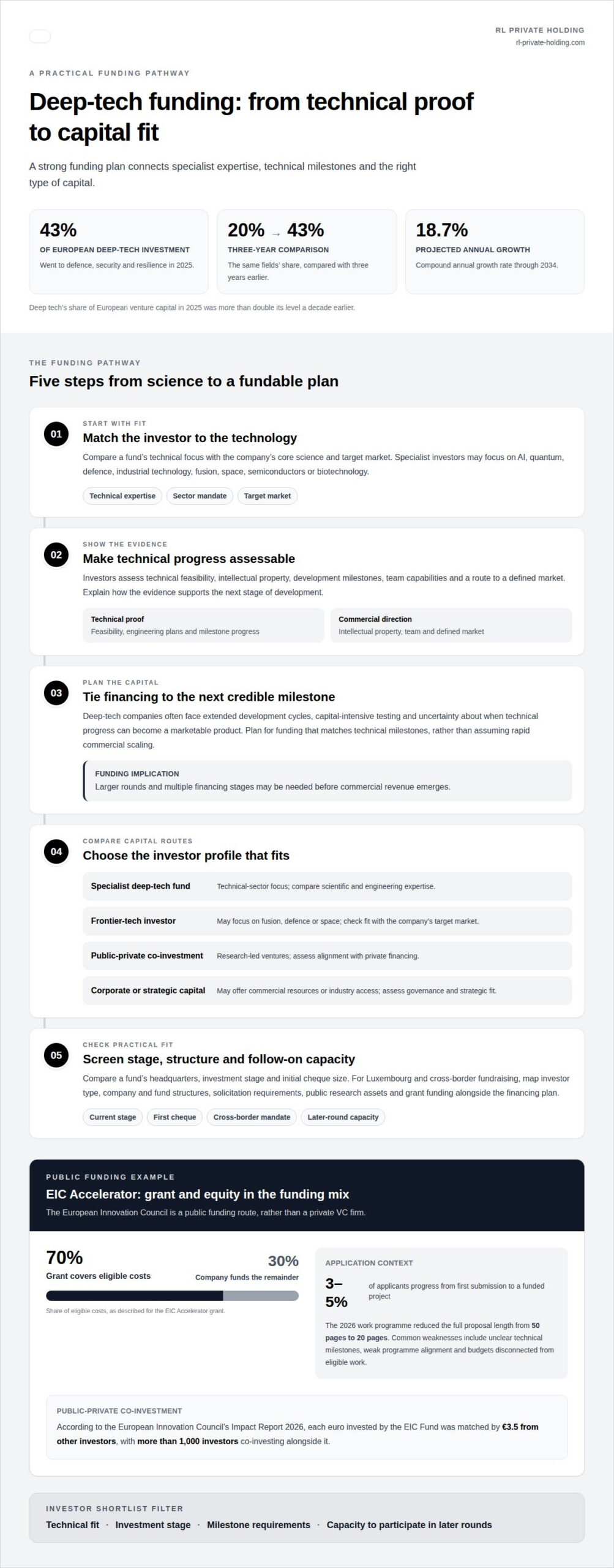
Deep tech’s share of European venture capital in 2025 was more than double its level a decade earlier. Venture capital for deep tech companies is expanding as investment in areas such as defence, security and resilience grows; those fields represented 43% of European deep tech investment in 2025, compared with 20% three years earlier. The market is projected to grow at an 18.7% compound annual growth rate through 2034.
Deep tech can be a demanding investment: companies often face extended development cycles and need capital aligned with technical milestones, rather than rapid commercial scaling. That longer horizon is drawing specialist funds and investors into the sector.
This comparison explains the growth of venture capital for deep tech companies and shows how funds differ by location, investment focus, stage and initial cheque size. It also considers what those differences mean for companies seeking capital in Luxembourg and across Europe, helping you identify fund profiles suited to your technology and financing stage.
Key Takeaways
- Distinguish research-intensive ventures from conventional technology startups by considering development milestones, capital needs and time to market.
- Compare specialist investors by technical focus, including AI, quantum, defence and industrial technology, rather than relying on reputation alone.
- Use a fund’s location, investment stage and first-check size to narrow the options that align with your company’s financing needs.
- Assess whether venture capital funding or a broader investment approach best fits your company’s stage and long-term objectives.
Why is deep tech VC growing faster than traditional VC?
Deep tech attracts capital because technical breakthroughs can enable new industries, even as they require longer development and financing pathways. In Europe, specialist investors and public-private co-investment are part of the same ecosystem.
Deep Tech and Traditional Technology Investments
Traditional technology investments often prioritize software adoption, customer growth and commercial execution. Deep tech startups also need to demonstrate technical feasibility, protect intellectual property and reach demanding engineering milestones before revenue scales. That distinction affects how investors assess a target company and structure successive funding series. A fusion venture, for example, must advance its underlying technology before it can compete for commercial deployment.
Deep-Tech Fund Investment Focus
Deep-tech venture capital firms focus on research-led businesses where technical progress and capital needs shape investment decisions. Frontier-tech funding spans fusion, defence and space, as well as fields such as semiconductors and biotechnology. These funds differ from general technology investors in their sector expertise and ability to assess laboratory results, engineering plans and industrialisation. For founders, matching a fund’s focus to the company’s core technology is a practical first filter.
For fundraising in Luxembourg and the EU, relevant requirements depend on the company and fund structures, investor type, cross-border solicitation, and any public research assets or grant funding involved. Map these factors early alongside the financing plan, particularly if the transaction spans multiple countries.
Investors assess a startup’s technical evidence, intellectual property, development milestones, team capabilities and route to a defined market. They also consider whether the proposed funding can take the company to its next credible technical or commercial milestone.
The main challenges are long development cycles, capital-intensive testing and uncertainty about when technical progress can become a marketable product. These pressures can mean larger rounds and multiple financing stages before commercial revenue emerges.
Public-private capital can help address that funding gap. According to the European Innovation Council’s Impact Report 2026, each euro invested by the EIC Fund was matched by €3.5 from other investors, with more than 1,000 investors co-investing alongside it.
| Investor option | Focus | Useful comparison criterion |
|---|---|---|
| Specialist deep-tech fund | Technical sectors | Scientific and engineering expertise |
| Frontier-tech investor | Fusion, defence or space | Fit with the company’s target market |
| Public-private co-investment | Research-led ventures | Alignment with private financing |
Shortlist investors by technical fit, stage, milestone requirements and capacity to participate in later rounds.
Who are the top deep tech and hard science VCs?
There is no single investor profile across AI, quantum, defence and industrial technology. Founders should compare specialist VC funds by technical expertise, investment stage and ability to support a company’s transition from science to deployment. In Europe, deep tech accounted for 32% of venture capital funding in 2025, reflecting its place in the wider innovation ecosystem.
The European Innovation Council (EIC) is a major public funding route, rather than a private VC firm. The EIC Accelerator combines grants and equity: its grant covers 70% of eligible costs, while the company funds the remaining 30%.
Public funding can support technical development without immediately requiring founders to give up equity. Private VC can provide risk capital and support successive growth rounds, while corporate investors and strategic partnerships may bring commercial resources or industry access. Contributions and terms vary, so assess governance, strategic fit and the intended use of funding.
Application quality matters. Only 3% to 5% of EIC applicants progress from first submission to a funded project. The 2026 work programme reduced the full proposal length from 50 pages to 20 pages. Common mistakes include weak alignment with the programme’s objectives, unclear technical milestones and budgets that do not connect costs to eligible work. Build the proposal around those links.
Subsector funding also influences investor choice. AI, quantum, defence and industrial technology each call for different expertise and routes to adoption. Compare each fund’s stated focus with the company’s science, target market and next financing milestone.
There is no universal equity or valuation term for deep tech rounds. One illustrative transaction gives up 20% equity to raise €2.5 million at a €10 million pre-money valuation. Founders can use this as a comparison point, not a standard; the amount raised, valuation and negotiated terms determine dilution.
For a company assessing its capital structure, venture capital funding can form part of a broader investment discussion.
Fund headquarters, focus, stage, and first-check sizes
Compare funds by headquarters, technical focus, financing stage and initial cheque size. For Luxembourg startups, cross-border mandates and follow-on capacity can affect the fit.
Founders in Luxembourg can consider European and international funds with relevant sector mandates. Shortlist investors based on whether they are active in the company’s field, invest at its current stage and take an approach suited to its development plan. Choosing venture capital for deep tech companies starts with these practical fit criteria, not geography alone.
Fund Headquarters and Investment Focus
A fund’s headquarters shows where it is based, while its investment focus indicates the technologies and markets it targets. A Luxembourg company can compare locally based investors with funds elsewhere in Europe, then check whether their mandates cover its technical field. For example, an industrial technology startup should prioritise investors able to assess engineering and deployment, rather than choosing a fund solely for proximity.
Matching Funds to Startup Stages
Match the fund’s stage mandate to the company’s financing round. Pre-seed and seed investors often support early technical validation; Series A investors assess progress towards product-market fit and commercial execution. Later-stage funds focus on scaling operations and market reach. Before approaching a fund, map the company’s current evidence, next milestone and intended use of capital to the fund’s stated stage. This makes venture capital for deep tech companies more targeted.
First Checks and Typical Check Sizes
First-check size varies with fund type and stage. Accelerator-affiliated funds typically invest in pre-seed or seed rounds, while Series A and growth funds can commit larger amounts as technical and commercial requirements expand. Later-stage financing needs can reach €100 million or more, depending on the technology. Compare a potential first check with the capital needed to reach the next milestone and the company’s likely follow-on requirements.
Shortlist funds by stage, sector mandate, initial investment capacity and willingness to participate in later rounds. This helps distinguish investors suited to early validation from those positioned to support industrial scale-up.
Deep tech venture capital firms and funds
Deep tech funds differ from generalist venture investors through their technical mandates, diligence methods and portfolio construction. More than 120 established hard-science VC firms are writing checks across fusion, space, semiconductors and biotechnology. That breadth matters: a fund experienced in semiconductor manufacturing may assess a company differently from one focused on fusion research or space systems.
When raising capital, start with each fund’s published investment thesis. Check whether its portfolio reflects relevant science, customers and routes to revenue. A portfolio of research-led companies can indicate experience with technical milestones, while a focus on software growth may point to a different investment approach. Look for signs of strategic support, such as help with industrial partnerships, customer access or later financing.
Diligence should test both the science and the business case. Prepare a concise account of the technical evidence, intellectual property position, development milestones and assumptions behind the commercial model. Connect each funding request to a defined use, such as prototype development, testing or production readiness. This helps investors see how capital can move the company towards revenue, rather than treating research progress as a substitute for a target market.
Deep-tech venture capital firms also vary in how they build portfolios. Some concentrate on a defined technical field, while others invest across multiple hard-science sectors. Deep-tech unicorns numbered more than 540 globally in 2025, but that broad total does not make every company comparable. Founders should examine the fund’s individual investments and the stage at which it backed them, not rely on a headline portfolio count.
Build a practical shortlist using three filters: technical fit, relevant investment experience and capacity to support the company’s next financing needs. For example, a space company should prioritise funds experienced in assessing space technology and its route to commercial use. This keeps the process focused on investor fit, not brand recognition alone.
For a discussion of strategic investment options, consider investment opportunities.
RL Private Holding: Venture Capital Funding
RL Private Holding provides venture capital funding for companies seeking investment to advance their business objectives. After comparing funds by technical focus, stage and investment capacity, founders can assess how this offering aligns with their financing needs and development plans.
This offering may suit a company assessing how to fund its next phase and considering venture capital as part of a broader investment context. RL Private Holding also offers private equity investment management, real estate asset management and wealth management services, each suited to different investment needs.
Prepare a concise overview of the company’s technology, current stage, intended use of capital and key milestones. This gives you a clear basis for discussing venture capital’s role in the company’s plans. Contact RL Private Holding to discuss its venture capital funding.
Prepare for the Next Financing Decision
A disciplined approach to venture capital for deep tech companies starts with a financing plan that can evolve alongside the business. Set out how each investment will support the next technical or commercial milestone, and keep the assumptions visible as the company progresses. This gives founders a practical basis for discussing capital needs, timing and strategic priorities with prospective investors.
As the company develops, revisit the plan in light of new evidence, market changes and the resources needed to execute. Financing decisions are not isolated events: each can shape the company’s future options, ownership structure and capacity for growth. Clear priorities help keep those decisions connected to the long-term business objective.
For an investment discussion relevant to your company’s plans, contact RL Private Holding. A considered next step can help you move forward with greater clarity and purpose.
Frequently Asked Questions
Do deep tech VCs invest at pre-seed?
Yes. Some deep tech investors participate at pre-seed, particularly accelerator-affiliated funds and specialists assessing research-led ventures. At this stage, founders can present a defined technical problem, early experimental evidence and a credible plan for the next validation milestone. A complete commercial track record is not the only basis for discussion; the quality of the science and the team’s ability to execute also matter.
How should you pitch deep tech VCs in 2026?
Build the pitch around a clear investment case, not a technical presentation alone. Explain the customer problem, why the technology offers a defensible solution, what evidence supports its feasibility and how the company will reach adoption. In 2026, founders should also make the requested capital and planned milestones easy to connect. Use concise evidence, distinguish demonstrated results from hypotheses, and tailor the pitch to each fund’s mandate.
What counts as a deep tech company, and how is it different from other startups?
A deep tech company develops technology originating in high-tech research and development, including work from public or private research labs, small and medium-sized enterprises, or startups. Its core advantage depends on scientific or engineering progress, rather than mainly applying established technology to a new business model. For example, a venture commercialising a novel materials process fits this profile more closely than a standard software company using existing tools.
How much venture capital do deep tech startups typically raise at pre-seed, seed, and Series A?
There is no single amount for pre-seed, seed and Series A deep tech rounds. Required capital depends on the technology, testing and equipment needs, team costs, and milestones to reach before the next round. A laboratory-based company may have different needs from a software-intensive venture. Build a milestone-based budget, separating essential development costs from later expansion, and size the raise around that plan.
How can a deep tech company prepare for venture capital fundraising?
Prepare a concise data room before approaching investors. Include a summary of technical evidence, intellectual property records, a development roadmap, a detailed use-of-funds plan and a clear account of customer discovery. Assign an owner to each diligence area and ensure financial projections match the development schedule. Founders should also agree internally on fundraising objectives and decision-making authority so investor discussions stay consistent and timely.
How long does deep tech fundraising typically take, and what are the main steps?
A Series A deep-tech fundraise typically takes 9-12 months. Map the company’s technical evidence, intellectual property, team, target market, next milestone and capital use; then shortlist funds by technical focus, stage, check size and follow-on capacity.