

The corporate venture capital vs traditional VC divide does not rule out collaboration: both types of investor can co-invest in a startup while bringing different objectives and resources to a funding round. Traditional VCs generally focus on financial returns, while CVCs may also seek strategic value for a corporate parent. Their interests can complement each other when expectations are aligned.
It’s reasonable to see these investors as pursuing different priorities. For founders, understanding those priorities helps clarify what each investor may contribute, how decisions can differ, and what to consider when combining capital. The history of corporate venture investing reaches back to Pierre S. Du Pont’s investment in General Motors in 1914, and the model has since developed alongside traditional VC.
This comparison explains how the two approaches differ in objectives, investment horizons, decision-making, and startup support. It also looks at how CVC and traditional VC investors can participate in the same round, and how founders can assess whether their financial and strategic goals align.
Key Takeaways
- Compare investors by their return objectives, decision-making processes and investment horizons, not funding alone.
- Assess whether a corporate investor’s strategic priorities align with your startup’s plans for growth and independence.
- Consider how corporate expertise, networks and resources could complement the financial focus of traditional venture capital.
- Plan a hybrid funding round around clear roles, aligned expectations and transparent terms for each investor.
- Explore how corporate venture capital has evolved to understand why it now forms part of the broader funding landscape.
Why do corporates invest in risky ventures?
Corporate venture capital (CVC) can expose a startup to risks beyond ordinary financing. A parent company, for example, may change its strategic priorities, reduce investment, or become a competitor. Before accepting corporate capital, founders should assess information-sharing, commercial exclusivity, and expectations for future funding.
Corporates invest because startups can offer access to innovation, technologies, and markets that complement an established business. A CVC investment may support a commercial partnership or help a parent understand an emerging field. Traditional venture capital (VC), by contrast, generally targets financial returns, often backing high-growth businesses with the potential for substantial exits.
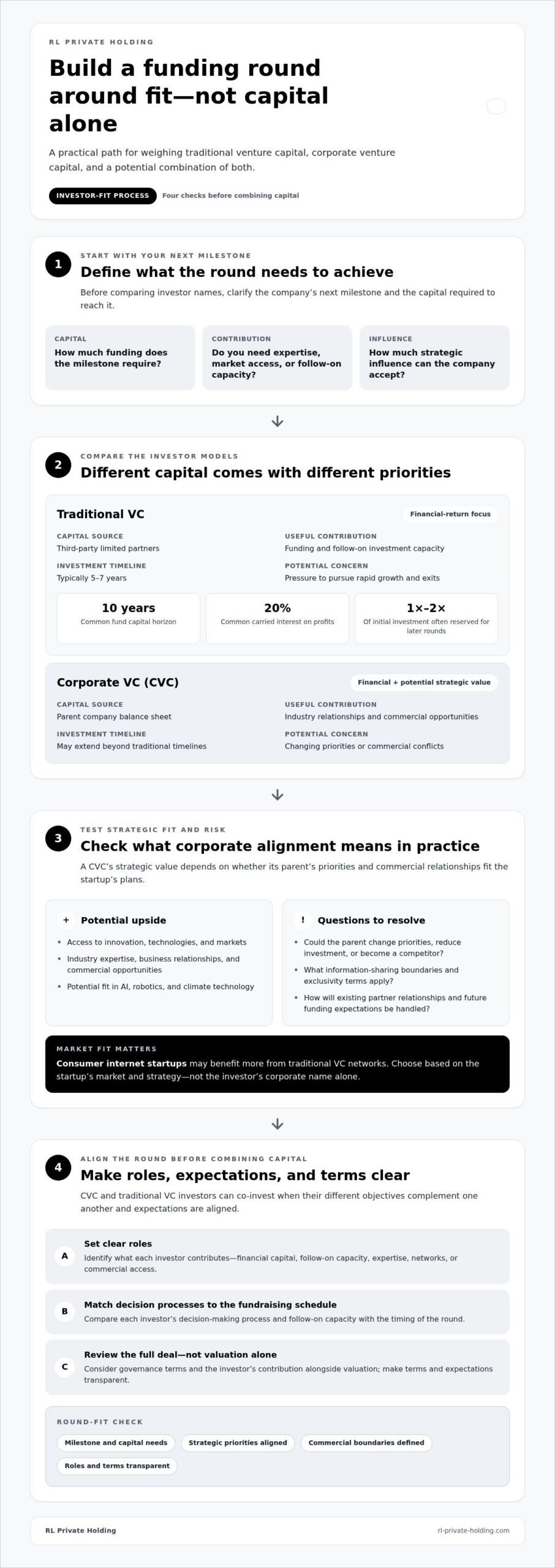
Those different purposes shape investor incentives. Traditional VC funds commonly operate on a 10-year capital horizon and generally receive carried interest equal to 20% of profits generated by their investment activities. Their investment capital comes from third-party limited partners. CVC capital comes from the parent company’s balance sheet, so corporate strategy and financial performance can influence investment focus or deployment.
Investment timelines also affect fit. Traditional VC funds and CVCs can differ in their investment horizons. Traditional firms often make high-risk, high-reward investments, expecting a few major successes to offset modest losses. Business angels typically invest smaller amounts and at earlier stages than venture capital funds. Traditional VCs usually reserve another 1x-2x of their initial investment for later rounds.
Use these criteria to compare investors during fundraising:
| Criteria | Traditional VC | Corporate VC |
|---|---|---|
| Primary objective | Financial returns and high-growth exits | Financial returns and potential strategic value |
| Capital source | Third-party limited partners | Parent company balance sheet |
| Time horizon | Typically 5-7 years for investments | May extend beyond traditional timelines |
| Useful contribution | Funding and follow-on investment capacity | Industry relationships and commercial opportunities |
| Potential concern | Pressure to pursue rapid growth and exits | Changing priorities or commercial conflicts |
To choose between corporate venture capital vs traditional VC, start with your company’s next milestone. Identify the capital required, the expertise or market access you need, and the level of strategic influence you can accept. Then compare each investor’s follow-on capacity and decision-making process with your fundraising schedule.
The figure illustrates how funding and dilution interact, but it cannot determine whether an investor is suitable. Consider governance terms and the investor’s contribution alongside the valuation.
Corporate capital can be valuable in AI, robotics, and climate technology, where a parent may offer relevant expertise or commercial connections. Consumer internet startups may benefit more from traditional VC networks. Choose according to your startup’s market and strategy, not the investor’s corporate name alone.
Financial and strategic objectives of corporate venture capital
A CVC investment can create commercial conflicts if a startup works with companies that compete with its parent. Before accepting capital, founders should define information-sharing boundaries and exclusivity terms, and agree how existing partner relationships will be protected.
CVCs balance financial returns against strategic value, but the balance varies by corporate investor. This distinction shapes how investments are assessed and how the relationship may develop.
Strategic and Commercial Goals
A CVC may invest to strengthen its parent’s market position, access technologies, or develop commercial partnerships. For example, a corporate investor could connect a startup with business groups that understand its target customers. That access differs from a traditional VC’s primary focus on financial returns. It can create useful synergies if the startup’s commercial roadmap also benefits.
These strategic objectives can change. A parent company may revise its priorities or financial outlook, affecting the CVC’s investment focus or capital deployment. Stanford Graduate School of Business notes that CVC arms have historically faced challenges in achieving both financial and strategic objectives. Founders should establish which outcomes matter to the corporate partner before counting projected business access as part of the investment’s value.
Financial Goals of CVCs
Financial returns remain relevant to CVCs, even when strategic objectives carry greater weight. The corporate investor commits capital to a startup and may benefit if its value grows. Unlike an independent fund that assesses investments primarily against investor returns, a CVC may also consider its parent’s commercial position. The emphasis varies among CVCs, so founders should clarify how the investment will be assessed.
Corporate parents acquire companies backed by CVCs relatively infrequently, suggesting a preference for strategic partnerships over direct acquisitions. A startup should not treat an investment as an implied purchase offer. Instead, distinguish the equity relationship from potential commercial arrangements, partnerships, or acquisitions that could complement the parent’s business.
Partnership terms deserve particular attention when a startup serves several groups in the same market. A corporate investor may become a customer, supplier, or strategic collaborator, while competitors remain important to the startup’s growth. Founders can map existing and planned relationships, then identify what information each partner needs. This helps preserve commercial options without assuming every corporate relationship requires exclusivity.
For example, a software startup serving multiple manufacturers could take investment from one manufacturer while continuing to sell to others. It should separate product-development discussions from confidential customer information and define access rights in writing. The key distinction is between general industry insight and sensitive data that could expose another partner’s position. Clear boundaries support cooperation without making one corporate relationship central to every commercial decision.
Before signing, conduct a practical alignment review: identify the parent’s strategic objective, the startup’s expected commercial benefit, and any effect on existing partners. Then clarify decision rights, information access, and circumstances that could change the relationship. These steps make the financial and strategic objectives clear, helping founders judge whether the proposed partnership supports their market plans as well as the investor’s priorities.
Strategic and operational support for startups
Funding addresses only one startup constraint: execution. A corporate venture capital investor can add industry expertise, administrative support, specialised coaching, and access to its parent’s internal resources. For example, a robotics startup could use a corporate partner’s technical knowledge to understand how its technology fits established industrial operations.
Corporate relationships can also connect startups with new markets and prospective client groups. A climate technology startup, for instance, may be introduced to business units that could assess its product commercially. Such access can shorten the distance between product development and customer feedback, while the startup remains responsible for its own sales strategy.
Partnership programmes create value when both organisations have a clear commercial purpose. A corporate investor might arrange a pilot, supplier relationship, or product collaboration that complements its parent’s business. Founders can turn that possibility into a practical plan by identifying the business unit involved, defining the pilot’s objective, and agreeing how each party will assess its results.
Operational support may address administrative work that a young company has not yet established internally. A CVC may offer administrative support and specialised coaching, while the startup retains responsibility for its management decisions. Founders can identify a specific operational gap, such as a need for industry expertise, then agree how the corporate network will help address it.
Traditional venture capital primarily pursues financial returns, with initial public offerings and acquisitions among the possible exit strategies. That focus can make a traditional VC useful when a startup’s main requirement is capital and investor support aligned with growth and eventual exit options. Compare what each investor can contribute to the company’s immediate objectives.
Corporate investors may pursue commercial arrangements, partnerships, or acquisitions that complement or enhance their parent’s business. These routes are distinct: a commercial partnership can create a customer or distribution relationship without changing ownership. A startup should define the outcome it seeks rather than treating investment as an automatic route to a corporate acquisition.
Investors’ networks can also influence a startup’s competitive position. A corporate connection may offer access to prospective clients, but a partnership with one established company can affect how other market participants view the startup. Founders can map key customers and competitors, then set information boundaries before sharing sensitive product or commercial details.
Research on startups with corporate investors finds reduced bankruptcy risk and higher exit multiples. These findings describe an observed relationship, not a promised result for any individual company. When comparing support, list the resources each investor can contribute, the relevant people or business units, and how those contributions relate to the startup’s operating and exit plans.
Hybrid CVC and traditional VC funding rounds
A hybrid funding round combines capital from a corporate venture capital investor and a traditional venture capital fund. Both can participate in the same financing while bringing different resources and objectives. For a startup, the opportunity is to pair a financial investor’s funding approach with a corporate investor’s industry connections, while keeping each party’s role clear.
The sources of capital differ. Traditional VC firms raise money from third-party limited partners and pool it in investment funds. CVC capital comes from the parent company’s balance sheet. In a hybrid round, founders should understand each investor’s decision process and how the corporate parent’s commercial interests relate to the startup’s plans.
Equity calculations make a round’s effects tangible. Founders can use this calculation to compare the proposed investment with dilution while assessing each investor’s contribution separately.
Before identifying investors, founders can prepare a round plan that sets out the capital required, its intended use, and the milestone the financing will support. They can then assess which traditional VC firms fit the startup’s growth strategy and which corporate investors offer relevant commercial opportunities. This order keeps the financing rationale central, rather than letting a corporate relationship define the operating plan.
In a funding round, a corporate investor may contribute access to internal resources, expertise, or prospective clients. A traditional VC may bring a focus on financial returns and experience across its portfolio. The startup should distinguish these contributions in discussions. For example, describe commercial introductions as potential support, not guaranteed revenue or a substitute for independent customer development.
- Clarify roles: identify the lead investor, who coordinates the round, and each investor’s expected contribution.
- Align terms: review ownership, governance rights, information access, and any commercial arrangements together.
- Protect flexibility: consider how existing customers, competitors, and future fundraising opportunities could be affected.
These steps help founders consider operational implications alongside valuation. A corporate investor’s access to sensitive business information may matter when its parent operates in the same market. Clear boundaries can define what information supports the investment relationship and what remains confidential, helping the startup preserve relationships across its customer and partner ecosystem.
Hybrid capital is most useful when both investors can support the same business plan without imposing conflicting priorities. Before agreeing, founders should compare the round’s financial terms, strategic contributions, and decision-making expectations. A clear financing structure lets corporate and traditional investors collaborate while the startup stays focused on its agreed milestones.
History and growth of corporate venture capital
An early example of corporate venture capital dates to 1914, when Pierre S. Du Pont invested in General Motors. The investment illustrates an enduring idea: an established company can invest in an external business to gain financial exposure and strategic insight. Today, CVC sits alongside traditional VC as a distinct route for connecting corporate capital with startup innovation.
The model’s reach has expanded. Global CVC-backed funding and deal counts tripled in recent years, and the number of corporate investors in startups reached nearly 1,000 by 2021. More than half of Fortune 100 companies had established dedicated investment arms in recent years. More than 40% of the largest global corporate entities operate dedicated CVC units.
These figures indicate that corporate investment is not confined to a small group of technology companies. A corporate investor may use its portfolio to explore new technologies, support strategic partnerships, or assess emerging markets. For a startup, the significance lies in the potential range of investors and counterparties, not simply the number of corporate funds.
Investment focus has also broadened across sectors. About half of the 92 new CVC funds established in 2021 were in software, financial services, and media and entertainment. This distribution shows how corporations have used investment vehicles to engage with innovation beyond their core operations. Founders can use an investor’s sector focus to identify whether its interests match their product and target market.
CVC’s place in the wider venture ecosystem is also reflected in deal participation. Corporate venture capital accounted for 47% of global venture deal value and was involved in more than 25% of global venture deals. These measures describe different aspects of activity: deal value concerns the share of total investment value, while deal participation concerns the proportion of transactions involving a corporate investor.
Growth does not remove the distinction between strategic and financial objectives. A startup should assess a CVC investment alongside its valuation, commercial plans, and potential acquisition pathways. Corporate parents acquire CVC-backed companies relatively infrequently, suggesting a preference for strategic partnerships over direct acquisitions. A corporate investment should therefore not be treated as a commitment to acquire the startup.
For founders, the practical lesson is to evaluate each corporate investor as both a capital source and a potential business partner. Review its portfolio, identify relevant business units, and consider how its priorities could complement the company’s plans. This approach makes market context useful during fundraising, rather than relying on historical growth alone.
For a startup assessing its next financing stage, explore venture capital funding as one part of its investment planning.
RL Private Holding: Venture Capital Funding
RL Private Holding provides Venture Capital Funding for readers considering how external investment could support a startup’s growth plans. Comparing corporate and traditional venture capital can help founders identify the investor structure, strategic alignment, and financial objectives relevant to their next funding decision.
When evaluating a funding opportunity, consider the capital required, its intended use, ownership implications, and the support that could advance the business. RL Private Holding also provides Private Equity Investment Management, Real Estate Asset Management, and Wealth Management Services, each serving a different investment need.
For a discussion about Venture Capital Funding and your investment plans, contact RL Private Holding.
Make your next funding decision with purpose
Your next step is to turn investor comparisons into a clear financing position. Define the milestone the capital must support, the strategic input that would strengthen execution, and the commercial boundaries that protect your plans. With those priorities set, assess potential partners against your company’s direction rather than choosing on funding alone. The distinction in corporate venture capital vs traditional VC can frame that decision, but the right structure is the one that supports your business objectives and preserves room for future growth.
RL Private Holding offers Venture Capital Funding for investment needs, alongside Private Equity Investment Management and Real Estate Asset Management. Consider these offerings in relation to the capital strategy and investment requirements that matter to you.
Contact RL Private Holding to discuss venture capital and take a considered next step toward your funding objectives.
Frequently Asked Questions
Can CVCs and VCs collaborate?
Yes. Corporate venture capital investors and traditional venture capital firms can invest in the same startup or funding round. To structure collaboration, agree who leads negotiations, how investor updates are shared, and how follow-on decisions will be handled. For example, a traditional VC might coordinate financing discussions while a CVC contributes relevant industry introductions. Each investor’s rights and responsibilities should remain clear in the investment documents.
What are the differences between VC and CVC?
Traditional VC firms typically invest pooled capital raised from limited partners, while CVCs invest capital from a corporate parent. Their priorities can differ: traditional VCs generally focus on financial returns, whereas CVCs may also value commercial or strategic benefits. For founders, this distinction matters when assessing investor involvement, information access, and whether the corporate investor’s business relationships fit the startup’s plans.
Why Do Corporations Turn to CVC?
Corporations use CVC to gain financial exposure to startups and engage with technologies or business models relevant to their operations. An investment can also create opportunities to explore commercial partnerships or understand a changing market. For instance, a company considering new software capabilities could invest in a startup and assess potential collaboration. The investment lets the corporation participate without making acquisition its immediate objective.
Why is it important?
Understanding CVC matters because an investor can influence more than a startup’s financing plan. Corporate involvement may affect potential customer relationships, access to business information, and future collaboration with other market participants. Founders can use this understanding to identify opportunities and possible conflicts before signing. It also helps investors and startups set realistic expectations about what funding provides and what depends on separate commercial agreements.
What is corporate venture capital (CVC) and how does it differ from traditional VC?
Corporate venture capital is investment in startups using capital from a corporation, usually through an investment arm or related structure. Traditional venture capital generally invests money pooled from outside investors. The distinction in corporate venture capital vs traditional VC is therefore about both the source and purpose of capital. Founders comparing offers should examine each investor’s objectives, decision process, governance terms, and potential contribution beyond funding.
How do CVCs and traditional VC firms make money and generate returns?
Traditional VC firms can generate returns when portfolio companies increase in value and are later acquired or become publicly listed. They generally charge a management fee equal to 2% of committed fund capital and receive carried interest equal to 20% of profits from investment activities. A CVC may benefit from investment gains accruing to its corporate parent, alongside strategic or commercial value. The structure and emphasis vary between investors.
How do investment goals differ between CVCs and traditional VCs?
Traditional VCs generally evaluate investments by their potential to produce financial returns for fund investors. A CVC can consider financial performance alongside benefits to its parent, such as insight into a technology or a potential commercial relationship. A startup could, for example, be financially attractive and strategically relevant to a corporate investor for different reasons. Founders should ask how the investor will assess progress and which outcomes it values.
How do CVC deal terms, valuation, and ownership stakes compare with traditional VC?
There is no single set of terms for every CVC or traditional VC investment. Both may negotiate valuation, ownership, governance, information rights, and conditions for later investment. Corporate deals can also include commercial provisions that affect the startup’s relationships or operations. Compare the complete term sheets, not just the valuation: a higher price may not outweigh restrictive rights or terms that narrow future financing and partnership opportunities.