

A headline valuation is rarely the metric that determines a venture’s ultimate success. Identifying genuine founder-friendly venture capital firms Europe offers requires looking past marketing rhetoric and evaluating the actual mechanics of institutional term sheets. Aggressive liquidation preferences and restrictive oversight covenants frequently compromise common equity long before an exit occurs. True alignment isn’t established through founder-friendly pledges; it’s secured through equitable transaction structures that safeguard strategic autonomy across every subsequent growth cycle.
You already recognize the structural friction caused when conventional closed-end fund lifecycles dictate the timeline of your corporate roadmap. This institutional guide evaluates the leading founder-aligned venture capital firms and investment structures across Europe, providing an objective framework to evaluate competing term sheets and secure growth capital without surrendering operational control. Ahead, we benchmark market standards for equity dilution, examine modern governance provisions under updated model frameworks, and assess patient capital models engineered for durable, long-term technological expansion.
Key Takeaways
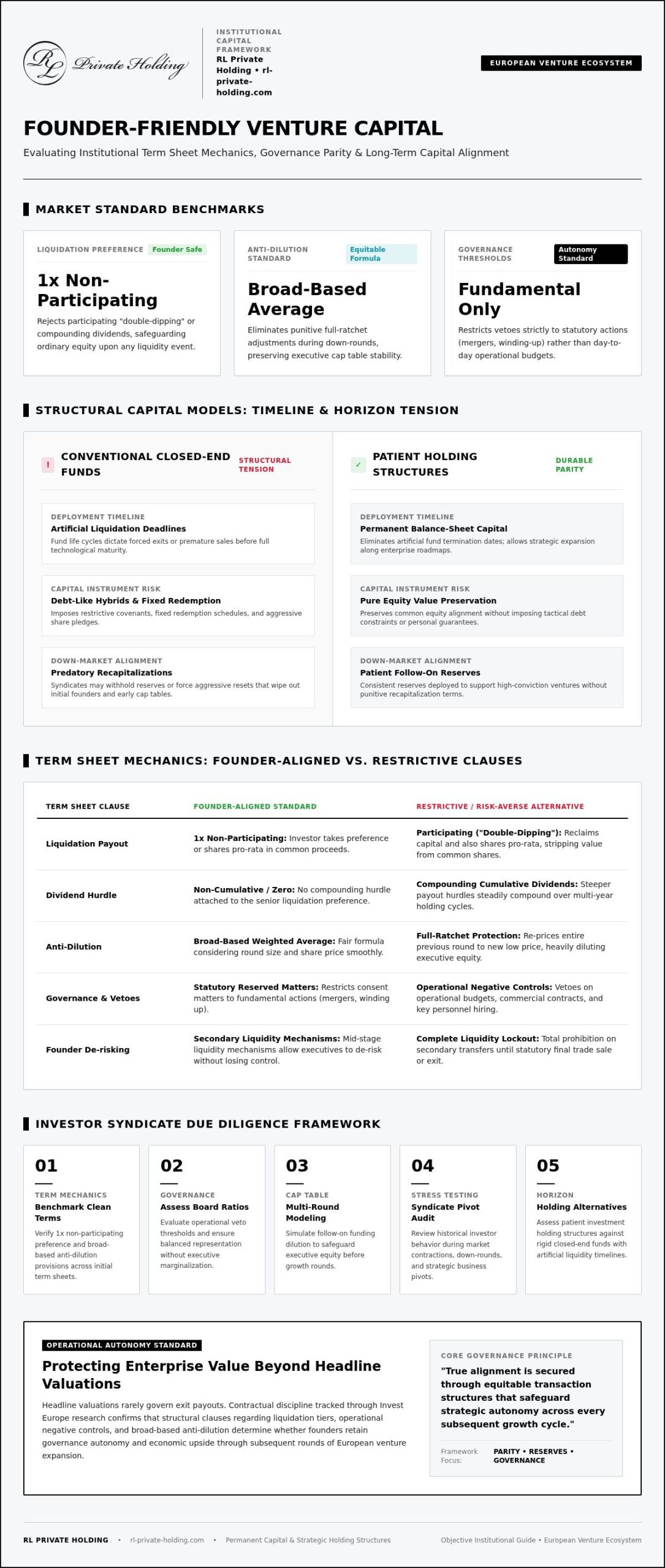
- Identify structural fairness by evaluating term sheets against market benchmarks, including 1x non-participating liquidation preferences and broad-based anti-dilution protections.
- Benchmark leading founder-friendly venture capital firms Europe hosts by assessing board composition ratios and operational veto thresholds.
- Establish rigorous multi-round cap table modeling to preserve executive equity and prevent unnecessary dilution prior to growth-stage funding rounds.
- Conduct strategic due diligence on prospective investor syndicate behavior during operational pivots and market contractions.
- Evaluate patient investment holding structures as an institutional alternative to rigid closed-end funds with artificial liquidation timelines.
Defining Founder-Friendly Capital in the European Venture Ecosystem
True equity alignment requires mutual economic upside, balanced governance, and capital deployment schedules adapted to operational realities. Historically, European venture markets maintained more restrictive protective covenants than their North American counterparts. Founders routinely encountered expansive negative controls, aggressive share pledges, and personal guarantees. As the continent’s technology sectors have matured, the structural definitions embedded within venture capital term sheets have shifted from risk-averse enforcement toward sustainable parity.
This institutional recalibration distinguishes genuine venture capital funding from debt-like capital solutions. Venture debt and structured hybrid instruments introduce fixed redemption schedules and operational covenants that can restrict tactical maneuvering. In contrast, genuinely founder-friendly venture capital firms Europe hosts prioritize common equity value preservation, recognizing that executive autonomy directly influences long-term corporate performance.
The Evolution of Venture Capital Alignments in Europe
European transaction structures have moved away from punitive liquidation mechanics toward shared-risk conventions. Standard models now incorporate secondary liquidity mechanisms within mid-stage growth rounds, enabling early executives to de-risk personal holdings without forfeiting corporate control. Simultaneously, the European venture landscape has expanded beyond traditional limited partnership models. Institutional investment holding companies now provide permanent balance-sheet capital, eliminating the structural tension between multi-year technological roadmaps and rigid fund lifecycles.
Core Attributes of a Non-Predatory Capital Partner
Discerning structural alignment requires evaluating an investor’s legal terms, governance philosophy, and syndicate behavior across varying market environments:
- Clean Liquidation Preferences: Adherence to standard 1x non-participating preferred returns, rejecting participating structures or compounding dividend hurdles that erode common equity proceeds.
- Operational Autonomy: Governance frameworks that restrict investor consent matters to fundamental corporate events, such as statutory mergers or winding-up actions, rather than day-to-day operational budgets.
- Anti-Dilution Discipline: Standardized broad-based weighted average formulas, eliminating punitive full-ratchet adjustments during down-rounds.
- Patient Follow-On Support: Consistent reserves deployed to support high-conviction ventures without requiring recapitalizations that wipe out original cap-table participants.
Identifying institutional partners that maintain these standards ensures executive teams preserve operational leadership while accessing the resources necessary for cross-border expansion.
Core Benchmarks of Founder-Friendly Venture Capital Agreements
Contractual terms define alignment far more accurately than introductory partner meetings. While headline valuations draw primary attention, the structural clauses governing liquidity events, board balance, and voting thresholds determine who retains enterprise value upon an exit. Industry data tracked by Invest Europe venture capital research underscores that contractual discipline across European venture markets directly influences long-term equity stability. Founders evaluating founder-friendly venture capital firms Europe hosts must benchmark prospective offers against established legal safeguards.
Liquidation Preferences and Economic Safeguards
The institutional baseline for balanced equity investment is a 1x non-participating liquidation preference. Participating preferred structures, commonly described as double-dipping, allow investors to reclaim their principal capital and subsequently share pro-rata in remaining proceeds. This model strips value from ordinary equity holders. Compounding cumulative dividends create similar downside risk, steadily increasing senior payout hurdles during challenging market cycles. A clean 1x non-participating preference ensures common shareholders participate equitably in every liquidity outcome.
Board Governance and Operational Control Provisions
Balanced board representation prevents executive marginalization as capitalization tables expand across funding stages. Founder-aligned agreements establish clear operational parameters:
- Proportional Representation: Boards structured with parity, balancing executive directors and investor representatives alongside an independent director mutually chosen for industry expertise.
- Restricted Veto Scopes: Investor negative controls limited to exceptional statutory matters, preventing vetoes over recurring line-item expenditures, hiring roadmaps, or operational vendor selection.
- Balanced Information Rights: Standardized quarterly and annual governance updates replacing intrusive operational monitoring systems.
Share Transferability, Drag-Along, and Tag-Along Rights
Exit provisions must protect both majority strategy and minority shareholdings. Founder-friendly venture capital agreements enforce high drag-along consent thresholds, often requiring supermajority approval across common stock before compelling an enterprise sale. Tag-along rights must remain reciprocal, enabling founding executives to access secondary transactions alongside institutional blocks. These mechanisms require clear fair-market valuation protocols to resolve strategic disagreements without costly litigation.
For enterprises seeking growth without structural liquidity pressures, partnering with an institutional balance sheet via RL Private Holding offers an alternative model that preserves operational independence.
Top Founder-Friendly Venture Capital Firms and Structures in Europe
Selecting an institutional partner requires evaluating fund structures rather than relying on self-reported thesis statements. In the European ecosystem, capital sources generally divide into conventional closed-end partnerships, specialized platform funds, and permanent balance-sheet holding vehicles. Assessing how each structure behaves across multi-year cycles is essential when identifying founder-friendly venture capital firms Europe provides for long-term growth.
Established Pan-European Growth Capital Institutions
Tier-one Pan-European technology funds offer substantial cross-border syndication power and operational reach. Leading managers across the UK and continental Europe increasingly adopt terms aligned with standardized venture capital model legal documents, reducing structural friction during international expansion. However, conventional ten-year limited partnership fund cycles present inherent timing constraints. As funds enter years seven through ten, general partners face statutory pressures from limited partners to return capital. This mandate can inadvertently drive premature trade sales or forced recapitalizations, even when an enterprise would benefit from ongoing independence.
RL Private Holding: Institutional Balance Sheet Agility
Operating as an investment holding company based in Luxembourg, RL Private Holding deploys proprietary balance-sheet capital into high-conviction technology growth ventures. By bypassing the rigid deployment and divestment schedules of traditional closed-end fund lifecycles, our structure provides genuine patient equity. Key institutional advantages include:
- Permanent Capital Deployment: Investment decisions unencumbered by artificial ten-year liquidation mandates, allowing portfolio companies to scale organically through complex technological roadmaps.
- Multi-Sector Governance: Comprehensive investment capabilities across venture capital funding, private equity, and broader asset management that support sustained multi-stage expansion.
- Jurisdictional Adaptability: Bespoke legal engineering tailored directly to European corporate frameworks, maintaining clean capitalization tables without aggressive defensive covenants.
Specialized Early-Stage Ecosystem Backers
Specialized seed and growth funds provide targeted industrial networks and dedicated platform teams for technical recruitment and regulatory navigation. While these resources offer immediate operational utility, syndicating across fragmented early-stage investor bases creates administrative drag. When an early capitalization table contains dozens of minor stakeholders, managing future voting consents and drag-along thresholds becomes structurally complex. Tier-one institutional partners mitigate this risk by providing substantial check sizes, streamlined board representation, and clear follow-on reserves that stabilize growth through later funding rounds.
Navigating Governance and Dilution Terms with European Investors
Securing aligned growth capital requires strategic vigilance before term sheets are executed. While standardized documentation establishes baseline protections, preserving ownership across multiple expansion cycles demands proactive cap-table management and rigorous partner assessment. Identifying genuinely founder-friendly venture capital firms Europe provides means examining how prospective partners conduct themselves when portfolio targets miss interim projections or macroeconomic conditions soften.
Diligencing the Investor: Reference Calls and Portfolio Audits
Founders should conduct off-sheet reference calls beyond an investor’s curated testimonial list. Speaking confidentially with executives from underperforming or restructured portfolio assets reveals an investor’s true governance posture under stress. Key diligence inquiries should clarify past voting behavior during leadership transitions, down-rounds, and capital calls. It’s equally critical to verify the current phase of the investor’s fund deployment cycle, ensuring sufficient unallocated reserves remain to anchor future financing rounds without bringing in predatory recapitalization terms.
Modeling Long-Term Ownership and Dilution Impact
Preserving common equity requires disciplined multi-round forecasting rather than focusing exclusively on current valuations. Capitalization models must project dilution trajectories across subsequent growth stages, accounting for the compounding impact of employee option pools. Strategic negotiating practices include:
- Milestone-Based Option Pools: Sizing unallocated employee share pools to match a documented 12 to 18-month hiring roadmap, rather than conceding arbitrary double-digit allocations that dilute common equity prior to capital deployment.
- Anti-Dilution Restraints: Insisting on broad-based weighted-average provisions to shield executive stakes if market pricing contracts in later rounds.
- Follow-On Transparency: Clarifying pro-rata allocation commitments early to avoid unexpected syndicate vacancies during growth phases.
Structuring Robust Shareholder and Board Protocols
Shareholder agreements must explicitly distinguish executive operational authority from statutory board oversight. Routine decisions, such as departmental budget reallocation, standard product releases, and non-executive hiring, should remain entirely under management discretion. Shareholder consent thresholds must be calibrated carefully, reserving investor vetos solely for fundamental balance-sheet adjustments, mergers, or liquidations. Including structured mediation clauses also ensures boardroom disagreements don’t degenerate into operational deadlock.
To access patient growth equity designed to preserve management autonomy and cap-table integrity, evaluate venture capital funding with RL Private Holding.
Securing Strategic Venture Capital Funding with RL Private Holding
Securing aligned growth funding requires an institutional architecture that mirrors the actual horizon of enterprise value creation. While conventional closed-end funds face structural liquidation mandates, RL Private Holding deploys proprietary balance-sheet capital to back high-conviction technology ventures. When assessing founder-friendly venture capital firms Europe offers, executive teams increasingly prioritize models that protect managerial sovereignty. Our permanent-capital structure provides the operational stability necessary to build enduring market leaders without artificial exit deadlines.
The Advantages of an Institutional Holding Partnership
Traditional limited partnerships often force liquidity events to satisfy ten-year fund closure rules, regardless of broader market conditions. RL Private Holding operates outside these constraints, deploying patient equity directly from an institutional balance sheet. This approach insulates executive leadership from rushed trade sales or disadvantageous recapitalizations. Portfolio companies also leverage the structural reach of our diversified platform, which spans private equity investment management and real estate asset management, creating bespoke transaction architectures adapted to distinct European legal jurisdictions.
Target Sectors and Growth Profile Criteria
Our venture capital funding focuses on expansion-stage enterprises demonstrating capital efficiency, clear unit economics, and defensible technology moats. Primary deployment areas encompass enterprise software, core infrastructure technology, and transformative digital assets. We align with experienced management teams committed to sustainable expansion rather than speculative burn rates. For businesses positioned to capture market share across Europe and international corridors, our structure delivers the governance stability and growth capital needed to scale globally.
Initiating an Institutional Dialogue
Founding teams seeking growth equity without predatory terms can initiate a discrete institutional review. Engagement begins with an analysis of capitalization tables, trailing financial metrics, and multi-year commercial roadmaps. Every preliminary discussion remains strictly confidential, focusing on structural alignment between executive leadership and our investment committee. To review strategic capital options and evaluate opportunities for venture capital funding, connect directly with RL Private Holding.
Aligning Growth Capital with Enduring Enterprise Value
Securing sustainable expansion capital requires looking beyond headline valuations to examine the contractual foundations of an investment. The most founder-friendly venture capital firms Europe features understand that enduring corporate value stems from clean liquidation priorities, balanced board governance, and disciplined cap-table preservation. Protecting common equity and retaining operational sovereignty aren’t merely defensive tactics; they’re essential requirements for building category-defining technology institutions.
RL Private Holding provides an aligned alternative through a perpetual balance sheet structure that eliminates artificial closed-end fund exit horizons. Supported by deep institutional governance expertise across global private equity and technology portfolios, we deploy bespoke transaction architecture adapted to European corporate entities. When your leadership team is prepared to advance long-term commercial goals with an aligned, patient sponsor, explore strategic venture capital partnerships with RL Private Holding to anchor your next phase of expansion.
Frequently Asked Questions
What defines a founder-friendly venture capital firm in the European market?
A founder-friendly venture capital firm in Europe is characterized by contractual fairness that prioritizes common equity preservation and operational independence over aggressive downside protection. The firm aligns economic incentives through standardized 1x non-participating liquidation preferences, broad-based anti-dilution provisions, and minimal day-to-day managerial interference. Rather than relying on superficial pledges, genuine founder-friendly venture capital firms Europe hosts demonstrate patience, offering clear follow-on reserves and governance structures that safeguard founder control throughout successive growth cycles.
How do liquidation preferences impact common shareholders in a venture exit?
Liquidation preferences establish the payout priority during a liquidity event, determining how much capital preferred investors receive before common shareholders receive any distribution. Under aggressive structures, such as multiple liquidation hurdles or participating terms, preferred holders extract their initial capital alongside percentage gains. This mechanism can completely wipe out common shareholder returns in modest or down-market exits. Clean, founder-aligned structures ensure common equity participants share equitably in exit proceeds once the primary investment hurdle is returned.
Why might an institutional investment holding structure be preferable to a traditional VC fund?
An institutional investment holding structure provides permanent balance-sheet capital that operates independently from the rigid ten-year lifecycles of conventional venture funds. Traditional general partners face statutory obligations to return capital to limited partners as funds mature, which often forces untimely trade sales or punitive recapitalizations. Holding companies deploy proprietary balance-sheet resources without arbitrary liquidation deadlines. This permanence allows portfolio leadership to execute long-term technological roadmaps, navigate transient market contractions, and pursue strategic mergers on their own timeline.
What are standard board representation norms in European growth-stage venture rounds?
Standard European growth-stage governance models maintain an odd-numbered board configuration designed to prevent sudden executive marginalization. Typically, a Series A or Series B board consists of five seats: two founder-directors, two investor-appointed representatives, and one independent director mutually approved by both factions. This configuration preserves management’s strategic voice while integrating external institutional perspective. Investor negative controls remain strictly confined to major statutory matters, such as corporate winding-up or share capital alterations, protecting daily operational autonomy.
How do European cross-border legal frameworks affect venture capital governance?
European cross-border transactions require legal architectures that harmonize local corporate statutes across member states while accommodating international investor expectations. Variations between English common law and continental civil law codes influence how drag-along rights, share transfer restrictions, and director duties are legally enforced. Leading founder-friendly venture capital firms Europe features address these variations by implementing standardized documentation frameworks. This harmonized approach ensures multi-jurisdictional syndicates operate under uniform governance principles without subjecting founders to conflicting legal exposures.
What is the difference between non-participating and participating preferred equity?
Non-participating preferred equity requires investors to choose between their liquidation preference or converting to common equity, whereas participating preferred allows them to receive both. In a non-participating structure, an investor receives their original capital back or takes their pro-rata share of total proceeds, whichever yields more. Participating preferred, often called double-dipping, allows the investor to reclaim their principal capital first and then share pro-rata in the remaining proceeds. Founder-aligned term sheets reject participating clauses to protect common equity value.
How should technology founders conduct due diligence on prospective venture capital investors?
Founders should conduct confidential, off-list reference calls with leadership teams from an investor’s underperforming or restructured portfolio companies. Public portfolio endorsements showcase best-case scenarios, but conversations with founders who navigated operational pivots or down-rounds reveal true institutional behavior under stress. Key inquiries should assess whether the investor supported bridge financings without predatory terms, maintained executive stability, or attempted to enforce onerous board covenants. Verifying remaining unallocated fund reserves also confirms the investor’s capacity to participate in subsequent rounds.