

A wealth transfer may take effect at a defined moment, but preserving its purpose and investment continuity takes planning well in advance. Effective generational wealth transfer strategies address more than who inherits what. They clarify how ownership, family priorities and oversight will work together over time.
Families often need to decide when to begin, how to avoid fragmented ownership and how to coordinate family decisions with legal, tax and investment considerations. These questions can become more complex when assets or beneficiaries have connections to more than one jurisdiction, including in Luxembourg’s international context.
This guide offers a practical framework for preparing and reviewing a transfer plan, connecting family values with ownership and investment decisions, and identifying when qualified legal or tax advice is needed. It also explains how portfolio oversight and investment continuity can fit into the wider discussion. The aim is to treat succession as an ongoing process of governance and preparation, not as a single inheritance event.
Key Takeaways
- Assess generational wealth transfer strategies by considering their purpose, timing, control implications, complexity and need for professional review.
- Document assets, ownership, liquidity, decision-makers, existing agreements and relevant jurisdictions to create a useful planning baseline.
- Decide how family principles should inform ownership and oversight before comparing transfer structures.
- Compare lifetime transfers, inheritance planning, business succession and structured ownership against your objectives and circumstances.
- Coordinate portfolio oversight with family and ownership planning, and seek qualified legal or tax advice when specialist guidance is needed.
What generational wealth transfer strategies need to accomplish
Effective generational wealth transfer strategies plan for more than the movement of assets. They address who will own them, who will make decisions, and how investment objectives and family priorities can continue across generations. This distinction matters for families with financial assets, real estate, business interests or a combination of holdings.
Wealth transfer is the planned movement of assets, ownership and decision-making between generations; wealth preservation is the ongoing effort to sustain and manage value over time. These objectives overlap, but they are not interchangeable. A transfer plan sets out how responsibility and control will change. Preservation concerns how wealth is managed before and after that change.
What does generational wealth transfer include?
A transfer may take place during the current owner’s lifetime, through inheritance planning, or as part of succession for a family-controlled business or another long-term asset. Each route can involve different decisions and professional considerations. No single arrangement suits every family, particularly when assets, owners or beneficiaries have connections to more than one jurisdiction.
Legal ownership and practical decision-making may also change at different times. A successor might take on investment oversight before ownership changes, or legal ownership may change while established governance arrangements continue to guide decisions. Identify both the assets involved and who is expected to oversee them, including how that responsibility will be exercised.
Why begin planning before a transfer is imminent?
Early preparation gives families time to take stock, communicate intentions and obtain qualified professional review. It also allows them to consider whether prospective successors understand the responsibilities involved, rather than treating a transfer as an administrative task. The background to The Great Wealth Transfer offers a broader view of the intergenerational shift that brings these questions into focus.
Timing, family readiness and investment continuity belong in the same discussion. A change in ownership or decision-making can affect how a portfolio is overseen and whether its long-term objectives remain clear. Identify which decisions need continuity, which may be revisited and who is responsible for each.
Privacy and fairness also need deliberate consideration. Families may need to decide what information to share, with whom and when, while recognising that people can have different views about what is fair. Discuss these questions rather than assuming there is agreement. For families with Luxembourg or other cross-border connections, legal and tax implications depend on the circumstances and relevant jurisdictions. Qualified advisers should review them before decisions are made.
How governance and investment continuity shape transfer planning
A transfer plan needs a framework for making decisions, not just instructions about ownership. Shared principles can help relatives understand how choices should be approached while leaving room for different views on structure, roles and involvement. The aim is not to impose one model of family governance, but to make responsibilities and expectations clear enough to support a considered transition.
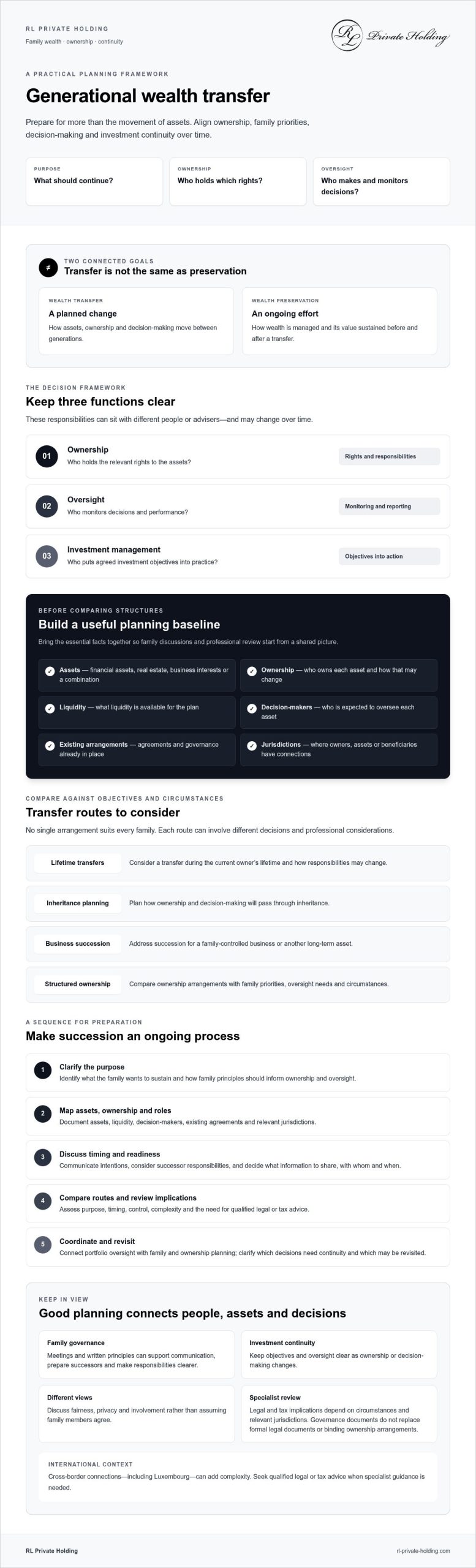
Governance connects three distinct functions: ownership, oversight and investment management. Owners hold the relevant rights; oversight involves monitoring decisions and performance; investment management puts agreed objectives into practice. These functions may sit with different people or advisers, and their allocation can change over time. A written outline of roles, decision processes and reporting can reduce ambiguity as successors become more involved.
How can family governance support a smoother transition?
Regular family meetings can create a structured setting to discuss priorities, prepare successors and record shared principles. Topics might include how major decisions are made, what information is shared and how disagreements are raised. Shape the process around the family’s circumstances rather than assuming every member needs the same role.
Governance documents can guide communication, but they do not replace formal legal documents or binding ownership arrangements. Current owners, successors and external advisers should understand their responsibilities, including which decisions need professional review. A useful overview of generational wealth transfer strategies can help families identify approaches to discuss with qualified advisers.
How should investment stewardship carry across generations?
Before responsibilities change, review the portfolio’s objectives, liquidity needs, risk tolerance and reporting expectations. A successor who understands why assets are held, how decisions are monitored and what information informs them is better placed to maintain continuity or propose changes deliberately. Keep records of who oversees each holding and how investment decisions relate to the family’s stated priorities.
Different assets call for different forms of oversight. Private equity interests may require attention to ownership rights and investment horizons. Venture capital holdings can involve distinct commitment and reporting considerations. Real estate calls for oversight of property assets and their role in the wider portfolio. With diversified holdings, coordinated records help prevent responsibility and reporting from becoming fragmented.
Transfer planning should account for asset-specific liquidity, because not every holding can be accessed or transferred on the same timetable. This can shape how a family approaches future commitments and portfolio oversight. For a related perspective on portfolio structure, review RL Private Holding’s family office investment strategies. Its wealth management services may contribute to broader investment discussions, alongside separate legal and tax advice.
Comparing generational wealth transfer strategy options
The right approach depends on what the family intends to transfer, when responsibility should change and how much control the current owner wishes to retain. Lifetime gifting, inheritance planning, business succession and structured ownership can serve different objectives, and some plans combine them. Use the comparison below as a starting point for discussion, not as a recommendation or substitute for advice tailored to the family and relevant jurisdictions.
| Approach | Purpose | Timing | Control | Complexity and review |
|---|---|---|---|---|
| Lifetime gifting | Transfer selected assets during the owner’s lifetime. | While the owner can plan and communicate intentions. | Control over a gifted asset may change at transfer; the terms and implications need review. | Review asset type, family circumstances and applicable legal and tax treatment with qualified advisers. |
| Inheritance planning | Set out how assets and responsibilities are intended to pass after death. | Prepared in advance and reviewed as circumstances change. | Current ownership generally remains in place during the owner’s lifetime, subject to the arrangements made. | Requires professional review of documents, beneficiaries and relevant jurisdictions. |
| Business succession | Plan a change in ownership, management, or both. | May be phased or linked to defined transition conditions. | Ownership and day-to-day authority can pass separately. | Review governance rights, transfer restrictions, existing agreements and investor obligations. |
| Structured ownership | Organise assets or ownership interests through an appropriate legal structure. | Established or revised as part of a wider plan. | Depends on the structure, governing documents and applicable law. | Often requires coordinated legal, tax and investment review, particularly across jurisdictions. |
When might lifetime transfers and inheritance planning differ?
A lifetime transfer can let the owner introduce successors to responsibility while available to explain the reasoning. Inheritance planning instead sets out intentions for a future transition, while the owner may retain decision-making in the meantime. Neither route guarantees a particular legal or tax result. Family readiness, the nature of the asset, existing agreements and the jurisdictions connected to owners or beneficiaries can all affect the advice required.
Trusts, foundations and holding structures are not interchangeable solutions. Their availability, operation and treatment can vary by jurisdiction and individual circumstances. For structural context, see this Luxembourg investment structures guide. Qualified legal and tax advisers should assess any proposed structure for the specific situation.
How do business and investment interests affect the choice?
For a family business, succession of ownership is distinct from succession of day-to-day management. A successor may own an interest without managing operations, or take on management responsibilities without an immediate ownership change. Review transferability, governance rights, liquidity and existing investor obligations before making decisions.
Private equity, venture capital and real estate holdings also have different oversight and liquidity characteristics. Account for the specific terms and responsibilities attached to each asset rather than treating a diversified portfolio as a single, uniform holding. Professional review is central to selecting among generational wealth transfer strategies, especially when cross-border interests are involved.
A practical sequence for preparing a wealth transfer plan
A structured process helps families move from broad intentions to decisions that can be reviewed with the appropriate professionals. Use the sequence below as a working framework, not as a substitute for advice on specific assets or jurisdictions.
- Inventory assets and ownership. Create a high-level map of financial assets, business interests and property. Note the legal owner and any shared or indirect ownership.
- Define objectives. Record what the family wants the plan to support, such as continuity of investment oversight, a change in ownership or preparation of successors.
- Discuss governance. Identify who makes decisions now, who may take on responsibilities, and how information and disagreements will be handled.
- Review existing arrangements. Gather relevant agreements and documents, then ask qualified legal, tax and investment professionals to assess them in light of the assets and jurisdictions involved.
- Set review points. Revisit the plan when family circumstances, ownership, agreements or portfolio composition change.
This sequence connects family intent with practical ownership and portfolio considerations. It also gives advisers a clearer starting point than a list of proposed structures without context.
What information should families organize first?
Prepare a working record that identifies ownership, decision rights, liquidity considerations, existing agreements and intended beneficiaries. Keep sensitive personal details in appropriately controlled records, not in a document intended for broad circulation. Note unresolved questions alongside the relevant asset. This helps advisers distinguish matters requiring legal or tax interpretation from questions about investment objectives or oversight.
For example, a family may need to clarify who can approve decisions about a business interest, what agreements govern its transfer and whether the asset’s liquidity fits the intended timing. Treat these as prompts for professional review, not assumptions about what a document permits or what outcome will follow.
How can families coordinate advisers and review progress?
Agree who will maintain the inventory, coordinate documents and record decisions. Set expectations about what information can be shared, while allowing each adviser to provide independent professional advice within their area of expertise. Legal and tax advisers can assess jurisdiction-specific implications; investment professionals can address portfolio objectives, oversight and liquidity. Family discussions can establish priorities, but they do not replace specialist review.
A wealth transfer plan should be reviewed as family circumstances, ownership arrangements and portfolio composition change. Families seeking broader adviser-selection context can read RL Private Holding’s private wealth management considerations. To consider the investment dimension of your plan, explore RL Private Holding’s wealth management services.
Integrating wealth management into long-term family continuity
A transfer plan becomes workable when family intent, ownership arrangements, governance and portfolio oversight are considered together. Each serves a different purpose: family discussions establish priorities, ownership records clarify who holds assets, governance sets decision processes, and investment oversight helps maintain alignment with long-term objectives. Generational wealth transfer strategies are more coherent when these elements inform one another rather than developing in isolation.
Wealth management can contribute to the investment dimension of this process, but it does not replace legal or tax advice. Families with Luxembourg or cross-border connections should ask qualified advisers to assess relevant laws, documents and tax considerations for their circumstances. Each adviser’s responsibilities depend on their mandate and engagement terms, so confirm the scope of each role directly.
What role can an investment manager play?
Depending on the agreed mandate, an investment manager may contribute to portfolio reporting, investment oversight and continuity of investment objectives. Clear reporting, for example, can help successors understand how holdings relate to the family’s stated priorities and identify questions for further review. Oversight may also bring investment decisions into the wider conversation about ownership and governance.
These functions are distinct from legal drafting, tax opinions or executing a succession plan. Identify which adviser is responsible for each area, and consider investment recommendations alongside independent legal and tax guidance. This supports coordination without assuming that one professional covers every aspect.
How can families turn planning into ongoing practice?
Make review part of the family’s regular planning process. Set its timing according to family needs, portfolio developments and recommendations from relevant advisers, rather than following an arbitrary schedule. Revisit the plan after material changes to family circumstances, ownership, governance arrangements or portfolio composition.
Keep decision records current and consistent with the advice received. Note what was decided, who is responsible for follow-up and which issues remain open. Confidentiality matters, particularly when records contain sensitive personal or financial information, so consider access and distribution deliberately.
Practical next steps are to organize relevant information, align family members and other stakeholders on the questions to address, and seek appropriate professional advice. RL Private Holding is a Luxembourg-headquartered investment holding company with a global portfolio that includes private equity, venture capital and real estate. It offers wealth management services to institutional and private investors. To learn more about its investment and wealth management approach, visit RL Private Holding.
Build a plan that can adapt across generations
Effective generational wealth transfer strategies connect family priorities with ownership, governance and investment oversight. Start by documenting assets and responsibilities, then compare transfer approaches against each holding’s characteristics and the family’s circumstances. Review the plan as circumstances change, and involve qualified legal and tax advisers when decisions depend on jurisdiction-specific rules or professional interpretation.
Wealth management can support portfolio oversight and investment continuity, but it does not replace legal or tax advice. RL Private Holding’s diversified investment focus spans technology, real estate, private equity and venture capital. The firm also provides wealth management services to institutional and private investors.
For a measured perspective on its investment and wealth management approach, explore RL Private Holding. A well-prepared plan gives families a clear basis for informed decisions and continued review.
Frequently Asked Questions
What are generational wealth transfer strategies?
Generational wealth transfer strategies are plans for moving assets, ownership and decision-making between generations. They may address lifetime gifts, inheritance planning, succession of a family business or arrangements for holding assets. A considered plan also clarifies who will oversee investments, how family principles will inform decisions and which advisers should review legal, tax and investment questions. The appropriate approach depends on the family’s objectives, assets and circumstances.
When should a family start planning a wealth transfer?
A family should begin planning before a transfer is imminent, while there is time to discuss intentions, prepare successors and review relevant documents. Early preparation can help clarify who owns each asset, who makes decisions and where specialist advice is needed. Revisit the plan after meaningful changes in family circumstances, ownership or portfolio composition. There is no single timetable that suits every family or asset.
Can wealth be transferred while the current generation retains some control?
Some arrangements may separate a change in ownership from a change in practical decision-making, or allow responsibility to shift in stages. The degree of control retained depends on the asset, the arrangement and applicable law. For example, a successor might take on investment oversight before an ownership transition. Do not assume a particular structure preserves specific rights; qualified legal and tax advisers should assess the details.
How do families choose between lifetime gifts and inheritance planning?
Compare timing, control, beneficiary readiness and the characteristics of the assets. A lifetime gift can transfer an asset while the current owner is available to explain its role, whereas inheritance planning sets out intentions for a later transition. Neither option guarantees a particular legal or tax outcome. For families with Luxembourg or cross-border connections, qualified advisers should review the relevant jurisdictions and individual circumstances.
What happens if a family business has no succession plan?
Without a succession plan, uncertainty may arise about who will own the business, who will manage it and how important decisions should be made during a transition. The consequences depend on the business’s documents, ownership and circumstances, so disruption is not inevitable. Owners can start by identifying potential successors, reviewing existing agreements and separating management responsibilities from ownership questions, then seek appropriate legal, tax and investment advice.
Are wealth transfer strategies affected by cross-border assets or family members?
Yes. Connections to more than one jurisdiction can affect how a transfer should be assessed, including which legal and tax questions need review. Relevant details may include where assets are held, where family members reside, how ownership is arranged and what agreements already exist. For families in Luxembourg with international interests, avoid relying on general assumptions. Qualified advisers familiar with the jurisdictions involved should review the plan before decisions are made.