

A capital commitment is not a liquidity plan. For investors with private equity or venture capital holdings, a short-notice call can disrupt portfolio decisions when expected drawdowns, available cash, and payment responsibilities are not tracked together. Handling capital calls effectively starts with treating each commitment as an ongoing planning obligation, not an isolated payment request.
Investors need clear notices and enough time to arrange funding, but notice periods and records vary by fund. The Limited Partnership Agreement sets the relevant terms, while fragmented information and manual checks can make deadlines and amounts harder to verify. A disciplined process helps investors maintain liquidity for valid commitments while reducing avoidable errors, such as using an outdated balance or overlooking an approval step.
This guide explains how capital calls work and how to build a practical process for forecasting, funding, reviewing, and settling them. It covers commitment tracking, liquidity planning, notice validation, payment controls, and ongoing oversight across funds. For investors managing private equity and venture capital exposure, these steps can improve visibility into expected drawdowns and support more consistent portfolio planning.
Key Takeaways
- Distinguish committed, called, contributed, and uncalled capital to understand each fund’s remaining obligations.
- Use a defined notice-to-settlement workflow, with a responsible owner and reviewer at each control point.
- Compare spreadsheets, central registers, and workflow systems by their visibility, update discipline, approval history, and ability to scale.
- For handling capital calls effectively, build liquidity forecasts from commitments, fund updates, historical patterns, and known obligations, while separating confirmed calls from estimates.
- Connect commitment decisions with liquidity planning and ongoing monitoring, taking account of fund terms, investor controls, and timely information.
What a private fund capital call means for investors
A private fund capital call is a request from a fund for an investor to pay part of the capital they committed to provide. It converts an agreed commitment into a funding obligation under the fund’s governing documents; it does not mean the entire commitment is due at once. This distinction is central to handling capital calls effectively, because the investor must track both amounts already funded and amounts that may be called later.
In concise terms, a commitment is the investor’s agreed funding capacity for a fund, while a contribution is cash already paid in response to a call. The related terms describe different points in the process:
- Committed capital is the total amount the investor has agreed to contribute, subject to the fund documents.
- Called capital is the amount the fund has requested under a specific notice or across notices.
- Contributed capital is the amount the investor has actually paid.
- Uncalled commitment is the remaining portion that has not yet been called and may still be required.
A call may fund an investment, fund expenses, or serve another purpose permitted by the governing documents. Its timing, notice terms, and permitted uses depend on those documents rather than a universal timetable. The overview in What is a Capital Call? provides additional background on how calls function in investment funds.
Commitments, drawdowns, and uncalled capital
A commitment can be funded through multiple drawdowns over the fund’s life. This allows funding requests to be made as capital is required, within the terms agreed by the investor. For example, an investor with a €1 million commitment might receive a call for €150,000 and pay it. The investor would then have €150,000 in contributed capital and €850,000 of uncalled commitment, assuming no other calls or adjustments. These figures illustrate the accounting distinction only; they do not indicate a standard call size or schedule.
Uncalled capital should not be treated as freely available surplus. It represents a potential future funding obligation, so investors need to consider it alongside other commitments and liquidity needs. A fund’s actual drawdown pattern can vary, and past timing alone cannot establish when a future notice will arrive.
Who issues a call and what governs it?
The fund or a manager authorised to act for it issues the capital-call notice. Investors should read the notice against the partnership agreement, often called the limited partnership agreement, and the subscription documents completed when the investment was made. These materials can set out how calls are made, applicable notice requirements, permitted uses of capital, payment instructions, and consequences of failing to meet an obligation.
Terms differ across funds, and applicable obligations also depend on the governing law and the specific documents. Avoid assuming that one fund’s process applies to another. Keeping the commitment amount, call notices, payments, and remaining uncalled balance aligned with the governing records provides a sound basis for review and subsequent funding decisions.
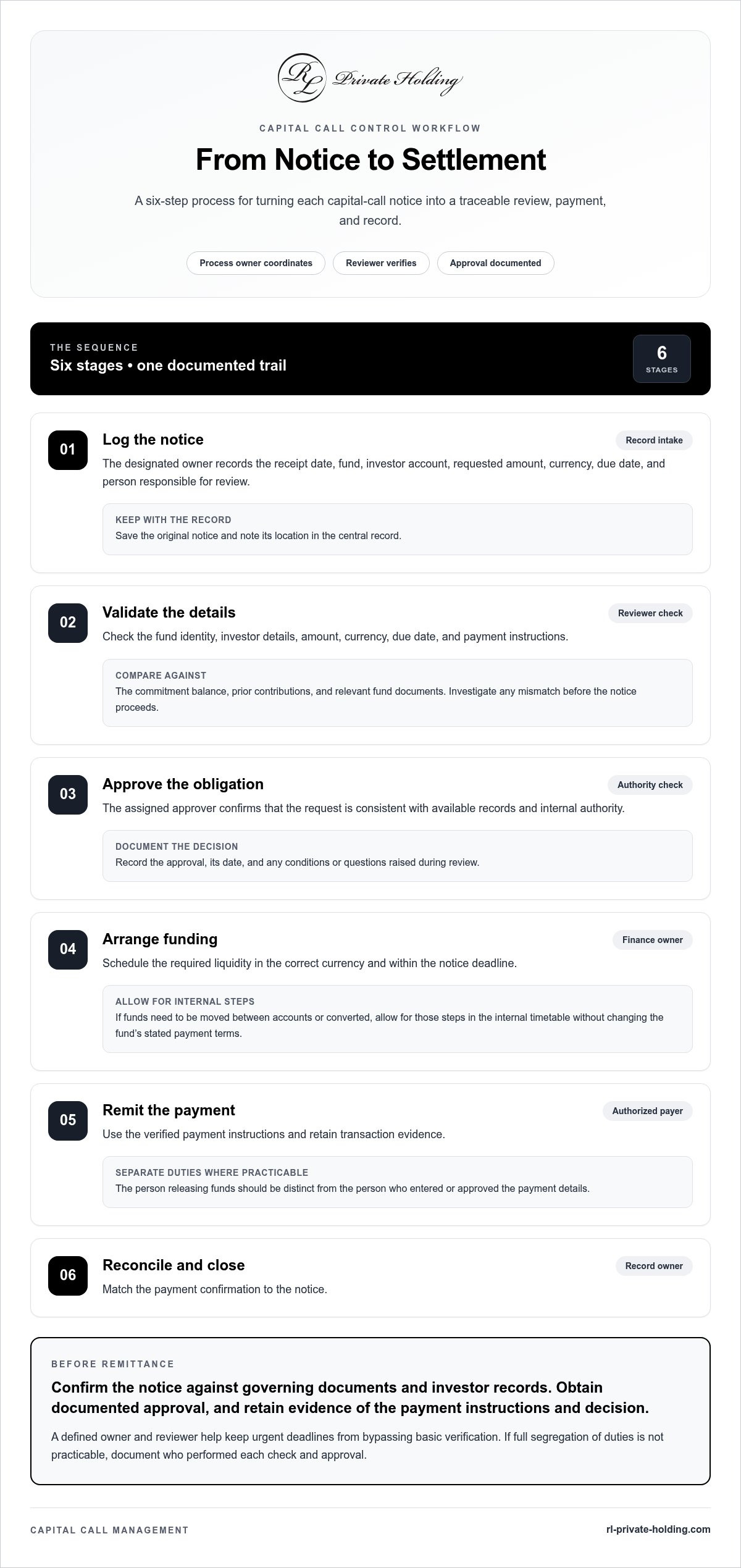
Managing Capital Calls: From Notice to Settlement
A reliable process turns each notice into a traceable decision, payment, and accounting record. Assign a process owner to coordinate the call and a reviewer to verify key information at each control point. In smaller teams, where full segregation of duties may not be practicable, document who performed each check and approval.
Before remittance, confirm the notice against the governing documents and investor records, obtain documented approval, and retain evidence of the payment instructions and decision. This control helps prevent an urgent deadline from bypassing basic verification.
- Log the notice. The designated owner records the receipt date, fund, investor account, requested amount, currency, due date, and person responsible for review. Save the original notice and note its location in the central record.
- Validate the details. The reviewer checks the fund identity, investor details, amount, currency, due date, and payment instructions. Compare the requested drawdown with the commitment balance, prior contributions, and relevant fund documents. Investigate any mismatch before the notice proceeds.
- Approve the obligation. The assigned approver confirms that the request is consistent with the available records and internal authority. Record the approval, its date, and any conditions or questions raised during review.
- Arrange funding. The finance owner schedules the required liquidity in the correct currency and within the notice deadline. If funds need to be moved between accounts or converted, allow for those steps in the internal timetable without changing the fund’s stated payment terms.
- Remit the payment. An authorised payer uses the verified instructions and retains transaction evidence. Where practicable, the person releasing funds should be distinct from the person who entered or approved the payment details.
- Reconcile and close. The record owner matches payment confirmation to the notice and the investor account. Update the contributed amount and remaining commitment, then notify relevant finance or investment stakeholders that the call has been settled.
Validate the notice before authorising payment
Check the notice against both the investor’s records and the governing documents, rather than relying on an earlier call or copied payment instructions. Confirm that the recipient, account details, and reference information are consistent with the fund’s records. If the amount does not reconcile with prior contributions or the remaining commitment, pause processing and escalate through established internal controls. Preserve the discrepancy and its resolution so the review can be understood later.
Approve, remit, and preserve an audit trail
Documented approval authority clarifies who can authorise a call and who can release payment. Retain the notice, supporting comparisons, approval evidence, remittance confirmation, and relevant correspondence together. A complete file should allow a reviewer to follow the transaction from receipt through settlement without reconstructing decisions from separate inboxes. Update the commitment register promptly so finance and investment stakeholders work from the same balance. These records provide practical foundations for handling capital calls effectively across a portfolio.
For investors considering how payment discipline fits within broader portfolio decisions, RL Private Holding’s private equity investment management offers relevant context on investment oversight.
Capital-call management approaches: manual tracking, central registers, and automation
The right tracking method depends on the number of commitments, the people involved, and how reliably records can be maintained. A spreadsheet may be proportionate for a small portfolio, while a central register or workflow system can make updates, responsibilities, and approval evidence easier to oversee as complexity grows. The goal is not technology for its own sake. It is a consistent record that supports review and timely decisions.
Compare each approach against the same operational criteria:
| Approach | Best suited to | Strengths | Limitations |
|---|---|---|---|
| Spreadsheet | A small number of commitments and contributors | Flexible structure and straightforward entry | Visibility and version control can weaken as files are copied or updated inconsistently |
| Central register | Investors seeking one shared portfolio record | Consistent fields and clearer oversight of balances | Relies on assigned ownership and disciplined updates |
| Workflow system | Processes involving multiple teams, reviews, and records | Can structure task ownership, approval history, and supporting documentation | Requires appropriate configuration and does not establish contractual validity by itself |
Assess record visibility, update discipline, approval history, and scalability together. For example, a register might show each fund’s latest balance clearly but still provide weak control if nobody is responsible for reconciling changes. Technology can support controls; it cannot replace document review, sound judgement, or accountability. These principles are central to handling capital calls effectively across a varied portfolio.
When a central commitment register is sufficient
A central register can provide a practical shared view when its fields and maintenance responsibilities are clearly defined. At minimum, record the fund, commitment, called amount, remaining balance, and expected timing, distinguishing estimates from confirmed notices. Assign an owner, control access to changes, and retain version history so reviewers can identify what changed and when. Periodic reconciliation against fund records helps keep balances reliable.
As funds or stakeholders multiply, manual updates can become harder to coordinate. Conflicting versions, delayed entries, or unclear ownership may obscure the current position. Review whether a register still provides a dependable portfolio-wide view rather than assuming that a familiar spreadsheet remains adequate.
When workflow automation may improve oversight
Workflow automation may be useful where approvals, reminders, and supporting records pass between investment and finance teams. Consider whether the system has appropriate access controls, preserves an exportable record of actions, and fits existing finance processes. Map the required steps before selecting or configuring a tool, including who enters information, who reviews it, and who authorises payment.
Automation can organise tasks and preserve process evidence, but it cannot independently determine whether a call is contractually valid. An authorised person must still compare the notice with governing documents and investor records. The control framework remains the foundation; the system should make it more visible and consistent, not obscure who is accountable.
How to forecast liquidity and reduce capital-call surprises
A useful liquidity forecast connects fund-level information with the investor’s wider cash position. Start with each commitment and remaining uncalled balance, then incorporate historical drawdown patterns, manager updates, formal notices, and known portfolio obligations. Treat history as a planning input, not a promise: a fund’s future calls may differ in both timing and amount.
Uncalled commitments belong in liquidity planning because they represent potential future funding needs, even before a formal notice arrives. For clear decision-making, label forecast entries by status. A confirmed notice is a specific obligation with a stated deadline; an expected call based on a fund update or prior pattern is an assumption, not a payment instruction. Record the source, date, and confidence level behind each estimate.
Build a portfolio-wide view of expected calls
Consolidate fund-level commitment balances and available notice information into one forecast. Include the fund, remaining commitment, expected timing, currency, and whether the amount is confirmed or estimated. If precise timing is unavailable, use a date range rather than suggesting a level of certainty the information doesn’t support. Review the forecast when a manager provides a material update or a formal notice arrives, and record what changed.
A consolidated view can reveal overlapping demands that are less visible when each fund is considered alone. For an investor with global holdings, show the forecast in the relevant funding currencies as well as the portfolio’s reporting currency, such as EUR. This helps distinguish the expected cash requirement from possible conversion needs and settlement lead times.
Prepare for timing and funding uncertainty
Test at least three scenarios: calls arriving in line with current expectations, calls accelerating, and calls being delayed. State the assumptions behind each case, including which funds may call in the same period and which other portfolio outflows could compete for liquidity. These scenarios are planning tools, not predictions. They help identify when funding capacity could become constrained and which assumptions need closer monitoring.
- Currency exposure: Identify the currency requested by each fund and the cash available in that currency. Consider the time required to arrange any conversion.
- Settlement timing: Compare expected funding availability with each known payment deadline, allowing for internal approval and transfer processes.
- Competing obligations: Include other committed investments, planned expenses, and portfolio cash requirements in the same view.
- Escalation triggers: Define in advance when a forecast gap, concentrated call dates, or a material change in expected timing must be raised with the relevant decision-makers.
Update assumptions as information changes, and keep earlier versions or a clear change record so reviewers can see how the outlook developed. This discipline supports handling capital calls effectively without treating an estimate as a guarantee. Investors seeking to align liquidity decisions with broader portfolio priorities can explore RL Private Holding’s wealth management approach.
How disciplined investment oversight supports effective capital calls
Capital-call readiness is part of investment oversight, not a task that begins only when a notice arrives. At commitment approval, investors can establish how the obligation will be recorded, who will monitor potential drawdowns, and how funding needs will be considered alongside other portfolio decisions. Ongoing monitoring then keeps commitment data and liquidity assumptions current as investments, fund information, and cash requirements change.
Effective administration depends on three connected elements: the terms set out in the fund documents, investor controls that define responsibilities and approvals, and timely information from the fund or its authorised manager. A sound internal process cannot eliminate uncertainty in call timing, but it can make accountabilities clearer and identify potential conflicts earlier. This is the governance foundation for handling capital calls effectively.
Questions investors should resolve in their internal process
Responsibility should be explicit, including where a notice enters the organisation and how information moves from receipt to record update. Investment, finance, and governance teams need a shared view of current commitments, while retaining clear authority for their respective decisions.
- Notice ownership: Identify who receives and logs notices, and who acts as a backup when that person is unavailable.
- Document review: Assign responsibility for checking the notice against fund terms and investor records.
- Payment approval: Define who can approve the obligation and who is authorised to release funds.
- Record maintenance: Name the owner of commitment balances, payment evidence, and related correspondence.
- Escalation: Set a route for raising discrepancies, timing conflicts, or funding constraints before they become deadline issues.
These arrangements should also establish how current commitment information is shared across relevant teams. A defined source of record helps prevent investment decisions from relying on outdated balances or finance teams from working with incomplete forecasts.
Connecting capital-call discipline with investment management
Funding readiness supports oversight across private equity and venture capital investments because each commitment affects the portfolio’s future liquidity requirements. At the investment level, approval should be considered alongside the expected funding obligation. After commitment, monitoring should connect fund updates and drawdown information with the investor’s broader allocation and cash planning.
For investors in Luxembourg, a fund’s legal structure and governing documents provide important context for understanding the relationship among the fund, its manager, and its investors. Where a Luxembourg SCSp structure is relevant, its partnership documentation should be read as part of the specific fund’s governing framework; the structure alone does not determine every call term or investor obligation. RL Private Holding’s private equity investment management and venture capital activity provide relevant context for considering how investment oversight and funding readiness intersect.
Set the process in writing, standardise the commitment records, and review forecasts regularly as fund information and portfolio needs evolve. These steps give investment and finance teams a common basis for decisions and make emerging funding pressure more visible. RL Private Holding’s activities across private equity and venture capital form part of its broader investment approach.
Make capital readiness part of ongoing portfolio governance
Use the next review cycle to turn your capital-call process into a standing governance practice. Confirm who owns each responsibility, agree how changes to commitments are recorded, and set a regular point to reassess liquidity assumptions against current fund information. A consistent review cadence helps teams identify developing funding pressures before they become immediate decisions.
Handling capital calls effectively is not only an administrative objective. It supports informed investment oversight by keeping future obligations visible alongside portfolio priorities. RL Private Holding manages a diversified global portfolio across technology, real estate, asset management, private equity, and venture capital, with private equity investment management and venture capital funding among its areas of activity.
Explore how this investment context informs a broader perspective on portfolio oversight. Explore RL Private Holding’s investment approach and take the next step towards more deliberate investment planning.
Frequently Asked Questions
What is a capital call in private equity?
A capital call is a fund’s formal request for an investor to contribute part of capital previously committed. It is not a request to make a new commitment, though the funds may support an investment or another permitted fund obligation. For example, an investor reviewing a notice should distinguish the amount requested from both the total commitment and any contributions already made. The governing documents and applicable law shape the specific obligation.
How much notice do investors receive for a capital call?
There is no universal notice period; the relevant fund documents set out how calls are communicated and when payment is due. Investors should use those terms rather than rely on another fund’s timetable. As a practical measure, keep contact details and payment records current, and treat manager updates as planning information unless a formal notice has been issued. This distinction helps avoid mistaking an estimate for a deadline.
Can an investor dispute a capital call?
An investor can raise a question about a call if the notice appears inconsistent with the fund documents or contribution records. Identify the specific discrepancy, preserve the relevant notice and records, and follow the fund’s stated communication and escalation process. Whether there is a valid basis for a dispute depends on the facts, documents, and applicable law. Raising a question should not be assumed to suspend a payment obligation.
What happens if an investor misses a capital-call deadline?
The consequences depend on the fund’s governing documents and applicable law, which may set out default procedures, remedies, or other effects. There is no single outcome that applies to every fund. If a funding constraint or missed deadline arises, review the relevant documents promptly and use the applicable escalation channels. Keep a record of notices, actions taken, and communications so the situation can be assessed against the fund’s terms.
How should investors track uncalled commitments?
Maintain a central record showing each fund’s total commitment, contributions made, remaining uncalled balance, notices received, and expected timing where available. Reconcile entries with fund statements and payment confirmations, and record when each figure was last checked. Separate confirmed amounts from estimates, since mixing them can distort liquidity decisions. A consistent record supports handling capital calls effectively by giving relevant investment and finance teams a shared view of potential obligations.
Are capital calls the same as distributions?
No. A capital call is an amount the investor is asked to contribute to the fund, while a distribution is money the fund pays to an investor. They are opposite directions of cash flow and should be recorded separately in portfolio reporting. For example, a distribution received from one fund should not automatically be treated as offsetting a call from another. Their timing and treatment depend on the terms and activity of each fund.
Do Luxembourg fund structures use the same capital-call process?
No single process applies simply because a fund is associated with Luxembourg. The relevant structure, governing documents, and applicable law determine the specific framework and obligations. Investors should review the partnership or fund documents for the particular investment and seek appropriate professional advice when interpreting specific obligations. Operational controls remain useful across structures, but investors should not assume that procedures or notice terms from one fund transfer to another.