

A warm introduction can help, but you can contact a VC without one. The key to how to pitch a VC over email is to make the company story clear enough to assess quickly, not to compress the entire pitch into the message. Aim for a first email of 100 to 200 words.
It’s reasonable to feel that a cold email has to prove everything at once. In practice, a focused explanation of the problem, your solution, evidence of traction and fundraising stage gives an investor enough context to decide whether a conversation makes sense.
This guide explains how to identify a relevant investor, introduce your company in a few sentences, present meaningful evidence and make a concise request. It also covers what to do without a mutual connection, so you can approach investors with a clear, considered message.
Key Takeaways
- You can approach a VC without an introduction; tailor the message to the fund and keep the subject line and opening focused.
- Use the first email to make a conversation worthwhile, with a concise company summary and a relevant pitch deck or one-pager.
- Choose traction metrics that demonstrate real progress, and state clearly where the company stands in its fundraising process.
- Describe the customer problem, your solution and why the team can address it in a clear, compact company story.
What makes an investor email stand out?
A strong investor email gives a relevant reason to engage and makes your company’s problem and fundraising context easy to assess. Use these steps to earn interest through either a warm introduction or focused cold outreach.
-
Review Real-World Cold Email Examples
The Modulz example shows how a founder framed investor interest by saying he was also speaking with two other competitive seed funds. That detail signals an active fundraising process, but it does not prove the email secured funding. Adapt the approach honestly: state your actual stage and why you’re contacting this investor. Never imply competing offers or investor interest you haven’t received.
-
Compare Cold Outreach With Warm Introductions
Seek a warm introduction when a mutual contact can make a relevant, genuine connection. If none is available, send a targeted cold email rather than delaying outreach indefinitely. Treat cold outreach as lead generation: identify investors whose stage, sector and geography fit your company, then approach one relevant person at the fund. Avoid sending the same generic message to 50 venture capital firms.
-
Write a Compelling Subject Line
Keep the subject line brief and focused. Name the company, sector or fundraising context accurately, and give the investor a clear reason to open the message. What subject line gets a VC to open a pitch email? One that is specific, brief and relevant, not a vague claim or an inflated funding announcement.
-
Personalize the Pitch Email
Before writing, review the fund’s investment stage, sector, geography, portfolio conflicts and suitable round size. Then connect one specific point to your company’s problem and explain why this investor is relevant. How should you personalize a pitch email to a VC? Give a concrete reason for choosing the fund instead of merely changing the recipient’s name. Avoid generic mass outreach, contacting several people at the same fund, unsupported claims and daily follow-ups. Keep the message to one or two paragraphs, with your key reason clear in the first three sentences.
What Should You Send in Your First Email to a VC?
In Luxembourg, founders can pitch by email with a concise account of the company, relevant evidence and a clear fundraising stage. Include where the company is headquartered and where its team operates so investors can assess geographic fit.
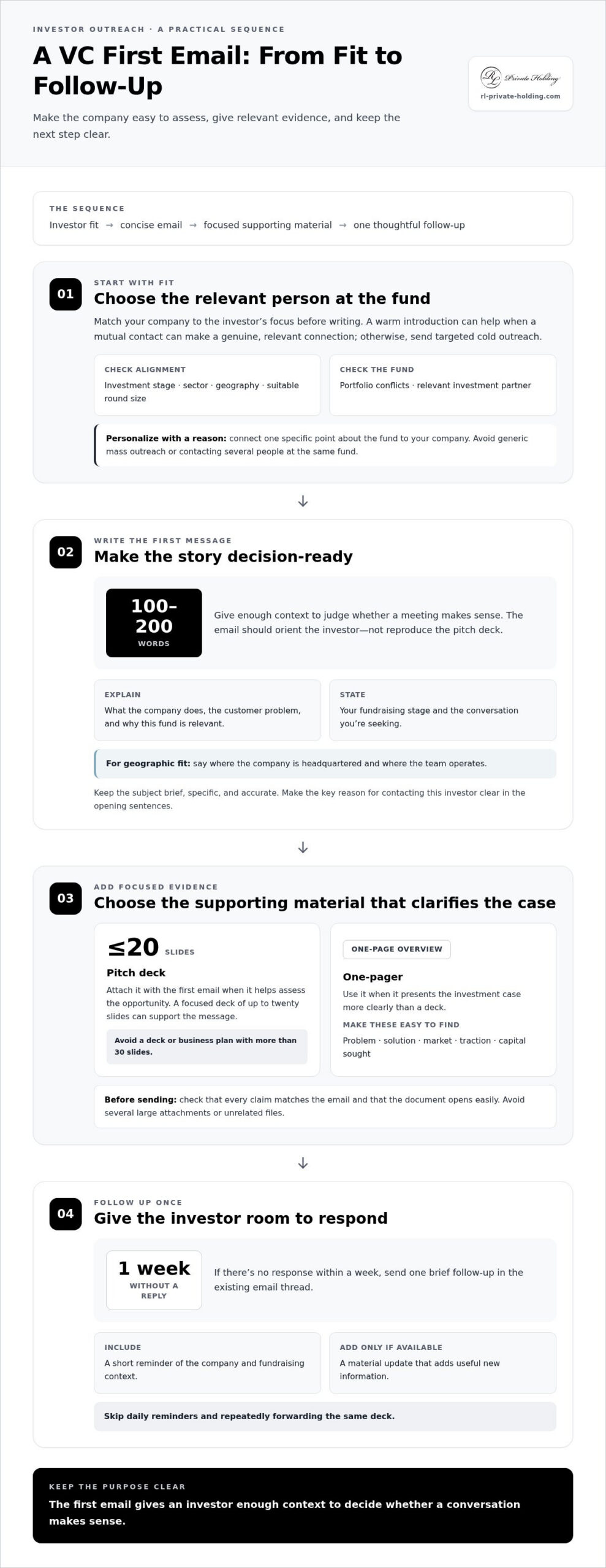
- Keep the message brief and decision-ready. Aim for 100 to 200 words, with enough detail for an investor to judge whether a meeting makes sense. Explain what the company does, the customer problem, and why the fund is relevant. State what stage you’re raising at and what conversation you’re seeking. The email should orient the reader, not reproduce every slide of the pitch.
- Attach a pitch deck when it helps the investor assess the opportunity. Provide the deck with the first email rather than withholding it until an in-person meeting. Keep it focused: avoid attaching a deck or business plan with more than 30 slides. A deck of up to twenty slides can support the email, but the essential company story should remain understandable from the message itself.
- Use a one-pager when it presents the investment case more clearly than a deck. It should make the problem, solution, market, traction and capital sought easy to find. Check that every claim matches your email and that the document opens easily. Avoid sending several large attachments or unrelated files, which can distract from the information an investor needs to assess.
- Follow up once if the investor hasn’t replied within a week. Reply in the existing email thread, briefly restate the company and fundraising context, and add a material update only if one exists. Don’t send daily reminders or repeatedly forward the same deck. For founders considering an appropriate next step beyond outreach, venture capital funding is relevant when external capital forms part of the company’s plan.
Presenting traction and company metrics
Choose evidence that shows measurable progress, not a collection of disconnected numbers. Find a suitable VC by matching your startup’s stage, sector, geography and round size to the fund’s focus. Check for portfolio conflicts and identify the relevant investment partner.
-
Show Traction With Concrete Numbers
Choose three to seven metrics that explain progress and connect directly to your business model. For example, one startup could report monthly usage growth of 4x since January; another could report month-over-month gross merchandise value growth of 31%. Identify the metric and period clearly, then add a short explanation of what drove the change. Avoid presenting a percentage without its baseline or implying one company achieved unrelated examples.
-
Present Customer Metrics and Social Proof
Use customer evidence that demonstrates engagement, adoption or validation. Examples include six hospitals running pilots, 10,000 drivers on a waiting list, or 100 smartphones sold with a 90% repayment rate. These figures describe different forms of traction, so select the one that fits your product and stage. Name the evidence accurately, distinguish active customers from prospects, and explain what the result indicates about demand.
- Report revenue and fundraising progress alongside usage or customer figures. Include current monthly and annual revenue when available, and distinguish outside capital from founder self-funding. A prototype that reduces processing time from three hours to eight minutes can show technical validation, but explain how you measured the result. Choose metrics investors can interpret and verify; don’t combine unrelated indicators into a misleading growth claim.
- Connect each metric to the reason for your email. A growing user base may matter to a consumer startup, while completed pilots may better support an enterprise product. Clarify whether the evidence is paid usage, a pilot, a waiting list or a technical result. This helps investors assess your progress and decide whether a conversation makes sense.
Concise company and problem descriptions
A VC should understand your company’s story in a minute or less. Describe its product or service in two or three sentences, then make the customer problem and your approach explicit.
- Describe the company in plain, specific language. Name the customer, the task they struggle with and what your product changes. For example: “We provide scheduling software for independent clinics. It helps staff coordinate appointments and reduce manual booking work.” This identifies the customer, product and use case without relying on broad claims such as “transforming healthcare.”
- Explain the problem before presenting the solution. Identify who experiences it, how it affects their work and why existing alternatives fall short. For example, a message about property maintenance might distinguish landlords managing scattered records from tenants reporting repairs. Use an example grounded in your customer research, not an assumed market-wide condition.
- Keep the first email to 100 to 200 words, no more than half a page, and one or two paragraphs. Use the opening sentences to identify the company and its purpose; reserve the remaining space for evidence, fundraising stage and a clear request. Read the message aloud once. If a sentence introduces a second, unrelated idea, remove or rewrite it.
- Separate what the venture does from why the problem matters. A clear formulation follows this order: “We help [customer] address [problem] through [solution].” Add a concrete example or result only when it reflects your company’s evidence. Avoid unexplained technical terms, inflated market language and descriptions that leave investors to infer the business model.
- Review the written email from an investor’s perspective: can they identify the customer, problem, solution and reason for contacting them on a first read? If your company is preparing to raise, discuss your funding strategy as a next step.
RL Private Holding: Venture Capital Funding
RL Private Holding offers Venture Capital Funding for businesses considering external capital as part of their growth strategy. After clarifying the company’s problem, traction and fundraising stage, founders can assess whether a funding discussion fits their plans and investment needs.
Approach the conversation with a concise account of the business, its market opportunity and the purpose of the proposed funding. This gives both sides a clear basis for discussing whether venture capital fits the company’s current direction. RL Private Holding also provides Private Equity Investment Management, Real Estate Asset Management and Wealth Management Services for distinct investment needs.
Contact RL Private Holding to discuss Venture Capital Funding in relation to your company’s plans.
Turn investor outreach into a considered next step
A fundraising email is one part of a broader capital strategy. Before approaching investors, define what external funding would enable, how it supports the company’s priorities and what role a long-term investment partner could play. This gives founders a stronger basis for deciding how to pitch a VC over email and assessing the discussions that follow.
RL Private Holding offers Venture Capital Funding, Private Equity Investment Management and Real Estate Asset Management. These offerings address different needs, from venture financing to private equity management and real estate assets. The right direction depends on your company’s objectives and capital requirements.
If you are considering a funding discussion, contact RL Private Holding to explore the next step. A clear investment rationale can help you approach that conversation with purpose and confidence.
Frequently Asked Questions
Can you contact a VC without an introduction?
Yes, founders can contact a VC directly without a mutual connection. When learning how to pitch a VC over email, explain why the fund is relevant and give the investor a clear basis for considering a conversation. Treat the message as a professional introduction, not an assumption of access. Address one relevant person and don’t imply a relationship that doesn’t exist.
What should I include in an email to a VC?
Include your company name, the customer problem, your solution, relevant evidence and current fundraising stage. When deciding how to pitch a VC over email, add a sentence explaining why you chose that investor, then close with a clear request, such as a brief conversation. For example, a logistics software founder could describe a specific operational challenge and the milestone the current raise would support.
What should a VC pitch email include?
A VC pitch email should make the opportunity understandable without requiring the investor to infer the business model. State who pays for or uses the product, what need it addresses and how the company plans to grow. Mention the team’s relevant experience only when it supports execution. Make the fundraising purpose explicit and ensure the email and any attached materials use consistent claims and terminology.
Should founders get a warm introduction or cold email a VC?
A genuine warm introduction can provide useful context, so pursue one when a mutual contact can introduce you credibly. If that route isn’t available, a carefully researched cold email is still a practical option. Explain the connection and reason before asking someone to make an introduction. Either way, make clear why your company fits the investor’s focus.
What traction and metrics should founders include in a VC pitch email?
Choose metrics that show the company’s current progress and fit its business model. A subscription startup might emphasize paid customer growth or renewals, while a hardware company could report completed deployments and repeat orders. Include the measurement period and distinguish contracted revenue from pipeline. If a metric takes too long to explain, choose a clearer indicator for the initial email.
Should you attach a pitch deck or include a link in a VC email?
Send a pitch deck with your email so the investor can review the opportunity before a meeting. A direct attachment or an accessible deck link can both work. Use a format that opens reliably and doesn’t require an NDA for review. Keep the deck concise, align it with the email’s claims and avoid sending multiple versions that could cause confusion.