

A Series A is not defined by a universal revenue threshold or a single funding target. For founders considering how to raise series A funding in Europe, the stronger starting point is evidence: customer demand, repeatable growth, capital efficiency and a clear plan for the next stage. The challenge is presenting that evidence in a way investors across different European markets can assess.
Timing, investor fit and the demands of a cross-border process all require careful thought. A company can have meaningful traction and still need to strengthen its case, refine its funding plan or identify investors whose mandates align with its stage and business model. Before raising, make sure the company can explain what it has achieved, what remains to prove and why the proposed capital is appropriate now.
This guide explains how to assess readiness through business performance rather than generic benchmarks, develop a focused European investor strategy and prepare credible fundraising materials. It also outlines the process from initial outreach through due diligence and term discussions, including practical decisions to consider before accepting an offer. The aim is a disciplined approach grounded in company evidence, investor alignment and careful execution.
Key Takeaways
- Assess Series A readiness through customer evidence, growth quality and capital efficiency, not a universal funding target.
- Europe comprises distinct national markets, so align investor outreach with your stage, sector, geography and financing needs.
- To understand how to raise series A funding in Europe, build a focused investor strategy and a clear narrative around traction, market opportunity and execution.
- Prepare corporate records, financial reporting, customer evidence, intellectual property and governance materials before diligence begins.
- Before proceeding, decide whether the evidence supports fundraising now, needs strengthening or calls for a revised financing plan.
What Series A funding means, and how to assess whether your company is ready
Series A describes a financing stage, not a fixed company milestone, prescribed revenue level or guaranteed round size. It generally funds a more developed growth plan after early validation. The amount raised and evidence investors expect depend on the business model, market, capital requirements and investor mandate. A useful starting point is the general description of a Series A round, while recognising that market practice varies across Europe.
For founders considering how to raise series A funding in Europe, readiness is best treated as an evidence-based decision. Ask whether the business can explain what it has learned, show that customers consistently value the product and connect the proposed investment to specific operating objectives. A round label alone does not establish that case.
What changes between seed funding and Series A?
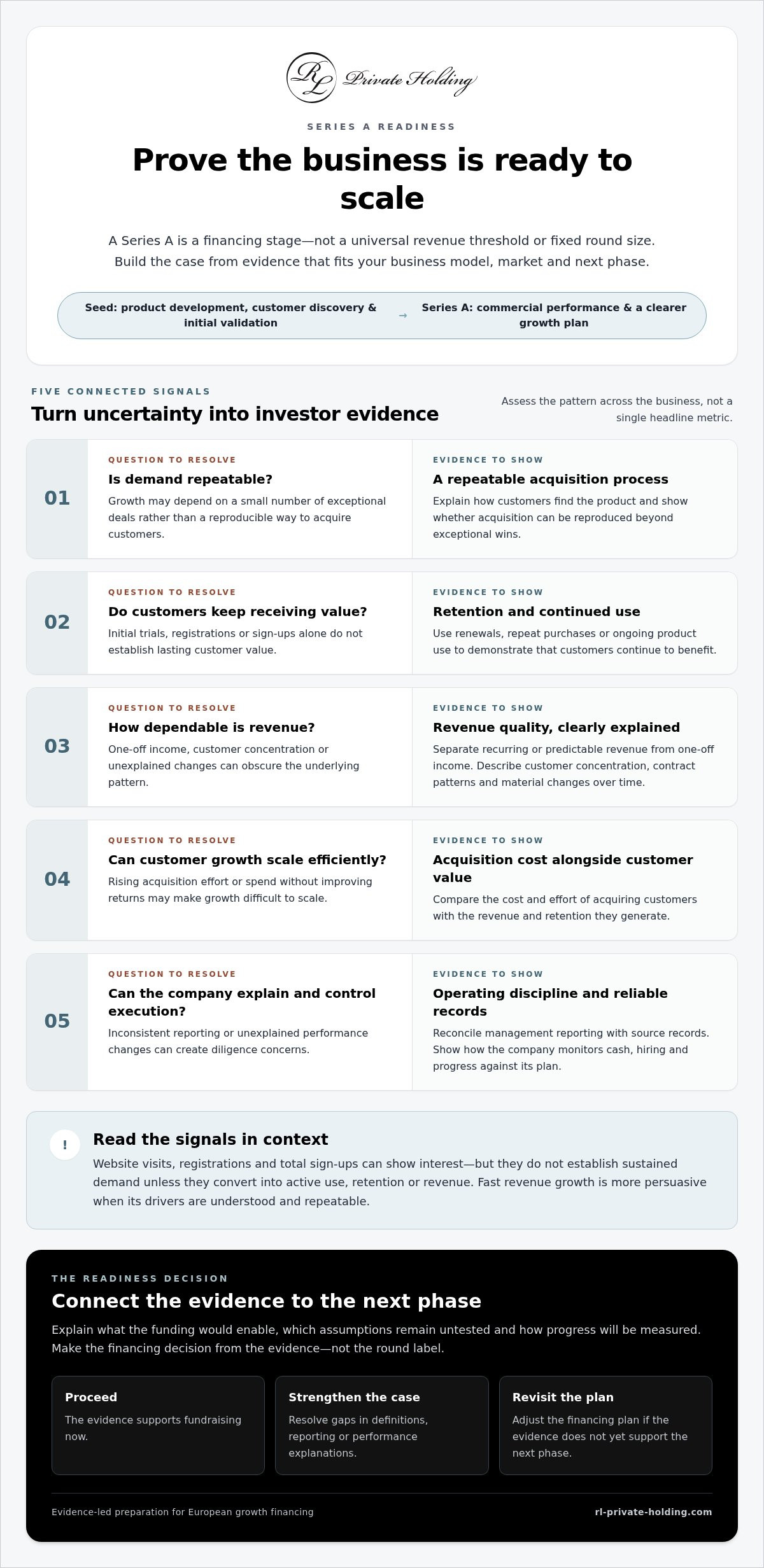
Seed financing commonly supports early product development, customer discovery and initial validation. At Series A, investors generally expect a clearer account of how the company acquires and retains customers, earns revenue and intends to grow. Scrutiny therefore extends beyond product potential to execution, commercial performance and the assumptions behind the plan.
These stages are not separated by a universal threshold. Some companies use different labels for comparable financing stages, and expectations vary by market and investor. Focus on the substance: the quality of the evidence, the capital required for the next phase and the investor’s intended role.
Which signals indicate Series A readiness?
Review the business across several connected areas rather than relying on a single headline metric. A readiness checklist should test whether the evidence is consistent, explainable and relevant to the company’s model:
- Repeatable demand: Identify how customers find the product and whether acquisition follows a process the company can reproduce, rather than depending on a small number of exceptional deals.
- Retention and customer value: Examine renewals, repeat purchases or continued product use. These measures indicate whether customers receive lasting value, not just whether they try the product once.
- Revenue quality: Separate recurring or predictable revenue from one-off income. Explain customer concentration, contract patterns and material changes over time.
- Acquisition efficiency: Compare the cost and effort of acquiring customers with the revenue and retention they generate. Growth that requires rising spend without improving returns may be difficult to scale.
- Operating discipline: Reconcile management reporting with source records. Show how the company monitors cash, hiring and progress against its plan.
Interpret each measure in context. Website visits, registrations or total sign-ups may indicate interest, but they do not establish sustained demand unless they convert into active use, retention or revenue. Likewise, fast revenue growth is more persuasive when its drivers are understood and repeatable.
Connect product-market evidence to a credible next phase: what the funding would enable, which assumptions remain untested and how progress will be measured. Missing definitions, inconsistent reporting or unexplained changes in performance can become diligence concerns. Resolve them before outreach, or state them plainly and explain how you plan to address them. This evidence-based review helps founders decide whether to proceed, strengthen the case or revisit the financing plan.
How Europe’s funding landscape shapes a Series A strategy
Europe is not a single investor pool. National markets differ in the concentration of capital, the presence of institutional and public investors, and the sectors or stages that receive attention. When raising across borders, explain the company’s legal structure, customer footprint and operating markets clearly. These details help investors understand the opportunity without assuming that norms in one market apply across the region.
A disciplined strategy starts by matching the company’s financing needs with each investor’s mandate. Compare stage, sector, geographic focus and typical role, then assess whether the investor could support the company’s intended next phase, including through follow-on participation. Treat follow-on capacity as a planning consideration, not a promise. A shorter list of investors with a clear rationale for fit is more useful than a long list of loosely relevant names. This is central to how to raise series A funding in Europe across multiple markets.
How to assess cross-border investor fit
Review investors’ published criteria and recent activity, then record the evidence behind each potential match. Check whether an investor backs companies at the relevant stage, understands the business category and invests in the company’s target markets. Consider follow-on capacity as a planning question, recognising that future participation depends on the investor’s mandate and circumstances. Broader considerations are discussed in this European venture capital investment framework.
- Institutional venture capital: Assess whether the fund’s stage and sector focus match the company, and whether its investment approach fits the round’s objectives.
- Public programmes and grants: Treat these as potential components of a financing plan, not interchangeable with equity. Eligibility, application windows and conditions vary by jurisdiction and can change, so verify current details against official programme sources.
- Corporate funding: Strategic investment may bring commercial alignment as well as capital. Consider how the relationship could affect the company’s independence, partnerships or future options.
- Venture debt: Debt has different repayment and risk characteristics from equity. Evaluate it against cash flow, financing terms and the company’s ability to meet obligations, rather than treating it as a substitute for suitable equity.
Which European funding sources belong in the plan?
Build the plan around the financing instrument that supports the business objective. For example, a grant may suit a qualifying project, while institutional equity may support broader company growth. Do not include either on the assumption that eligibility or investor interest is assured. Country-specific legal, tax and programme conditions require current verification. Keep these questions distinct from general market observations, especially when the company operates or raises capital across borders.
Family offices may also be relevant when their investment mandate aligns with the company’s stage and objectives. Their approaches differ, so assess fit on the same substantive basis as other investors. For further context on this investor type, see family office investment strategies. RL Private Holding provides venture capital funding and offers a perspective on venture capital investment.
How to prepare your Series A materials and target investors
A credible fundraising process begins with a clear sequence, not a presentation deck. Connect the company’s evidence to a specific financing objective, then identify investors whose mandates fit the opportunity. This structure helps explain why the company is raising, what the capital will support and how progress will be measured.
- Validate readiness: Confirm that performance data is consistent, material assumptions are documented and the business can explain its growth drivers.
- Set the use of funds: Work backwards from the next operating milestones, such as launching in a defined market, expanding delivery capacity or reaching a product objective. Build the financing requirement from the resources and timing those milestones require.
- Map investors: Identify funds and other relevant investors by stage, sector, geography, mandate and potential follow-on role.
- Prepare materials: Align the presentation, financial model and supporting evidence so they tell the same story.
- Begin outreach: Prioritise suitable investors and tailor each approach to the specific evidence and strategic fit.
This sequence is more useful than adopting an unsupported round-size benchmark. The financing objective should cover a defined plan and account for its assumptions, risks and operating priorities. For founders considering how to raise series A funding in Europe, a clear rationale also helps explain how the business will use capital across its relevant markets.
What belongs in a Series A investor presentation?
Build a coherent narrative from the market opportunity to the company’s execution plan. Explain the customer problem, solution, addressable market, business model and competitive position, then substantiate the case with customer and commercial evidence. Investors need to understand not only what the business has achieved, but why its approach can support the next phase of growth.
Show historic performance alongside forward-looking assumptions. Distinguish observed results from projections, identify the risks that could affect delivery and state how the company will monitor them. Connect the requested funding to specific milestones, using measures that indicate progress rather than general ambitions.
How to build a focused European investor list
Create a working map of potential investors rather than an undifferentiated directory. Record each investor’s published mandate, relevant portfolio experience, stage focus and geographic scope. Note the evidence for each match and the most relevant reason for an initial conversation. Prioritise demonstrated fit and credible access over list size.
Tailor outreach to each investor. A concise introduction should state what the company does, the evidence supporting its growth case, why it is raising and why that investor appears relevant. Keep the core facts consistent across communications while adapting the emphasis to the investor’s stated focus.
RL Private Holding’s venture capital focus provides a relevant perspective for founders refining their investor approach. Find out more about RL Private Holding’s venture capital focus.
How to run diligence, negotiate terms, and protect operating focus
Once investor discussions advance, fundraising becomes a coordinated transaction process. It typically moves from meetings and follow-up questions to due diligence, term review, legal documentation and closing. These stages can overlap, particularly when several investors are involved, so assign clear ownership of information and decisions from the outset.
For companies considering how to raise series A funding in Europe, cross-border execution makes organised records and responsibilities especially useful. Legal interpretation can depend on the company’s structure and relevant jurisdictions, so transaction documents and local requirements should be reviewed with qualified advisers.
- Investor meetings: Record questions, follow-up commitments and next steps after each discussion.
- Diligence: Provide a controlled set of consistent records and respond through named owners.
- Term review: Assess the proposed economics, governance and investor protections together.
- Documentation and closing: Coordinate final documents, approvals and outstanding conditions with the relevant advisers.
How to prepare for investor due diligence
Organise corporate, financial, commercial, employment and intellectual property records in a secure, clearly indexed data room. Check that claims in the investor presentation reconcile with underlying contracts, customer metrics and financial statements. Maintain a question log with an owner, response status and document version for each request. This reduces duplicated work and makes it easier to identify gaps before they delay decisions.
- Keep current company records, material agreements and governance documents together.
- Use consistent definitions and reporting periods across financial and customer data.
- Restrict access appropriately and maintain version control for shared materials.
Which term-sheet decisions deserve careful review?
Valuation and dilution are related but distinct. Valuation informs the price at which equity is issued, while dilution reflects how ownership changes as financing is completed and may be affected by the full transaction structure. Review governance, liquidation preferences, protective provisions and the implications for future fundraising as a connected set of negotiated terms, not as isolated clauses.
- Model ownership outcomes under the proposed terms and relevant future scenarios.
- Understand how investor consent rights and board arrangements may affect decisions.
- Review jurisdiction-specific meaning and enforceability with qualified legal advisers.
Protect operating focus by assigning fundraising responsibilities among the founders and leadership team. One person can coordinate investor communication, while functional leads prepare diligence materials and continue to own delivery. Set internal review windows and preserve time for customers, product and core operations.
Agree on a practical response if the process takes longer than planned or does not produce acceptable terms. Review cash needs and operating priorities so the company can make decisions without relying on an assumed closing. RL Private Holding provides venture capital funding and shares its investment perspective at RL Private Holding.
From European Series A preparation to a considered investor conversation
Preparation should lead to a clear decision, not an automatic launch. Founders can proceed when the evidence supports the growth plan, leadership agrees on the financing rationale and the company can manage the process without neglecting operations. If important evidence is incomplete, strengthen it before outreach. If the proposed financing no longer matches the business’s needs or timing, revisit the plan.
This decision framework makes how to raise series A funding in Europe a matter of deliberate execution. The objective is not to secure a meeting at any cost, but to hold a substantive discussion in which the company can explain its position and assess whether the investor’s mandate is relevant.
What founders should have ready before investor outreach
Before approaching investors, align the leadership team on the purpose of the financing, the milestones it should support and the strategic trade-offs the company is prepared to consider. Differing views on growth pace, control or use of capital can complicate discussions if they surface for the first time during negotiations.
Prepare a concise investor briefing supported by consistent core materials and an organised diligence document set. Assign clear owners for investor communication, follow-up questions, financial information and document updates. This division of responsibility helps maintain reliable responses while protecting customer delivery and other operating priorities.
How to make the investor conversation substantive
Open with the essentials: the company’s traction, strategic objectives, financing rationale and principal risks. Explain what the evidence shows, what the next phase is intended to achieve and how the proposed capital connects to that plan. State material uncertainties directly, with context on how the team is addressing them. A concise, balanced account is more useful than a presentation that treats every assumption as established fact.
Use the discussion to assess the investor as well. Focused questions can clarify whether the investor’s mandate fits the company’s stage and direction, how its decision process is structured and what alignment might look like over time. Treat these as exploratory questions, not a presumption of commitment.
- Mandate: Does the investor’s stated focus align with the company’s stage and objectives?
- Decision process: What information and internal steps shape consideration of an investment?
- Strategic alignment: How might the investor’s perspective relate to the company’s priorities and future financing needs?
Investor fit remains a substantive consideration throughout the process. RL Private Holding provides venture capital funding and manages a diversified portfolio across investment areas that include technology, real estate, asset management and private equity. Explore RL Private Holding’s investment focus to learn more about its activities.
Turn preparation into a deliberate next step
Before opening a fundraising process, prepare a brief internal decision note that records the assumptions behind the plan, the evidence supporting them and the conditions that would prompt a change in approach. This gives leadership a shared reference point as new information emerges and helps keep financing decisions connected to the company’s priorities.
For founders considering how to raise series A funding in Europe, investor discussions can also test strategic alignment. Treat each exchange as an opportunity to understand perspectives, clarify expectations and decide whether continued dialogue is worthwhile. A considered process preserves the company’s ability to choose its next step rather than treating fundraising as an end in itself.
RL Private Holding is an investment holding company that manages a diversified portfolio of businesses and provides venture capital funding. Explore RL Private Holding’s venture capital focus as you consider your fundraising strategy.
A disciplined decision, whether to proceed now or refine the plan first, can put the company on firmer ground for its next stage of growth.
Frequently Asked Questions
Can a company raise a Series A before it is profitable?
Yes, profitability isn’t a universal prerequisite for a Series A. Investors may consider whether customers are willing to pay, whether revenue is dependable and whether growth can lead to sustainable economics. A company investing heavily in expansion, for example, should distinguish deliberate growth spending from costs that aren’t producing results. Present actual performance separately from forecasts, explain the assumptions behind projections and show how the business plans to improve its economics over time.
Does a European Series A need a lead investor?
No, a lead investor isn’t required in every transaction. Where one is involved, the lead may help coordinate diligence, establish proposed terms or organise communication among participants, but the role varies by deal. Before relying on a lead, clarify who is responsible for consolidating investor feedback and how decisions will be made. Understand how commitments and documentation fit together across the group, especially if investors are participating from different countries.
Can investors from different European countries participate in the same Series A?
Yes, investors based in different European countries can participate in the same financing. Cross-border participation doesn’t mean every investor or company is subject to identical transaction requirements. For instance, a company may need to coordinate documentation and diligence requests across participants with different legal or organisational contexts. Before agreeing to transaction documents, identify which jurisdictions are relevant and obtain qualified advice for the specific structure rather than relying on a general template.
How long does it take to raise Series A funding in Europe?
There’s no dependable standard timetable for a European Series A. The duration can depend on how quickly the company and investors establish alignment, the scope of diligence, the number of participants and the time needed to negotiate and complete documents. In planning how to raise series A funding in Europe, avoid building cash plans around a predicted closing date. Treat timelines published elsewhere as examples, not forecasts for your transaction.
Can founders retain control after raising Series A funding?
Yes, founders may retain significant influence, but control depends on the negotiated structure rather than the Series A label. Consider how ownership changes interact with board composition, voting arrangements and investor consent rights. For example, a founder may hold a substantial shareholding yet have limited authority over specific reserved decisions. Review the combined effect of these provisions, including their implications for future financing, instead of relying on headline valuation as a measure of control.
What should a startup do if its Series A fundraising does not close?
First, determine what the process revealed before deciding what to change. If investors lacked conviction in demand, the next step may be stronger customer evidence; if terms were the obstacle, reassess the financing structure and strategic trade-offs. Review cash planning and protect essential operations while the company evaluates its options. A fundraising process that doesn’t close is information, not a definitive verdict on the business or its ability to raise capital later.