

95% of institutional venture capitalists named the team as essential. That focus reflects the risks of backing a young company: investors must judge whether its founders can build, adapt and make sound decisions as conditions change. Understanding how VCs evaluate a founding team means looking beyond résumés to experience, complementary skills, execution and resilience.
It’s natural to expect a strong product or large market to carry much of an investment case. At an early stage, though, a team’s ability to respond to obstacles and turn plans into progress can matter just as much, especially when traction is limited.
This article explains why investors assess founders, how they weigh experience against market opportunity, and what execution and resilience look like in practice. It also explores how team dynamics can reveal risk, helping you understand the questions behind a venture capital decision.
Key Takeaways
- Assess founder experience by its relevance to the problem, not by credentials alone; complementary technical, operational and commercial expertise can strengthen a team.
- Weigh the team alongside the market and product. Early customer validation can help show whether the opportunity is grounded in real demand.
- Look for evidence of execution in how founders set milestones, take ownership and adapt their plans in response to feedback.
- Evaluate resilience through founders’ decisions under pressure, including how they address setbacks, manage disagreements and sustain progress.
- Consider team dynamics and leadership capacity as risk signals, since a company’s ability to make decisions and retain talent affects its capacity to scale.
1. Do investors care more about founder experience or market opportunity?
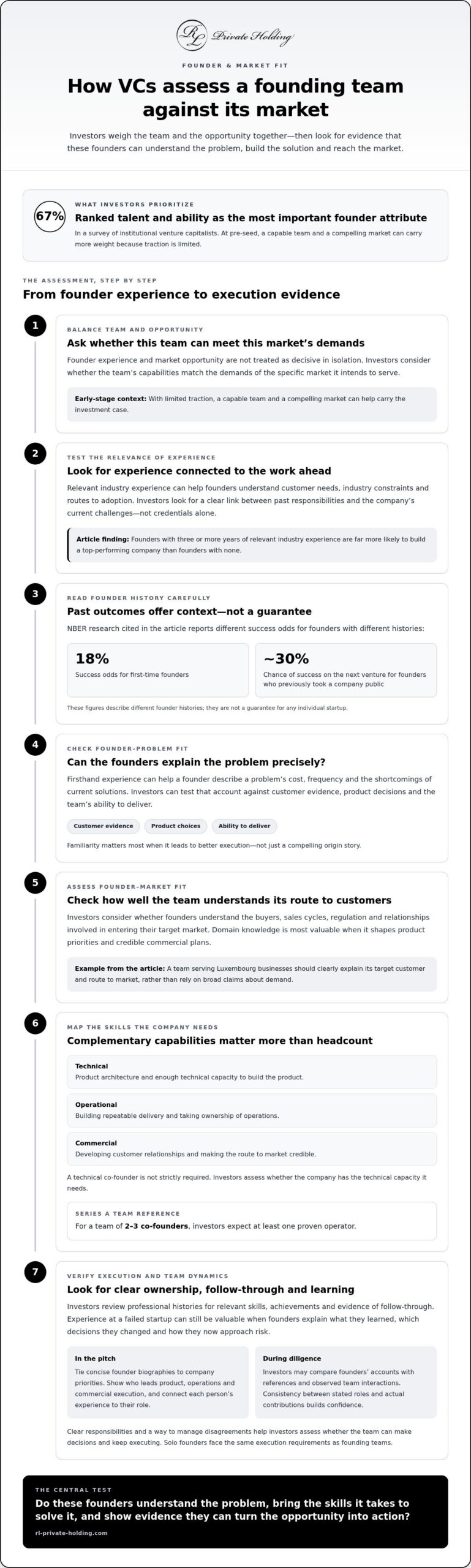
Investors weigh founder experience against market opportunity rather than treating either as decisive alone. At pre-seed, a capable team and a compelling market can carry more weight because traction is limited. In a survey of institutional venture capitalists, 67% ranked talent and ability as the most important founder attribute. The practical factor is whether this team can address this market’s demands.
Relevant experience helps founders understand customer needs, industry constraints and likely routes to adoption. Founders with three or more years of relevant industry experience are far more likely to build a top-performing company than founders with none. NBER research reports that first-time founders have 18% success odds, while founders who previously took a company public have about a 30% chance of success on their next venture. Those figures describe different founder histories, not a guarantee for any individual startup.
Founder-problem fit asks why these founders are suited to solve this particular problem. A founder who has experienced the problem firsthand may be able to explain its cost, frequency and shortcomings in current solutions precisely. Investors can compare that account with customer evidence, product decisions and the team’s ability to deliver. Familiarity matters most when it leads to better execution, not just a compelling origin story.
Founder-market fit adds industry knowledge to the assessment. Do the founders understand buyers, sales cycles, regulation and the relationships needed to enter their target market? A team serving Luxembourg businesses, for example, should clearly explain its target customer and route to market rather than rely on broad claims about demand. Domain expertise is most valuable when it informs product priorities and credible commercial plans.
Team composition also matters. Technical founders may lead product architecture, operational founders may build repeatable delivery, and commercial founders may develop customer relationships. A technical co-founder is not strictly required, but investors assess whether the company has enough technical capacity to build its product. For a Series A team of 2–3 co-founders, investors expect at least one proven operator.
Solo founders face the same execution requirements as founding teams, including technical capacity, customer access and operational ownership. Multiple co-founders can bring complementary expertise, but investors also consider whether responsibilities are clear and disagreements can be managed. A larger founding team is not automatically stronger: capability and working dynamics matter more than headcount.
Investors review founders’ professional histories for relevant skills, achievements and evidence of follow-through. They look for a clear link between past responsibilities and the company’s current challenges. Experience at a failed startup can also be valuable if founders explain what they learned, which decisions they changed and how they now approach risk.
To show team credibility in a pitch deck, include concise founder biographies tied to company priorities. Identify who leads product development, operations and commercial execution, and connect each person’s experience to their role. Include specific achievements and customer evidence where available. This helps investors judge whether the team can turn its market thesis into action.
Investors also assess co-founder relationships by looking at role clarity, decision-making and responses to conflict. Founders should explain how they divide responsibilities and resolve strategic differences. During diligence, investors may compare these accounts with references and observed team interactions. Consistency between stated roles and actual contributions builds confidence in the team’s ability to execute.
The strongest case connects experience to opportunity: the founders understand the problem, bring complementary skills and can explain how they will build and sell the solution. Market potential still matters, but a large opportunity cannot replace a team prepared to pursue it. When considering how VCs evaluate a founding team, present evidence linking the founders’ backgrounds to the work ahead.
2. Why Do Venture Capitalists Focus on Founders?
Investors focus on founders because early-stage companies have limited operating history. The team must make decisions while product, customers and market assumptions are still developing. In a survey of institutional venture capitalists, 95% named the team as essential. A separate measure of the same investment assessment shows human capital as the single most significant factor for 47% of respondents.
Those figures don’t mean product and market are secondary in every decision. In the cited survey, 13% identified product as the single most significant investment factor, while 8% chose the market. The difference reflects how investors assess uncertainty: a strong market thesis still depends on whether founders can build a useful product and reach customers.
At seed stage, Kelly Mak of Workbench said investors look for three of four pillars: team, product, market and traction. Founders can use this framework to identify gaps before a pitch. If customer evidence is limited, explain the product’s specific value and the team’s ability to deliver. If traction is still early, share what customer conversations or pilots have taught the company.
Execution connects the pitch deck to market validation. Investors assess whether milestones follow from customer evidence and whether the team adjusts its plan when feedback challenges an assumption. For example, founders can describe a pilot, the problem it tested, the response and the next product decision. That sequence is easier to evaluate than general claims about demand.
Market size matters because venture investors seek companies with substantial room to grow. An estimate is more useful when it identifies a defined customer group, a purchasing need and a realistic path to expansion. Founders should explain their initial segment first, then show how adjacent customers or regions could broaden the opportunity. A large headline estimate alone does not establish a venture-scale business.
Domain understanding strengthens the case. Founders should explain how buyers make decisions, which alternatives they use and what slows adoption. In Luxembourg, a company with regional ambitions should clarify which customers it will serve first and how it will reach them in relevant markets. This makes the market thesis concrete without treating one country as the entire opportunity.
Do venture capital criteria for founding teams differ in Luxembourg and Europe? The core assessment still covers team, product, market and traction, while expectations vary by investor, sector and company stage. For a Luxembourg-based venture, founders should clearly state their target geography and customer acquisition plan.
During team due diligence, investors may ask who leads product, sales and operations, how major decisions are made, and what the team learned from setbacks. Founders should answer with clear examples and consistent responsibilities. They should also explain what evidence would lead them to change strategy, showing how the team responds when market assumptions are tested.
In practice, how VCs evaluate a founding team comes down to the connection between founder capability and market evidence. A credible case explains what the team knows, what customers have demonstrated and how the company will turn those findings into disciplined execution.
3. Founder resilience and execution ability
Investors assess resilience by examining how founders respond when plans meet resistance. A delayed launch, weak customer response or technical setback can reveal how a team diagnoses problems. Founders can explain what changed, who led the response and what the team learned. This makes resilience observable rather than simply a claim about personality.
Execution speed is not just about shipping quickly. Startups need to test whether product changes solve a meaningful customer problem. Founders can describe an iteration cycle: identify a user issue, make a focused change, gather feedback and decide what to improve next. This shows whether learning is guiding product development.
Momentum is credible when progress is tied to a defined milestone. Rather than present a broad ambition, founders can identify the next product release, customer validation step or operational capability. They should explain what evidence will mark completion and how it supports the next stage. Investors can then assess whether the plan fits the venture’s current resources.
A founder’s execution track record is relevant when it sheds light on current responsibilities. Investors may examine previous projects, operating roles and examples of delivery. A founder who led a product launch should explain their contribution, the obstacles and how the team responded. Distinguishing personal ownership from collective results makes the account more credible.
Resilience also means changing direction without losing strategic discipline. When customer feedback challenges an assumption, founders should show how they distinguish a useful pivot from a reaction to temporary pressure. For example, they can compare the original assumption with new evidence, then explain which product or sales decision changed. This demonstrates adaptation based on learning.
How do VCs assess a founding team’s ability to recruit and execute? They look at whether founders can define the roles needed, attract capable people and give them clear ownership. Investors also compare hiring priorities with operating milestones: recruitment should address specific execution gaps, not expand headcount without a clear purpose.
Continuity planning offers another practical test. Investors can ask who would own architecture, hiring and delivery during the next 30 to 60 days if a CTO leaves. Founders should identify interim owners, key decisions and delivery priorities. A considered response demonstrates operational awareness and reduces dependence on one individual.
For each milestone, founders can set out the objective, accountable owner, required resources and evidence of completion. They should also explain how they will respond if results differ from expectations. This makes execution easier to assess across funding rounds and shows how the team turns setbacks into decisions and progress.
4. Resilience under pressure
Investors assess how founders respond when pressure puts their original plan to the test. Early-stage investors consider lived experience, grit and resilience alongside skills and motivation. If customer feedback contradicts a product assumption, for example, founders can explain what they learned, which decision changed and why. A clear account demonstrates adaptability through action rather than claims of passion.
Passion matters when it sustains attention to a real problem. It is less convincing when founders use commitment as a substitute for evidence or strategy. Consider a startup whose initial sales approach fails: founders can describe the customer responses they reviewed, the obstacle they identified and how they revised their approach. This shows persistence without mistaking repetition of an ineffective tactic for progress.
Pressure also tests leadership and team dynamics. Investors assess whether founders can make sound strategic and operational decisions, manage risk and execute under stress. A disagreement over product priorities can provide a useful example. Founders should explain how they resolved it, who made the final decision and how responsibilities remained clear afterward.
Adaptability does not mean changing direction every time a setback occurs. Founders should distinguish a temporary difficulty from evidence that a core assumption is wrong. They can describe the original strategy, the customer or operating evidence that challenged it, and the adjustment that followed. This helps investors judge whether a pivot reflects disciplined learning.
Resilience is also evident in how a team manages pressure on capital and resources. Founders should explain which priorities they protect, which activities they defer and how those choices preserve progress toward company milestones. For example, a team might focus limited capacity on validating a core customer need before adding secondary product features.
What founder commitment and time-allocation signals do VCs expect? Investors look for founders who can explain their responsibilities, priorities and sustained involvement in building the company. A concrete account of time spent on product development, customer discovery, hiring or operations says more than a general claim of dedication.
Founders can prepare for pressure-focused diligence by documenting a setback and their response. Set out the problem, evidence considered, decision taken and result. This structure keeps the account specific and reveals how leadership, judgment and resilience work together.
Investors also assess whether founders can consider advice without giving up accountability. A founder might describe a mentor questioning the company’s pricing strategy, then explain how customer evidence informed the final decision. The signal is not automatic agreement; it is the ability to weigh new information and take responsibility for the outcome.
5. Founder quality as a risk-management signal
Venture capital investors assess founder quality as an indication of how a company may handle uncertainty. A clear vision matters, but so do the decisions made when plans fail. Founders solving a customer problem, for example, should explain how they test assumptions, respond to contrary evidence and assign responsibility. These signals help investors assess judgment, adaptability and the team’s approach to risk.
Management dynamics can create material company risk. Up to 65% of high-growth startups fail because of conflicts within their management teams. Investors therefore assess how founders share authority, resolve disagreements and communicate difficult decisions. A team that can describe its decision process provides a more useful signal than founders who simply claim they work well together.
Common red flags include unclear roles, inconsistent accounts of company priorities and recurring conflict without a way to resolve it. Investors may also notice founders who dismiss customer evidence, avoid accountability or cannot say who owns key decisions. These concerns can weaken a funding case even when the product shows promise.
Co-founder relationships deserve specific attention during diligence. HBR notes evidence suggesting that up to 43% of founders ultimately buy out their cofounder because of rifts and power struggles. Investors may explore how equity, responsibilities and decision rights align, then compare founders’ explanations with observed team dynamics and references.
Founder quality also affects a company’s ability to attract and retain skilled employees. Investors assess whether leaders set clear expectations, communicate a coherent strategy and give team members meaningful ownership. A founder who can explain why a key hire is needed, what that person will own and how success will be assessed, for example, shows operational discipline.
Risk signals should be considered together, not in isolation. A disagreement about product direction may reflect productive debate if founders can explain the evidence and decision process. It is more concerning when responsibilities remain disputed or decisions repeatedly stall. Investors assess the pattern, its effect on execution and the founders’ ability to address it.
Founders can make their approach to risk management visible by preparing a concise account of a difficult decision. State the issue, the evidence considered, who owned the decision and the outcome. Then explain what changed in the company’s process. This gives investors concrete grounds to assess leadership rather than relying on broad claims about resilience.
Strong founder signals don’t remove venture risk, but they help investors judge how a team may respond to it. For founders seeking capital, explore venture capital funding as a potential next step.
RL Private Holding: Venture Capital Funding
RL Private Holding provides Venture Capital Funding for businesses seeking investment to support their development. The criteria discussed above can help founders present a clear account of their market, team capabilities, execution priorities and approach to risk. This context helps clarify whether venture capital fits a company’s objectives and financing needs.
Before pursuing funding, founders can organize their investment case around the problem they are solving, evidence of customer demand, team responsibilities and the milestones capital would support. A disciplined explanation clarifies the opportunity and the role funding would play in the company’s plans.
If your business is considering venture capital funding, contact RL Private Holding to discuss the next step.
Put Your Investment Case Into Motion
Understanding how VCs evaluate a founding team can help you prepare for a more substantive investment conversation. Start by clarifying your company’s priorities, identifying the support it needs and explaining how prospective capital would advance its plans. A focused discussion can help establish whether venture funding fits that direction.
RL Private Holding provides Venture Capital Funding, Private Equity Investment Management and Real Estate Asset Management. Each serves a distinct investment context, helping founders and investors consider which approach aligns with their objectives and the opportunity under review.
If your business is considering venture capital, prepare a concise account of its investment case and intended use of capital. Contact RL Private Holding to begin a discussion about Venture Capital Funding. A thoughtful next step can turn preparation into a clearer path forward.
Frequently Asked Questions
Why Do Venture Capitalists Focus on Founders?
Founders shape a startup’s priorities before established systems or predictable revenue exist. Investors therefore assess how the people leading the company make decisions with incomplete information. A founder who can explain why the company declined a tempting opportunity, for example, may demonstrate strategic discipline. The decision itself matters less than the reasoning, evidence and accountability behind it.
Are Young Founders More Likely to Succeed?
No reliable conclusion follows from age alone. The average successful startup founder is 45 years old, while the average unicorn founder started their first unicorn at 35 years old. These averages describe different groups; they don’t show that younger founders are more likely to succeed. Investors can instead assess whether a founder has the judgment, relevant skills and support needed for the company’s current demands.
Can domain expertise be built, or do you need it from day one?
Founders can develop domain expertise, but need a credible way to close knowledge gaps. A team entering a specialised field could map customer workflows, study purchasing decisions and involve experienced advisers. It should then show how those insights changed product choices or market assumptions. Investors can assess whether learning is improving decisions instead of relying only on the founder’s initial familiarity with the industry.
Do Elite Degrees Matter to Venture Capitalists?
An elite degree can provide context about a founder’s education, but it does not prove they can build a company. Investors can examine work samples, customer insight and decisions made in previous roles. A founder without a prestigious qualification can demonstrate capability by describing a relevant project, their specific contribution and what the result taught them. The substance of that evidence is more useful than a credential alone.
Do Venture Capitalists Prefer Leaders or Managers?
Investors look for leadership and management capacity, though their relative importance changes as a company develops. Leaders set direction, communicate priorities and make difficult choices. Managers translate those priorities into accountable work, operating processes and follow-through. A founder can illustrate both by explaining a strategic decision, how they communicated it to the team and how they monitored progress afterward.
Do investors care more about founder experience or market opportunity?
Neither factor stands alone: investors consider whether founders can pursue an opportunity effectively. A team with extensive experience still needs a market case supported by customer evidence. Likewise, a promising market needs founders who can make informed decisions and deliver. In a pitch, connect a specific founder capability to a market challenge, such as a sales cycle the team understands or a product constraint it can address.
Does a startup need a technical co-founder to raise funding?
No, a technical co-founder is not strictly required. Investors assess whether the company has enough technical capacity to build its product and whether responsibility for technical decisions is clear. A non-technical founding team should explain who leads product development, how technical quality is assessed and how the company will retain control of its core product knowledge.
Final Takeaways: What do Early-Stage Investors Want?
Early-stage investors want a coherent case connecting the company’s opportunity, leadership and capacity to deliver. Before a meeting, prepare a concise evidence file covering the customer problem, what has been tested, key assumptions and the decisions those findings prompted. Clearly identify who owns important functions. This preparation makes the discussion more substantive and helps investors identify issues for closer diligence.