

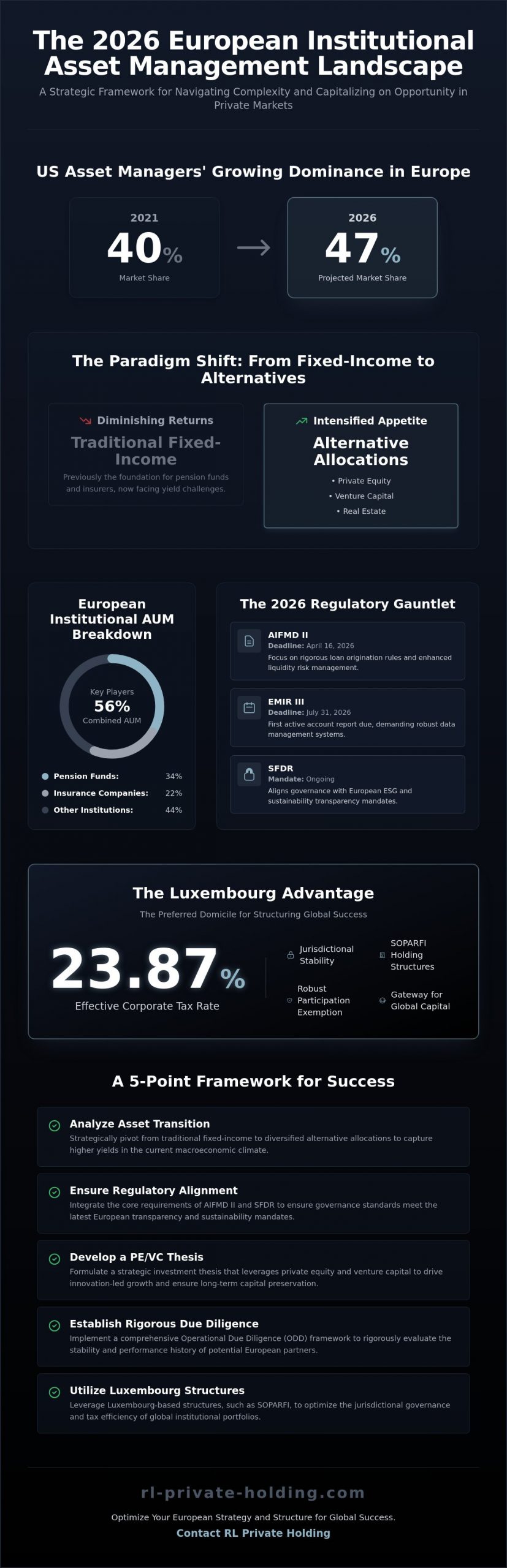
US-based asset managers have increased their share of the European market to 47% as of 2026, up from 40% in 2021, a shift that underscores the necessity for a more disciplined strategic framework. You likely recognize that the environment for institutional asset management Europe is currently defined by a wave of regulatory recalibration, where institutional success depends on a firm’s ability to integrate complex directives like AIFMD II and EMIR III into their core operations. This article offers a comprehensive analysis of the European institutional landscape, providing the clarity needed to manage illiquidity and enhance transparency in private equity fee structures. We’ll outline a framework for selecting venture capital partners and demonstrate how Luxembourg structures can be utilized to optimize governance and tax efficiency. This includes a review of the 23.87% effective tax rate in Luxembourg and the participation exemption thresholds that remain central to the Grand Duchy’s appeal for institutional investors in 2026.
Key Takeaways
- Analyze the transition from traditional fixed-income models to diversified alternative allocations within the evolving landscape of institutional asset management Europe in 2026.
- Identify the core regulatory requirements of AIFMD II and SFDR to ensure governance standards align with the latest European transparency and sustainability mandates.
- Develop a strategic investment thesis that integrates private equity and venture capital to drive innovation-led growth and long-term capital preservation.
- Establish a rigorous operational due diligence (ODD) framework for evaluating the stability and performance history of potential European investment partners.
- Utilize Luxembourg-based structures, such as the SOPARFI, to optimize the jurisdictional governance and tax efficiency of global institutional portfolios.
The Evolution of Institutional Asset Management in Europe in 2026
The European institutional landscape has transitioned from a period of relative stability into an era defined by structural complexity and a pivot toward private markets. While the European Fund and Asset Management Association (EFAMA) has historically focused on the growth of UCITS, the 2026 market environment demonstrates that institutional asset management Europe is now increasingly concentrated within the alternative investment fund (AIF) sector. This shift is driven by the diminishing returns of traditional fixed-income portfolios, which previously served as the primary foundation for pension funds and insurance companies. These entities, which represent 34% and 22% of assets under management respectively, are now forced to navigate a volatile global market characterized by stagflation fears and geopolitical uncertainty.
Luxembourg has solidified its position as the primary gateway for this capital. The Grand Duchy provides a stable jurisdictional framework that is essential for managing cross-border allocations. With a combined effective tax rate of approximately 23.87% in Luxembourg City and a robust participation exemption regime, it remains the preferred domicile for sophisticated holding structures. The implementation of AIFMD II by the April 16, 2026 deadline has further refined the governance requirements for these funds, ensuring that institutional managers maintain high levels of transparency and risk oversight. This regulatory environment supports the use of SOPARFI structures, which are vital for managing global portfolios with a focus on long-term capital preservation.
The Shift Toward Alternative Assets
Institutional appetite for private equity and venture capital has intensified as investors seek higher yields that public equities often fail to provide in the current macroeconomic climate. Real estate remains a cornerstone of the European institutional portfolio, offering a tangible hedge against inflation. However, managers must balance these allocations against the inherent illiquidity of private assets. This has led to the rising popularity of evergreen fund structures, which provide periodic liquidity windows while maintaining exposure to long-term growth assets. Success in this sector requires a disciplined approach to asset selection and a clear understanding of the underlying fee structures that impact net performance.
Key Market Drivers for 2026
Digital transformation has moved beyond a secondary consideration to become a primary driver of operational efficiency. The integration of artificial intelligence and distributed ledger technology allows firms to manage complex reporting requirements under EMIR III and MiFID II with greater precision. For instance, the first report for the active account requirement under EMIR III is due on July 31, 2026, necessitating robust data management systems. Additionally, demographic shifts are altering the flow of capital, as sovereign wealth funds play a more active role in the European market. Jurisdictional stability has become a critical factor for these global partners, who prioritize the legal certainty and institutional permanence offered by established financial hubs.
Regulatory Frameworks and Governance Standards for European Allocations
The European institutional landscape is currently defined by a wave of regulatory recalibration rather than simple deregulation. For entities engaged in institutional asset management Europe, the April 16, 2026, transposition of AIFMD II into national laws marks a significant milestone. This directive introduces rigorous rules for loan origination and enhanced liquidity risk management tools that demand greater operational transparency. Leading firms, such as those highlighted in the Top 500 Asset Managers list, recognize that these frameworks aren’t merely administrative hurdles. Instead, they serve as a foundation for trust. Fiduciary duty now encompasses a broader scope, requiring managers to demonstrate a disciplined synthesis of alternative asset exposure and robust governance. Luxembourg’s regulatory environment provides the legal certainty needed to navigate these complexities, offering a stable jurisdiction for global capital.
ESG and Sustainable Finance Disclosure Regulation (SFDR)
The Sustainable Finance Disclosure Regulation (SFDR) has fundamentally altered institutional decision-making. Navigating Article 8 and Article 9 fund classifications is now a core competency for any sophisticated allocator. While some global regions have seen a decline in ESG uptake, European asset managers continue to support environmental and social resolutions at a rate of approximately 80% as of 2026. This divergence underscores the importance of standardized sustainability reporting. Data transparency isn’t optional; it’s a prerequisite for institutional asset management Europe. Integrating impact investing into a core strategy requires precise data and a clear understanding of the evolving regulatory technical standards (RTS) expected by late 2026.
Institutional Governance and Risk Mitigation
Robust governance relies on independent board oversight and the presence of experienced, professional management. Managing cross-border regulatory risk in multi-jurisdictional portfolios demands a methodical approach to operational discipline. Best practices now prioritize digital-first reporting and real-time investor communication to address the transparency demands of 2026. This level of oversight ensures that institutional partners can manage illiquidity in volatile markets while maintaining compliance with frameworks like EMIR III. For organizations looking to optimize their governance structures, aligning with an expert private equity investment management firm provides the necessary stability and professional distance required for long-term success.
Strategic Asset Allocation: Integrating Private Equity, VC, and Real Estate
Effective institutional asset management Europe requires a departure from the traditional siloed approach to alternative assets. Sophisticated allocators now prioritize a unified cross-sector investment thesis that synthesizes private equity, venture capital, and real estate within a single governance framework. This integration isn’t merely an administrative convenience; it’s a strategic necessity for long-term capital preservation. By aligning these distinct asset classes, firms can mitigate the strategic governance challenges inherent in a fragmented market. This holistic view allows for a more precise calibration of risk and return, ensuring that each component of the portfolio serves a specific function in the broader wealth preservation mandate.
The Mechanics of Venture Capital and Private Equity
Venture capital funding serves as the primary engine for innovation-led growth. In the European ecosystem, identifying growth-stage technology opportunities requires deep sector expertise and a disciplined selection process. Private equity investment management complements this by focusing on operational restructuring and value creation in mature enterprises. These strategies are designed to generate alpha that public markets often can’t match. Managers must remain mindful of the J-curve effect, where early-stage capital calls and management fees result in initial negative returns. A well-structured portfolio accounts for this temporary illiquidity by laddering investments across different vintage years to ensure a steady flow of realizations.
Real Estate Asset Management Principles
Real estate remains a fundamental hedge against inflation and market volatility. Institutional strategies focus on prime European commercial and residential assets that offer stable, long-term yield. The integration of real estate asset management with broader private equity structures allows for more efficient tax and operational oversight. Risk management in this sector extends from the initial development phase through to long-term leasing and property maintenance. By utilizing Luxembourg-based holding vehicles, investors can ensure their real estate holdings benefit from the same high standards of governance as their private equity and venture capital allocations within the broader landscape of institutional asset management Europe.
Operational Due Diligence and Selection of Institutional Partners
Operational due diligence (ODD) has become the primary safeguard for mitigating risk within the sphere of institutional asset management Europe. While the strategic allocation to alternatives provides the potential for higher yields, it also introduces operational complexities that public markets don’t share. Institutional success depends on a firm’s ability to verify the internal controls, valuation methodologies, and compliance frameworks of their chosen partners. This process is no longer a secondary check; it’s a fundamental requirement for fulfilling fiduciary duties in an increasingly regulated environment. Investors must look beyond top-line returns to ensure that the management firm possesses the institutional permanence required to handle long-term capital commitments.
The Institutional Due Diligence Checklist
A methodical assessment of the investment team is the first priority. Allocators should evaluate the tenure of key personnel and the clarity of the decision-making process. Historical performance requires a deep attribution analysis to determine whether past returns were the result of a repeatable strategy or simply market beta. Furthermore, the robustness of a firm’s internal risk management systems must be scrutinized. This includes a review of how the manager handles the new reporting requirements under AIFMD II, particularly regarding liquidity risk management tools and delegation arrangements. A disciplined partner will demonstrate a clear organizational hierarchy and a transparent approach to conflict resolution.
Understanding Investment Management Fees
Fee structures in the European private market context must prioritize alignment between the manager and the institutional investor. While management fees provide the necessary capital for operational stability, performance-based incentives like carried interest should be structured to reward genuine alpha generation. Transparency is paramount. Investors should demand a clear breakdown of all costs to avoid hidden expenses that erode net returns over time. In Luxembourg, the use of sophisticated holding structures allows for a more efficient administration of these fees, provided the manager maintains rigorous reporting standards. Benchmarking these costs against industry peers ensures that the institutional allocator isn’t overpaying for standard market access.
Technology plays a critical role in enhancing this transparency. The integration of AI and distributed ledger technology allows for greater accuracy in reporting, especially as firms prepare for the EMIR III reporting deadlines in July 2026. For institutional allocators, partnering with a firm that demonstrates an unwavering commitment to operational precision is essential. Engaging with a disciplined provider of private equity investment management ensures that these governance standards are met with professional distance and institutional gravity. This methodical approach to partner selection serves as the final line of defense in a volatile global market.
The Luxembourg Holding Advantage: Structuring for Global Success
Luxembourg is the premier jurisdiction for institutional asset management Europe because of its legal certainty and sophisticated toolset. While many observers focus on retail fund distribution, the Grand Duchy’s real strength for institutional players lies in its holding company models. The SOPARFI (société de participations financières) offers strategic flexibility for managing global portfolios. It functions as a stable European hub that facilitates capital flows across borders with minimal friction. Under the 2026 tax regime, companies with income over €200,000 face a combined effective tax rate of 23.87% in Luxembourg City. This includes the 16% corporate income tax, the 7% solidarity surcharge, and the 6.75% municipal business tax. The participation exemption regime remains a primary attraction. It provides full tax exemptions on dividends and capital gains if the holding company meets specific conditions, such as a 10% shareholding or an acquisition price of at least €1.2 million for dividends and €6 million for capital gains. These thresholds ensure that the jurisdiction remains competitive for large-scale private equity and venture capital allocations.
Luxembourg Investment Structures (SOPARFI)
The SOPARFI structure is designed for institutional investors who require a high degree of control over their global participations. Its strategic flexibility allows for the holding of various asset types, including real estate and technology ventures, within a single entity. This centralization simplifies governance and reporting under the new AIFMD II and EMIR III frameworks. By using a Luxembourg holding company, investors benefit from a stable hub that is recognized globally for its professional expertise. The jurisdiction doesn’t just offer tax efficiency; it provides a predictable legal environment that is essential for managing the high-stakes nature of private equity and asset management.
RL Private Holding: A Discreet Partner in Institutional Growth
RL Private Holding operates with the quiet authority required for complex global investments. The firm’s approach is rooted in institutional gravity and professional discipline. It focuses on the structural components of the business across sectors like technology, real estate, and private equity investment management. This methodical focus ensures that investments are handled with a long-term perspective. The firm doesn’t seek the spotlight; it acts as a steady hand in the background of major global allocations. There’s a clear convergence happening where the lines between wealth management and institutional asset management Europe are blurring. Sophisticated investors now demand the same level of governance and transparency for their private holdings as they do for large-scale institutional funds. This shift requires a partner that understands the nuances of global structures and maintains a high formality register in all communications. By prioritizing structural integrity over marketing hyperbole, the firm projects the stability that global partners value in a volatile market.
Organizations seeking a disciplined global partner can Contact RL Private Holding for an institutional briefing on European structures. This briefing provides a factual presentation of how to optimize tax and governance through Luxembourg.
Strengthening Institutional Portfolios for the 2026 Regulatory Era
The landscape of institutional asset management Europe demands a methodical approach to both jurisdictional selection and asset allocation. Success in 2026 is predicated on the synthesis of private equity, venture capital, and real estate within a unified governance framework. This integration allows for the mitigation of strategic risks while maximizing the benefits of Luxembourg’s stable regulatory environment and its robust participation exemption regimes. Institutional allocators must prioritize transparency in fee structures and high standards of operational due diligence to fulfill their fiduciary mandates in an increasingly complex global market.
RL Private Holding provides the institutional-grade governance and professional management required for these sophisticated cross-border strategies. Headquartered in Luxembourg, a premier global financial center, the firm maintains a diversified portfolio across technology, real estate, and private equity sectors. Its commitment to stability and professional discipline ensures that global partners receive a sober, factual presentation of their investment opportunities. You’re invited to Explore Strategic Institutional Solutions with RL Private Holding to align your portfolio with these high standards of governance. Maintaining a steady hand in a volatile market remains the definitive path toward long-term capital preservation.
Frequently Asked Questions
What is the primary role of institutional asset management in Europe?
Institutional asset management Europe primarily serves to steward capital for large-scale entities such as pension funds and insurance providers. These firms focus on fulfilling fiduciary duties through disciplined asset allocation and risk mitigation. By managing diverse portfolios, they ensure long-term capital preservation and generate consistent yields for their beneficiaries.
Why is Luxembourg the preferred jurisdiction for institutional investors?
Luxembourg provides a stable and predictable legal environment that is essential for cross-border investment activity. The jurisdiction is favored for its specialized holding vehicles and its deep pool of professional expertise in alternative assets. Its central location and established financial infrastructure make it the premier hub for global capital entering the European market.
How does AIFMD affect institutional asset management in Europe?
The Alternative Investment Fund Managers Directive (AIFMD) establishes a rigorous framework for the oversight and transparency of alternative fund managers. It mandates high standards for liquidity risk management, valuation, and reporting. The recent updates to the directive ensure that institutional managers maintain consistent governance across all EU member states.
What is the difference between private equity and venture capital in an institutional portfolio?
Private equity focuses on operational value creation in mature companies, while venture capital targets high-growth potential in early-stage technology firms. Institutional portfolios use private equity for stability and alpha generation. Venture capital serves as a vehicle for innovation-led growth, offering a different risk-return profile within a diversified alternative allocation.
How are asset management fees typically structured for institutional investors?
Fees are typically composed of a base management fee calculated as a percentage of assets under management and a performance-based incentive. This performance fee, or carried interest, aligns the manager’s interests with those of the investor. Transparency in reporting is vital to ensure all costs are clearly understood and benchmarked against industry standards.
What is a SOPARFI and how does it benefit institutional asset management?
A SOPARFI is a Luxembourg holding company that provides significant strategic flexibility for managing global participations. It benefits from a robust participation exemption regime, which can eliminate taxes on dividends and capital gains under specific conditions. This structure is particularly effective for institutional asset management Europe when handling multi-jurisdictional private equity or real estate holdings.
How do institutional investors manage risk in European real estate?
Risk management in real estate involves a focus on prime commercial and residential assets with stable leasing profiles. Investors utilize rigorous operational due diligence to evaluate property management and market conditions. Structuring these investments through established legal vehicles ensures that real estate holdings are integrated into a broader, disciplined governance framework.
What are the key trends for institutional asset management in 2026?
Key trends include the increasing use of technology for reporting accuracy and the growth of evergreen fund structures. Digitalization and the integration of AI are transforming operational efficiency across the sector. Additionally, the continued commitment to sustainability principles distinguishes the European market from other global regions, influencing how capital is allocated.