

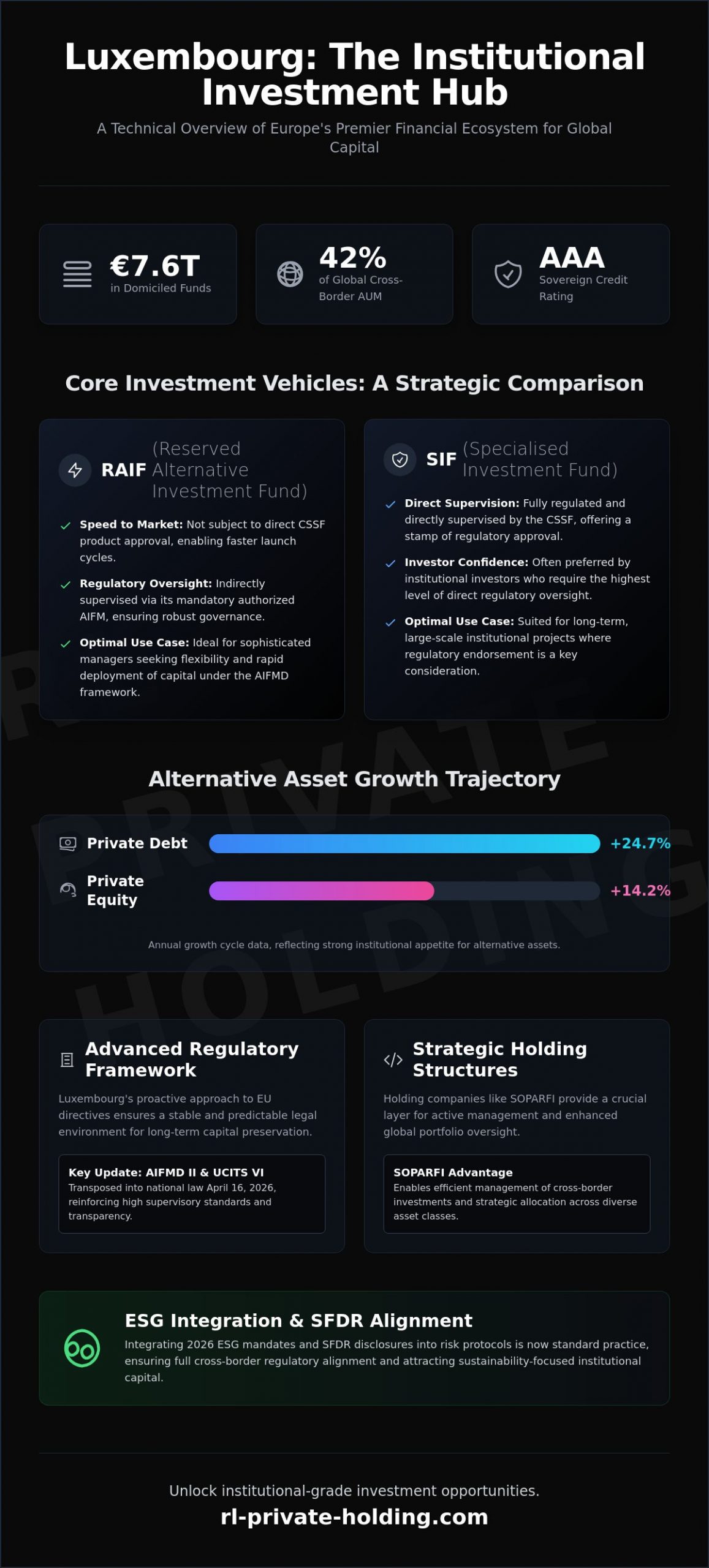
Luxembourg currently facilitates 42% of the global cross-border assets under management, maintaining a total of approximately €7.6 trillion in domiciled investment funds. This concentration of capital highlights why institutional investment opportunities Luxembourg remain a primary focus for global asset managers seeking stability and sophisticated regulatory frameworks. The recent transposition of AIFMD II and UCITS VI into national law on April 16, 2026, further solidifies the jurisdiction’s commitment to high supervisory standards and operational transparency.
Identifying the most effective vehicles for long term alternative assets often involves managing the technical nuances between structures such as the Reserved Alternative Investment Fund (RAIF) and the Specialised Investment Fund (SIF). This strategic reference offers a comprehensive technical overview of the current financial ecosystem. You’ll gain a clear map of the structural benefits available to institutional capital and a detailed look at the asset classes, including private equity and real estate, that are essential for modern portfolio diversification.
Key Takeaways
- Analyze the foundational stability of the Luxembourg financial ecosystem and its role in long-term capital preservation for institutional investors.
- Evaluate technical frameworks for institutional investment opportunities Luxembourg within the private equity and venture capital asset classes.
- Compare the strategic advantages of the Reserved Alternative Investment Fund (RAIF) and Specialized Investment Fund (SIF) to determine the optimal vehicle for specific capital requirements.
- Integrate current 2026 ESG mandates and SFDR disclosures into risk management protocols to ensure cross-border regulatory alignment.
- Understand the transition toward active management through holding company structures like the SOPARFI to enhance global portfolio oversight.
The Luxembourg Financial Ecosystem for Institutional Capital
Luxembourg is established as the preeminent European center for institutional asset management, serving as the primary bridge between global capital and the European Single Market. The Luxembourg Financial Ecosystem is defined by its concentration of expertise and a regulatory framework that prioritizes the security of complex cross-border structures. For entities exploring institutional investment opportunities Luxembourg, the jurisdiction offers a unique combination of political neutrality and economic resilience. This environment doesn’t just host funds; it provides a comprehensive infrastructure designed for the preservation and growth of institutional capital.
Unlike other regional hubs, Luxembourg maintains a consistent “Triple A” sovereign credit rating from all major agencies. This rating is a critical component of institutional risk models, as it serves as a baseline for capital preservation strategies. It reflects a debt-to-GDP ratio that remains significantly lower than the Eurozone average, providing a buffer against systemic shocks. The Commission de Surveillance du Secteur Financier (CSSF) and the Commissariat aux Assurances (CAA) act as the primary governing bodies. They ensure market integrity through rigorous supervisory standards and a proactive approach to European Union directives.
Sovereign Stability and Institutional Gravity
The legal environment in Luxembourg is characterized by a high degree of predictability and legal certainty. This attracts a dense network of global custodian banks and specialized professional service providers who manage the operational requirements of institutional funds. The workforce in the Grand Duchy is uniquely multilingual and technically proficient in the nuances of international tax and fund law. This concentration of talent creates a gravitational pull for institutional capital. Investors find the necessary infrastructure to support sophisticated investment vehicles without the friction found in less specialized markets.
The Role of Luxembourg in Global Capital Markets
As of late 2025, total assets under management in Luxembourg-domiciled funds reached approximately €7.6 trillion. This scale demonstrates the jurisdiction’s function as a global gateway. It allows institutional investors to aggregate capital from multiple jurisdictions into a single, highly regulated pool for distribution across the European Union. The diversity of institutional investment opportunities Luxembourg provides is a direct result of this scale and the historical resilience of the financial sector. Data shows that the Grand Duchy maintains a steady trajectory even during periods of global market volatility. This stability isn’t accidental; it’s the result of a long-term strategy to maintain a specialized focus on alternative asset classes like private equity and real estate.
Core Alternative Asset Classes and Investment Vehicles
The expansion of alternative assets within the Grand Duchy reflects a strategic pivot by global funds seeking yield beyond traditional equity markets. Recent data indicates that Private Equity (PE) assets in Luxembourg saw a 14.2% increase, while private debt assets grew by 24.7% in the preceding annual cycle. These figures underscore the depth of institutional investment opportunities Luxembourg offers to capital allocators. The jurisdiction’s capacity to host diverse strategies allows for a high degree of portfolio customization, ensuring that institutional mandates for risk-adjusted returns are met with precision.
Allocating to Luxembourg-domiciled alternative assets provides a structural buffer against broader market volatility. The Regulatory Frameworks and Structural Advantages inherent in the local market provide a secure foundation for these long-term commitments. By utilizing specialized vehicles, institutional investors can access niche sectors such as infrastructure and green technology, which are increasingly central to the national economic strategy. This ecosystem supports the entire investment lifecycle, from initial capital calls to final divestment.
Private Equity and Venture Capital Dynamics
Institutional capital in Luxembourg shows a clear preference for growth-stage technology and large-scale infrastructure projects. These investments typically follow a 10 to 12 year lifecycle, requiring a stable legal environment for successful execution. Co-investment opportunities have become a standard feature, allowing institutional partners to participate directly alongside general partners in specific high-value deals. This direct participation is often facilitated through sophisticated private equity investment management, which provides the necessary oversight for complex cross-border transactions. Venture capital funding has also matured, with a specific focus on fintech and ICT sectors that benefit from the local digital infrastructure.
Institutional Real Estate Asset Management
Real estate continues to serve as a core institutional inflation hedge within the Luxembourgish framework. The market offers a balance between stable commercial office portfolios and high-demand residential developments. Institutional investors frequently utilize the Reserved Alternative Investment Fund (RAIF) or the Specialised Investment Fund (SIF) to hold these assets, benefiting from the tax neutrality and structural flexibility these vehicles provide. Whether through direct asset ownership or indirect participation via fund units, real estate remains a fundamental component of a diversified institutional portfolio. The ability to ring-fence specific properties within sub-funds allows for clear risk segregation and streamlined management of international real estate holdings.
Regulatory Frameworks and Structural Advantages
The structural integrity of Luxembourg’s Financial Regulatory Framework serves as a primary differentiator for global capital. Institutional investors prioritize the jurisdiction for its strict adherence to the Alternative Investment Fund Managers Directive (AIFMD), which ensures a standardized level of investor protection across the European Union. With the recent entry into force of AIFMD II on April 16, 2026, the framework now includes enhanced rules for liquidity management tools and leverage limits for loan-originating funds. These updates reinforce the stability required for institutional investment opportunities Luxembourg, particularly within the alternative asset space. Tax neutrality remains a cornerstone of this ecosystem. The system is designed to prevent double taxation, ensuring the tax burden is generally borne at the level of the investor rather than the investment vehicle itself.
The SOPARFI: A Strategic Holding Vehicle
The Société de participations financières, or SOPARFI, is the most common vehicle for holding and financing activities in Luxembourg. It’s not a specific fund type but a fully taxable commercial company that benefits from the participation exemption regime. This allows for the tax-exempt receipt of dividends and capital gains, provided specific holding periods and ownership thresholds are met. Institutional partners utilize the SOPARFI for its broad access to Luxembourg’s extensive network of over 80 double tax treaties. This structure provides the flexibility needed for managing global private equity and real estate portfolios, serving as a robust platform for international asset holding and cross-border capital flows.
RAIF vs. SIF: Selecting the Optimal Fund Structure
Choosing between the Reserved Alternative Investment Fund (RAIF) and the Specialised Investment Fund (SIF) depends on the specific regulatory requirements of the mandate. The RAIF has seen significant adoption, with over 2,200 registrations since its inception, primarily due to its rapid time-to-market. It doesn’t require direct authorization from the CSSF, as it’s managed by an authorized external AIFM. In contrast, the SIF is a multi-purpose vehicle that remains under the direct prudential supervision of the CSSF. This makes it suitable for strategies that require an additional layer of institutional oversight. Both frameworks are restricted to “well-informed investors,” a category that includes institutional entities and individuals committing a minimum of €125,000 who have been appraised by a credit institution or investment firm.
Evaluating Risk and ESG Integration in Luxembourg Portfolios
Risk management within the Luxembourg financial center has evolved into a multi-dimensional discipline that integrates traditional prudential oversight with sophisticated sustainability metrics. The Commission de Surveillance du Secteur Financier (CSSF) has designated sustainable finance and risk management as its primary supervisory priorities for 2026. This focus ensures that institutional investment opportunities Luxembourg remain grounded in transparency and structural resilience. Institutional capital allocators must now implement rigorous due diligence protocols that assess a partner’s ability to manage ICT-related risks under the Digital Operational Resilience Act (DORA) while maintaining compliance with updated liquidity requirements.
Effective risk management requires the implementation of robust internal controls and independent auditing processes. Open-ended funds and UCITS are now mandated to select at least two liquidity management tools, with the selected tools communicated to the CSSF by April 16, 2026. These protocols are essential for maintaining stability in alternative asset structures, where liquidity profiles can be complex. Transparency in reporting isn’t merely a regulatory requirement; it’s a fundamental component of institutional mandates. Investors seeking to optimize their exposure should prioritize partners with proven expertise in real estate asset management and complex risk modeling to ensure long-term capital preservation.
Institutional Governance and Risk Oversight
The governance of institutional portfolios in Luxembourg relies on a clear segregation of duties and specialized oversight. Liquidity risk management has become particularly technical following the new leverage limits for loan-originating AIFs, which are capped at 175% for open-ended funds and 300% for closed-ended structures. Robust internal reporting systems must provide real-time data to ensure these thresholds aren’t breached. Independent auditing remains a cornerstone of the ecosystem, providing the necessary verification of asset valuations and operational integrity that institutional capital requires for global cross-border allocations.
SFDR and the Future of Sustainable Allocation
Sustainable finance is no longer an elective strategy but a core regulatory framework. At the end of 2025, sustainable public and private market funds in Luxembourg held €1,632.7 billion in assets under management. The next reporting cycle for Principal Adverse Impact (PAI) disclosures is June 30, 2026, covering the 2025 reference period. Institutional funds are increasingly categorized under Article 8 or Article 9 of the SFDR, with Article 9 funds requiring a specific sustainable investment objective. This classification system, combined with the EU Taxonomy, provides a standardized language for evaluating the environmental impact of real estate and infrastructure investments. There’s also a notable increase in institutional demand for impact-driven venture capital, where measurable social or environmental outcomes are weighted alongside financial returns.
Strategic Allocation and the Role of Private Holding Entities
Institutional capital is increasingly transitioning from passive fund participation toward active management through dedicated holding companies. This shift represents a move toward greater control and transparency in asset oversight. Within the context of institutional investment opportunities Luxembourg, the holding company model provides a robust framework for aggregating cross-sector interests under a single governance structure. By centralizing decision-making in a Luxembourgish headquarters, entities maintain a steady hand over global operations while benefiting from the jurisdiction’s institutional gravity.
RL Private Holding operates at the intersection of these trends, providing a disciplined approach to private equity investment management and real estate asset management. The firm maintains a strategic focus on sectors with long-term growth potential, including infrastructure and technology-driven ventures. This model prioritizes capital preservation through meticulous risk assessment and a commitment to operational excellence. It doesn’t just track market trends; it creates value through active participation. Sophisticated holding entities employ these strategies to ensure that wealth isn’t only managed but protected across multiple market cycles.
Managing Diversified Global Portfolios
The synergy between venture capital funding and private equity management allows for a comprehensive approach to the corporate lifecycle. Holding structures facilitate these cross-sector strategies by allowing capital to be reallocated efficiently between different asset classes without the friction of multiple external fund layers. This centralization often leads to more predictable management fee structures and aligned performance incentives. It ensures that the interests of the holding entity remain strictly focused on the performance of the underlying assets. Centralized management also simplifies the reporting requirements mandated by the CSSF for institutional portfolios.
The Future of Institutional Wealth Management
Luxembourg’s evolution into a primary hub for family offices and private holdings is expected to accelerate throughout 2026. The jurisdiction’s stability and specialized workforce provide the necessary environment for managing multi-generational wealth. Selecting a long-term partner requires a focus on institutional permanence and a shared commitment to disciplined growth. Entities seeking to navigate these complexities should discover the strategic approach of RL Private Holding to global asset management. This focus on stability and exclusivity remains the cornerstone of successful institutional allocation in the Grand Duchy.
Advancing Institutional Strategies in the Grand Duchy
The Luxembourg financial center maintains its position as the preeminent hub for cross-border capital through a combination of sovereign stability and regulatory innovation. The implementation of AIFMD II and the continued refinement of SFDR reporting requirements provide a clear framework for long-term growth. Institutional investors now have access to a sophisticated toolkit of vehicles, from the rapid time-to-market of the RAIF to the structural versatility of the SOPARFI holding company. These tools are essential for managing the complexities of modern alternative asset allocation.
Identifying and securing institutional investment opportunities Luxembourg offers requires a partner with a commitment to institutional-grade governance and transparency. RL Private Holding utilizes its global portfolio management expertise to oversee diverse interests with a specialized focus on technology and real estate. This disciplined approach ensures that capital is deployed effectively and protected through rigorous risk management protocols. We invite you to Explore Strategic Institutional Investment Management with RL Private Holding to align your long-term objectives with a steady, professional partner.
Frequently Asked Questions
Why is Luxembourg considered a primary hub for institutional investment?
Luxembourg hosts over 42% of global cross-border fund assets, totaling approximately €7.6 trillion as of late 2025. This scale creates a concentration of specialized service providers and custodian banks that is unmatched in Europe. These factors, combined with a stable political environment, ensure that institutional investment opportunities Luxembourg remains a primary consideration for global capital allocators seeking long-term security.
What are the main differences between a RAIF and a SIF for institutional investors?
The Reserved Alternative Investment Fund (RAIF) offers a faster time-to-market because it doesn’t require direct authorization from the CSSF. Instead, it’s supervised through its authorized Alternative Investment Fund Manager (AIFM). The Specialised Investment Fund (SIF) is a directly regulated product, providing an additional layer of prudential oversight that some institutional mandates require for specific risk profiles.
How does the SOPARFI structure benefit international holding companies?
The SOPARFI functions as a commercial company that benefits from Luxembourg’s extensive network of over 80 double tax treaties. It’s particularly effective for holding activities due to the participation exemption regime. This regime allows for tax-exempt dividends and capital gains on qualifying participations, making it a preferred structure for institutional private equity and real estate portfolios.
What ESG regulations must Luxembourg investment funds comply with in 2026?
In 2026, funds must comply with the Sustainable Finance Disclosure Regulation (SFDR) and the Corporate Sustainability Reporting Directive (CSRD). The next reporting cycle for Principal Adverse Impact (PAI) disclosures is June 30, 2026. Additionally, the CSSF has prioritized the supervision of ESG claims to prevent greenwashing, requiring funds to align with the latest EU Taxonomy criteria.
Can institutional investors access venture capital opportunities through Luxembourg structures?
Luxembourg’s ecosystem supports venture capital through vehicles like the Common Limited Partnership (SLP) and the RAIF. These structures are frequently used to deploy capital into growth-stage technology and fintech sectors. Institutional investors benefit from the jurisdiction’s sophisticated digital infrastructure and the diversity of institutional investment opportunities Luxembourg provides through high-impact venture strategies and specialized management firms.
What role does the CSSF play in institutional investment oversight?
The Commission de Surveillance du Secteur Financier (CSSF) oversees the prudential supervision of the financial sector. Its role includes the authorization of fund managers and the monitoring of compliance with European directives like AIFMD II. In 2026, the regulator is specifically focused on ICT risk management under DORA and the integration of sustainable finance disclosures into institutional reporting.
How does Luxembourg maintain its “Triple A” sovereign credit rating?
Luxembourg’s “Triple A” rating is a result of consistent fiscal discipline and a debt-to-GDP ratio that is significantly lower than the Eurozone average. The government’s proactive approach to transposing EU directives also contributes to a stable legal environment. This economic resilience provides a secure baseline for institutional risk models and long-term capital preservation strategies.
What are the typical management fee structures for private equity in Luxembourg?
Private equity structures in Luxembourg typically involve a management fee and a performance-based incentive known as carried interest. A modernized tax regime for carried interest became effective on January 1, 2026, taxing contractual carried interest at approximately 11.45%. While specific fee levels vary by mandate, the structural transparency of Luxembourgish vehicles ensures that performance incentives are clearly defined within the fund documents.