

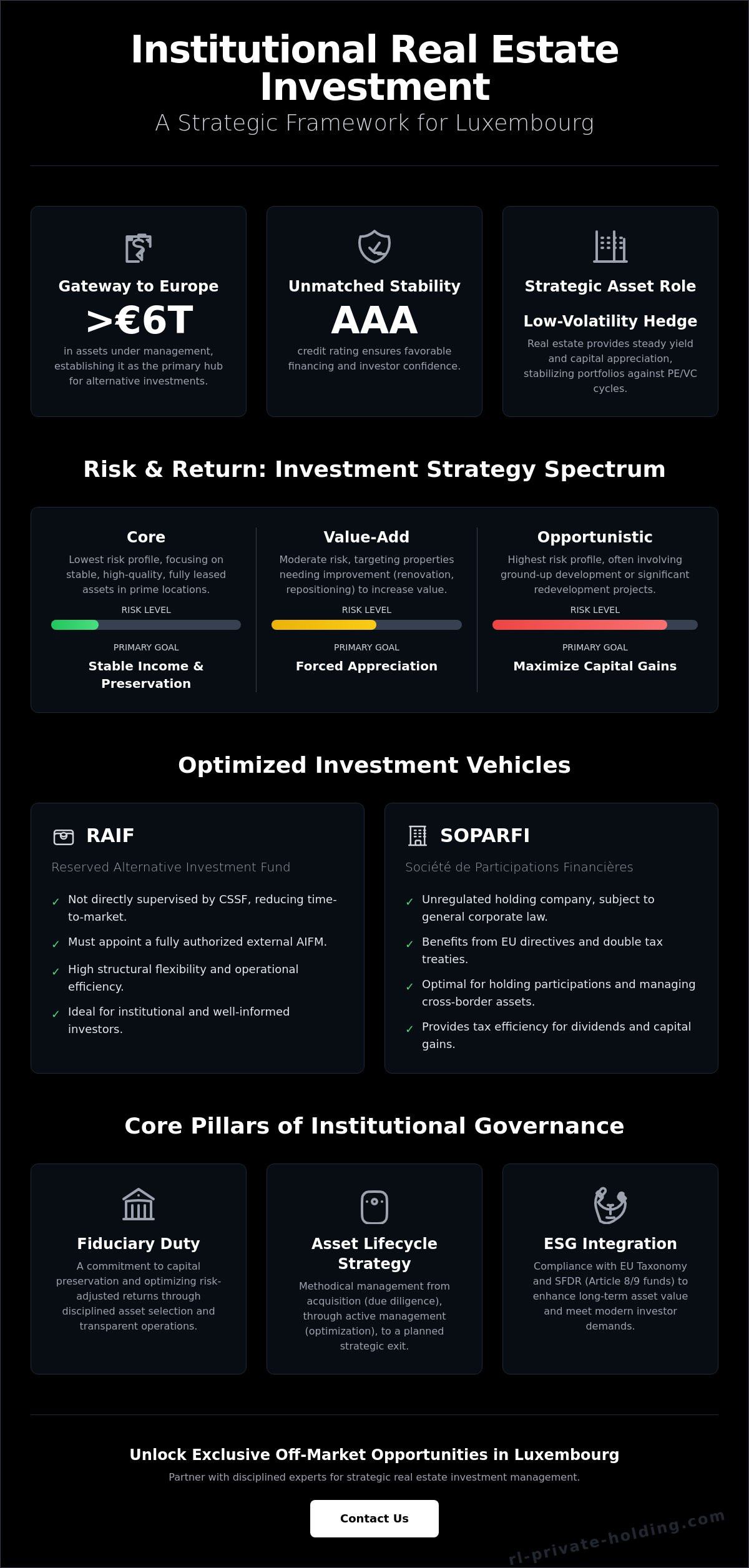
Luxembourg serves as the primary gateway for European alternative investments, currently overseeing more than €6 trillion in assets under management. Within this environment, the successful execution of real estate investment management Luxembourg requires a sophisticated integration of regulatory adherence and institutional-grade governance. It’s no longer sufficient to rely on market momentum; instead, managers must adopt the disciplined frameworks typically associated with high-level private equity.
Institutional investors recognize that the local market’s maturity, combined with the implementation of AIFMD II in April 2026 and the new three-tier property tax system, has increased the complexity of maintaining yield. This guide provides a definitive framework for navigating these structural shifts while ensuring that real estate portfolios remain compliant and performant. We examine the strategic selection of investment vehicles, the nuances of the current fiscal landscape, and the operational principles essential for modern asset governance.
Key Takeaways
- Understand the strategic function of real estate as a low-volatility hedge against the cyclical nature of private equity and venture capital investments.
- Identify the most efficient structures for real estate investment management Luxembourg, focusing on the specific regulatory advantages of the RAIF and SOPARFI vehicles.
- Examine the core governance pillars and ESG integration standards required to fulfill institutional fiduciary duties and maintain long-term asset value.
- Distinguish between Core, Value-Add, and Opportunistic strategies to effectively mitigate risk and enhance performance in a mature European market.
- Learn how local market intelligence and a disciplined management approach facilitate the identification of exclusive off-market opportunities.
The Strategic Role of Real Estate in Luxembourg Institutional Portfolios
Institutional real estate investment management Luxembourg constitutes the systematic oversight of high-value property assets through regulated and unregulated structures. For global holding companies, real estate isn’t merely a physical asset. It’s a strategic pillar that provides a low-volatility hedge against the more aggressive cycles of venture capital and private equity. While private equity targets high internal rates of return over shorter horizons, real estate offers a steady yield and capital appreciation that stabilizes the broader portfolio. This balance ensures that the overall entity remains resilient during periods of market contraction.
Luxembourg’s status as a safe haven significantly influences market dynamics. The country’s political neutrality and economic resilience lead to compressed cap rates in prime commercial and residential sectors. Investors accept these lower yields in exchange for the security of the underlying asset and the predictability of the legal environment. There’s been a definitive shift from direct property ownership toward structured, indirect investment vehicles. These structures allow for more precise tax planning and operational efficiency, especially when managing cross-border portfolios that require centralized governance.
Real Estate as a Core Asset Class for Wealth Preservation
Asset managers prioritize real estate for its inherent correlation with inflation protection in the Eurozone. As consumer prices fluctuate, real estate values and rental incomes typically adjust, preserving the real value of the capital. Within multi-generational wealth management structures, Luxembourg real estate serves as a foundational layer. It provides long-term capital stability that survives market volatility. The use of a Specialized Investment Fund (SIF) or similar vehicle ensures that these assets are managed with the professional rigor required by institutional standards. This structured approach facilitates the seamless transfer of wealth while maintaining control over the asset’s operational performance.
The Luxembourg Advantage: Stability and Global Reach
The nation’s consistent AAA credit rating provides a significant advantage in real estate financing. It allows investment managers to secure debt at more favorable terms, enhancing the overall cash-on-cash return for the portfolio. Luxembourg’s proximity to major European capital markets facilitates a constant flow of institutional liquidity. This accessibility, paired with a stable political climate, drives sustained interest from global sovereign wealth funds and private family offices. The focus remains on disciplined growth within a jurisdiction that respects the principles of long-term asset protection and professional real estate investment management Luxembourg.
Core Pillars of Institutional Asset Management and Governance
The fiduciary duty of an investment manager within the Luxembourg real estate sector involves a commitment to capital preservation and the optimization of risk-adjusted returns. This responsibility requires a disciplined approach to asset selection and a transparent operational framework. Given the stability of the current Luxembourg Investment Climate, managers must operate with a high degree of institutional gravity to maintain investor trust. This duty isn’t static. It evolves throughout the asset lifecycle, beginning with a rigorous due diligence process and extending through active management to a calculated strategic exit.
Effective real estate investment management Luxembourg necessitates a lifecycle strategy that prioritizes value creation at every stage. Acquisition isn’t merely about property procurement; it’s about identifying assets with structural advantages that align with broader portfolio goals. Once acquired, active management focuses on lease optimization and cost control. The final stage, a strategic exit, is planned at the point of entry to ensure liquidity and maximize capital gains in a competitive market. This methodical approach ensures that each asset serves its intended purpose within the larger institutional holding.
ESG Integration and Sustainable Value Creation
The implementation of the EU Taxonomy and the Sustainable Finance Disclosure Regulation (SFDR) has fundamentally altered asset valuation. Luxembourg managers now categorize funds under Article 8 or Article 9 to reflect their environmental commitments. There’s a direct correlation between a building’s energy efficiency and its long-term liquidity. Institutional buyers increasingly avoid “stranded assets” that don’t meet modern carbon standards. Transitioning to green asset management involves proactive retrofitting and sustainable tenant engagement to safeguard the asset’s future marketability and maintain its institutional grade.
Reporting Standards and Operational Transparency
Institutional stakeholders require granular visibility into fund performance. Adherence to INREV (European Association for Investors in Non-Listed Real Estate Vehicles) standards ensures that reporting is consistent and comparable across the industry. Professional real estate asset management relies on real-time data to monitor occupancy rates, cash flows, and debt covenants. Independent third-party valuations provide an objective layer of governance, ensuring that net asset values (NAV) accurately reflect current market conditions. This transparency is essential for maintaining the integrity of the investment vehicle and fulfilling reporting obligations to global partners.
Luxembourg Investment Vehicles: SCSp, RAIF, and SOPARFI
Selecting the appropriate legal vehicle is a fundamental component of real estate investment management Luxembourg. Managers must evaluate the trade-offs between regulatory intensity, tax transparency, and operational speed. The SOPARFI is a versatile holding vehicle. It’s a fully taxable entity, which provides the benefit of Luxembourg’s extensive double tax treaty network. This is essential for managing global real estate assets where cross-border withholding taxes must be mitigated. While the SOPARFI is a traditional choice, the Reserved Alternative Investment Fund (RAIF) and the Special Limited Partnership (SCSp) represent the modern evolution of the jurisdiction’s fund law.
The RAIF: Flexibility and Speed to Market
The RAIF has become the standard for institutional real estate due to its efficient setup process. It doesn’t require direct CSSF supervision at the fund level, which significantly accelerates the launch timeline. Governance is instead ensured through an authorized Alternative Investment Fund Manager (AIFM). For well-informed investors meeting the €100,000 minimum investment threshold, the RAIF provides a regulated-like environment with a 0.01% annual subscription tax on net assets. Under the AIFMD II framework effective as of April 2026, these vehicles also benefit from harmonized rules regarding loan-origination and delegation, ensuring they remain competitive for institutional capital deployment.
The SCSp: Tax Transparency and Contractual Freedom
The SCSp is particularly effective for private equity-real estate (PERE) strategies. It lacks legal personality, making it tax-transparent for Luxembourg purposes. Partners have significant freedom to define management rights and profit distribution in the partnership agreement. This flexibility makes it an ideal vehicle for joint ventures where different stakeholders require specific governance terms or waterfall structures. It integrates seamlessly into broader private equity frameworks, allowing real estate to be managed with the same contractual rigor as other alternative asset classes. The absence of a minimum capital requirement further enhances its utility for bespoke investment structures.
While the RAIF and SCSp offer fund-like features, the SOPARFI (Société de Participations Financières) remains a staple for traditional holding activities. It’s often structured as an S.à r.l. with a minimum capital of €12,000 or an S.A. requiring €30,000. Unlike specialized funds, the SOPARFI doesn’t have a diversification requirement. This makes it suitable for holding a single, high-value asset or a concentrated portfolio. It’s a stable, predictable choice for entities that prioritize long-term holding over the complexities of a regulated fund structure. Each of these vehicles serves a distinct strategic purpose, and their selection depends on the underlying investor base and the target asset profile.
Risk Mitigation and Value Creation in a Mature Market
In a mature and highly competitive environment, achieving superior returns requires a departure from passive holding. Institutional real estate investment management Luxembourg must prioritize a clear distinction between risk-return profiles to meet specific portfolio objectives. While Core assets provide the stability characteristic of the local market, the current interest rate environment and high demand for prime locations necessitate a more nuanced allocation strategy. Managers must move beyond simple property acquisition to focus on sophisticated value creation through every phase of the asset’s life.
Strategic Allocation: From Core to Opportunistic
Core assets in Luxembourg typically feature high-quality tenants and long-term leases, offering a risk-return profile that mirrors sovereign debt. To mitigate the low-yield objection inherent in these safe-haven assets, disciplined managers often pivot toward Value-Add strategies. This involves identifying properties with operational inefficiencies or physical obsolescence that can be corrected through targeted capital expenditure. Redevelopment and repositioning allow for capital appreciation in a market where undeveloped land is increasingly scarce. Opportunistic strategies focus on distressed assets or complex urban regeneration projects that require deep local market intelligence to navigate successfully.
Identifying off-market opportunities is a critical component of institutional value creation. In a transparent but tightly held market, many significant transactions occur outside of public auctions. Managers leverage established networks to access these private holdings before they reach the open market. This intelligence also informs risk management protocols for cross-border holdings. Understanding the nuances of the 2026 property tax reform, which introduced the IFON, IMOB, and INOL tiers, is essential for accurate valuation and long-term fiscal planning.
Active Management as a Risk Hedge
Active management serves as the primary driver for increasing Net Operating Income (NOI). This process involves aggressive tenant diversification to prevent concentration risk and meticulous lease term management to align with broader market cycles. In leveraged portfolios, managers must address interest rate volatility through disciplined hedging strategies and debt restructuring. The integration of predictive maintenance technology and AI-driven energy management further reduces operational expenditures. By lowering costs and optimizing occupancy, managers protect margins even during periods of economic stagnation.
Professional real estate asset management provides the structural discipline needed to navigate these complexities and secure long-term performance for institutional stakeholders.
The RL Private Holding Approach to Diversified Real Estate
RL Private Holding functions as a disciplined manager of diversified global portfolios, utilizing Luxembourg as its strategic institutional core. The firm’s methodology treats real estate not as an isolated asset class but as a vital component of a broader capital preservation strategy. By maintaining a centralized presence in the world’s leading investment hub, the firm ensures that every property asset benefits from the jurisdiction’s structural stability and regulatory rigor. This approach facilitates the seamless integration of real estate investment management Luxembourg with other alternative asset classes, providing a unified framework for long-term growth.
The firm prioritizes exclusivity and institutional gravity in its operations. This commitment is reflected in the selection of high-quality assets that align with the goals of sophisticated stakeholders. Stability is achieved through a methodical evaluation of market fundamentals and a refusal to participate in speculative cycles. By acting as a steady hand in the global financial landscape, the firm provides the professional distance and strategic focus required to manage complex private holdings effectively.
Cross-Sector Synergy: Real Estate and Private Equity
RL Private Holding applies the same rigorous discipline found in private equity investment management to its real estate holdings. This synergy allows for a more analytical approach to property valuation, where assets are scrutinized for their operational efficiency and exit potential from the day of acquisition. Utilizing a single holding structure for diverse sectors like real estate, private equity, and venture capital creates significant administrative efficiencies. It also ensures that the firm’s fiduciary duties are executed with consistent standards across the entire portfolio. The firm’s management fee structures are designed to maintain a strict alignment between asset performance and stakeholder interests, ensuring that value creation remains the primary objective.
A Disciplined Global Partner in Luxembourg
As a global partner, the firm maintains an understated yet authoritative presence. It provides the organizational hierarchy and internal discipline necessary to navigate the complexities of international wealth preservation. Institutional and private investors benefit from allocation strategies that are both sophisticated and transparent. The focus remains on building a legacy of permanent capital through a clear, well-ordered plan that respects the nuances of the Luxembourg regulatory environment. This disciplined approach ensures that real estate remains a reliable pillar of the firm’s diversified holdings.
The firm continues to refine its strategies to meet the evolving needs of the global investment community. We invite you to explore our real estate asset management capabilities and learn more about our approach to institutional governance.
Advancing Institutional Real Estate Strategies in a Global Context
The evolution of real estate investment management Luxembourg requires a disciplined transition from passive asset holding to active, institutional-grade governance. Success in this mature market depends on the precise selection of investment vehicles and the integration of ESG standards into the core of asset valuation. By prioritizing structural transparency and local market intelligence, managers can effectively mitigate risks associated with regulatory shifts and interest rate volatility. It’s this methodical approach that ensures long-term capital stability for sophisticated stakeholders.
RL Private Holding maintains its headquarters in the heart of the Luxembourg financial center, providing a stable base for the management of diversified global portfolios. Our firm utilizes specialized expertise across the technology, real estate, and private equity sectors to ensure that every asset is managed with the professional rigor required by institutional standards. We focus on wealth preservation and strategic growth, acting as a steady partner in an increasingly complex landscape. We invite you to Consult with our investment management team regarding Luxembourg real estate strategies to discuss the optimization of your private holdings. Establishing a resilient framework today ensures the future performance of your portfolio.
Frequently Asked Questions
What is the primary benefit of managing real estate through a Luxembourg RAIF?
The primary benefit of the Reserved Alternative Investment Fund (RAIF) is its accelerated time-to-market. It bypasses direct CSSF authorization for the fund itself, provided it is managed by an authorized AIFM. This structure allows for the rapid deployment of capital into real estate assets while maintaining an institutional-grade regulatory framework. It’s particularly effective for professional investors who require structural flexibility without the delays often associated with fully regulated vehicles.
How does Luxembourg’s regulatory environment protect institutional real estate investors?
Investor protection is ensured through a multi-layered oversight system that includes the AIFMD II directive and the supervision of fund managers by the CSSF. Institutional real estate investment management Luxembourg relies on the mandatory appointment of an independent depositary to safeguard assets and monitor cash flows. These rigorous standards provide a transparent and predictable environment, ensuring that the interests of global stakeholders remain secure within a stable legal jurisdiction.
What is the difference between an SCSp and a SOPARFI for real estate holdings?
The SCSp is a tax-transparent special limited partnership that lacks legal personality, allowing profits to flow directly to partners. In contrast, a SOPARFI is a fully taxable corporate holding company that is opaque for tax purposes. While the SCSp offers significant contractual freedom for joint ventures, the SOPARFI is often selected for its ability to benefit from Luxembourg’s extensive network of double tax treaties when holding international property.
How is ESG performance measured in Luxembourg institutional real estate?
ESG performance is primarily measured through the Sustainable Finance Disclosure Regulation (SFDR) and alignment with the EU Taxonomy. Real estate assets are categorized under Article 8 or Article 9 based on their environmental and social characteristics. Managers utilize standardized reporting frameworks, such as GRESB, to provide stakeholders with verifiable data on energy efficiency, carbon emissions, and sustainable tenant engagement, which are now critical components of institutional asset valuation.
Why do family offices prefer Luxembourg for real estate asset management?
Family offices favor this jurisdiction due to its political neutrality and consistent AAA credit rating, which provide a secure foundation for wealth preservation. The availability of diverse investment vehicles allows for bespoke structuring that meets specific multi-generational goals. Additionally, the presence of a highly specialized ecosystem of legal and financial experts facilitates the sophisticated management of complex, cross-border real estate portfolios within a single, stable hub.
What are the typical management fee structures for Luxembourg real estate funds?
Fee structures typically consist of a base management fee calculated as a percentage of the Net Asset Value (NAV) and a performance-based component. This performance fee often follows a waterfall model, where the manager receives a portion of the profits only after a preferred return is distributed to investors. These arrangements ensure that the interests of the investment manager remain strictly aligned with the long-term capital appreciation goals of the institutional stakeholders.
How does RL Private Holding integrate real estate into a broader private equity portfolio?
RL Private Holding applies the same analytical rigor and governance standards to real estate that it uses for private equity and venture capital. This cross-sector approach allows real estate to function as a stabilizing, low-volatility component within a broader alternative investment strategy. By centralizing management, the firm identifies synergies between different asset classes, ensuring that property holdings contribute to the overall resilience and strategic growth of the entire global portfolio.
Is Luxembourg real estate still a viable hedge against inflation in 2026?
Real estate remains a viable inflation hedge in 2026 due to the prevalence of index-linked rental agreements in the commercial sector. As consumer prices rise, lease incomes typically adjust, preserving the real value of the cash flow. The tangible nature of property assets provides a fundamental floor for capital preservation within the Eurozone. This stability makes institutional real estate an essential pillar for portfolios seeking to protect purchasing power during periods of economic fluctuation.