

A larger private equity allocation is not automatically a stronger pension strategy. Investment strategies for pension funds in private equity should be judged by how an allocation fits the fund’s overall portfolio, liquidity needs and long-term obligations, rather than by private equity returns alone. Direct investments and co-investments can offer a different route from committing capital through funds, but they also bring distinct demands for oversight and risk assessment.
It is sensible to weigh private equity’s potential for long-term returns against its illiquidity, uncertain cash-flow timing and extended holding periods. The key decision is not simply whether to invest, but which structure and allocation fit the pension plan’s broader objectives.
This article explains how pension funds can assess private equity, compare fund investments with direct deals and co-investments, and evaluate cash flows and returns in the context of the overall portfolio. It also shows how these choices relate to pension obligations and disciplined, long-term investment management.
Key Takeaways
- Assess private equity by its effect on the pension plan’s overall portfolio, obligations and liquidity needs, not by headline returns alone.
- Compare fund commitments with direct investments and co-investments by weighing access, oversight demands and the plan’s capacity to assess individual deals.
- Evaluate cash-flow timing alongside risk-adjusted performance, separating returns linked to market exposure from potential investment skill.
- Use governance, due diligence and clear accountability to determine whether direct investing or a fund-based approach better fits the plan’s resources and objectives.
Good Idea or Bad Idea: private equity for pension plans?
Private equity can support a pension portfolio, but its suitability depends on obligations, liquidity and risk tolerance. Investment strategies for pension funds in private equity should therefore assess the allocation’s effect on the whole portfolio, not assume it improves results.
Historical shifts in pension allocations
North American institutional pension funds began investing in private equity in the late 1970s, making the asset class a long-standing allocation choice. During 2010 to 2022, low interest rates encouraged more pension funds to seek yield through private equity. Allocations accelerated after 2009-2010, including venture capital. This history matters because a fund’s decision should reflect its current obligations, not simply follow earlier market trends.
Private equity in pension portfolios
A private equity allocation is a portion of pension assets committed to privately held companies, directly or through funds. It matters because illiquid holdings can affect a plan’s capacity to meet benefit payments and rebalance its portfolio. In 2025, more than half of global pension funds allocated at least 10 percent to private markets, including private equity and private credit. At least one third held 15 percent or more in private assets.
Those global figures show adoption, not a suitable target for every pension fund in Luxembourg. For comparison, U.S. public pension plans averaged an 11.6% private equity allocation in 2023. The average Generalized Investor Portfolio Equivalent across pension-plan and private-equity-fund combinations was approximately zero for 1995 to 2018. That result indicates the representative U.S. public plan would not have benefited from changing its allocation during that sample period.
Private equity and venture capital can provide growth exposure beyond listed markets, but they also involve higher risk and longer investment horizons. Pension funds must weigh these characteristics against their responsibilities to retirees. A prudent allocation links the role of private assets to the plan’s liabilities, liquidity needs and risk tolerance. Large allocations elsewhere provide context, not a reason to copy them.
Direct and fund-based private equity investment
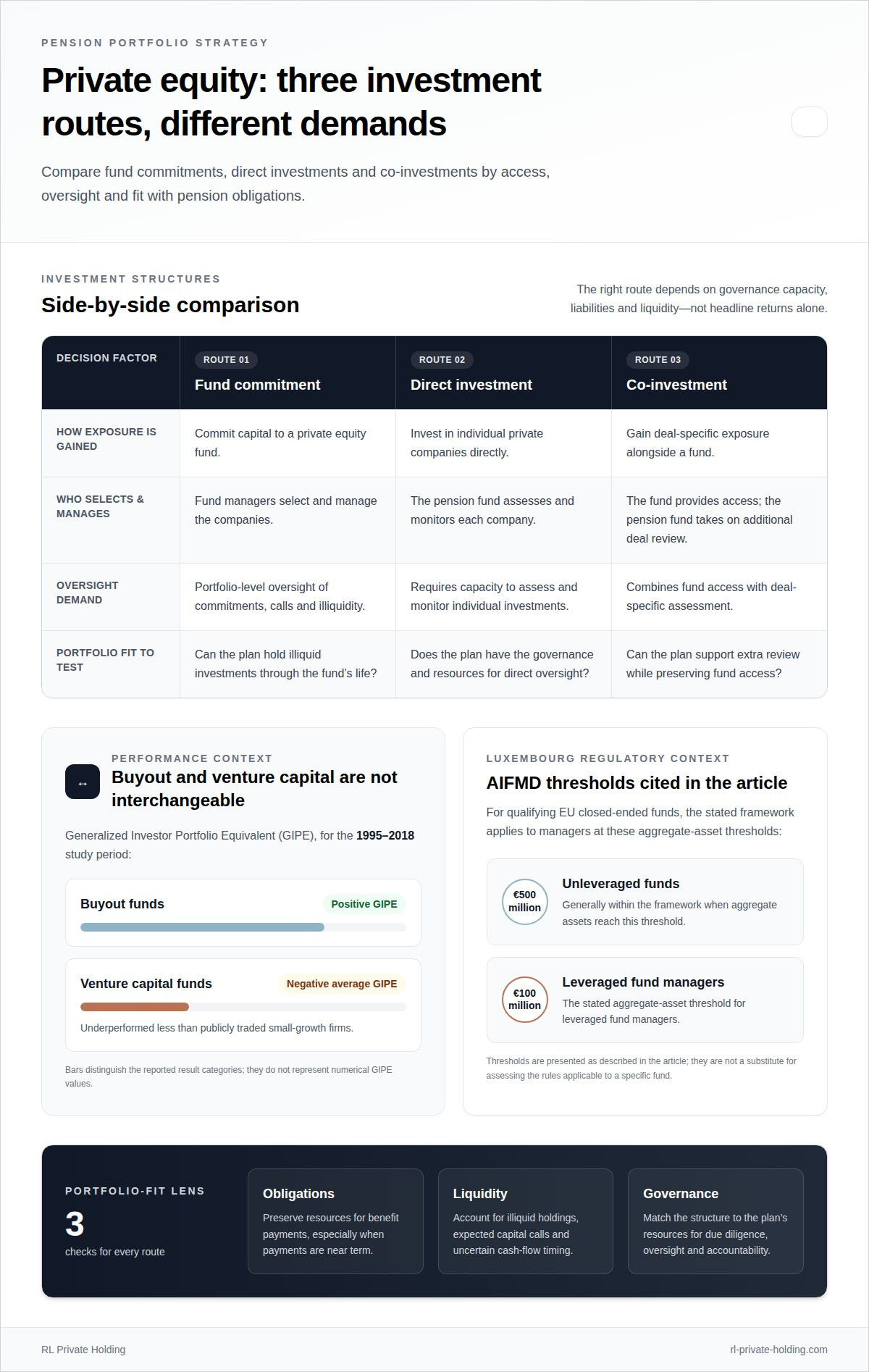
Pension funds can use private equity funds, direct investments or co-investments, depending on governance capacity, liabilities and liquidity. In Luxembourg, relevant EU rules include AIFMD: according to the European Union, managers of qualifying EU closed-ended, unleveraged funds generally fall within its framework when aggregate assets reach €500 million; the stated threshold for leveraged fund managers is €100 million.
Buyout and venture capital performance
Buyout funds and venture capital funds expose pension portfolios to different private-company investment profiles, so their results should be assessed separately. For the 1995 to 2018 study period, buyout funds had a positive Generalized Investor Portfolio Equivalent, or GIPE. Venture capital funds had a negative average GIPE, but underperformed less than publicly traded small-growth firms. This comparison helps institutional investors judge each strategy against its alternatives, rather than treating private equity as one uniform asset class.
Manager access and selection skill
Access means securing commitments to sought-after funds; selection skill means identifying managers likely to perform well. The distinction matters because public pension plans’ apparent advantage in choosing private equity funds was largely attributable to access to successful managers, rather than superior selection ability. A pension committee should assess whether its investment process can secure suitable opportunities and monitor them, without treating access alone as evidence of skill or a guarantee of strong results.
Large-scale fund commitments
Large commitments let pension funds invest substantial capital through private equity funds while delegating company selection and management to fund managers. This can suit institutional investors seeking exposure to private companies without building a direct-investment operation. It still calls for portfolio-level oversight: commitments must fit the plan’s asset mix, expected capital calls and capacity to hold illiquid investments throughout the fund’s life.
Liabilities and liquidity needs shape this choice. A pension fund facing near-term benefit payments must preserve resources for those obligations, while a plan with longer-dated commitments may have more room for illiquid holdings. Direct investments require the fund to assess and monitor individual companies; fund commitments place those responsibilities with the manager. Co-investments fall between the two, combining access through a fund with deal-specific exposure and additional review.
For a closer look at private equity portfolio decisions, consider how investment management fits the plan’s governance and liquidity framework.
Private equity fund cash-flow and return evaluation
Assess private equity by examining cash-flow timing, net performance and its contribution to the pension portfolio. These measures help connect investment outcomes with liabilities and return objectives.
Value creation and return potential
Private equity value creation is the growth in a company’s value during an investment, reflected in proceeds when the investment is realised. Pension investors may expect superior risk-adjusted returns over long investment periods, typically 8 to 10 years. This horizon makes timing important: distributions may arrive well after capital commitments. Assessing both cash flows and realised outcomes helps distinguish potential value creation from capital that remains invested.
Pension fund return objectives
A pension fund’s return objective is the performance needed to support its obligations and investment plan. The growing use of alternative investments is driven partly by the need to meet or exceed actuarial return assumptions that underpin pension obligations. Compare a private equity fund’s expected capital calls and distributions with the plan’s payment needs. Timing matters: delayed distributions can strain liquidity even when reported valuations appear stable.
Risk-adjusted returns and alpha
Risk-adjusted evaluation considers the risks taken to generate returns; alpha is performance beyond what systematic risk explains. Compare private equity with the pension plan’s actual portfolio, asset mix, constraints and cash-flow preferences, rather than relying on a generic index alone. The Investor Portfolio Equivalent discounts private equity cash flows using the plan’s own portfolio return. Due diligence should also examine conflicts, approval processes, local mandates, consultant incentives and investment committee accountability.
Investment costs and fee structures
Private equity fee structures set out the charges and performance-based compensation specified in fund agreements. Review management fees, performance-linked fees, expense allocations and the rules governing when compensation is payable. These terms affect net returns, so compare expected cash flows after fees, not just gross fund performance. Check how costs apply throughout the investment period and whether fund reporting clearly presents deductions and distributions.
Direct private equity investments and co-investments
Direct ownership and co-investments give pension funds exposure to individual private companies beyond standard fund commitments. The central trade-off is greater responsibility for individual deals in exchange for more targeted investment decisions.
Direct investment approaches
A direct investment is an ownership stake a pension fund takes in a private company without investing through a private equity fund. The fund then takes responsibility for assessing the company, its governance and its eventual exit path. Institutional investors should evaluate their internal capacity to monitor each holding and connect the company’s prospects to beneficiaries’ long-term obligations.
Direct holdings can concentrate exposure in particular companies or sectors. A pension plan should consider each prospective investment’s effect on the overall portfolio and liquidity, including whether it can hold the asset through a long investment period. Real estate is a separate private asset category, not interchangeable with company equity. Clear ownership oversight supports disciplined investment decisions.
Co-investment approaches
A co-investment lets a pension fund invest alongside a private equity fund in a specific deal. The pension investor gains direct exposure to the company while sharing the transaction with a fund manager. Before committing capital, the investment committee should examine approval processes, conflicts of interest and accountability. These checks help determine whether the opportunity fits the plan’s investment objectives.
Co-investments also call for deal-level scrutiny, rather than reliance on the fund’s wider portfolio alone. Assess the company’s business, governance, investment rationale and likely path to liquidity. Consider the effect on exposure across existing holdings and whether the plan can continue to support pension obligations. This structure may suit a plan seeking targeted exposure, provided its review and monitoring resources match the added responsibility.
Direct investment and co-investment decisions should also account for incentives and political influences in investment selection. Due diligence can examine local investment mandates, consultant incentives and investment committee accountability. Evidence from U.S. public pension plans found that funds located within a pension plan’s state had lower risk-adjusted returns than out-of-state funds, despite similar risk levels. This supports independent scrutiny rather than location-based preference.
The practical distinction is responsibility: with direct deals, the pension fund oversees the investment itself; with co-investments, a fund manager is also involved. Neither structure automatically delivers stable returns. The right choice depends on the plan’s governance, liquidity capacity and ability to assess each company on its merits.
RL Private Holding: Venture Capital Funding
RL Private Holding provides Venture Capital Funding and Private Equity Investment Management for investors considering private-market opportunities. These services may suit pension funds assessing venture capital exposure or seeking investment management aligned with private equity objectives. The appropriate structure depends on the fund’s investment mandate, liquidity profile and governance approach.
For institutions also considering property exposure, Real Estate Asset Management addresses a distinct asset class and belongs within the wider portfolio strategy. Wealth Management Services may suit private investors with broader investment needs.
To discuss how RL Private Holding’s investment services relate to your objectives, contact the firm or visit rl-private-holding.com.
Turn the assessment into a disciplined investment mandate
The next step is to turn the analysis into a mandate decision-makers can apply consistently. Define the role private equity should play in the pension plan, the liquidity constraints governing commitments and how performance will be assessed against the fund’s objectives. This creates a practical basis for comparing opportunities and documenting why a proposed allocation fits the plan.
For Luxembourg pension decision-makers, investment strategies for pension funds in private equity should link investment authority, due diligence and ongoing oversight. A written framework can clarify when direct investments or co-investments merit consideration, and when a fund-based approach is more suitable. The aim is not to pursue private equity for its own sake, but to make decisions accountable to beneficiaries and the plan’s long-term responsibilities.
RL Private Holding can be a point of contact as you consider your investment objectives and next steps. Contact RL Private Holding to begin a discussion and develop a considered path forward.
Frequently Asked Questions
How do pension funds allocate portfolios to private equity?
Pension funds allocate to private equity through a policy decision that defines its role in the total portfolio. They can implement that allocation through fund commitments, direct company investments or co-investments. For example, a plan might use funds for broad exposure while reserving direct deals for opportunities its investment team can assess. The policy should also assign oversight responsibilities and explain how exposure will be monitored.
What are typical private equity allocation targets for pension funds?
No single allocation target suits every pension fund. The right target depends on obligations, liquidity requirements, risk tolerance, governance capacity and the mix of other assets. A plan with limited resources for private-market oversight may choose a different approach from one with established investment processes. Treat peer allocations as context, then document why the selected target fits the plan’s circumstances.
How do buyout, venture capital, growth equity, and secondaries compare for pension funds?
Buyout funds typically acquire established businesses, while venture capital backs companies at earlier stages of development. Growth equity generally targets businesses seeking capital to expand, and secondaries involve purchasing existing private fund interests or exposures. These strategies differ in company maturity, investment structure and potential sources of value. Compare them by asking which risks and cash-flow profiles complement the pension fund’s existing portfolio.
How do pension funds assess private equity returns and benchmark performance?
Pension funds should review performance using net cash flows, investment dates and the plan’s actual objectives. Separate realised proceeds from unrealised valuations, which are not cash available for benefit payments. Compare investments with relevant alternatives of similar strategy and timing, and examine results across fund vintages. This gives committees a more useful assessment than a single headline return.
What are the liquidity and cash-flow risks of private equity for pension funds?
Private equity can put pressure on liquidity because capital may be called before investments generate distributions, and exit timing is uncertain. A pension fund should map expected calls against benefit payments, operating needs and liquid assets. Consider how delayed exits could affect planned spending or rebalancing. This cash-flow view helps the investment committee assess whether the portfolio can meet obligations without relying on premature sales.
How should pension funds manage private equity commitments and pacing?
Pension funds can manage pacing by coordinating new commitments with existing funds, expected capital calls and anticipated distributions. Keep a forward-looking schedule that distinguishes planned commitments from capital already called, and update it as portfolio conditions change. Spreading commitments across fund vintages can reduce dependence on a single investment period. Governance procedures should specify who monitors the schedule and when the committee reviews its assumptions.