

What if the greatest risk to your portfolio isn’t the downturn itself, but having to sell assets at the wrong time? If you’ve asked, “is my portfolio ready for a market downturn,” the answer depends less on predicting markets than on understanding how your investments would meet real obligations under pressure.
Uncertainty about potential losses, available liquidity, or overlapping exposures is a reason to review how your portfolio is structured. A measured assessment can bring vulnerabilities into view before market stress forces decisions. This article offers a practical framework built around four factors: liquidity, concentration, investment time horizon, and governance.
You’ll learn how to compare accessible assets with expected cash needs, assess how different holdings may respond to adverse scenarios, and align investment horizons with financial commitments. You’ll also find guidance on stress-testing and setting a consistent review process, so decisions can follow a considered plan rather than short-term market movements. These principles support disciplined portfolio oversight and wealth management, where clear objectives and an understanding of how assets fit together matter.
Key Takeaways
- Portfolio readiness means aligning investment risks and available liquidity with financial obligations, not avoiding every loss or predicting market timing.
- Map expected spending and potential capital calls against when each investment can be accessed, including assets that may take longer to sell or value.
- Compare public and private investments by liquidity, valuation frequency, time horizon, and economic sensitivity to identify possible mismatches.
- To assess whether is my portfolio ready for a market downturn, test how plausible adverse scenarios could affect obligations and decision-making. Keep verified information separate from assumptions.
- Set a regular review process that connects portfolio objectives, oversight responsibilities, and changing liquidity needs.
What Is a Market Downturn-Ready Portfolio?
A portfolio is ready for a market downturn when its investment risks, accessible liquidity, financial obligations, and decision-making arrangements are aligned. Readiness doesn’t mean every holding will retain its value. It means you have assessed how a decline could affect planned spending and can make decisions in line with established objectives, rather than reacting without a clear process.
A downturn-ready portfolio aligns risk and liquidity with the investor’s obligations and time horizon, while recognising that losses remain possible. The question is not whether a downturn can be avoided, but whether the portfolio can continue to serve its purpose if market values fall. The answer to “is my portfolio ready for a market downturn” depends on your circumstances, not a single allocation or market forecast.
Readiness Is Not the Same as Predicting the Market
Market timing tries to anticipate when prices will fall or recover and adjust investments accordingly. Readiness instead examines whether the portfolio can absorb losses without undermining its objectives or forcing an unplanned sale. Historical stock market downturns provide context, but they cannot establish the timing or scale of a future decline.
Diversification can spread exposure across assets, sectors, and strategies, but it doesn’t prevent a portfolio from falling during broad market stress. A decline also doesn’t automatically mean the investment objective should change. Before treating a price movement as a reason to revise a long-term plan, consider whether it affects the reason for holding an asset, the time available to meet the objective, or a near-term cash requirement.
Which Investor Circumstances Change the Assessment?
An investor who expects to draw on capital soon has different liquidity needs from one with a longer investment horizon and no near-term distributions. For example, a planned withdrawal next year may make access to funds more important than it is for an investment intended to support objectives many years away. Measure the time horizon against when the money is needed, not simply how long the portfolio has existed.
Institutions should also account for scheduled distributions, operating obligations, and capital commitments that may fall due during market stress. These needs can create a demand for liquidity even when an investment remains suitable over the long term. Apply the same review to public and private exposures: assess each holding’s economic sensitivity, valuation frequency, and ability to provide capital when required. Don’t assume an asset category is inherently resilient.
Decision-making capacity matters as much as investment structure. A portfolio may have a long horizon on paper but still face pressure if responsibilities are unclear, key information is missing, or stakeholders disagree about acceptable losses. Decide who reviews the portfolio, what information they need, and which obligations take priority. This makes it easier to distinguish a planned response from a reaction to market noise. Next, examine liquidity, exposures, and commitments together to find where they may not align.
How Liquidity, Time Horizon, and Risk Exposure Shape Downturn Resilience
Liquidity is the ability to access capital when it is needed, in a usable amount and within a realistic timeframe. An asset’s label doesn’t tell you how quickly it can be converted to cash or whether it could be sold at its estimated value under pressure. A listed investment may be tradable but lose value during a decline. A private investment may take longer to realise. The practical question is whether the access conditions for each holding match the date and purpose of expected cash needs.
To assess whether is my portfolio ready for a market downturn, map investment horizons against planned spending, liabilities, distributions, and potential capital calls. A long-term holding may suit an objective far in the future, yet be a poor source for a near-term payment if access depends on a sale, redemption window, or realisation event. Check both timing and uncertainty: separate amounts with a known due date from commitments whose timing or size may change.
Can You Meet Cash Needs Without Selling Under Pressure?
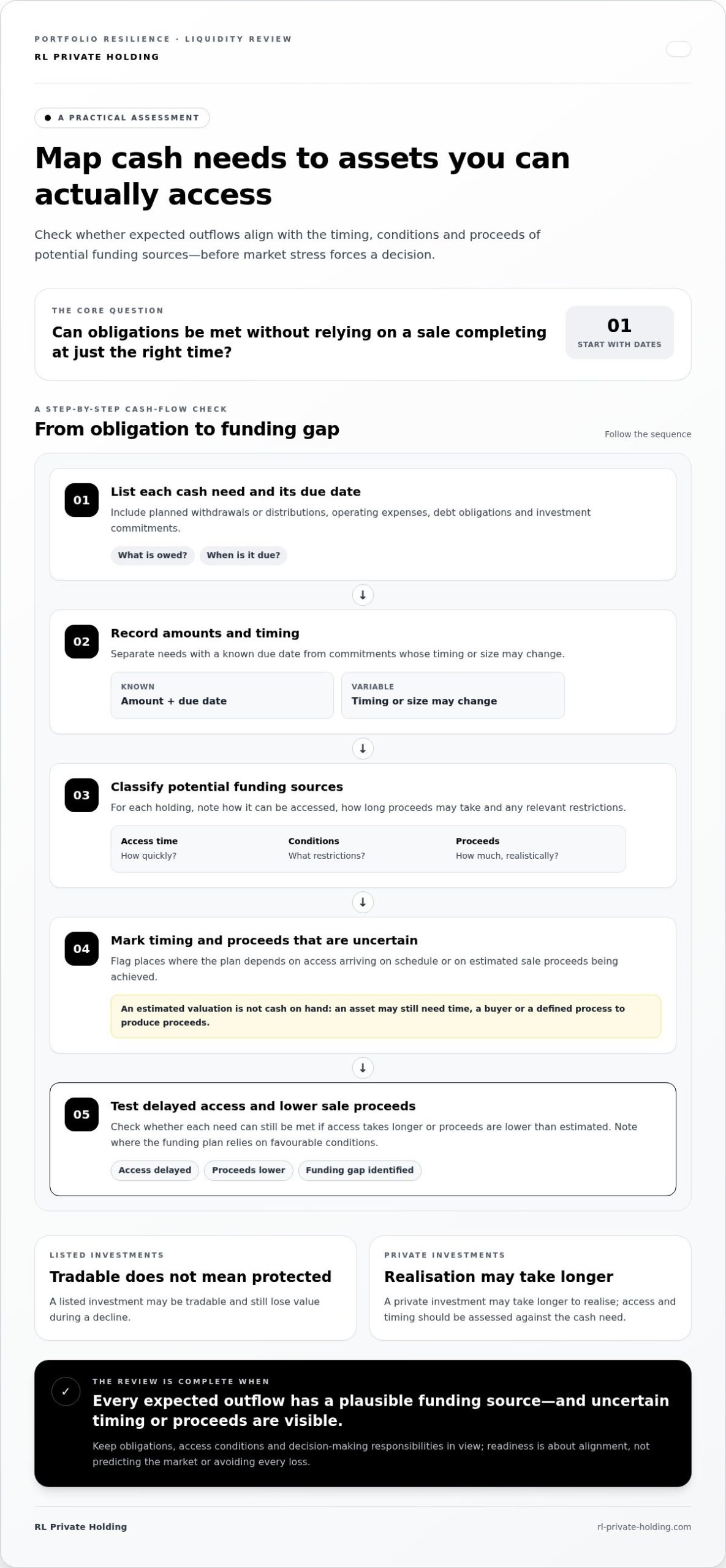
Create a dated schedule of outflows and compare it with assets that can realistically be accessed by each date. Include personal withdrawals or institutional distributions, operating expenses, debt obligations, and investment commitments. For each potential funding source, note access conditions and the time it may take to receive proceeds. This can reveal whether the plan depends on a sale completing precisely when markets are unsettled.
- List each expected cash need and its due date.
- Record the amount and timing of planned distributions and capital commitments.
- Classify potential funding sources by access time and any relevant restrictions.
- Mark gaps where timing or estimated proceeds are uncertain.
Don’t treat a valuation as cash on hand. An asset may have an estimated value but still require time, a buyer, or a defined process before it produces proceeds. Test the schedule against delayed access or lower sale proceeds to see where the funding plan depends on favourable conditions.
Where Could Losses or Correlated Exposures Accumulate?
Review concentration at several levels, including issuer, sector, asset class, geography, currency, and major counterparties. Different holdings may share the same underlying economic driver. For example, assets tied to property demand may respond to similar pressures even if they sit in separate funds or investment structures. Diversification by name or category alone can hide common sensitivities.
- Identify holdings linked to the same sector, revenue source, or financing conditions.
- Note exposures that depend on the same geography, currency, or counterparty.
- Compare each exposure’s likely response with the timing of related cash needs.
Public and private investments also differ in how prices are observed and capital is accessed. Publicly traded assets generally have observable market prices, though those prices can move sharply. Private investments may be valued less frequently and take longer to realise. Neither characteristic alone establishes resilience. Assess each exposure in relation to its role, risk drivers, and liquidity needs. A wealth management perspective can help connect these portfolio considerations with broader investment objectives.
How to Assess Portfolio Balance Across Public and Private Investments
A holdings list can look diversified while concealing overlapping risks. To assess balance, look beyond the number of investments. Compare what each exposure may do under stress, how often it is valued, and how readily capital can be accessed. Public and private investments can serve different roles, but neither category is inherently safer. Suitability depends on the portfolio’s objectives, time horizon, liquidity needs, and underlying economic exposures.
A comparison matrix makes those differences easier to see. For each holding or strategy, record its asset class, principal economic drivers, valuation frequency, expected investment horizon, and access conditions. Then consider how it relates to the rest of the portfolio. If several investments depend on similar business activity or financing conditions, they may face the same source of pressure despite having different names or structures.
What Public and Private Holdings Can Mean During Stress
Publicly traded holdings generally have observable market prices, which can move quickly as investor expectations change. Private assets may be valued on a different schedule, so reported valuations may not reflect market movements as frequently. Less frequent valuation doesn’t remove economic risk or uncertainty. Nor should it be mistaken for a stable underlying value or immediate access to capital.
Compare each holding using consistent questions:
- Liquidity: What process and timeline apply before capital can be accessed?
- Valuation: How often is value assessed, and what information informs that assessment?
- Time horizon: When is the investment expected to contribute to portfolio objectives?
- Economic sensitivity: Which business, sector, financing, or demand conditions could affect it?
This comparison can help when considering private equity investment management alongside publicly traded investments. The aim is not to rank the categories, but to determine whether their timelines and exposures complement the portfolio or create a mismatch with planned obligations.
How to Identify Concentration That a Holdings List Can Hide
Where underlying information is available, look through funds and investment vehicles to identify the businesses, sectors, funding sources, and counterparties they depend on. A portfolio with several funds may still have meaningful exposure to the same industry or financing environment. Separate companies may also rely on similar customer demand or a shared source of capital.
Group exposures by their underlying drivers, then note where those drivers recur. For example, holdings with different labels may still be sensitive to the same changes in borrowing conditions or sector demand. This review can also sharpen questions about venture capital portfolio diversification: do the investments vary in their underlying business risks, or only in the number of companies held?
The result should be a clearer view of what is genuinely distinct and what may move for similar reasons. If you’re asking, “is my portfolio ready for a market downturn,” use the analysis to identify dependencies and review whether each exposure’s role, valuation visibility, and investment horizon fit the portfolio’s wider plan.
Stress-Test Your Portfolio Without Forecasting Downturns
A portfolio stress test is a structured review of how specified adverse conditions could affect holdings, liquidity, and investment objectives. It isn’t a prediction of when a downturn will occur, a calculation of guaranteed outcomes, or a personalised investment recommendation. Its value is in making dependencies visible before a difficult decision is required.
Keep verified portfolio information separate from scenario assumptions. Current holdings, contractual commitments, scheduled distributions, and documented liquidity terms belong in the first category. Possible market declines, slower asset sales, delayed distributions, or changes in financing conditions belong in the second. Date the information and assumptions so you can identify what has changed at the next review. Mark missing or uncertain details explicitly rather than treating estimates as confirmed facts.
A useful stress-test sequence is to document the portfolio, define plausible scenarios, assess their effects, identify response options, and assign decision-makers and review triggers. This sequence helps answer “is my portfolio ready for a market downturn” through a disciplined assessment instead of an attempted forecast.
A Five-Step Portfolio Stress-Test Checklist
Use the same sequence for each review. It keeps the analysis focused on portfolio capacity and decisions, not on predicting market direction.
- Record the baseline: List holdings, accessible liquidity, liabilities, scheduled distributions, and anticipated capital commitments. Note the source and date of each material figure.
- Choose scenarios: Consider plausible conditions such as falling public-market prices, reduced liquidity, delayed realisations, or several pressures occurring together. Label each scenario as an assumption, not a forecast.
- Assess effects: Trace how each scenario could affect cash availability, concentrations, and the ability of investments to meet their intended objectives.
- Identify responses: Record options consistent with existing objectives, such as reviewing the timing of discretionary commitments or using an established liquidity source. Don’t assume an asset can be sold promptly at its estimated value.
- Set governance: Define review triggers, responsible decision-makers, required information, and the process for documenting a decision.
What to Review Before Changing an Allocation
Before changing an allocation, revisit the investment policy, time horizon, liquidity requirements, and any material change in personal or institutional circumstances. Compare a proposed action with established rebalancing rules. A planned review may call for a response when defined conditions are met. A reaction to headlines alone may not reflect the portfolio’s objectives or obligations.
For private equity exposures, review how investment timelines, commitments, and oversight responsibilities fit within the wider portfolio. A related private equity investment management discussion can put those strategy-specific factors in context alongside the overall review.
Keep a brief record of the scenario, assumptions, information gaps, possible effects, and agreed next steps. This creates continuity between reviews and helps distinguish a change in circumstances from a short-term market reaction. Portfolio-focused wealth management connects investment objectives with portfolio oversight.
How Disciplined Portfolio Oversight Supports Long-Term Resilience
Portfolio oversight connects investment objectives with the practical conditions that can affect them: time horizons, liquidity needs, material exposures, and decision-making authority. Review these elements together. A portfolio may remain aligned with long-term goals, while a change in planned distributions, commitments, or circumstances creates a new liquidity requirement.
Review is most useful as an ongoing discipline, not an emergency response to falling markets. A consistent process helps investors distinguish changes in the portfolio or its obligations from short-term price movements. It also makes it easier to identify when assumptions need updating and who is responsible for assessing the implications.
What a Repeatable Review Process Should Record
Maintain a current record of investment objectives, material exposures, liquidity assumptions, and the date of each review. Document who has decision authority and what evidence is required before material portfolio changes are considered. Update the record when obligations, investment horizons, or portfolio composition change, so decisions reflect current circumstances rather than outdated assumptions.
A useful review record can include:
- The portfolio’s objectives and the time horizon assigned to each major goal.
- Significant exposures, including any known overlap across assets, sectors, or strategies.
- Expected cash needs and the assumptions used to assess access to capital.
- Review dates, responsible decision-makers, and the rationale for material decisions.
This record supports continuity. When responsibilities are shared, documented authority and decision criteria help ensure a material change receives considered review rather than being driven by conflicting expectations.
When to Seek a Structured Portfolio Review
A structured review can help when liquidity requirements, planned distributions, capital commitments, or investment objectives materially change. It can also clarify the portfolio’s position when exposures may overlap or information about valuations, access timelines, or underlying holdings is incomplete. The purpose is to understand the implications and available choices, not to presume that a particular allocation or transaction is appropriate.
Ask whether the portfolio still connects its intended outcomes with the time available, the capital that may be needed, and the risks it carries. Revisit “is my portfolio ready for a market downturn” whenever one of those conditions changes, as well as during scheduled oversight. A consistent review can identify issues before they become urgent while leaving room for uncertainty about how markets will develop.
RL Private Holding provides wealth management and private equity services to institutional and private investors, with investment activity across areas including technology, real estate, private equity, and venture capital. Its portfolio perspective connects investment objectives with ongoing asset oversight, while recognising that resilience depends on each investor’s circumstances.
Make the Next Review Deliberate
Turn your readiness assessment into a documented review date and a set of conditions that would prompt an earlier reassessment. This keeps portfolio oversight connected to changing obligations and objectives, rather than letting market headlines set the agenda. You can then revisit “is my portfolio ready for a market downturn” through evidence and an established decision process, not a prediction.
RL Private Holding’s investment activity spans technology, real estate, asset management, private equity, and venture capital. Its wealth management and private equity services support institutional and private investors. This perspective connects portfolio construction with investment horizons and ongoing asset oversight, while recognising that resilience depends on each investor’s circumstances.
For a considered next step, explore RL Private Holding’s investment management approach and how it relates to diversified portfolios. A disciplined review cannot remove uncertainty, but it can help you approach future decisions with greater clarity and purpose.
Frequently Asked Questions
Is my portfolio ready for a market downturn if it is diversified?
Not necessarily. Diversification can spread exposure, but the number of holdings alone doesn’t show whether they depend on distinct risks. To assess whether is my portfolio ready for a market downturn, review how much of the portfolio each exposure represents and flag holdings whose underlying risks are unclear. For example, several funds may hold interests in different companies while sharing exposure to the same industry. Revisit the analysis as holdings change.
Can I protect my portfolio from losses during a market downturn?
No strategy can guarantee that a portfolio will avoid losses in every downturn. A more useful exercise is to define in advance what level of decline would prompt a review and what evidence would justify a change. Consider both your financial capacity to bear losses and your ability to remain committed to the investment objective. These are different considerations, and neither creates certainty about future results.
How do I stress-test my investment portfolio?
Start with a current portfolio record, then assess a small set of adverse but plausible situations. For instance, consider the combined effect of lower asset values and a delayed distribution, and note which planned decisions could be affected. Label scenario assumptions clearly rather than presenting estimates as facts. A useful test also identifies missing information that could materially change the assessment.
What happens if I need cash while markets are falling?
The outcome depends on the amount needed, the deadline, and which resources are accessible at that time. Separate essential or contractually due payments from discretionary spending that may be postponed, then compare their timing with available funding sources. If the plan depends on selling a specific investment, consider what happens if the sale takes longer or proceeds differ from its current estimated value.
Should I sell investments before a market downturn?
A forecast by itself doesn’t establish that selling is appropriate. Before making a change, write down the reason for it and the condition that would show the decision was mistaken. Compare that rationale with the investment’s role and the portfolio’s agreed objectives. This record can help distinguish a deliberate decision from a response to headlines. The consequences of selling depend on individual circumstances and may include tax considerations.
Are private investments more vulnerable during a market downturn?
Not automatically. The relevant question is how the underlying investment may be affected, not simply whether it is private. Review factors such as the business’s operating conditions, financing needs, and expected routes to realising value. A reported valuation may change less often than a public market price, so it can provide a less immediate view of changing conditions. Consider that information alongside the investment’s role and horizon.
How often should I review my portfolio’s downturn readiness?
There is no single review frequency that suits every portfolio. Set a recurring review point that reflects the complexity of the investments and the timing of expected obligations, then add event-based reviews when circumstances change. Examples include a new capital commitment, a planned distribution, or a substantial change in holdings. Dated records make it easier to see whether an assumption has changed without treating every market movement as a signal to act.