

For the institutional allocator, time is not a passive variable but a primary driver of the illiquidity premium. While many investors focus on entry and exit multiples, the true engine of wealth preservation lies in a disciplined long-term private equity investment strategy. It’s clear that the friction of public market volatility often disrupts the steady growth required for multi-generational capital. You likely understand that the misalignment between traditional fund cycles and long-term wealth goals can hinder the ability to capture the full value of private assets.
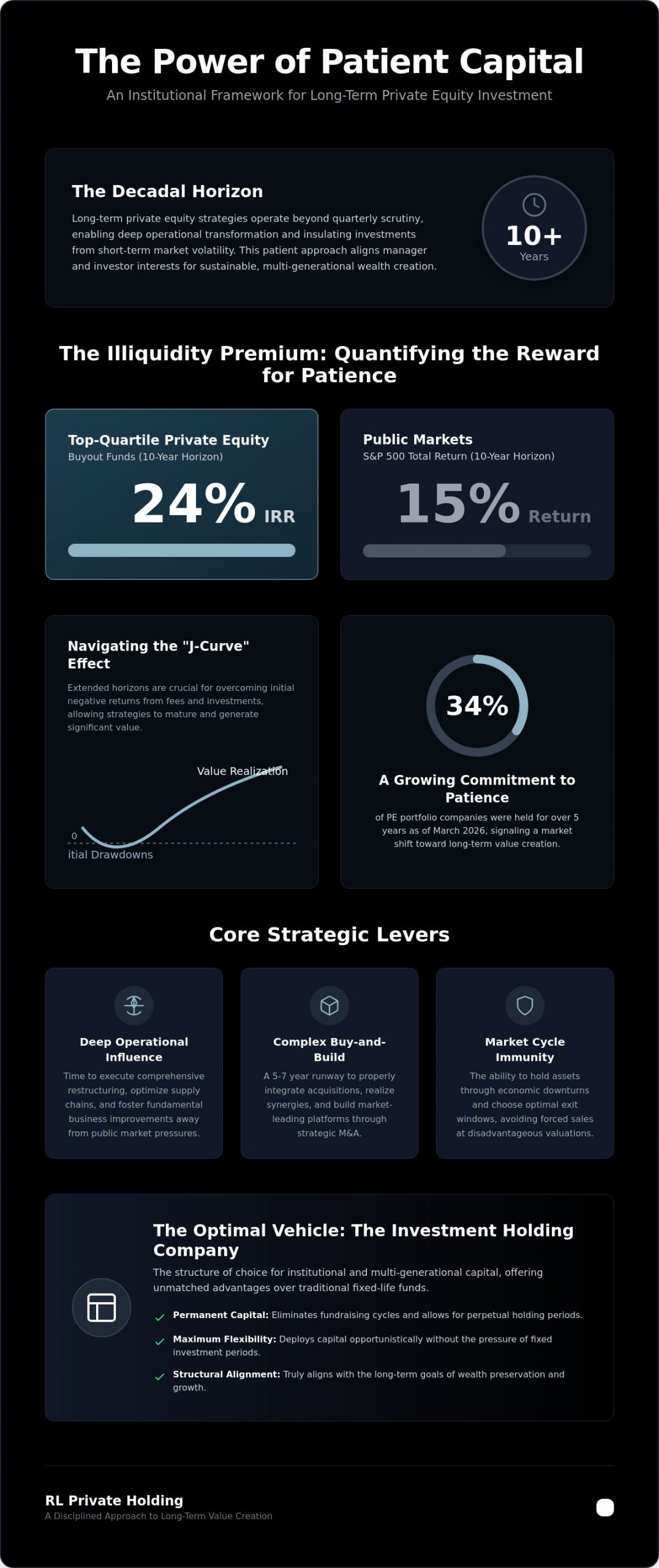
This article provides an institutional-grade analysis of how extended investment horizons drive superior value creation and portfolio stability. We’ll explore the mechanics of operational influence within portfolio companies and how a strategic framework can transform illiquidity from a constraint into a competitive advantage. By examining current market shifts, such as the fact that 34% of private equity portfolio companies were held for more than five years as of March 2026, we provide a roadmap for achieving stable, non-correlated returns over decades.
Key Takeaways
- Define the strategic parameters of a long-term private equity investment, emphasizing the necessity of a decadal horizon for optimal structural alignment.
- Quantify the illiquidity premium and its function in facilitating the execution of comprehensive buy-and-build strategies within portfolio companies.
- Examine the inherent stability of private equity valuations relative to public market volatility and the role of valuation frequency in portfolio management.
- Establish a rigorous framework for asset allocation while identifying methodologies to mitigate capital call and manager selection risks.
- Evaluate the structural benefits of the investment holding company as a vehicle for the preservation and growth of patient institutional capital.
The Fundamentals of Long-Term Private Equity Investment
A long-term private equity investment represents a strategic allocation into non-publicly traded companies with a duration that typically exceeds ten years. This asset class functions as a pillar of modern institutional portfolio diversification. It offers a structural buffer against the volatility inherent in public markets. Unlike public equities, where performance is often scrutinized on a quarterly basis, private equity operates on a timeline that allows for significant business transformation. This extended horizon fosters a fundamental alignment of interests between general partners (GPs) and limited partners (LPs). GPs are incentivized through performance-based fees, such as the industry-standard 20% carried interest, to maximize long-term enterprise value. LPs provide the patient capital necessary to execute complex strategic initiatives that wouldn’t be possible under the gaze of daily ticker fluctuations.
The Mechanism of Patient Capital
The primary advantage of patient capital lies in its immunity to short-term market sentiment. Longer holding periods provide the necessary runway for deep operational restructuring without the pressure of immediate public disclosure. Once the initial capital deployment phase concludes, the investment enters a critical value-add stage. During this period, managers implement structural changes, optimize supply chains, or pursue aggressive market expansion. Because the capital is committed, the strategy remains insulated from market-timing risks. Managers don’t have to sell assets prematurely during cyclical downturns. Instead, they can wait for optimal market conditions to realize gains. This approach effectively converts time into a lever for value creation.
Key Participants in the Private Equity Ecosystem
Several entities collaborate to maintain the integrity of this ecosystem. An investment holding company often serves as a vehicle for providing permanent capital. This model allows for even greater flexibility than traditional fixed-life funds. Institutional investors, such as pension funds and endowments, play a vital role by maintaining liquidity ladders to manage their long-term obligations. Finally, professional asset management firms oversee the day-to-day governance of portfolio companies. They focus on monitoring long-term key performance indicators that track fundamental growth rather than transient accounting metrics. This disciplined approach ensures that a long-term private equity investment serves its purpose in wealth preservation and capital appreciation across decades.
The Illiquidity Premium: Driving Returns Through Extended Horizons
The illiquidity premium represents the excess return investors demand for forgoing immediate access to their capital. In the context of a long-term private equity investment, this premium isn’t just a theoretical concept but a measurable reward for enduring the multi-year lock-up periods required for business transformation. Historical data supports this; over the last ten years, top-quartile buyout funds achieved a 24% IRR, significantly outpacing the S&P 500’s 15% total return. This disparity highlights the strength of private equity performance compared to public markets when evaluated over a full cycle. By accepting illiquidity, institutional portfolios gain access to value-creation levers that are unavailable in liquid markets, such as complex buy-and-build strategies. These strategies require time to integrate acquisitions and realize synergies, often taking five to seven years to reach maturity.
Investors must also navigate the “J-curve” effect. This phenomenon describes the initial period of negative returns due to management fees and investment costs before the portfolio companies begin to generate positive cash flow. Extended horizons help mitigate the impact of entry and exit multiple fluctuations. While the median purchase multiple increased to 11.8x EBITDA in 2025, long-term holders can wait for favorable exit windows rather than being forced to sell during a downturn. As of March 2026, 34% of private equity portfolio companies had been held for more than five years, reflecting a growing commitment to patient value creation.
Drivers of the Private Equity Alpha
The illiquidity premium is the structural reward for capital commitment. In the 2026 market, alpha is increasingly driven by operational improvements rather than simple financial engineering. As interest rates have stabilized, the focus has shifted to the integration of artificial intelligence and supply chain optimization to expand margins. Reinvested cash flows within a private portfolio compound more efficiently without the tax leakage or dividend pressures found in public companies. For those seeking to integrate these sophisticated strategies, wealth management services can provide the necessary structural oversight.
Mitigating the Costs of Illiquidity
Managing a long-term program requires a disciplined approach to liquidity. The secondary market has become a vital tool for rebalancing, seeing $103 billion in transactions in the first half of 2025 alone. Diversifying across vintage years is equally critical. It ensures that capital isn’t overly concentrated in a single economic cycle. Sophisticated structures, such as investment holding companies, provide a buffer for these long-term lock-ups by managing a broad array of assets that generate staggered distributions.
Comparing Long-Term Private Equity with Public Market Volatility
Public markets are defined by high-frequency price discovery. This creates a psychological environment where short-term sentiment often overrides fundamental value. By contrast, a long-term private equity investment provides a smoothing effect through quarterly valuation cycles. This structural difference means that private equity portfolios don’t reflect the daily noise of public ticker volatility. While critics refer to this as “stale pricing,” for the institutional allocator, it serves as a stabilizer. It prevents knee-jerk reactions to macroeconomic headlines that don’t impact the underlying health of the asset over a decadal horizon.
A common objection is whether this lack of daily liquidity obscures true risk. However, volatility and risk are not synonymous. Public markets often conflate the two, leading to forced liquidations during downturns when prices decouple from reality. In private markets, the absence of a daily exit option forces a focus on fundamental enterprise value. This results in a lower correlation with broader market indices, particularly during periods of extreme sentiment. When investing in private equity, the primary risk is the permanent loss of capital, not the temporary fluctuations in a paper valuation. Because private equity managers have direct control over their companies, they can pivot operations in real-time to preserve value, a luxury public shareholders don’t possess.
Valuation Methodologies in Private Markets
Institutional managers increasingly adhere to International Private Equity and Venture Capital (IPEV) valuation guidelines. These frameworks ensure that quarterly reports are grounded in fair value, even without a liquid exchange. This reporting cadence acts as a hedge against short-term shocks. It allows managers to focus on multi-year strategic goals rather than managing for the next earnings call. By decoupling the valuation from real-time market sentiment, the asset class provides a more accurate reflection of the business lifecycle.
Risk-Adjusted Returns and the Sharpe Ratio
Standard metrics like the Sharpe ratio often underestimate the risk-adjusted performance of private equity due to lower reported volatility. A more accurate assessment looks at the trade-off between leverage and operational control. While private equity often employs higher levels of debt, this is balanced by active governance. Private equity governance structures effectively reduce agency costs by aligning manager incentives directly with long-term shareholder value. This alignment ensures that capital is deployed with surgical precision, focusing on wealth preservation over decades. The active ownership model allows for rapid intervention if a company’s performance deviates from the strategic plan, mitigating the risk of terminal failure.
Strategic Allocation and Risk Management in Private Equity
Strategic allocation within an institutional portfolio is a function of both risk tolerance and the specific liabilities the capital is intended to cover. A long-term private equity investment shouldn’t be viewed as a standalone bet but as a structural component that complements liquid holdings. Developing a framework for this allocation involves setting clear targets for commitment levels while accounting for the “denominator effect” during public market downturns. This effect occurs when the value of public holdings drops, causing the percentage of private equity in the portfolio to rise. It’s essential to maintain a consistent exposure that can withstand these cyclical shifts without necessitating forced liquidations.
Effective risk management begins with identifying the three primary pillars of private market risk. Capital call risk requires investors to maintain a sophisticated liquidity ladder to meet drawdowns as GPs identify opportunities. Concentration risk is mitigated by spreading capital across diverse sectors, such as technology and healthcare, to avoid idiosyncratic shocks. Finally, manager selection risk remains the most critical variable. In private equity, the gap between top-quartile and median performance is far wider than in public equities. This makes the selection process the primary driver of alpha. Institutions seeking a methodical approach to these challenges should consult a comprehensive private equity risk management framework to ensure all pillars of exposure are systematically addressed. For institutions seeking to optimize their private market exposure, our Private Equity Investment Management provides the rigorous oversight necessary for sustained capital growth.
Diversification Across Vintages and Sectors
Time-diversification is as critical as asset-diversification. By staggering commitments across multiple vintage years, an investor ensures they don’t deploy all capital at a market peak. This strategy smooths the impact of economic cycles and ensures a steady return of capital over time. Integrating various sub-asset classes also adds layers of stability. Balancing high-growth Venture Capital Funding with more mature buyout strategies and Real Estate Asset Management creates a multi-layered defense against market volatility. Each sector reacts differently to interest rate changes and inflationary pressures, providing a natural hedge within the private allocation.
The Role of Due Diligence
A robust due diligence protocol is the only reliable defense against manager underperformance. This involves a granular analysis of track records through significant economic events, including the 2008 financial crisis and the 2023 interest rate adjustments. Continuity of the investment management team is a non-negotiable metric. A change in key personnel often signals a shift in strategy or culture that can jeopardize long-term results. Investors must also verify that their partners meet the latest regulatory standards. As of June 2026, the SEC increased the “qualified client” threshold to $1.4 million in assets under management or a $2.7 million net worth. Evaluating the governance of the Luxembourg investment structure ensures the vehicle meets these high standards of transparency and compliance.
The Investment Holding Company as a Vehicle for Patient Capital
Traditional private equity funds operate within fixed-life structures, typically mandating a ten-year cycle. This often forces exits at sub-optimal times to meet fund liquidation requirements. An investment holding company offers an evergreen alternative. This model provides permanent capital, allowing for a long-term private equity investment strategy that isn’t constrained by arbitrary deadlines. For portfolio companies, this translates to a stable growth trajectory. They can focus on fundamental value creation rather than preparing for a sale every five years. RL Private Holding utilizes this structure to manage a diversified global portfolio, ensuring that wealth preservation remains the primary objective across decades. Permanent capital removes the pressure of the fundraising cycle, allowing managers to focus entirely on the operational health of their assets.
The holding company model facilitates multi-generational wealth preservation by aligning the investment horizon with the actual lifecycle of a business. It’s a structure built for endurance. Unlike traditional funds that must return capital to investors within a set period, the holding company can reinvest proceeds into new opportunities or support existing companies through multiple stages of growth. This compounding effect is the ultimate goal of institutional allocators. It transforms the investment from a series of discrete trades into a continuous engine for capital appreciation.
Advantages of the Luxembourg SOPARFI Structure
Luxembourg stands as the preeminent global hub for Private Equity Investment Management. The SOPARFI (Société de Participations Financières) structure is particularly effective for international institutional investors. It offers a combination of tax efficiency and regulatory stability that is rare in other jurisdictions. This framework facilitates a sector-agnostic approach, allowing capital to flow into the most promising opportunities regardless of industry boundaries. Because the structure is permanent, it avoids the friction costs associated with launching new fund vintages. This stability is a cornerstone of institutional wealth preservation, providing a transparent and disciplined environment for global capital to thrive over the long term.
Partnering for Long-Term Value
The transition from a passive allocator to a strategic partner is a defining characteristic of the holding company model. By providing permanent capital, the firm becomes deeply embedded in the growth-stage firms it supports. This long-term commitment allows for the integration of specialized expertise. For instance, RL Private Holding combines its core PE strategy with dedicated Real Estate Asset Management and Venture Capital Funding insights. This multi-disciplinary approach ensures that portfolio companies have the resources they need to scale over ten to twenty years. Institutional investors looking to move beyond the constraints of traditional funds should evaluate structures that prioritize duration over turnover. The next step involves a rigorous assessment of how a long-term private equity investment fits into an existing Wealth Management Services framework to ensure alignment with multi-generational goals.
Securing Institutional Wealth Through Decadal Horizons
The transition toward a structural commitment in private markets requires a departure from the quarterly pressures of public exchanges. By embracing the illiquidity premium, institutional allocators convert time into a primary lever for value creation. A disciplined long-term private equity investment strategy provides the necessary stability to navigate macroeconomic shifts while maintaining a focus on fundamental enterprise growth. The integration of diversified vintage years and sector specialization remains the most effective methodology for mitigating concentration risk and ensuring consistent capital appreciation.
As the global financial landscape evolves, the permanence of the investment holding company model offers a robust framework for multi-generational wealth preservation. RL Private Holding operates with this disciplined focus, maintaining a global investment scale from its headquarters in Luxembourg. Our governance structure ensures professional asset management across a diversified portfolio of technology, real estate, and venture capital assets. Explore our strategic approach to private equity investment management at RL Private Holding. Establishing a patient capital framework is a vital step toward achieving superior, non-correlated returns in an increasingly volatile market.
Frequently Asked Questions
What is the typical horizon for a long-term private equity investment?
A typical horizon for a long-term private equity investment is ten years or more. As of March 2026, 34% of private equity portfolio companies had been held for more than five years, reflecting a growing industry commitment to patient value creation. This extended duration allows managers to implement deep operational restructuring and wait for optimal exit windows without the pressure of short-term market timing. It’s a strategic commitment that prioritizes fundamental enterprise growth over the transient liquidity offered by public exchanges.
How does the illiquidity premium benefit institutional investors?
The illiquidity premium provides institutional investors with excess returns as compensation for forgoing immediate capital access. Over the last ten years, the top quartile of buyout funds outperformed public markets with a 24% IRR. This premium enables the execution of complex strategies, such as buy-and-build models, which require several years to reach maturity and generate significant alpha. By locking in capital, investors gain access to a level of operational influence that isn’t possible in the public markets.
Is private equity more risky than investing in the public stock market?
Private equity presents a different risk profile rather than being inherently more risky than public stocks. Public markets are defined by high-frequency volatility, but the primary risk in private equity is the permanent loss of capital. Active governance and direct operational control often allow managers to mitigate terminal failure risks more effectively than passive public holdings. This hands-on approach provides a level of security and oversight that isn’t available in liquid markets.
What is the difference between a private equity fund and an investment holding company?
A private equity fund typically operates with a fixed-life model of ten years, whereas an investment holding company provides permanent capital. Holding companies offer an evergreen structure that isn’t forced to sell assets to meet liquidation deadlines. This allows for a more patient approach to value creation and the compounding of reinvested cash flows. It’s an ideal vehicle for those seeking to avoid the friction and timing risks associated with the traditional fundraising cycle.
How does Luxembourg facilitate long-term private equity structures?
Luxembourg facilitates a long-term private equity investment through established frameworks like the SOPARFI. These vehicles provide international investors with tax efficiency and a stable regulatory environment that is recognized globally. The country’s status as a hub for private equity investment management ensures access to sophisticated legal and administrative expertise. This regulatory stability is essential for maintaining the integrity of institutional capital and ensuring compliance across multiple jurisdictions over extended periods.
What role does venture capital play within a long-term private equity portfolio?
Venture capital funding acts as a high-growth engine within a broader long-term portfolio. It targets innovative, early-stage firms that offer significant appreciation potential over a decadal horizon. When integrated with mature private equity and real estate, it provides a balanced mix of stability and aggressive growth. This sector-agnostic approach ensures that the portfolio remains exposed to disruptive technologies that drive future value without sacrificing the stability of more mature assets.
How are management fees and carried interest structured in long-term PE?
Long-term private equity structures generally utilize a fee model consisting of an annual management fee and carried interest. The management fee covers operational expenses and the day-to-day oversight of portfolio companies, while carried interest aligns the manager’s incentives with the fund’s ultimate profitability. This performance-based structure ensures that the interests of the general partner remain focused on achieving the investor’s decadal wealth goals. It prioritizes the actual realization of value over short-term accounting gains.
Can private equity investments be used for wealth preservation and succession planning?
Private equity serves as an effective vehicle for wealth preservation and succession planning due to its focus on decadal horizons. The nature of these assets aligns with the timelines required for transferring institutional wealth across generations. It provides a stable foundation for comprehensive wealth management services while ensuring capital remains productive and insulated from public market noise. This structural alignment is critical for maintaining familial or institutional legacies over several decades.