

Limited partners can invest alongside a private equity fund in a specific portfolio-company deal. These co-investment opportunities for limited partners are typically offered by the fund manager. The general partner leads the investment, while co-investors hold passive, minority positions. This gives an LP the choice to participate in an individual deal rather than relying solely on the fund’s investment decisions.
That choice can increase exposure to a selected company, but it also calls for a separate assessment of the investment and its terms. Co-investing does not remove the need to understand how the deal fits the main fund’s strategy or where the parties’ interests might diverge.
This article explains how co-investments are structured, why private equity firms offer them, and how a deal moves from review to investment. It also covers key considerations for limited partners, including the manager’s assessment, allocation and fee arrangements, and potential tensions between the fund and its co-investors.
Key Takeaways
- Understand how a limited partner can invest alongside a fund in a specific company, while the general partner typically retains control of the investment.
- Follow how a potential deal moves from the fund manager’s review to an offer, allocation, and investment decision.
- Assess how selective deal access and potentially lower fees compare with concentration, due diligence, and alignment risks.
- Recognise where the fund manager’s objectives, the main fund’s interests, and co-investors’ priorities may diverge.
Co-investment opportunities: Potential opposing interests between the fund manager and the limited partners?
A private equity general partner (GP) manages the fund, selects investments and oversees operations. Limited partners (LPs) supply capital but delegate day-to-day management to the GP. Through a co-investment, an LP can participate in an individual portfolio company instead of investing only through the main fund. This offers deal-level choice, while the GP continues to lead the investment and typically retains control.
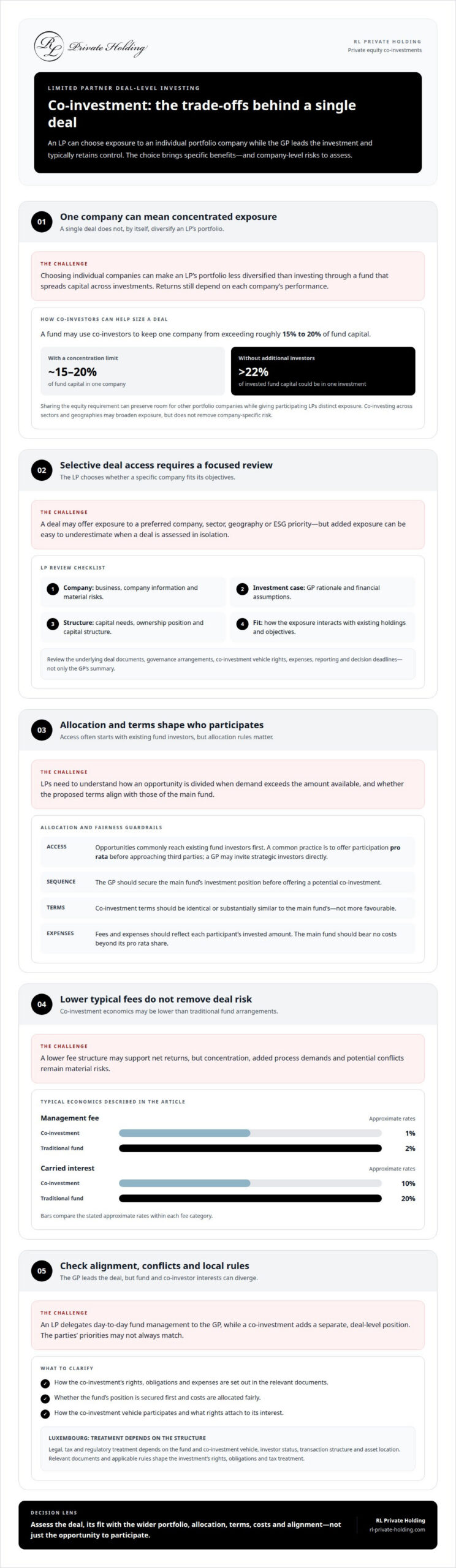
Potential benefits include more selective exposure and often lower fees than a traditional fund investment. The trade-off is concentration: choosing individual companies can make an LP’s portfolio less diversified, while a fund spreads capital across investments. Co-investing across sectors and geographies may broaden exposure, but returns still depend on each company’s performance. One deal does not, by itself, diversify a portfolio.
Allocation can affect the interests of both the GP and LPs. A fund may offer opportunities to LPs pro rata, while retaining the right to invite strategic third parties directly. Co-investments should be offered on terms identical or substantially similar to the main fund’s, not on more favourable terms. The GP should secure the fund’s position first, and the main fund should bear no costs beyond its pro rata share.
Concentration limits can also shape the offer. A private equity fund may use co-investors to keep one company from exceeding roughly 15% to 20% of fund capital. Without additional investors, an investment could account for over 22% of invested fund capital. Sharing the equity requirement can preserve room for other portfolio companies, while giving participating LPs a distinct exposure.
In Luxembourg, legal, tax and regulatory treatment depends on the fund and co-investment vehicle, investor status, transaction structure and asset location. For LPs, the relevant documents and applicable rules shape the investment’s rights, obligations and tax treatment. Typical co-investment economics are approximately a 1% management fee and 10% carried interest, compared with 2% and 20% in traditional private equity fund arrangements. These lower economics may support net returns, but deal concentration, added process demands and potential conflicts remain material risks.
Co-investment deal process
A co-investment process starts when a general partner identifies a transaction requiring more capital than the main fund intends to commit. The opportunity then moves through access, review, allocation and commitment, with the timetable shaped by the transaction.
Deal Selection Flexibility
Deal selection flexibility lets an LP decide whether to participate in an individual company investment rather than accept every investment selected for a private equity fund. The LP can assess how the deal’s sector, geography and risk profile fit its portfolio and investment objectives.
The decision still calls for focused due diligence. Review the company’s business, the GP’s investment rationale, the capital structure and the proposed ownership position. Consider how the additional exposure interacts with existing holdings. Participating can increase exposure to a preferred transaction, but declining means the LP has no direct position in that company.
Deal Access and Allocation
Deal access usually comes through the GP managing the main fund, which offers LPs the chance to invest alongside it. Co-investment opportunities for limited partners commonly reach existing fund investors first. A common practice is to offer participation pro rata before approaching third parties, although a GP may invite strategic investors directly.
The GP should secure the main fund’s investment position before offering a potential co-investment. The offer outlines the proposed commitment and transaction timetable, allowing an LP to assess whether it has time and capacity to review and commit. Allocation rules matter because they explain how participation is divided when LP demand exceeds the amount available.
Evaluating Offers and Negotiating Terms
Evaluating co-investment opportunities for limited partners means testing the investment case against the underlying deal documents, rather than relying only on the GP’s summary. Review the transaction rationale, company information, financial assumptions, capital requirements, governance arrangements and material risks. Confirm how the co-investment vehicle participates, what rights attach to its interest and how expenses are allocated.
Compare the proposed terms with those of the main fund and examine the allocation process. Terms should be identical or substantially similar, not more favourable. Fees and expenses should reflect each participant’s invested amount, including the main fund’s pro rata share. Clarify commitment mechanics, reporting and decision deadlines before committing. These checks help establish whether the exposure and obligations fit the LP’s investment strategy.
Limited partners as co-investors
For an LP, co-investing changes the relationship with a private equity firm from a fund commitment alone to deal-level participation. The LP can decide whether a particular portfolio company fits its objectives, such as exposure to a target sector or an ESG priority. This selectivity can be attractive when an opportunity supports a defined strategy, but each decision also adds company-specific exposure. Consider how the investment fits the wider portfolio, rather than assessing the deal in isolation.
Access also depends on the relationship between the LP and the general partner. GPs tend to favour existing fund investors and value co-investors that can make decisions promptly, commit meaningful capital and act reliably. An LP seeking regular deal access therefore needs an investment process that can meet tight transaction timetables. That means clear decision authority, available capital and people able to review an offer. Experience and capacity matter because participation involves more than expressing interest.
Building a co-investment portfolio can require dedicated strategy and staffing. The LP must define which sectors, geographies and transaction types fit its mandate, then assess whether its team can review each opportunity. For example, an LP targeting growth in a specific sector may favour a company that matches that focus and decline a transaction outside its expertise. Selectivity is useful only when the LP can assess the company, its risks and the proposed investment independently.
Co-investing can strengthen long-term business relationships, but interests may diverge. A GP may offer a deal to maintain relationships with LPs or support a transaction larger than the fund would make alone. An LP that declines still has an interest in ensuring the opportunity does not impair the main fund. A follow-on investment in a company already held by the fund may carry a different risk profile from a new acquisition. Treat each offer as both an investment decision and a relationship decision, considering portfolio fit, review capacity and alignment together.
What are LP co-investment opportunities in private equity?
A private equity co-investment lets an LP invest directly in an operating company alongside a financial sponsor. The LP usually holds a passive, minority interest, while the sponsor controls the investment and monitors the company. This differs from a fund commitment, where the GP selects portfolio companies and the LP has limited choice over individual deals.
A common structure uses a separate vehicle to pool capital from co-investors. The vehicle invests in the same company as the sponsor, so participants share exposure to that asset. Co-invested capital can represent an estimated 20% to 40% of the equity in a private equity deal. The precise share depends on the transaction’s funding needs and the fund’s investment limits.
The sponsor contributes more than capital. Its industry knowledge, due diligence, network and value-creation experience inform the investment and its ongoing monitoring. Co-investors generally rely on that work while assessing the opportunity independently. For example, an LP considering a minority interest in a company should understand the sponsor’s plan, the company’s financing structure and how the vehicle’s rights align with the main investment.
Co-investments may have lower fees than traditional fund commitments, potentially improving net returns if the company performs well. They also let an LP choose specific transactions and build exposure to selected sectors. These benefits come with company-level concentration, limited control and dependence on the sponsor’s execution. Lower fees do not remove investment risk or ensure stronger performance.
For an LP, the central distinction is between choosing a deal and controlling it. A co-investment offers more discretion over where capital goes, but the sponsor usually retains decision-making and monitoring responsibilities. The opportunity is most relevant when the LP can assess the company, understand the investment structure and accept the risks of a passive minority position. A sound decision weighs these factors against the diversification of the LP’s broader portfolio.
RL Private Holding: Private Equity Investment Management
RL Private Holding provides Private Equity Investment Management for institutional and private investors considering how private equity fits their investment objectives. After reviewing an individual co-investment, investors can consider its place in the wider portfolio, including concentration, sector exposure and its relationship to existing commitments.
This is a useful next step when assessing private equity exposure or considering how an investment fits a broader wealth strategy. The appropriate approach depends on objectives, portfolio structure and investment horizon. RL Private Holding also provides Wealth Management Services to support broader investment planning.
Contact RL Private Holding to discuss your private equity investment objectives.
Turn deal access into a considered investment decision
The next step is to place each potential co-investment within a deliberate investment framework. Define the role of a direct company position, the exposure it adds and how it relates to existing commitments. This turns co-investment opportunities for limited partners into decisions guided by portfolio objectives rather than transaction momentum. A clear rationale also helps maintain consistency when attractive deals come with short timetables.
RL Private Holding offers Private Equity Investment Management, alongside Venture Capital Funding and Real Estate Asset Management. These activities provide relevant context for investors considering private-market allocations across company investments and real estate. The right focus depends on the investor’s objectives and portfolio strategy.
For a considered discussion of co-investing and your broader private-market objectives, contact RL Private Holding to discuss co-investing. A well-defined investment rationale is a constructive place to begin.
Frequently Asked Questions
What Are Co-Investments?
An LP co-investment is a separate investment alongside a sponsor in a named portfolio company, rather than an allocation across an entire fund. In practice, an LP may subscribe through a dedicated vehicle that holds the company interest, while the sponsor retains its own investment role. The vehicle documents set out the LP’s economic rights, reporting arrangements, transfer limits and obligations.
What Makes Co-Investment Return Profiles Attractive?
An attractive return profile can reflect deal-level selection and economics that leave a larger share of gains with investors, but headline returns alone can mislead. Compare projected net proceeds after vehicle expenses with the main fund’s reporting basis. Consider timing too: delayed exits can reduce annualized returns even when a company eventually sells above its entry valuation. Model downside and base cases separately.
What due diligence should LPs conduct before co-investing?
LP due diligence should test both the company’s fundamentals and the investment structure. Review revenue quality, customer concentration, debt obligations, cash needs, and the assumptions behind the sponsor’s valuation and exit plan. Then examine the subscription and vehicle documents for governance, information rights, expenses, transfer restrictions and conflicts. As a final test, consider whether the downside case fits the LP’s mandate and liquidity plan.