

A real estate portfolio can hold several properties yet remain exposed to the same underlying risks. Assets may be concentrated by sector, market, tenant, or income source, even when the holdings appear diverse. Managing a diversified real estate portfolio means looking beyond the number of properties to understand how each exposure affects income, risk, and liquidity. Direct ownership and indirect investments also need to be assessed on their own terms.
Investors need a consistent basis for comparing these choices and monitoring them over time. A structured framework can reveal material concentrations and dependencies, then help assess decisions against investment objectives and practical constraints.
This guide explains how to map exposures, compare direct and indirect holdings, and establish a repeatable review process. The aim is to make real estate decisions in light of the portfolio’s overall role, rather than judging each asset in isolation.
Key Takeaways
- Define the role of real estate in the wider investment strategy. Diversification can manage concentration, but it cannot eliminate investment risk.
- Map sectors, markets, tenants, leases, and income sources to identify exposures that may share underlying drivers.
- Compare direct and indirect real estate investments by control, access to multiple assets, liquidity, operating responsibilities, and information needs.
- Use a repeatable process to set a mandate, assess options, record decisions, and review exposures.
- Assess property allocations alongside broader objectives and constraints, including income needs and liquidity requirements.
Managing a diversified real estate portfolio starts with defining its role
Before adding or selling property exposure, decide what real estate is intended to contribute to the broader investment strategy. The aims may include income, potential capital appreciation, preservation of wealth, or a combination. These priorities can compete: an investment suited to a long horizon may not provide the liquidity needed for near-term obligations. Start by making the priorities explicit, along with the investor’s time horizon and tolerance for loss.
Diversification helps manage concentration; it does not guarantee returns or eliminate investment risk. Property values, operating costs, tenant demand, financing conditions, and access to capital can all affect outcomes. Assess the underlying exposures and dependencies, not just the number of assets.
What does real estate portfolio diversification mean?
Real estate portfolio diversification is the distribution of property exposure across relevant sectors, markets, tenants, lease structures, and income drivers to reduce reliance on any one source of risk. It does not mean every holding behaves independently. Several assets may depend on similar tenants, local economic activity, financing conditions, or leasing demand.
For example, buildings in different locations may still leave an investor concentrated if they serve the same sector and rely on similar tenant types. Indirect holdings, including Real Estate Investment Trusts (REITs), can provide exposure to multiple properties, but the risks depend on the underlying assets and strategy. The investment structure alone does not show how diversified the exposure is.
Set objectives before changing property exposure
Turn broad investment aims into practical priorities. An income objective focuses attention on the timing and reliability of cash flows. Capital appreciation prioritises potential value growth, while preservation places greater weight on managing downside exposure. Liquidity is about how readily capital can be accessed. These objectives may point to different property types, ownership structures, and holding periods.
Consider when capital may be needed and what obligations it must meet. An investor with near-term commitments may place more importance on liquidity than one with a longer investment horizon. Neither preference is universally right. The appropriate trade-off depends on the investor’s circumstances and risk tolerance.
- Objective: Identify the primary purpose of the real estate allocation and any secondary aims.
- Horizon: Note when the investment may need to support distributions, commitments, or other obligations.
- Constraints: Record liquidity needs and the level of loss or uncertainty the investor can accept.
Use this mandate as a reference point for later decisions. A portfolio with multiple assets may still fail to serve its purpose if its exposures are highly correlated or its capital is difficult to access when required. Defining the role first helps keep subsequent choices aligned with broader objectives.
Map property sectors, markets, and income drivers to understand real diversification
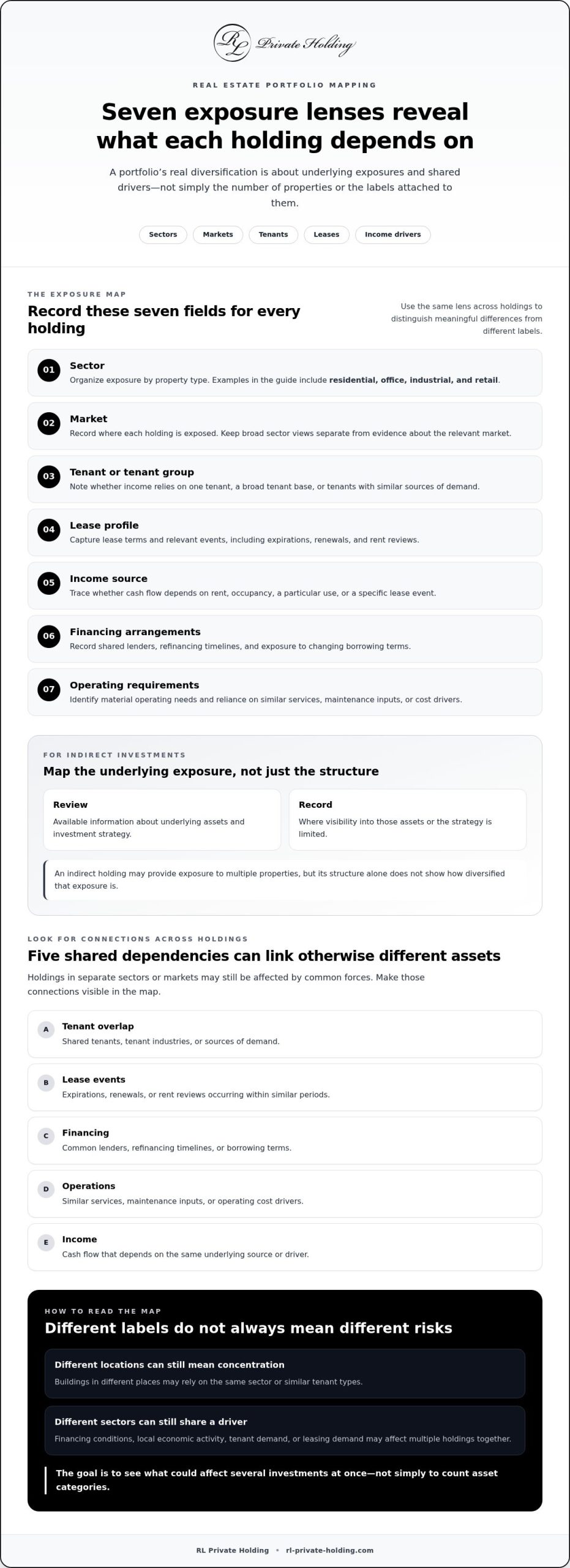
Once the portfolio’s purpose is clear, map what it depends on. For each holding, record its sector, market, tenant or tenant group, lease profile, income source, financing arrangements, and material operating requirements. For indirect investments, review the available information about underlying assets and strategy, and note where visibility is limited. This exposure map helps distinguish meaningful differences from holdings that merely have different labels.
Compare property sectors by their underlying drivers
Residential, office, industrial, and retail are useful categories for organising exposure, not automatic recommendations. Assess each holding through its tenant demand, lease terms, operating needs, and income sources. Two assets in different sectors may rely on a small number of tenants, while similar properties may have different lease structures or operating dependencies.
For each holding, note whether income depends on one tenant, a broad tenant base, a particular use, or a specific lease event. Keep general sector views separate from evidence about the relevant market. A broad view about office or residential demand does not establish the condition of a particular asset or jurisdiction. The Benefits of real estate for portfolio diversification discusses potential portfolio roles. Assess any expected benefit against the investor’s actual exposures and current evidence.
Look beyond sector labels to shared dependencies
Holdings in separate sectors or markets can still be exposed to common forces. Financing conditions may affect assets with different uses, while similar operating requirements or clustered lease expirations can create pressure across multiple holdings at once. Map these connections explicitly. Managing a diversified real estate portfolio means examining what could affect several investments together, not simply counting asset categories.
- Tenant overlap: Identify shared tenants, tenant industries, or sources of demand.
- Lease events: Note expirations, renewals, and rent reviews that fall within similar periods.
- Financing: Record common lenders, refinancing timelines, and exposure to changing borrowing terms.
- Operations: Compare reliance on similar services, maintenance inputs, or operating cost drivers.
- Income: Trace whether cash flow depends on rent, occupancy, lease renewals, or another source.
To make concentrations visible, list holdings down one side of a simple matrix and these dependencies across the other. Mark confirmed overlaps. A cluster of marks signals an area for closer analysis, not proof that losses will occur. Add a confidence note beside each entry: verified for documented facts, estimate for an informed approximation, and to validate where current market evidence is needed.
Keep observable facts separate from assumptions. Lease documents can establish expiry dates; claims about future demand require current, jurisdiction-relevant support. Sector labels alone do not demonstrate meaningful diversification. Investors can connect this mapping exercise with real estate asset management to assess property exposure within a broader portfolio.
Compare direct and indirect real estate exposure before allocating
Direct and indirect investments can both contribute to real estate exposure, but they differ in how investors access assets, exercise oversight, and receive information. This distinction matters when turning portfolio objectives into an allocation. Compare the specific ownership structure and terms under consideration instead of assuming that every fund, trust, or other vehicle works in the same way.
What direct ownership can mean for portfolio management
Direct ownership provides exposure to specific real estate assets. It may allow closer asset-level oversight, but it also makes the portfolio more dependent on each property’s characteristics, tenants, leases, and market. The investor’s role in operating decisions varies with ownership and management arrangements. Assess valuation methods, reporting frequency, and the practical process for accessing capital for each holding.
How indirect exposure differs from direct property
Indirect exposure is obtained through an investment vehicle. Its structure determines the assets held, investor rights, reporting, and liquidity terms. A vehicle may provide access to multiple properties, but the breadth and concentration of that exposure depend on its mandate and holdings. Pooled ownership changes how exposure is accessed; it does not remove underlying property, tenant, financing, or market risks.
Use the comparison below as a starting point. Treat each point as a question for analysis, not a universal feature of either route.
| Decision criterion | Direct property | Indirect exposure |
|---|---|---|
| Investor control | Assess the rights attached to ownership and who makes asset-level decisions. | Review how decisions are made under the vehicle’s governance and mandate. |
| Access to assets | Exposure is tied to the specific properties acquired. | Exposure may span multiple properties, depending on holdings and structure. |
| Liquidity | Consider the process and timing involved in selling or transferring an asset. | Examine redemption, transfer, or sale terms; these differ across vehicles. |
| Operating responsibilities | Determine which ownership, oversight, and operating tasks fall to the investor or appointed parties. | Establish which responsibilities sit with the vehicle and what oversight remains with investors. |
| Information needs | Review asset-level information on valuation, occupancy, leases, and operations. | Assess available reporting on the vehicle, its holdings, valuation approach, and material risks. |
Use the comparison to identify what each option would add, which exposures it would repeat, and what information is needed to monitor it. For example, an indirect holding may broaden property exposure while increasing reliance on a manager’s reporting and decisions. Direct ownership may allow more asset-specific oversight, while making concentration and operating analysis more important.
There is no universally superior route. The right choice depends on the mandate, liquidity needs, desired oversight, and capacity to review the investment. When managing a diversified real estate portfolio, assess the actual terms and underlying exposure of each option before treating direct and indirect holdings as substitutes.
Use a repeatable process to build and review a diversified property portfolio
A consistent workflow turns portfolio objectives into decisions that can be reviewed, explained, and updated. For institutional and private investors, keeping a record shows why a change was made, what evidence supported it, and which conditions could prompt another review. This is especially useful when ownership, reporting, and decision-making responsibilities are shared.
Translate investment objectives into an exposure plan
Begin with a written mandate that records the portfolio’s objectives, investment horizon, liquidity requirements, risk tolerance, and decision-making responsibilities. Use the exposure map to identify concentrations, dependencies, and gaps against that mandate. For each proposed change, record the rationale, relevant evidence, assumptions, and unresolved questions. This gives investors a clear basis for comparing options without treating a market view as an established fact.
- Define the mandate. Set out the intended role of real estate, investment constraints, obligations, and who has authority to recommend or approve decisions.
- Map existing exposure. Consolidate holdings and relevant asset, tenant, lease, income, financing, and liquidity information. Note where data is incomplete.
- Assess options. Compare potential changes against the mandate and existing dependencies. Record expected benefits, trade-offs, evidence, and key assumptions.
- Implement and document. Record the approved decision, its rationale, responsibilities, and the information needed to assess it over time.
- Review and adjust. Compare current conditions with the original rationale, then document whether to maintain, revise, or reconsider the allocation.
This sequence gives each decision a traceable record. It also helps distinguish a change prompted by new evidence from one driven by short-term market movement. Asset-level context can complement the process; the article Real Estate Asset Management in the Luxembourg Market addresses property oversight in that setting.
Monitor performance, concentration, and changing conditions
Review income, occupancy, tenant concentration, valuations, lease events, and portfolio dependencies together. Set review intervals according to the mandate, decision timetable, and availability of reliable reporting, rather than relying on a universal schedule. A change in one measure may matter differently depending on the investment’s role and the portfolio’s wider obligations.
Scenario analysis can add discipline to the review. Consider how an income disruption could affect obligations, how a valuation decline might change concentration or allocation, and whether liquidity needs could coincide with limited ability to sell or redeem an investment. These are resilience tests, not forecasts. Record the assumptions and identify what information would trigger a reassessment.
For broader allocation context, family office investors can also consider how property decisions relate to the principles discussed in Family Office Investment Strategies in Luxembourg. RL Private Holding provides real estate asset management as part of a disciplined investment approach.
Integrate real estate portfolio management with broader investment oversight
Property decisions are part of a wider allocation, not a separate exercise. A real estate investment may contribute income or long-term value potential, but it can also affect liquidity, concentration, and the capital available for other objectives. Managing a diversified real estate portfolio means assessing each allocation in the context of the investor’s full balance sheet, time horizon, obligations, and tolerance for risk.
Coordinate real estate with the wider investment portfolio
Review property exposure alongside other investments, including private equity and venture capital, as well as wealth management objectives. These categories can differ in underlying assets, investment horizons, and access to capital, so allocating across them does not automatically offset risk. A portfolio may still depend on similar economic conditions or face overlapping liquidity demands. Consider how each allocation serves the portfolio’s overall purpose and constraints.
For example, an investor with substantial capital committed to long-term or less liquid holdings may need to consider how additional property exposure fits with future obligations. An income objective may also need to be balanced against the need to retain accessible capital. These are portfolio-level trade-offs that cannot be resolved by looking at a property in isolation.
Institutional and private investors can apply the same discipline while accounting for different governance and reporting needs. A shared view of objectives, exposures, and obligations can help decision-makers understand how property choices interact with other allocations. The firm’s article on Private Equity Investment Management offers a related perspective on considering private equity alongside real estate.
Apply the framework through considered asset management
Ongoing asset management connects portfolio objectives with oversight of property exposure. It considers real estate’s position within the broader allocation while keeping attention on relevant asset-level factors. Reviews should use available information and account for changing objectives, market evidence, and portfolio constraints, rather than relying on a fixed assumption about the role property will play.
RL Private Holding is a Luxembourg-headquartered investment holding company with global operations and interests in real estate, asset management, private equity, and venture capital. It provides real estate asset management and wealth management services to institutional and private investors. This broader investment context supports disciplined consideration of how property relates to wider objectives.
A considered review brings together the real estate mandate, underlying exposures, liquidity needs, and other investment commitments. It can also clarify the reasons for retaining or adjusting an allocation. Investors can use real estate asset management to align property oversight with broader investment priorities.
Make portfolio oversight part of the investment discipline
Keep portfolio decisions connected to the objectives they are intended to serve. As obligations, available information, and market conditions change, revisit whether each property exposure still fits the investment mandate. A clear decision record helps distinguish a considered adjustment from a reaction to short-term uncertainty.
For institutional and private investors, managing a diversified real estate portfolio is an ongoing discipline, not a one-time allocation exercise. Portfolio oversight is more useful when considered alongside asset-level management and broader investment priorities. RL Private Holding’s work across real estate and related investment areas offers a perspective on how these responsibilities fit together.
To align property exposure with broader investment priorities, explore RL Private Holding’s investment approach.
Frequently Asked Questions
Does diversification eliminate real estate investment risk?
No. Diversification can limit dependence on a single property or income source, but it cannot prevent losses or ensure returns. A portfolio spread across several assets may still face shared pressures, such as tighter financing or weaker tenant demand. For example, consider how simultaneous payment delays by multiple tenants could affect income. This helps reveal where diversification may reduce concentration and where broader risks remain.
How many property sectors should a diversified real estate portfolio include?
There is no fixed number of sectors that makes a portfolio diversified. The appropriate mix depends on the investment mandate, available capital, time horizon, and ability to oversee each exposure. Adding another sector may broaden the portfolio, but it can also introduce unfamiliar operating or tenant risks. Judge a proposed allocation by whether it changes the portfolio’s underlying dependencies, not simply by whether it increases the sector count.
Can a real estate portfolio be diversified without owning multiple properties?
Yes. Depending on its structure and holdings, an investment vehicle can provide exposure to multiple properties without requiring direct ownership of each asset. The portfolio’s actual diversification still depends on what the vehicle holds and how concentrated those holdings are. Review its mandate, underlying exposures, and reporting to understand what the investment adds. A single vehicle may itself have concentrated exposure, so its name alone is not sufficient evidence.
What risks remain in a diversified property portfolio?
Risks can include tenant non-payment, vacancy, unexpected operating needs, refinancing difficulty, valuation changes, and limited access to capital. These can affect individual holdings or arise across several assets at once. For example, if lease renewals cluster in one period, income may be more exposed to the same timing risk than the property count suggests. Review both asset-specific issues and events or conditions that could affect multiple holdings.
Is direct real estate more diversified than indirect real estate?
Not inherently. Direct ownership may concentrate exposure in a specific asset, while an indirect investment may hold several properties. Structure and underlying holdings determine the comparison. A vehicle with a narrow mandate can remain concentrated, while direct holdings in distinct sectors and markets may have different exposures. Compare the assets, tenant and income dependencies, investor rights, liquidity provisions, and available reporting. The better fit depends on the portfolio’s objectives and oversight capacity.
How often should investors review a real estate portfolio?
Set a review schedule that reflects the mandate, obligations, and timing of available information instead of applying one interval to every portfolio. A review may be needed sooner if a major tenant leaves, financing terms change, or a significant lease event approaches. Distinguish scheduled reviews from event-triggered assessments, documenting what changed and whether it affects the original investment rationale. Review timing should support informed decisions, not create unnecessary trading.
What should investors assess before adding another property exposure?
Consider how the proposed investment fits the mandate, what it contributes that existing holdings lack, and whether it creates new dependencies. Assess the source and reliability of income, tenant exposure, financing, operating responsibilities, valuation information, liquidity terms, and reporting. Also consider whether the investment competes with capital needed for other obligations. A written rationale, including key assumptions and possible downside scenarios, makes the decision easier to revisit as circumstances change.