

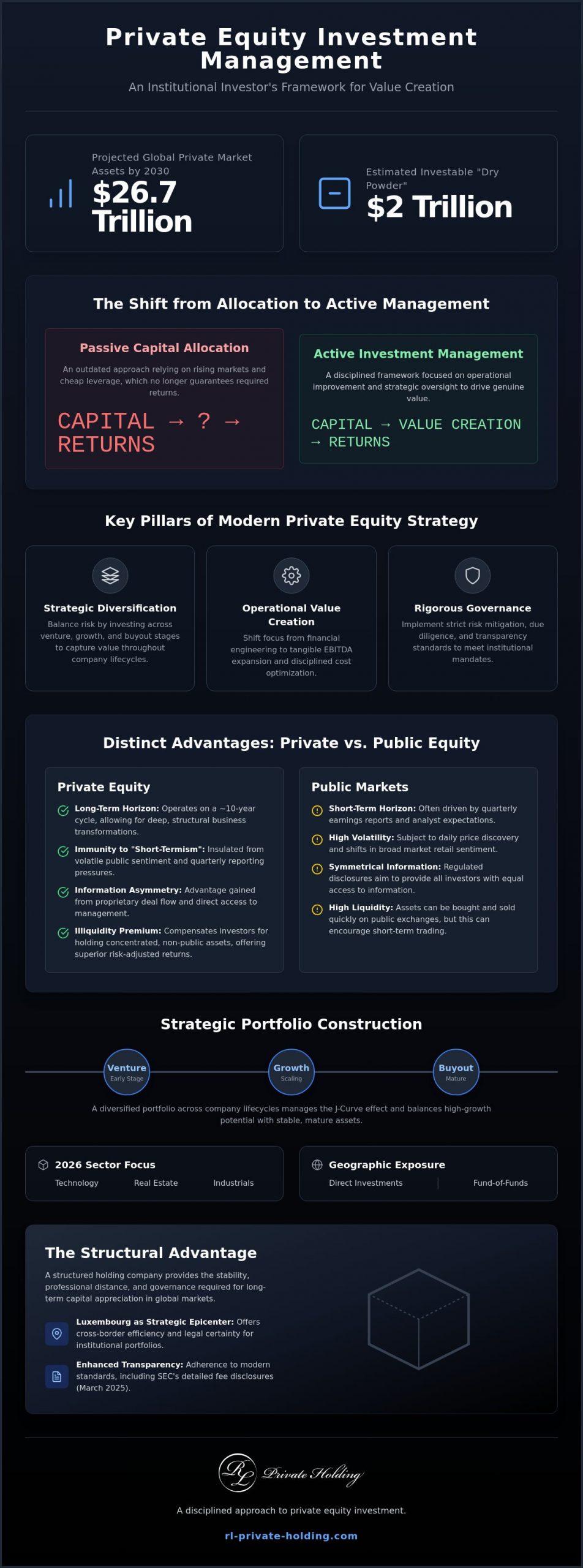
Global private market assets are projected to reach $26.7 trillion by 2030, yet the mere deployment of capital no longer guarantees the outsized returns institutional mandates require. In an environment where dry powder has reached an estimated $2 trillion, the distinction between simple allocation and sophisticated private equity investment management has become the primary determinant of portfolio success. You’re likely aware that navigating opaque fee structures and executing tangible operational value creation presents significant hurdles for even the most disciplined investment committees. This complexity is further heightened by a shifting regulatory landscape, including the SEC’s quarterly statement requirements that mandate detailed fee disclosures as of March 2025.
This article provides a comprehensive reference for institutional investors on managing private equity portfolios to achieve long-term capital appreciation and operational excellence. We’ll examine the strategic frameworks necessary for robust risk management and the structural advantages of Luxembourg-based investment vehicles. By the end of this analysis, you’ll have a clearer understanding of how to align institutional governance with the practical demands of modern value creation.
Key Takeaways
- Distinguish between passive capital allocation and active private equity investment management to ensure superior institutional oversight and portfolio performance.
- Identify strategic frameworks for diversifying assets across venture, growth, and buyout stages to balance risk and capture value throughout company lifecycles.
- Shift the focus from traditional financial engineering toward operational value creation through disciplined EBITDA expansion and cost optimization.
- Implement rigorous risk mitigation protocols and due diligence standards to navigate the J-Curve effect and maintain high institutional governance.
- Understand how a structured holding company provides the stability and professional distance required for long-term capital appreciation in global markets.
Defining Private Equity Investment Management in the Global Landscape
The global investment environment in 2026 has transitioned into a period where the mere allocation of capital no longer suffices to meet institutional benchmarks. With global private market assets projected to reach $26.7 trillion by 2030, the discipline of private equity investment management has shifted from a secondary activity to a primary driver of institutional solvency. Passive capital allocation, which once relied on rising market multiples and cheap leverage, has been superseded by active management frameworks. These frameworks utilize the holding company as a central pillar of institutional stability and oversight. For a comprehensive overview of private equity, one must look past the initial transaction to the multi-year stewardship of the underlying asset.
Luxembourg continues to serve as the strategic epicenter for these sophisticated structures. Its regulatory environment provides the cross-border efficiency and legal certainty required for large-scale institutional portfolios. By utilizing Luxembourg-based vehicles, managers can ensure that their governance standards remain consistent across diverse jurisdictions. This structural reliability is essential for maintaining the professional distance and disciplined focus needed for long-term capital appreciation.
The Core Objectives of Private Equity Management
Capital preservation remains the fundamental baseline for any institutional mandate. This is achieved through rigorous entry-price discipline and exhaustive due diligence that extends beyond financial statements into ESG and legal compliance. True alpha generation in the current cycle isn’t derived from financial engineering. It’s the result of tangible operational improvements. This requires a total alignment of interests between general partners and limited partners. Modern transparency standards, including the SEC’s quarterly statement requirements enforced in 2025, ensure that fee structures and performance metrics are clearly articulated and verified.
Private Equity vs. Public Market Management
The primary advantage of private equity is its immunity to the “short-termism” of public markets. Public equities are often held hostage by quarterly reporting cycles and volatile retail sentiment. Private equity managers operate on a ten-year horizon. This extended duration allows for the execution of complex structural changes without the distraction of daily price discovery. Information asymmetry also provides a distinct advantage. In private markets, proprietary deal flow and direct access to management teams allow for more informed decision-making. Investors accept an illiquidity premium because they recognize that concentrated, informed exposure offers a superior risk-adjusted return compared to broad public indices.
Strategic Frameworks for Private Equity Portfolio Management
Effective private equity investment management requires a multi-tiered approach to portfolio construction. Institutional investors must balance capital across various company lifecycles to mitigate systemic risk while capturing specific growth premiums. This involves a deliberate mix of venture capital, growth equity, and buyout strategies. By diversifying across these stages, a portfolio can manage the J-curve effect more effectively. A Strategic Framework for Private Equity emphasizes that this long-term perspective is what distinguishes private markets from public volatility, allowing for structural transformations that public markets often cannot sustain.
Sector-specific management is equally critical to this framework. In 2026, technology and real estate remain high-conviction areas, though industrial assets provide a necessary hedge against inflationary pressures. Geographic exposure must also be calibrated, often by integrating direct investments with a fund-of-funds approach. This allows for localized expertise in emerging markets while maintaining core holdings in stable jurisdictions like North America and Europe. With global fundraising reaching $86 billion in the first quarter of 2026, the market remains highly competitive, requiring a disciplined hand to identify assets that offer genuine value rather than just momentum.
Buyout and Growth Capital Strategies
The execution of buyout strategies focuses on established companies with stable, predictable cash flows. The management of leveraged buyouts (LBOs) now demands a heightened focus on debt sustainability given the financing costs observed throughout early 2026. Growth equity serves as a bridge, supporting scale-up operations in mature markets without the heavy leverage typical of LBOs. Mezzanine financing often fills the gap in the capital stack, providing flexible subordinated debt that preserves equity for the primary investors while offering a layer of protection against downside risk.
Venture Capital and Technology Asset Management
Managing venture capital requires a different set of protocols. Risk assessment is based on developmental milestones rather than historical EBITDA. Professional managers nurture innovation through board representation and strategic mentorship, ensuring that early-stage companies have the institutional support needed to scale. Exit planning is a continuous process, whether through secondary sales or initial public offerings. Given that private equity firms hold an estimated $2 trillion in dry powder as of Q1 2026, the competition for high-quality tech assets is intense. Organizations often benefit from the disciplined oversight of an established holding company when navigating these high-stakes venture cycles.
Value Creation: The Engine of Private Equity Returns
The transition from financial engineering to operational value creation represents the most significant evolution in modern private equity investment management. In an era where financing costs have remained elevated through early 2026, institutional investors can’t rely on multiple expansion or cheap leverage to drive returns. Superior performance now stems from the ability to fundamentally improve the underlying business. This shift requires a hands-on approach where the manager acts as a strategic partner rather than a passive shareholder. By focusing on EBITDA expansion, firms can deliver the capital appreciation that institutional mandates require regardless of broader market volatility.
Top-tier management teams are the primary catalyst for this transformation. A disciplined investment framework prioritizes the placement of proven executives who can execute complex turnaround or growth plans. These leaders are increasingly utilizing artificial intelligence to reimagine workflows and reduce operational costs. According to recent industry trends, the adoption of AI in private equity-backed companies is no longer optional. It’s a critical tool for creating new value and maintaining a competitive edge in saturated markets. Digital transformation initiatives often focus on data-driven decision-making, allowing for real-time adjustments to pricing and supply chain logistics.
Operational Improvement Frameworks
Standardizing governance across a diversified portfolio ensures that every asset adheres to the same high institutional standards. This creates a baseline of transparency and accountability that facilitates smoother operations. Strategic bolt-on acquisitions are frequently employed to drive industry consolidation, allowing portfolio companies to gain market share and achieve economies of scale. Managers also focus on optimizing supply chains and human capital management to protect margins. These interventions are methodical and data-centric, moving beyond anecdotal evidence to deliver measurable results.
Financial and Structural Optimization
While operations drive the core value, financial and structural optimization provides the necessary support for high-multiple exits. Refining capital structures to lower the weighted average cost of capital remains a key objective for professional managers. Tax-efficient management is often achieved through Luxembourg-based holding structures, which provide the legal and fiscal stability required for global portfolios. Preparing an asset for exit involves years of rigorous financial reporting and audit readiness. This disciplined approach ensures that when the time comes for a secondary sale or an IPO, the asset is positioned to command a premium valuation. As exit activity totaled $306.7 billion in the first quarter of 2026, the importance of being “exit-ready” has never been higher.
Risk Mitigation and Institutional Governance Standards
Robust institutional governance serves as the necessary counterbalance to the pursuit of high-yield returns. In a globalized market, the discipline of private equity investment management requires a framework that identifies and neutralizes risks before they impact the balance sheet. This isn’t merely a defensive posture. It’s a strategic imperative that ensures capital appreciation is sustainable over the full ten-year fund lifecycle. Effective risk mitigation integrates rigorous due diligence with a clear understanding of the regulatory landscape, particularly as new standards like the NAIC guidelines for insurers become effective in 2026. These guidelines allow regulators to challenge inflated credit ratings, making internal governance more critical than ever.
Due Diligence as a Risk Management Tool
Due diligence protocols must extend beyond basic financial audits to include legal and ESG considerations. Identifying hidden liabilities in cross-border transactions is essential, especially when dealing with varying jurisdictional standards. Managers must assess management quality and ensure a total alignment of interests between all stakeholders. Scenario modeling for economic downturns or sector-specific shocks allows for the stress-testing of portfolio companies. This methodical approach ensures that even in a challenging operating environment, the investment thesis remains intact. It’s about verifying every assumption before the first capital call is made.
Managing the J-Curve effect is another vital component of institutional oversight. The early stages of a private equity fund often see negative cash flows as capital is deployed and management fees are paid. Professional managers mitigate this by staggering investment vintages and maintaining a disciplined deployment schedule. This prevents a liquidity crunch and ensures that the portfolio remains balanced as it moves toward the realization phase. Transparency in this process is now a regulatory requirement, following the SEC’s March 2025 enforcement of detailed quarterly fee and expense disclosures.
Governance and Compliance in Luxembourg
Luxembourg remains the preferred jurisdiction for institutional asset protection due to its sophisticated legal frameworks. The Luxembourg SOPARFI (Société de Participations Financières) provides a stable environment for holding diversified global assets while ensuring tax-efficient management. Adhering to AIFMD (Alternative Investment Fund Managers Directive) standards provides investors with an additional layer of security through mandatory reporting and independent depositary requirements. These structures ensure that sophisticated investors receive the transparency they demand, backed by the legal certainty of the European Union’s most established financial center. Institutional managers seeking greater structural flexibility increasingly deploy the Luxembourg special limited partnership alongside these vehicles to achieve tax-transparent, bespoke fund architectures suited to the demands of 2026.
Independent valuation and annual audits provide the final seal of institutional integrity. These third-party reviews ensure that asset values are recorded accurately and that conflicts of interest are identified and managed. Institutions seeking a partner with a disciplined approach to risk can explore our private equity investment management services to see how these standards are applied in practice. This commitment to transparency and rigorous oversight is what builds the long-term trust necessary for global capital stewardship.
RL Private Holding: A Disciplined Approach to Private Equity
RL Private Holding operates with a philosophy of quiet authority, prioritizing institutional stability over the disruptive trends that often characterize the private market. Our approach to private equity investment management is rooted in the belief that long-term capital appreciation requires a steady, disciplined hand. By maintaining our headquarters in Luxembourg, we leverage a globally recognized center of excellence to manage a diversified portfolio that spans key sectors such as technology and real estate. This structural advantage allows us to provide the professional distance and rigorous oversight necessary for high-stakes asset management.
Transparency remains a cornerstone of our organizational framework. We maintain a commitment to clear fee structures and performance incentives that are strictly aligned with the interests of our partners. This discipline ensures that our focus remains on operational value creation rather than short-term gains. It reflects our identity as a secure global partner that values institutional permanence and strategic focus above all else.
Institutional Expertise in Asset Management
Our firm employs a methodical process for identifying high-potential private assets. We utilize a global network to secure proprietary deal flow, ensuring that our investments are not subject to the same competitive pressures as broadly marketed transactions. We understand that for Ultra-High-Net-Worth Individuals (UHNWIs), the integration of wealth management and private equity is essential for comprehensive portfolio health. This unified approach addresses the common gap between individual wealth preservation and institutional-grade investment strategies, providing a seamless transition between capital protection and growth.
Partnering for Long-Term Value
RL Private Holding serves as a discreet partner in major global investments. We provide access to exclusive venture capital and buyout opportunities that are often unavailable to the broader market. We act as a steady presence in the background, ensuring that every asset in the portfolio adheres to our high standards of governance and operational efficiency. Those seeking to align their portfolios with a disciplined institutional framework can Contact RL Private Holding for a formal consultation on private equity allocation. Our role is to provide the worldly expertise and organized structure required to navigate the complexities of the global financial landscape with confidence.
Securing Long-Term Value in Global Private Markets
The transition toward operational value creation and rigorous governance marks a significant shift for institutional portfolios. Success in the current landscape requires moving beyond passive allocation to a framework that prioritizes transparency and structural stability. By focusing on EBITDA expansion and utilizing sophisticated investment vehicles, investors can better navigate the complexities of global capital cycles. A disciplined approach to private equity investment management ensures that capital is actively stewarded rather than simply deployed.
RL Private Holding maintains a worldly presence as a secure global partner. Headquartered in Luxembourg, a leading global financial center, we manage a diversified portfolio across technology, real estate, and asset management. Our commitment to professional, institutional-grade governance and reporting provides the reliability that sophisticated investors require for long-term capital appreciation. We invite you to Explore Strategic Private Equity Management with RL Private Holding to align your objectives with a firm that values institutional permanence and strategic focus. It’s a path toward more resilient and productive portfolio outcomes.
Frequently Asked Questions
What is the primary difference between private equity and venture capital management?
Private equity management typically involves investing in mature companies with established revenue streams and stable cash flows to drive operational improvements. Venture capital management focuses on early-stage enterprises with high growth potential but significant risk. While private equity relies on EBITDA expansion and debt sustainability, venture capital uses milestone-based funding to nurture innovation from the seed stage through to market entry.
How are management fees and carried interest typically structured in private equity?
The standard structure for private equity investment management fees often follows the “2 and 20” model. This includes an annual management fee of approximately 2% of committed capital to cover operational expenses and a carried interest of 20% on realized profits. This performance-aligned incentive ensures that the interests of the general partners remain focused on achieving superior returns for the limited partners above a specific hurdle rate.
Why is Luxembourg considered a leading hub for private equity investment management?
Luxembourg is a global epicenter for private markets due to its robust legal framework and regulatory stability within the European Union. Its sophisticated investment vehicles, such as the SCSp and RAIF, provide institutional investors with the flexibility and transparency required for cross-border transactions. The jurisdiction also offers high levels of legal certainty and adherence to AIFMD standards, making it a preferred choice for sophisticated asset stewardship.
What are the typical exit strategies for a private equity investment?
Professional managers typically utilize three primary exit pathways: initial public offerings (IPOs), secondary sales to other private equity firms, or trade sales to strategic corporate buyers. The choice of strategy depends on the asset’s maturity and the prevailing market conditions. In the first quarter of 2026, global exit activity reached a value of $306.7 billion, highlighting the importance of rigorous financial reporting to secure high-multiple valuations during the realization phase.
How does a holding company structure benefit private equity investors?
A holding company structure provides centralized oversight and institutional stability for a diversified portfolio of assets. It allows for the isolation of liabilities within individual subsidiaries while maintaining a consistent governance framework at the parent level. This structure facilitates long-term capital appreciation by allowing managers to operate with professional distance and focus on strategic growth without the pressures of daily market volatility.
What role does ESG play in modern private equity investment management?
ESG considerations are now integral to the due diligence and operational oversight phases of private equity investment management. Beyond simple compliance, ESG serves as a tool for risk mitigation and value creation by identifying potential liabilities and improving resource efficiency. Institutional investors prioritize assets that demonstrate high environmental and social standards, as these factors often correlate with long-term resilience and superior exit multiples.
How do institutional investors manage the illiquidity of private equity assets?
Institutional investors manage illiquidity by diversifying their commitments across various investment vintages and asset classes. This strategy helps smooth the J-curve effect and ensures a steady flow of distributions over time. Managers also utilize secondary markets to rebalance portfolios or exit positions before the end of a fund’s life, providing a layer of liquidity within a traditionally illiquid investment framework.
What is the importance of a SOPARFI in Luxembourg investment structures?
The SOPARFI is a fully taxable commercial company in Luxembourg that benefits from extensive tax treaty networks and EU directives. It’s used primarily as a holding vehicle to manage and finance global participations with a high degree of asset protection. This structure provides the legal and fiscal stability necessary for institutional investors to manage diversified international portfolios while maintaining rigorous compliance with European standards.