

In a global economy defined by persistent geopolitical shifts and inflationary pressures, the structural illiquidity of private markets has transitioned from a perceived constraint to a primary mechanism for institutional stability. Many investors now find that the increasing correlation between public equities and bonds has compromised the effectiveness of traditional hedging strategies. Private equity wealth preservation offers a sophisticated alternative, utilizing non-correlated assets to maintain capital value when liquid markets falter. With 53% of private equity professionals identifying deteriorating credit quality as a significant risk in 2026, the strategic focus has shifted from speculative growth to disciplined capital protection.
You likely recognize that a portfolio must do more than just grow; it must remain resilient across volatile economic cycles. This article demonstrates how private equity serves as a critical pillar for institutional wealth preservation and long-term capital stability. We will examine the specific role of the illiquidity premium as a stabilizer and explore how the 72% of general partners who prioritize operational improvements are successfully maintaining value. By the end of this analysis, you will understand how to leverage these private market structures to secure your capital against the erosive effects of market volatility and shifting regulatory thresholds.
Key Takeaways
- Understand the critical distinction between maintaining nominal asset value and preserving real purchasing power through private equity wealth preservation in inflationary cycles.
- Learn how the structural illiquidity premium serves as a primary stabilizer by mitigating the risks of reactive capital withdrawal during periods of public market volatility.
- Identify strategic diversification methods across growth-stage private equity and venture capital to counteract the increasing correlation between traditional equities and bonds.
- Explore institutional frameworks, such as Luxembourg holding companies and Alternative Investment Fund governance, that ensure transparency and structural integrity for global assets.
- Examine the role of disciplined stewardship in managing complex, non-correlated portfolios within the sectors of technology, real estate, and private equity.
The Evolving Role of Private Equity in Wealth Preservation
The 2026 economic environment has forced a fundamental reassessment of how institutional capital is protected. Wealth preservation is no longer measured by nominal account balances; instead, it’s defined by the retention of real purchasing power. With the bank prime loan rate at 6.75% as of June 2026, the cost of capital has introduced a new layer of complexity for liquid portfolios. Private equity has emerged as a primary vehicle for this strategic stewardship, offering a buffer against the immediate volatility of public exchanges. This shift reflects a move away from speculative gains toward a disciplined focus on long-term capital stability.
Maintaining Purchasing Power in Volatile Markets
Public market sentiment often reacts to geopolitical shifts with a speed that erodes the value of liquid assets. Private equity valuations tend to lag behind these public fluctuations. This delay provides a stabilizing effect during periods of high inflation. Private equity wealth preservation is the strategic allocation to non-publicly traded assets to mitigate market correlation. In 2026, inflationary trends continue to pressure the purchasing power of cash and fixed-income instruments. Institutional investors utilize private markets to lock in value through tangible operational improvements rather than relying on market multiples. Data from April 2026 shows that 72% of general partners now identify these operational changes as the primary lever for value creation.
Beyond the 60/40 Portfolio: The New Standard
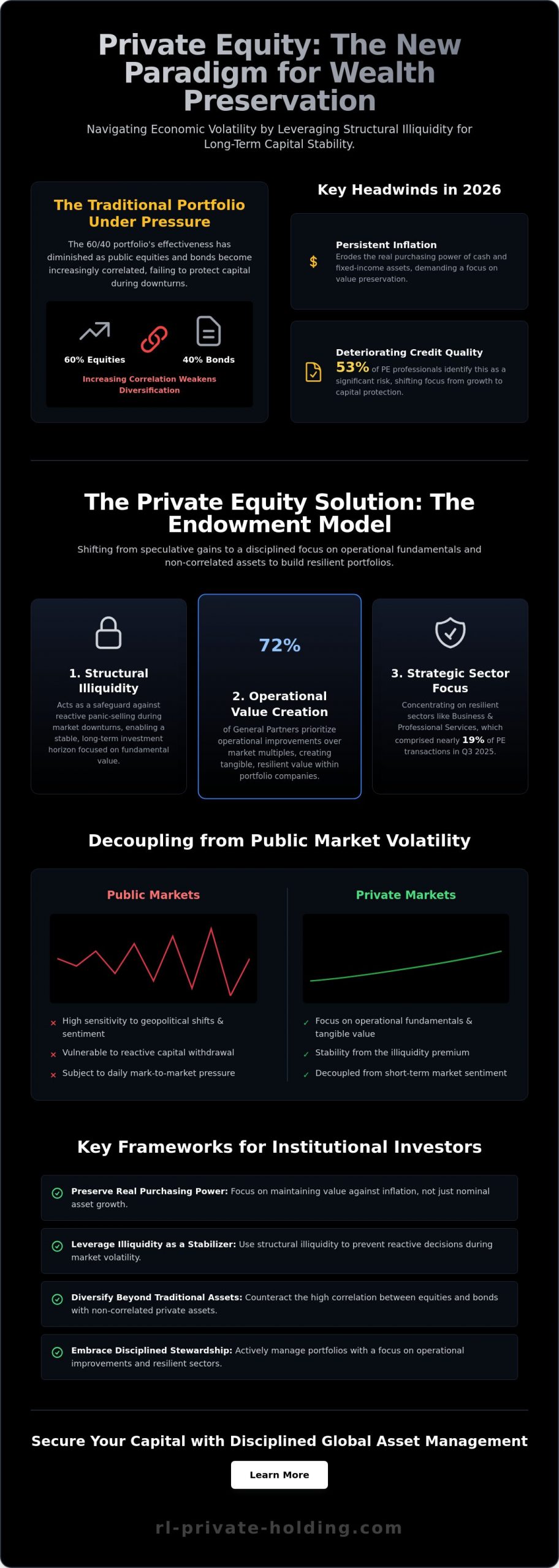
The traditional 60/40 split between equities and bonds failed to protect institutional capital effectively throughout 2025. As correlations between these two asset classes tightened, the diversification benefits of bonds vanished. This has led to the widespread adoption of the ‘Endowment Model’ among sophisticated family offices and institutional partners. This model prioritizes several key structural advantages:
- Structural illiquidity: This prevents reactive selling during market downturns and allows for a longer investment horizon.
- Growth-stage focus: Direct investment in companies with resilient business models and proven cash flows.
- Sector resilience: A focus on sectors like business and professional services, which represented nearly 19% of private equity transactions in the third quarter of 2025.
The pivot toward mature private equity ensures that capital remains productive without being subject to the daily whims of retail investor sentiment. By focusing on non-correlated alternative assets, firms can build a wealth management diversified portfolio that maintains its integrity across various economic cycles. This approach replaces the passive reliance on public benchmarks with an active, disciplined form of global asset management.
The Illiquidity Premium: A Mechanism for Capital Stability
The illiquidity premium is frequently characterized as a simple compensation for the inability to access capital quickly. In the context of private equity wealth preservation, this premium functions as a structural safeguard rather than a mere constraint. By restricting immediate liquidity, these investment vehicles protect capital from the reactionary panic selling that often occurs during public market downturns. Institutional investors recognize that the absence of daily mark-to-market pricing reduces psychological pressure, allowing for a focus on long-term value rather than temporary sentiment. This stability is a cornerstone for portfolios designed to withstand the volatility of the 2026 economic environment.
Decoupling from Public Market Sentiment
Private equity managers prioritize operational fundamentals over the daily fluctuations of stock indices. This focus was particularly evident during the market volatility observed between 2020 and 2022, where private asset valuations remained notably more stable compared to the sharp corrections seen in public markets. The inclusion of alternative investments within a broader portfolio provides a necessary buffer. It ensures that the core of an institution’s wealth is not subject to the irrationality of retail trading or the noise of high-frequency public exchanges. This decoupling allows for a more sober assessment of an asset’s true worth based on cash flows and market position.
Strategic Time Horizons and Value Realisation
The lifecycle of a private equity investment typically spans seven to ten years. This duration aligns precisely with the objectives of long-term capital protection. It allows managers to execute complex value creation strategies that would be impossible under the quarterly reporting pressures of public companies. Effective management involves a disciplined approach to capital calls and distributions. This ensures that while the core capital is preserved and grown, there is a steady flow of returns to meet institutional obligations. For those seeking a structured approach to these complex cycles, engaging with wealth management services can provide the necessary oversight to maintain portfolio balance.
Matching investment duration with wealth preservation goals is essential for institutional health. A decade-long horizon provides the runway needed for operational improvements to take hold and for market cycles to mature. This long-term commitment rewards the investor with a premium that liquid assets cannot provide. In a landscape where the bank prime loan rate sits at 6.75%, the ability to hold non-correlated assets becomes a significant advantage for maintaining the real value of a global portfolio. Private equity wealth preservation thus relies on the disciplined patience that structural illiquidity enforces.
Diversification Strategies Across Private Asset Classes
Effective private equity wealth preservation requires a deliberate spread across various private asset classes to neutralize sector-specific volatility. While growth-stage investments provide stability through established cash flows, venture capital and real estate offer complementary benefits that strengthen the overall portfolio. This multi-layered approach ensures that institutional capital isn’t overly exposed to a single economic variable. By targeting companies with proven business models, investors minimize the speculative risks associated with earlier stages. These entities often operate in resilient sectors such as professional services, which accounted for nearly 19% of private equity transactions in late 2025. Diversification isn’t merely about broad exposure; it’s about selecting non-correlated assets that respond differently to the same economic pressures. This discipline allows for the maintenance of capital across various market phases, ensuring that the core principal remains intact.
Venture Capital in Growth-Stage Technology
Technology remains the primary driver of capital growth in 2026. Innovation is no longer optional; it’s a defensive necessity to protect a portfolio from obsolescence. Sophisticated investors mitigate risk by utilizing Venture Capital Funding through diversified fund structures that spread exposure across multiple technical domains. This approach ensures that the portfolio benefits from high-growth potential without the fragility of concentrated bets. Identifying future industry leaders early provides a small-cap hedge that balances the more conservative portions of an institutional allocation. The integration of advanced analytics for due diligence has become a standard practice for firms seeking to identify these resilient opportunities. By capturing innovation at the growth stage, a portfolio remains relevant as market dynamics shift.
Real Estate and Tangible Asset Integration
Real estate serves as a tangible anchor in a preservation strategy, providing a natural index against inflation. The integration of Real Estate Asset Management with private equity structures creates a synergistic effect, where physical assets provide stability and private equity provides operational upside. Real estate provides a yield-generating floor to a private equity portfolio. This tangible component is essential for maintaining purchasing power when liquid markets experience inflationary erosion. By incorporating these physical holdings, a strategy for private equity wealth preservation gains an additional layer of protection against the devaluation of liquid assets. Infrastructure and real estate assets remain resilient pillars that support long-term capital stewardship. These assets often benefit from long-term contracts and essential utility, making them less susceptible to the cyclical downturns that affect consumer-facing industries. With 72% of general partners focusing on operational improvements, the active management of these tangible assets ensures they continue to produce value regardless of broader market sentiment.
Institutional Frameworks for Private Equity Allocation
Institutional frameworks provide the necessary legal and operational scaffolding for successful private equity wealth preservation. These structures ensure that global assets are consolidated under a transparent and tax-efficient regime, which is essential for maintaining capital across diverse jurisdictions. Without a robust structural foundation, the benefits of non-correlated assets can be undermined by regulatory friction or administrative inefficiency. Sophisticated investors prioritize jurisdictions that offer both legal stability and a high degree of transparency to protect their long-term interests.
The Role of Luxembourg as a Global Financial Hub
Luxembourg remains the preeminent jurisdiction for private equity due to its sophisticated and stable legal environment. The SOPARFI (Société de participations financières) structure is particularly favored for institutional wealth preservation because it allows for efficient global asset consolidation. This holding company structure provides a clear framework for managing cross-border investments while ensuring compliance with the Alternative Investment Fund Managers Directive (AIFMD). Oversight by the Commission de Surveillance du Secteur Financier (CSSF) ensures that these entities operate with the institutional gravity required by global partners. This regulatory environment offers a predictable landscape that is vital for long-term capital stewardship.
Governance and Risk Management Protocols
Governance is maintained through a disciplined alignment of interests between fund managers and investors. Carried interest serves as the primary mechanism for this alignment, rewarding long-term value creation over short-term gains. For assets held over three years, the federal tax rate for carried interest is 23.8% in the United States, representing a combination of the 20% long-term capital gains rate and the 3.8% net investment income tax. This tax structure incentivizes the patient capital approach that is central to wealth preservation strategies. For institutions requiring specialized oversight of these complex structures, engaging with Private Equity Investment Management services ensures that allocation strategies remain compliant and strategically sound.
Regulatory requirements are becoming increasingly technical as the industry matures. The SEC has proposed increasing the Form PF filing threshold for private fund advisers to $1 billion in assets under management, with a compliance date of October 1, 2026. This shift reflects a broader trend toward intensified regulatory scrutiny of valuation practices and fee allocations. A robust due diligence framework must therefore include:
- Performance alignment: Verifying that management fees and carried interest structures prioritize capital protection.
- Valuation transparency: Ensuring that private asset valuations are conducted with methodical precision.
- Conflict mitigation: Implementing clear protocols to manage potential conflicts of interest within the fund structure.
By adhering to these rigorous governance standards, institutions can navigate the private markets with confidence. The focus remains on structural integrity and disciplined reporting, which are the hallmarks of professional asset management in 2026.
RL Private Holding: Disciplined Stewardship of Global Assets
RL Private Holding operates with an institutional gravity that reflects its position as a disciplined global partner in the financial landscape. The firm maintains a diversified portfolio focused on sectors with high barriers to entry, including advanced technology, strategic real estate, and mature private equity. This approach is central to the firm’s philosophy on private equity wealth preservation, where capital protection is prioritized over speculative yield. By maintaining a composed and objective investment strategy, the firm provides a steady hand for institutional partners who value professional distance and long-term results. The firm presents itself as a silent giant, focusing on the structural components of asset management rather than marketing hyperbole.
A Disciplined Approach to Global Portfolio Management
The internal investment committee at RL Private Holding adheres to a methodical and hierarchical selection process. This committee focuses on companies and assets that demonstrate resilience across economic cycles, particularly those capable of operational value creation. With 72% of general partners identifying operational improvements as the primary lever for value in 2026, the firm’s focus remains on structural enhancements and disciplined fiscal oversight. The bank prime loan rate of 6.75% and the federal funds rate of 3.62% as of June 2026 emphasize the need for this rigorous approach to capital allocation. Transparency is a core principle, with reporting standards that meet the rigorous requirements of global institutional investors and regulatory bodies.
Partnering for Long-Term Capital Security
Security is achieved through the utilization of sophisticated legal frameworks, such as the Luxembourg-based global holding structures. These structures provide the necessary transparency and regulatory compliance required for cross-border asset management under AIFMD guidelines. RL Private Holding offers access to exclusive opportunities in Venture Capital Funding and Real Estate Asset Management, ensuring that each allocation is aligned with the broader goal of capital stability. Performance-based structures ensure that the firm’s interests remain strictly aligned with those of its partners, fostering a sense of institutional permanence. This strategic focus allows for the preservation of wealth across generations, even in a volatile global economy.
For institutions seeking a partner characterized by quiet authority and strategic focus, the firm provides a clear path through the complexities of the private markets. The emphasis is consistently placed on the integrity of the investment process and the stability of the underlying assets. Explore our strategic approach to private equity investment management to understand how disciplined stewardship can protect your global portfolio.
Securing Institutional Capital in a Shifting Global Economy
The transition toward private markets reflects a fundamental shift in how global institutions approach long-term stability. By utilizing the illiquidity premium and non-correlated asset classes, investors can effectively decouple their core capital from the reactionary cycles of public exchanges. This strategic focus on operational value creation and structural integrity ensures that real purchasing power is maintained despite persistent inflationary pressures. Professional private equity wealth preservation has become an essential pillar for those managing multi-generational assets in the volatile 2026 landscape.
RL Private Holding provides the disciplined stewardship necessary to navigate these complex alternative markets with confidence. Headquartered in Luxembourg, the global hub for private equity, the firm manages a diversified portfolio of technology and real estate assets with institutional precision. Our performance-aligned incentive structures ensure that every strategic decision prioritizes client-first outcomes and capital security. Learn more about RL Private Holding’s institutional investment management to see how a steady hand can reinforce your portfolio’s resilience across economic cycles. A disciplined approach to these private asset classes will ensure your capital remains secure and productive for years to come.
Frequently Asked Questions
What is the primary difference between private equity growth and wealth preservation?
Private equity growth strategies prioritize aggressive capital appreciation through high-risk expansion, whereas private equity wealth preservation focuses on the retention of real purchasing power. The preservation model utilizes non-correlated assets to protect the principal against market volatility and inflationary erosion. This approach replaces speculative risk with a disciplined focus on long-term capital stability and predictable operational value across various economic cycles.
Is private equity suitable for all institutional investors seeking preservation?
Private equity is suitable for institutional investors who have a defined tolerance for illiquidity and a multi-generational investment horizon. It’s not a universal solution for entities requiring immediate capital access for their entire portfolio. Successful preservation requires a strategic balance that allows core assets to remain committed through full market cycles. Investors must align their specific liquidity requirements with the structural constraints of private market vehicles.
How do Luxembourg investment structures enhance wealth preservation?
Luxembourg investment structures provide a sophisticated legal framework that serves as the global standard for asset consolidation and protection. The SOPARFI structure offers institutional-grade transparency and tax efficiency for complex, cross-border holdings. These frameworks ensure that global assets are managed under a predictable and stable regulatory regime. Oversight by the CSSF and strict compliance with AIFMD further reinforce the security and integrity of the preservation strategy.
What is the typical illiquidity period for a private equity preservation strategy?
The typical illiquidity period for a private equity preservation strategy ranges between 7 and 10 years. This timeframe is necessary to allow managers to implement deep operational improvements without the pressure of public market sentiment or short-term volatility. Matching investment duration with long-term wealth goals is essential for capturing the illiquidity premium. This period ensures that value realization occurs at the most favorable point in the asset’s lifecycle.
How does RL Private Holding manage risk within its private equity portfolio?
Risk management is achieved through a disciplined focus on sectors with high barriers to entry and proven long-term resilience. RL Private Holding utilizes an internal investment committee to conduct rigorous due diligence on every potential allocation within its global portfolio. The firm prioritizes institutional-grade technology and real estate assets that offer inherent structural stability. This methodical approach ensures that risk is mitigated through careful asset selection and strict performance alignment.
Can private equity effectively hedge against 2026 inflation rates?
Private equity effectively hedges against inflation by investing in tangible assets and companies that possess strong pricing power. Unlike liquid assets, private valuations often reflect underlying operational growth that can outpace the 2026 inflationary trends. Real estate components within a wealth management diversified portfolio provide an additional layer of protection through inflation-indexed yields. This ensures that the institutional portfolio maintains its real value even as the purchasing power of cash declines.
What role does venture capital play in a wealth preservation framework?
Venture capital serves as a strategic hedge against industry obsolescence within a modern wealth preservation framework. By identifying future industry leaders, it protects the broader portfolio from the disruptive effects of rapid technical innovation. This small-cap exposure provides a necessary balance to more conservative allocations in mature private equity. Innovation is treated as a defensive necessity to ensure that the institutional portfolio remains relevant across shifting economic landscapes.
How are management fees structured in private equity wealth preservation?
Management fees in private equity wealth preservation have adjusted to reflect a maturing market, with the average rate reaching approximately 1.61% as of 2026. These base fees are typically paired with a performance-based incentive known as carried interest, which aligns the interests of the manager with the institutional partner. This structure ensures that the firm is rewarded only after achieving specific capital protection and growth benchmarks. It fosters a disciplined stewardship model focused on client-first outcomes.