

The most effective private wealth management firms in Luxembourg in 2026 are no longer defined by their advisory suites, but by their capacity to operate as disciplined investment holding entities. You likely recognize that the complexity of cross-border investment structures and the opacity of traditional banking models often obscure the path to real value. Finding a partner with direct expertise in private equity and venture capital management remains a significant challenge in a landscape increasingly governed by new regulations such as UCITS VI and the June 2026 ESG Ratings Regulation.
This analysis provides a comprehensive overview of the Luxembourg landscape, specifically focusing on the strategic integration of alternative assets and the benefits of sophisticated holding structures for the current fiscal year. We will examine the impact of the new carried interest regime, the evolution of SOPARFI participation exemptions, and how a disciplined, institutional approach to global portfolio management ensures long-term stability. Understanding these shifts is essential for investors seeking to align with a firm that prioritizes structural integrity over simple brokerage services.
Key Takeaways
- Understand the transition from traditional advisory models to the sophisticated alternative investment holding frameworks defining the 2026 landscape.
- Examine the strategic advantages of the SOPARFI structure as a central vehicle for managing diversified global asset portfolios with structural integrity.
- Discover the specific due diligence protocols required to evaluate private wealth management firms Luxembourg, focusing on direct management expertise rather than third-party advisory.
- Learn how to integrate venture capital, private equity, and real estate asset management into a cohesive, institutional-grade investment strategy.
- Identify the transparency and fee structure benchmarks necessary to align with a disciplined, long-term partner in the global financial market.
The Evolution of Wealth Management in Luxembourg for 2026
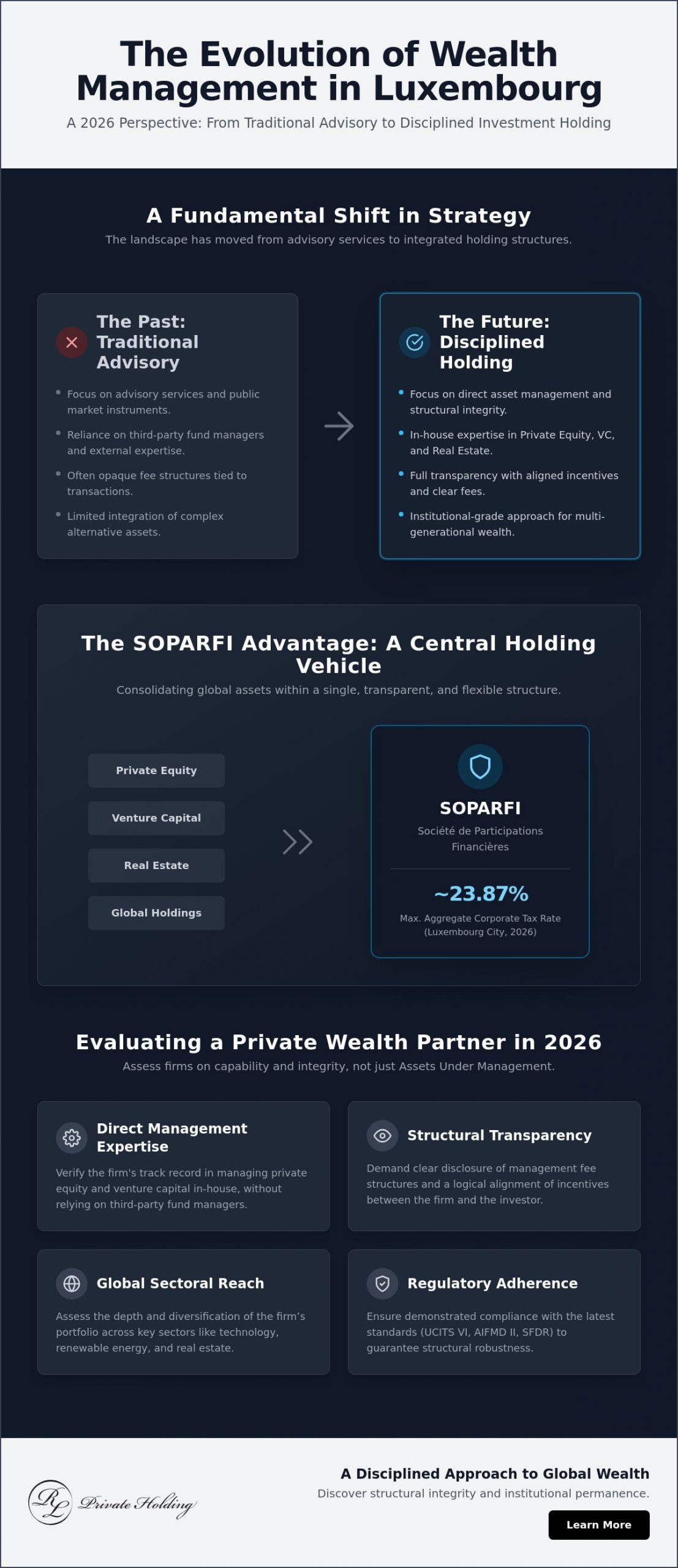
The financial environment in 2026 reflects a fundamental transition in how capital is preserved and deployed. Historically, private wealth management firms Luxembourg operated within the parameters of traditional retail banking models, focusing primarily on advisory services and public market instruments. Today, the landscape has shifted toward institutional-grade holding structures that prioritize alternative asset integration and direct management. This evolution is driven by a demand for greater structural transparency and the need to manage complex, cross-border portfolios within a stable, predictable regulatory framework.
The Economy of Luxembourg remains a cornerstone of European finance, providing the necessary legal and technical infrastructure for this sophisticated shift. As of June 2026, the implementation of the ESG Ratings Regulation and the continued maturation of SFDR requirements have solidified the jurisdiction’s role as a global epicenter for sustainable and transparent asset management. Sophisticated investors no longer settle for standard private banking; they require entities that offer digital reporting capabilities alongside deep technical knowledge of local tax regimes, such as the 2026 real estate tax reforms and the updated carried interest rules.
The Institutional Shift in Private Wealth
Sophisticated investors are increasingly moving away from standard private banking due to the inherent limitations of third-party advisory models. There’s a growing preference for partners that exhibit “quiet authority” through the direct management of private equity and venture capital. This professional distance ensures the relationship remains objective and focused on the long-term performance of the holding structure rather than short-term market fluctuations. The transition for private wealth management firms Luxembourg isn’t merely about scale; it’s about adopting a methodology of wealth preservation that mirrors the discipline of global institutional funds. Luxembourg’s regulatory stability, particularly with the established Reserved Alternative Investment Fund (RAIF) and SOPARFI frameworks, provides the secure foundation global holding companies need to consolidate their international interests.
Key Metrics for Evaluating Luxembourg Firms
When assessing a potential partner, Assets Under Management (AUM) remains a relevant metric, but it’s no longer the sole indicator of capability. In 2026, the quality of a firm is defined by its sectoral diversification and its ability to navigate global markets with precision. You should evaluate firms based on the following criteria:
- Direct Asset Management Expertise: The firm’s track record in managing private equity and venture capital without relying on external fund managers.
- Structural Transparency: Clear disclosure of management fee structures and a logical alignment of incentives between the firm and the investor.
- Global Sectoral Reach: The depth of the firm’s portfolio across diverse sectors, including technology, renewable energy, and real estate asset management.
- Regulatory Adherence: Demonstrated compliance with the latest UCITS VI and AIFMD II standards, ensuring the holding structure remains robust against future legal shifts.
A disciplined approach to these metrics ensures that the chosen partner can act as a steady hand in the background of major investments, providing the institutional permanence required for multi-generational wealth preservation.
Strategic Investment Holding Structures: The SOPARFI Advantage
The SOPARFI (Société de Participations Financières) serves as the primary structural vehicle for sophisticated investors seeking to consolidate global assets within a single, transparent entity. Unlike traditional fund structures that may be subject to rigid investment restrictions, the SOPARFI operates as a fully taxable commercial company, providing the flexibility required to manage a diverse array of holdings. For the 2026 tax year, the maximum aggregate corporate tax rate for a SOPARFI in Luxembourg City remains approximately 23.87%. This stability, combined with Luxembourg’s responsible governance, ensures that the jurisdiction remains the preferred choice for institutional-grade wealth holding.
The primary advantage of this structure lies in the participation exemption regime. To qualify for a 100% tax exemption on dividends and capital gains in 2026, a SOPARFI must maintain at least a 10% shareholding in a subsidiary, or a participation with an acquisition cost of at least €1.2 million for dividends or €6 million for capital gains. These assets must be held for a minimum of 12 months. Leading private wealth management firms Luxembourg utilize these specific thresholds to design portfolios that facilitate long-term private equity and real estate allocation without the friction of frequent tax events. This allows for a more disciplined approach to capital reinvestment across a global portfolio. Investors seeking to understand how these structural advantages translate into a wealth management diversified portfolio built for long-term resilience will find that the SOPARFI framework provides an ideal foundation for integrating non-correlated alternative assets.
Operational Frameworks for Global Holdings
A centralized holding model enables the integration of diverse sectors, such as technology and renewable energy, under a unified management framework. By centralizing management fees and performance-based incentives at the holding level, investors gain a clearer view of their total cost of ownership. This structure supports institutional discipline, ensuring that every asset, from venture capital funding to real estate, is managed with the same level of professional distance and objective analysis. Utilizing a disciplined investment holding model allows for the seamless transition of capital between sectors as global market conditions evolve.
Risk Management within Holding Structures
Diversification within a SOPARFI acts as a primary tool for wealth preservation. In 2026, the role of institutional asset management is to mitigate sector-specific volatility by maintaining a balanced exposure to both growth-oriented venture capital and stabilizing real estate assets. Regulatory reporting requirements for these entities have become more rigorous, particularly with the 0.5% net wealth tax on net assets and the minimum net wealth tax of €4,815 for financial holding companies. These requirements, while demanding, reinforce the transparency and legitimacy of the structure in the eyes of international tax authorities and financial institutions.
Integrating Alternative Assets: PE, VC, and Real Estate
The integration of alternative assets within a single holding structure represents the transition from passive wealth preservation to active capital appreciation. While many private wealth management firms Luxembourg offer access to unlisted assets, few demonstrate the technical capacity to manage the inherent synergies between venture capital, private equity, and real estate. In 2026, the objective is to create a balanced ecosystem where the high-growth potential of technology investments is offset by the cash-flow stability of commercial property.
The expansion of private equity (PE) in Luxembourg highlights the jurisdiction’s role as a primary gateway for accessing global alternative markets. Strategic allocation now requires a more nuanced approach than simple diversification. It involves balancing the long-term illiquidity of growth-stage private equity with the predictable performance of institutional real estate. This alignment ensures that the portfolio remains robust through varying market cycles while capturing value at different stages of the asset lifecycle.
Venture Capital and Technology Growth
Technology remains the primary driver for venture capital in 2026, particularly in sectors such as sustainable infrastructure and artificial intelligence. The mechanics of these investments have been refined by the new carried interest regime effective for the 2026 tax year, which distinguishes between contractual carried interest, taxed at a maximum of 11.45%, and participation-linked interest. Identifying growth-stage opportunities requires access to deep institutional networks that operate beyond the reach of standard retail banking. Exit-based revenue models are prioritized. The focus remains on capturing value through disciplined management rather than speculative trading.
Institutional Real Estate Management
Real estate asset management serves as a critical stabilizing force within a growth-oriented portfolio. In the current fiscal year, the focus has shifted from residential holdings to commercial and strategic real estate assets that offer higher net yields, typically between 2.0% and 3.0% in early 2026. Managing these global portfolios from a Luxembourg hub allows for the seamless integration of property assets into a broader private equity framework. This approach accounts for the 2026 real estate tax reform, including the new IFON and IMOB frameworks. By centralizing management, investors ensure that their real estate holdings aren’t isolated assets. Instead, they’re part of a comprehensive strategy to mitigate sector-specific volatility.
Selecting a Private Wealth Partner: Due Diligence Protocols
Selecting a partner among private wealth management firms Luxembourg requires a shift from superficial relationship metrics to rigorous institutional due diligence. Investors must look beyond the “bespoke service” marketing common in the sector to identify entities with the operational scale to manage high-stakes holdings. This process begins with an objective assessment of the firm’s track record in direct asset management. Many entities operate as third-party advisors, essentially acting as intermediaries for other fund managers. A disciplined partner, however, maintains internal expertise across private equity and venture capital, ensuring that the investment strategy is executed with technical precision rather than outsourced.
Evaluating a firm’s global footprint and sectoral expertise is equally critical. A partner must demonstrate a deep understanding of the sectors they manage, whether it’s technology-driven venture capital or large-scale real estate asset management. This includes the ability to manage complex, multi-sector holding structures that span multiple jurisdictions. Internal governance and institutional discipline are what distinguish the premier private wealth management firms Luxembourg from standard advisory groups. A firm’s organizational hierarchy and its adherence to international standards, such as the June 2026 ESG Ratings Regulation, serve as indicators of long-term stability.
The Importance of Institutional Gravity
A firm’s communication style often reflects its operational philosophy. In the high-stakes environment of private equity, a formal and objective tone signifies a methodical approach to risk and capital deployment. You should avoid firms that rely on marketing hyperbole or hype-driven investment narratives. Instead, look for a “silent giant” persona. This understated confidence suggests a firm that’s secure in its market position and focused on results rather than self-promotion. This institutional permanence is vital for maintaining professional distance and making sober investment decisions.
Fee Structure Transparency
Transparency in fee and incentive structures is the final pillar of due diligence. In 2026, benchmarks for management fees must be clearly defined and justified by the level of direct management provided. Performance-based carried interest models are standard for aligning the interests of the firm with those of the investor. However, the mechanics of these models must be transparently reported, especially regarding the valuation of unlisted assets. Clear reporting ensures there’s no ambiguity in how value is created and shared. For those seeking a partner that embodies these principles, reviewing our institutional approach to wealth management provides a clear benchmark for professional discipline.
RL Private Holding: A Disciplined Approach to Global Wealth
RL Private Holding operates as a discreet and authoritative entity within the global financial landscape. Unlike many private wealth management firms Luxembourg that prioritize high-volume advisory services, we function as a disciplined investment holding company. Our focus remains on the direct management of a diversified global portfolio, emphasizing strategic positions in technology, real estate, and private equity. This institutional framework provides the stability and exclusivity required for high-stakes capital preservation. By maintaining a neutral and composed emotional register, we ensure that every investment decision is based on factual analysis rather than market sentiment.
The Holding Company Model
The holding company model allows us to act as a steady hand in the background of major investments. We prioritize clarity and structural integrity in every transaction, moving beyond the standard retail advisory models. By leveraging our Luxembourg headquarters, we maintain a central hub for global investment reach. This location facilitates the efficient management of cross-border interests while adhering to the rigorous regulatory standards discussed earlier, such as the 2026 tax frameworks. Our commitment to long-term thinking ensures that capital is deployed with methodical precision, providing a sense of institutional permanence for our partners. It’s a structure designed for those who value professional distance and a focus on long-term outcomes.
Partnering with RL Private Holding
Our strategic focus is centered on venture capital funding and private equity investment management for growth-stage firms. We identify opportunities where institutional discipline can drive significant value. In 2026, capturing value in the technology sector requires a worldly perspective and a highly organized approach to asset reporting. This is complemented by our expertise in real estate asset management, which provides a stabilizing foundation for the broader portfolio. We manage these assets with a clear plan, ensuring that sector-specific volatility is mitigated through a well-ordered organizational hierarchy. This approach doesn’t rely on hype; it relies on the steady execution of a global strategy.
Partnering with RL Private Holding provides access to a portfolio managed with the same level of rigor found in leading institutional funds. Our multi-sector expertise ensures that each asset class is treated with specialized technical knowledge. This approach eliminates the lack of transparency often found among private wealth management firms Luxembourg. Investors align with a firm that values professional distance and steady, predictable progress. It’s essential to partner with an entity that understands the nuances of the 2026 carried interest regime and the implications of the ESG Ratings Regulation. You can Explore our strategic approach to investment management to understand how our organizational framework supports global scale and long-term stability.
Securing Long-Term Stability in 2026
The 2026 financial landscape requires a transition from traditional advisory models to a more robust, institutional holding approach. Success in this environment depends on utilizing transparent structures like the SOPARFI and maintaining direct exposure to high-performance alternative assets. Identifying the right partner among private wealth management firms Luxembourg involves prioritizing entities that demonstrate operational discipline and a clear, multi-sector focus. This shift ensures that capital is not merely advised upon but is actively managed within a framework of structural integrity.
RL Private Holding remains a privately held investment holding company dedicated to managing a diversified global portfolio. With extensive expertise in Venture Capital, Private Equity, and Real Estate Asset Management, our firm provides the stability and professional distance necessary for sophisticated capital preservation. We’re headquartered in the world-class Luxembourg financial center, ensuring our operations are aligned with the highest international standards of governance and reporting. This institutional permanence allows us to act as a steady hand in the background of major global investments.
Partner with a disciplined global investment holding company to ensure your capital is managed with the precision and foresight required for the years ahead. We look forward to providing the steady, methodical partnership your global interests require.
Frequently Asked Questions
What are the primary benefits of a Luxembourg SOPARFI for wealth management?
A Luxembourg SOPARFI offers substantial structural advantages, primarily through the participation exemption regime. This framework allows for a 100% tax exemption on dividends and capital gains, provided specific shareholding thresholds and holding periods are met. Unlike specialized fund vehicles, a SOPARFI operates as a fully taxable commercial entity. This status grants it access to Luxembourg’s extensive network of double tax treaties and provides the flexibility required to hold a wide range of global assets within a single, transparent structure.
How do private wealth management firms in Luxembourg handle alternative assets like PE and VC?
Leading private wealth management firms Luxembourg manage private equity and venture capital through dedicated investment holding structures that facilitate direct asset oversight. This approach involves the integration of unlisted assets into a broader portfolio, ensuring compliance with the latest AIFMD II regulations effective in 2026. By utilizing specialized vehicles like the RAIF or SOPARFI, firms provide institutional investors with transparent reporting and disciplined management of growth-stage interests without the constraints of traditional retail banking models.
What is the typical fee structure for institutional asset management in Luxembourg?
Fee structures for institutional asset management in Luxembourg generally comprise a management fee based on total assets under management and a performance-based incentive, often structured as carried interest. The management fee covers the operational costs of the holding structure and direct asset oversight. Performance fees are designed to align the interests of the firm with those of the investor, ensuring that incentives are only realized upon the successful execution of investment exits or the achievement of specific yield benchmarks.
Why is Luxembourg considered a global hub for private equity and venture capital?
Luxembourg is recognized as a global hub for private equity and venture capital due to its stable regulatory environment and its position as a primary gateway to the European Union market. The jurisdiction provides a sophisticated toolbox of investment vehicles, such as the SCSp and RAIF, which are specifically designed for alternative assets. Additionally, the presence of a highly specialized ecosystem of legal and technical experts ensures that complex, cross-border transactions are executed with institutional precision and full regulatory compliance.
How does RL Private Holding differentiate itself from traditional private banks?
RL Private Holding differentiates itself by operating as a disciplined investment holding company rather than a traditional private bank. While banks often focus on retail advisory services and third-party fund distribution, our firm prioritizes the direct management of a diversified global portfolio. We function as a steady hand in the background of major investments, providing a level of institutional gravity and professional distance that traditional banking-led models typically lack.
What should institutional investors look for in a Luxembourg wealth management partner?
Institutional investors should evaluate a partner’s track record in direct asset management and their ability to navigate complex, multi-sector holding structures. It’s essential to assess the firm’s internal governance and its commitment to transparency, particularly regarding the valuation of unlisted assets. A suitable partner among private wealth management firms Luxembourg must demonstrate deep sectoral expertise in areas such as private equity and real estate while maintaining a formal, objective approach to risk management and capital deployment.
How is carried interest structured in growth-stage venture capital investments?
In 2026, carried interest in growth-stage venture capital is structured to distinguish between contractual incentives and participation-linked returns. Under the new regime effective for the 2026 tax year, contractual carried interest is taxed at a maximum rate of 11.45%. This structure rewards investment managers for achieving specific performance hurdles. It ensures that the incentive model is transparent and legally robust, providing a clear framework for the distribution of gains upon successful asset exits.
What role does real estate asset management play in a diversified holding company?
Real estate asset management acts as a stabilizing force within a diversified holding company, providing predictable cash flows and a hedge against sector-specific volatility. In a growth-oriented portfolio, property assets offer a counterpoint to the higher risk profile of venture capital and technology investments. By integrating real estate into a broader private equity framework, firms achieve a balanced asset allocation that accounts for the 2026 real estate tax reforms while maintaining long-term capital appreciation.