

A fund’s portfolio deserves as much scrutiny as its performance. The most useful questions to ask a fund manager before investing cover how investments are selected, valued and sized, how decisions are made, and who holds and safeguards client assets. Clear answers help you judge whether the manager’s approach, governance and investment horizon fit your objectives.
Performance matters, but it does not show how a portfolio is built or how the strategy may respond to pressure. You should also understand the manager’s experience, how responsibilities are shared, and how custody arrangements keep client assets separate from the management company.
This guide sets out practical questions for assessing portfolio construction, investment discipline, team continuity and asset protection in Luxembourg. It also explains what the answers can reveal about a fund’s structure and which risks to consider before committing capital.
Key Takeaways
- Clarify who makes investment decisions, how responsibilities are shared and what happens if a key person leaves.
- Assess the manager’s experience, lessons from past decisions and the evidence behind reported performance.
- Understand the fund’s legal and operating structure, including who holds the assets and how they are safeguarded.
- Test whether the portfolio’s objective, selection criteria and position-sizing approach align with your investment horizon and risk tolerance.
1. Investment team structure and key-person risk
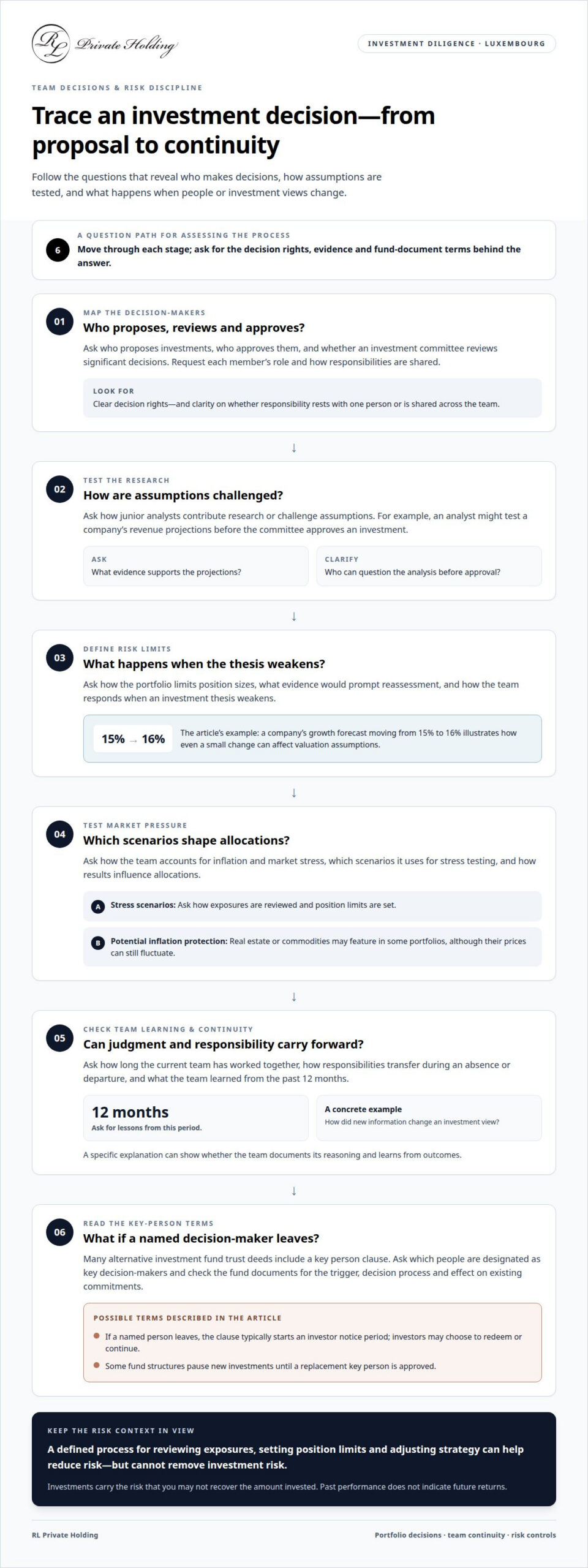
A portfolio depends on more than its stated strategy. Ask who proposes investments, who approves them, and whether an investment committee reviews significant decisions. Request each member’s role and ask how junior analysts contribute research or challenge assumptions. For example, an analyst might test a company’s revenue projections before the committee approves an investment. Clear decision rights reveal whether responsibility rests with one person or is shared across the team.
Ask which people are designated as key decision-makers and what happens if one leaves. Many alternative investment fund trust deeds include a key person clause. If a named person leaves, the clause typically starts an investor notice period, during which investors may choose to redeem or continue. Some fund structures pause new investments until a replacement key person is approved. The fund documents should explain the trigger, decision process and effect on existing commitments.
Team continuity matters because investment judgment develops through repeated decisions, not titles alone. Ask how long the current team has worked together and how responsibilities would transfer during an absence or departure. Invite the manager to discuss lessons from the past 12 months. A specific explanation, such as how new information changed an investment view, can reveal whether the team documents its reasoning and learns from outcomes.
Risk and return should be considered together. Ask how the portfolio limits position sizes and responds when an investment thesis weakens. A company’s growth moving from 15% to 16% illustrates how even a small forecast change can affect valuation assumptions. The manager should explain what evidence would prompt a reassessment, rather than treating projected returns as assured. Investments carry the risk that you may not recover the amount invested, and past performance does not indicate future returns.
Ask how the team accounts for inflation and market stress. Real estate or commodities may feature in some portfolios as potential inflation protection, although their prices can still fluctuate. Ask which scenarios the manager uses for stress testing and how the results influence allocations. A defined process for reviewing exposures, setting position limits and adjusting strategy can help reduce risk, but cannot remove investment risk.
2. What is the fund manager’s background?
Review the manager’s investment history alongside the fund’s stated strategy. Ask what they learned from mistakes and how those lessons changed later decisions. Invite them to describe weaknesses they have identified and challenges they anticipate. A useful answer links a past decision to a specific change in research, valuation or portfolio discipline. Ask how long they monitor a company before investing and what evidence could bring the review to an end.
Examine the record behind performance claims. Ask whether results come from a fully audited track record, a paper portfolio or a back-calculated model. These are not equivalent evidence. Ask how the fund performed during major market downturns, including the COVID-19 pandemic, and how it reports returns, volatility and other risk measures. Past performance does not indicate future returns, so consider whether the manager can explain both weaker periods and stronger ones.
Explore the investment method through a real company example. Ask which selection criteria are essential, which are optional, and how the manager tests each one. A manager investing in an unlisted company might explain how discounted cash flow, comparable transactions or its last funding round inform valuation. Ask whether qualitative judgment, quantitative screening or both shape the decision. The manager should explain how they engage with company leadership and what information could change their view.
Liquidity depends on the fund’s holdings and governing terms. Ask about redemption frequency, notice periods, lock-ins, early exit penalties and restrictions during market stress. An AIF may have a defined tenure, and extensions can occur; illiquid property or private equity holdings may not be saleable when an investor needs cash. The written terms should explain how redemption requests are handled, including during heavy demand. For portfolios with property exposure, property investment considerations can also help frame how asset liquidity fits an investor’s time horizon.
3. Fund company structure, client asset protection and custody
Start by mapping the fund’s legal and operating structure. Identify the fund vehicle, its manager, any appointed administrator, and the entity responsible for investment decisions. Ask how each party’s duties are documented and who oversees reporting. The manager, fund vehicle, administrator and custodian may perform distinct functions. An organization chart should show their relationships and lines of accountability. Among the questions to ask a fund manager before investing, clarify who is accountable for correcting records or reporting.
Is the fund regulated and authorized for sale to retail investors in Luxembourg? The answer depends on the specific fund’s regulatory status and distribution permissions. Ask the manager to identify its authorization or registration and explain which investor categories may subscribe in Luxembourg. Compare that explanation with the offering documents and their stated restrictions.
What assets and markets does the fund invest in? Its mandate should describe the asset classes, geographic exposure, concentration limits and use of borrowing. For example, a property-focused fund differs materially from one holding listed shares or private company interests. Ask how the mandate constrains portfolio decisions and how changes to it are communicated to investors.
Ask who the custodian is and where the fund’s assets are held. Establish how cash and securities are recorded, who can authorize movements, and what independent checks compare holdings against fund records. Ask what safeguards apply if the management company encounters financial difficulty. These details clarify operational separation, but they do not prevent market losses or make illiquid assets readily accessible.
Before investing in a Luxembourg fund, review its prospectus or offering memorandum, constitutive documents, subscription terms, Key Investor Information Document and latest annual report. These materials should explain the fund’s structure, investment mandate, risks, valuation methods, redemption conditions and custody arrangements. Useful questions to ask a fund manager before investing include how these documents align and where responsibilities are recorded. For example, confirm that the named custodian and asset-handling arrangements are consistent across the prospectus and investor information, then seek an explanation of any material difference before committing capital.
Retail investors may subscribe only if the fund’s Luxembourg distribution permissions allow it and its stated investor-category restrictions include them.
4. What is the fund’s investment strategy and objective?
Ask the manager to state the fund’s objective in operational terms: eligible assets, target markets and conditions that trigger a sale. Then ask how the investment philosophy shapes individual decisions. A growth strategy, for example, may prioritize expanding earnings, while a value strategy may emphasize valuation relative to expected prospects. The objective should clarify the intended balance between growth, income and capital preservation, without suggesting any outcome is assured.
Portfolio construction shows how the investment philosophy translates into exposure. Ask whether the manager uses a top-down approach, starting with economic or sector views, or a bottom-up approach, assessing individual companies first. Find out whether position sizes are capped and what evidence could change them. A well-defined process can help prevent style drift, where holdings gradually move away from the fund’s stated investment approach. Among the questions to ask a fund manager before investing, ask how they identify and address that drift.
Screening also deserves a precise explanation. Ask whether the fund applies qualitative criteria, quantitative measures or both, and which factors are essential rather than optional. For example, a quantitative screen may identify companies that meet defined financial measures, while qualitative analysis assesses leadership or competitive position. Ask how the fund handles an investment that passes its initial screen but later fails a core criterion. Questions to ask a fund manager before investing should also establish how research findings affect the decision.
Finally, test the strategy against different market conditions. Ask which scenarios the manager uses for stress testing and how they have shaped allocations during volatile markets. If the fund uses alternative investments or long and short positions, ask what role each plays in the portfolio. Discuss how the manager evaluates emerging themes such as artificial intelligence or ESG factors, and whether they form part of the core strategy. The answers should show how the mandate guides decisions, not merely describe a market outlook.
RL Private Holding: Venture Capital Funding
RL Private Holding provides Venture Capital Funding for investors and businesses considering private-market opportunities. This may be relevant when your objectives include venture capital and you are assessing how private investment fits into a broader portfolio. The questions covered above, including strategy, team continuity, custody and liquidity, remain central to evaluating any investment decision.
For needs focused on established private-market investments, RL Private Holding also offers Private Equity Investment Management. Its Real Estate Asset Management and Wealth Management Services address other investment needs. The appropriate offering depends on your objectives and the type of assets you are considering.
To discuss how RL Private Holding’s investment offerings relate to your objectives, contact RL Private Holding.
Make your next investment decision deliberate
Use your discussion with a fund manager to establish whether the mandate, decision-making process and investment horizon fit your objectives. The questions to ask a fund manager before investing can also help you identify issues that need closer consideration before committing capital. Clear, relevant answers provide a stronger basis for deciding whether to proceed, pause or reassess your allocation.
Where private-market exposure forms part of your plans, RL Private Holding offers Venture Capital Funding and Private Equity Investment Management. Its Real Estate Asset Management may suit objectives involving property assets. These offerings address different investment needs, so the right next step depends on the assets and approach you are considering.
Contact RL Private Holding to discuss your options and consider how your investment objectives could guide the next stage of your planning.
Frequently Asked Questions
How do you construct the portfolio?
Portfolio construction translates the fund’s objective into a set of compatible holdings. Ask how the manager balances exposure across companies, sectors, regions and asset types, and how they identify overlapping risks. For example, several investments may appear diversified by company name but depend on the same customer market. A clear explanation connects each holding’s role to the overall portfolio rather than describing investments in isolation.
How do you screen opportunities?
Managers screen opportunities by applying criteria that narrow the initial universe before deeper analysis. Ask which exclusions rule out an opportunity immediately and which indicators prompt further review. For example, a fund may assess market size, revenue quality or governance before committing diligence resources. Ask how exceptions are documented, too. This helps show whether screening is repeatable or relies on flexible judgment applied differently across prospective investments.
How does the fund describe its investment style?
A fund should describe its style in plain language and explain how it shapes choices across market conditions. Ask the manager to characterize the fund using an example of an investment it would decline, even if the opportunity appeared attractive. That boundary can clarify the fund’s actual orientation better than labels such as growth or value. Compare the explanation with the mandate and holdings.
What are your sell disciplines?
Sell disciplines define the evidence that would lead a manager to reduce or exit a holding. Ask how the decision might change if the original thesis weakens, a buyer disappears or new information alters the expected value. A manager might explain how they distinguish a temporary setback from a lasting change in business prospects. Also ask who reviews a proposed exit and how competing interests are handled.
What do you look for in a company?
Managers commonly assess a company’s market, business model, leadership and ability to execute its plans. Ask what evidence supports the company’s claims, such as customer retention, supplier relationships or the durability of its competitive position. For a private company, ask how management’s forecasts are tested against operating history. The answer should distinguish verifiable evidence from assumptions that still need scrutiny.
What does the research process look like?
A research process should show how an opportunity moves from initial review to an investment decision and ongoing oversight. Ask what information enters the decision record, who challenges the main assumptions and how unresolved concerns are captured. For example, an investment memorandum can set out the thesis, downside factors and evidence that would invalidate it. Ask how later developments are compared with those original expectations.