

Secondary transactions accounted for 71% of venture capital exit value in 2024, showing how important private share sales have become alongside IPOs and acquisitions. For Luxembourg-based investors, the size of the secondary market for venture capital investments depends on what is counted: direct company-share trades, fund interests, or broader private-capital transactions.
Liquidity is a central reason investors consider selling before a company lists or is acquired. But a secondary transaction is not like selling a publicly traded share: the asset, valuation and transfer process can all shape how the deal works.
This article explains why estimates of market size differ, why investors seek liquidity, and how direct sales and private and public markets work. It also covers the trade-offs involved in buying or selling, helping you assess how secondaries may fit into a broader investment strategy.
Key Takeaways
- Compare market estimates by checking whether they count company-share trades, fund interests or broader private-capital deals.
- Assess liquidity needs alongside fund commitments, portfolio concentration and the timing of expected distributions.
- In a direct sale, understand how transfer restrictions, buyer demand and the company’s latest valuation can shape the terms.
- Distinguish private secondary transactions from public-market trading: access, pricing and settlement work differently.
2023 – 2025E: How Big Is the Secondary Market for Venture Capital?
Estimates of the secondary market for venture capital investments vary because reports count different transaction types. Venture secondaries represented just over one-tenth of private-capital secondary volume, and secondary transactions accounted for 71% of venture capital exit value in 2024.
Estimating Secondary Transaction Volume
Secondary transaction volume measures sales of existing private-company shares, fund interests or venture portfolios. Its scope matters because combining these categories can produce different market estimates. Private deals may be negotiated directly, making activity harder to observe comprehensively. Venture secondary activity re-accelerated in 2023 and into 2024; the global transaction-volume estimates cited for this period were current as of January 2025.
Transfer Restrictions and First Refusal Rights
Transfer restrictions set conditions for selling private shares. A right of first refusal may give designated holders the chance to buy before an outside purchaser. Shareholder agreements may also require notice, approval or a specific transfer process. For founders and sellers, these provisions affect the deal’s timing and potential pool of buyers. Review the relevant documents early to understand the steps a proposed transaction must follow.
Secondary Transaction Processes and Participants
In a private equity secondary, a buyer can acquire an existing investor’s fund commitment and become a replacement limited partner. The buyer takes on the rights to future distributions and responsibility for unfunded liabilities. Sellers, buyers, fund managers, company management and advisers may all participate. Companies can also arrange transactions to provide stakeholder liquidity or manage cap tables and valuation without issuing new shares.
Secondaries Compared With IPOs and Direct Investments
A secondary sale transfers existing equity. An IPO makes shares available through a public listing, while a direct primary investment provides new capital to a company. For Luxembourg investors, the secondary market for venture capital investments can involve negotiated transfers of company shares or fund interests. Platforms may facilitate access, but applicable rules and transfer terms depend on the transaction structure. Unlike public trading, private deals are negotiated between participants.
Liquidity constraints and opportunistic investor behaviour
Private-company shares and venture funds can remain illiquid long after an investor wants to rebalance. Secondary sales offer a possible way to sell, but price, eligibility and timing depend on the asset and its transfer terms.
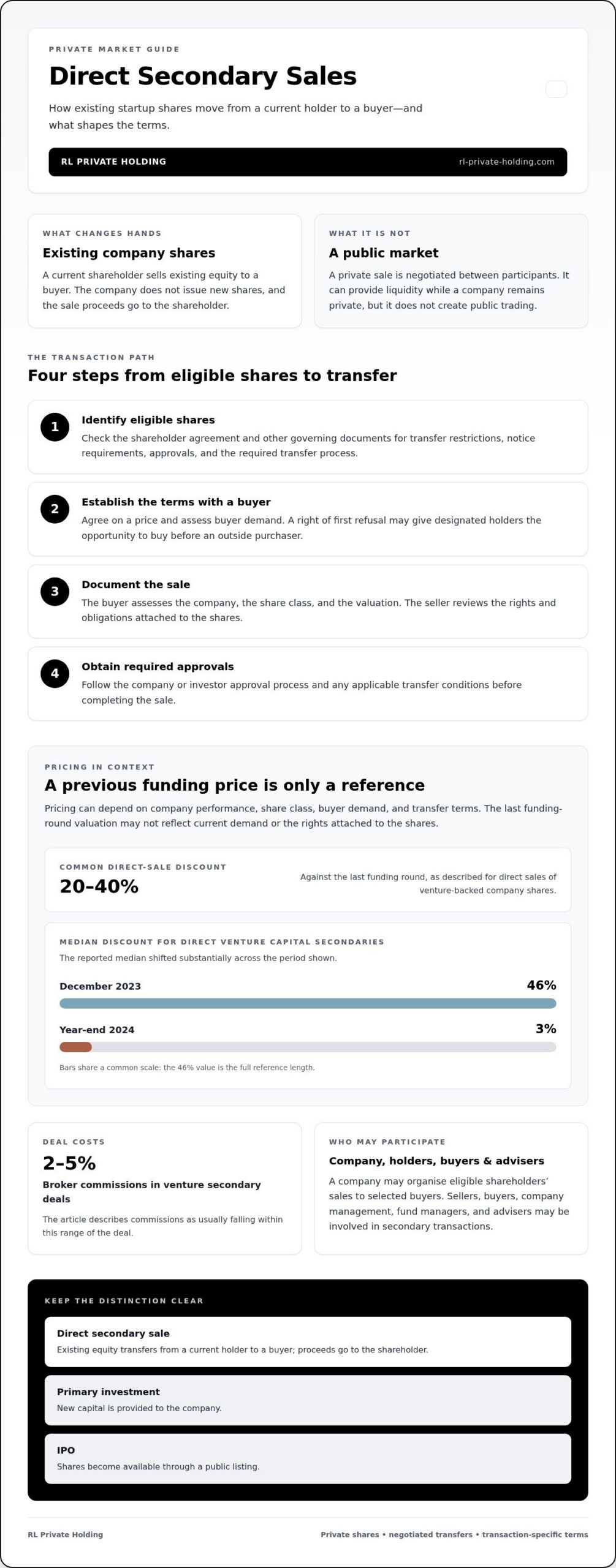
Broker commissions in venture secondary deals are usually 2 to 5% of the deal, while direct share sales commonly involve discounts of 20 to 40% against the last funding round. Minimum investment sizes depend on the transaction structure and buyer participation.
Liquidity Needs of Shareholders and Fund LPs
Liquidity needs arise when shareholders or limited partners want cash before a company exit or fund distributions. Employees may sell eligible shares, while LPs may reduce unfunded commitments, rebalance allocations or manage overcommitment. The considerations differ: a shareholder may focus on personal liquidity, while an LP weighs the wider portfolio and future obligations. A sale transfers exposure, not the underlying company’s operating risk.
Secondary Market Growth and Liquidity
Secondary activity gives existing investors a way to sell before an IPO or acquisition and can let companies provide liquidity while continuing to grow privately. However, that growth does not make every holding readily saleable. Buyers assess company prospects, share rights and transfer conditions before purchasing.
QSBS Rules and Early Investor Liquidity Timing
QSBS is a United States tax provision, not a Luxembourg tax category. The five-year holding period is one core condition for qualifying stock under the QSBS treatment described in the article. An early investor considering a sale must weigh that timing against liquidity needs. For Luxembourg residents, the tax treatment of a cross-border investment depends on their circumstances and the applicable rules for the asset and investor.
Liquidity and Risks in Venture Capital Exits
Venture investments typically take 3 to 12 years from first investment to exit, and an IPO may be delayed by 3 to 5 years beyond expectations. A secondary sale can bring forward liquidity, but buyers and sellers still face valuation uncertainty, transfer limits and the possibility of no acceptable offer. Investors should assess these factors alongside their funding needs and portfolio exposure. A considered investment strategy can help frame those trade-offs.
Direct secondary sales
A direct secondary sale transfers existing startup shares from a current holder to a buyer. Unlike a primary funding round, the company does not issue new equity, and the proceeds go to the shareholder. In a direct company secondary, a company may organise eligible shareholders’ sales to selected buyers. This can provide liquidity while the company remains private, but it does not create a public market.
Pricing depends on company performance, share class, buyer demand and transfer terms. Direct sales of venture-backed company shares commonly involve discounts of 20 to 40% against the last funding round. That reference price may not reflect current demand or the rights attached to the shares. Median discounts for direct venture capital secondaries fell from 46% in December 2023 to 3% by year-end 2024, illustrating how terms can shift with market conditions.
A sale generally involves identifying eligible shares, agreeing on a price, documenting the transfer and obtaining required company or investor approvals. Shareholders review their rights and obligations; buyers assess the company, share class and valuation. A company’s governing documents may give existing investors or the company the right to buy before an outside purchaser. A tender offer is another route: eligible holders receive an offer to sell at a set price, subject to its stated terms.
Direct sales can also use a special purpose vehicle (SPV) to aggregate buyers. In 2025, the median direct-secondary SPV raise involved nine LPs. This structure can pool participation, while adding a vehicle between investors and the company shares. Buyers should understand how the SPV holds equity, allocates distributions and handles future decisions. For sellers, the key distinction is whether they transfer shares directly or sell an interest in a vehicle. Tiger Global’s August 2023 sale of its remaining Flipkart shares implied a roughly 7% reduction from Flipkart’s last valuation, showing how negotiated secondary pricing can differ from a prior funding benchmark.
Private and public secondary markets
Private secondary markets trade existing interests in privately held companies, fund stakes and venture portfolios. Public secondary markets trade listed securities through established exchanges. This distinction affects how investors find buyers, assess value and complete a sale. Private transactions are negotiated, and company documents can restrict transfers; listed shares generally trade through public-market mechanisms.
Public technology valuations corrected in 2022, dampening venture secondary activity. Private capital secondary-market pricing rebounded sharply in 2024, while the overall secondary market grew by 40% from 2023 to 2024. These movements show why public-market prices can inform private valuations without determining them: private company shares differ in liquidity, rights and access to information.
Concentration is another feature to consider. Fifteen companies accounted for 61% of secondary trading value in 2024, and the top five represented 50.6% of volume in Q1 2025. These figures indicate that market-wide activity can be shaped by a limited number of large transactions. A broad market estimate therefore may not describe the trading conditions for a specific company or portfolio.
Pricing also varies by asset. Globally, LP portfolio pricing averaged 90% of net asset value in the first half of 2025. That figure concerns fund portfolios, not every private-company share. In Q1 2025, the average premium for venture secondary transactions was 6%, while the median premium was 3%. Investors should distinguish portfolio pricing from individual-company pricing when comparing opportunities.
For Luxembourg-based investors, the practical first step is to identify what the transaction transfers: listed shares, private-company equity, a fund interest or a portfolio. Each involves different access, information and transfer considerations. Private equity investment management can help frame how secondary holdings relate to broader portfolio objectives.
Assess your private and public portfolio exposure in light of the assets, liquidity needs and valuation criteria relevant to your investment strategy.
RL Private Holding: Venture Capital Funding
RL Private Holding offers Venture Capital Funding for businesses seeking investment to support their development. For investors assessing secondary transactions, this provides a related perspective: funding a company directly differs from purchasing existing shares from an investor. The distinction can help clarify whether the decision concerns new capital for a business or liquidity for a current shareholder.
RL Private Holding provides Private Equity Investment Management and Wealth Management Services. These services are relevant when considering how private investments fit into broader portfolio objectives. Investors weighing venture exposure alongside property can also consider Real Estate Asset Management as part of their investment picture.
To discuss Venture Capital Funding or explore RL Private Holding’s investment services, visit rl-private-holding.com.
Make the Next Investment Decision Deliberately
A secondary investment decision can prompt a broader review of how private assets fit your objectives, liquidity needs and tolerance for concentration. Consider the role you expect each holding to play, how long you can maintain it, and what might lead you to adjust your position. This framework can turn information about the secondary market for venture capital investments into a considered portfolio decision.
For Luxembourg investors, the next step may be to weigh a private-company opportunity against other investment priorities. RL Private Holding offers Venture Capital Funding, Private Equity Investment Management and Real Estate Asset Management. These offerings address distinct investment needs, from company funding to managing private equity and property assets.
To discuss your investment priorities with RL Private Holding, contact the firm. A clear view of your objectives is a constructive starting point for your next decision.
Frequently Asked Questions
How should you prepare for a secondary transaction?
Start by confirming exactly what you own and intend to sell. Gather share certificates or fund statements, ownership records, relevant agreements, and available company or portfolio information. Then clarify whether you want to sell all or part of the holding and set your decision criteria. If you are a Luxembourg-based investor, consider how the transaction fits your cross-border holdings and personal tax circumstances.
Why do companies and investors use the secondary market?
Companies may use secondary transactions to give employees or early shareholders a way to realise some value without issuing new shares. For example, an employee with substantial company equity may seek partial liquidity while retaining an ownership interest. Investors may also sell to change their portfolio exposure or address fund obligations. The motives differ: company-organised liquidity can support retention, while an investor-led sale may address allocation needs.
How are prices determined in the secondary market?
Buyers and sellers negotiate prices, taking into account company performance, available financial information, share-class rights and demand. A recent funding-round valuation can provide a reference point, but may not reflect current conditions or the terms of the shares being sold. Preferred and ordinary shares may carry different rights. Compare the proposed price with these factors rather than relying on a single headline valuation.
What are the Four Most Common Types of Secondaries?
Four common forms are direct sales of company shares, LP-led sales of fund interests, GP-led continuation transactions, and portfolio sales involving multiple fund interests or assets. In an LP-led sale, an investor transfers a fund stake to a new buyer. In a GP-led continuation, a fund manager offers a way to transfer selected assets into a new vehicle. The structures differ in who initiates the deal and what the buyer acquires.
What is the Secondaries Power Law?
The secondaries power law describes how investment outcomes can be concentrated in a small number of unusually successful assets, while other holdings contribute less. For buyers, a diversified portfolio does not guarantee exposure to the strongest performers, and a stake in a single company can carry concentrated risk. Review underlying holdings, company progress and ownership terms rather than assuming broad market growth will produce similar returns in every transaction.
When do Secondaries Occur?
Secondaries can occur at different stages in a company or fund’s life. A company may arrange a tender during a later funding stage, while an employee or early investor may seek a sale before a public listing or acquisition. Fund-interest transactions may arise when an LP wants to adjust a portfolio or a manager considers a continuation structure. Timing typically reflects liquidity needs, asset maturity and buyer interest.