

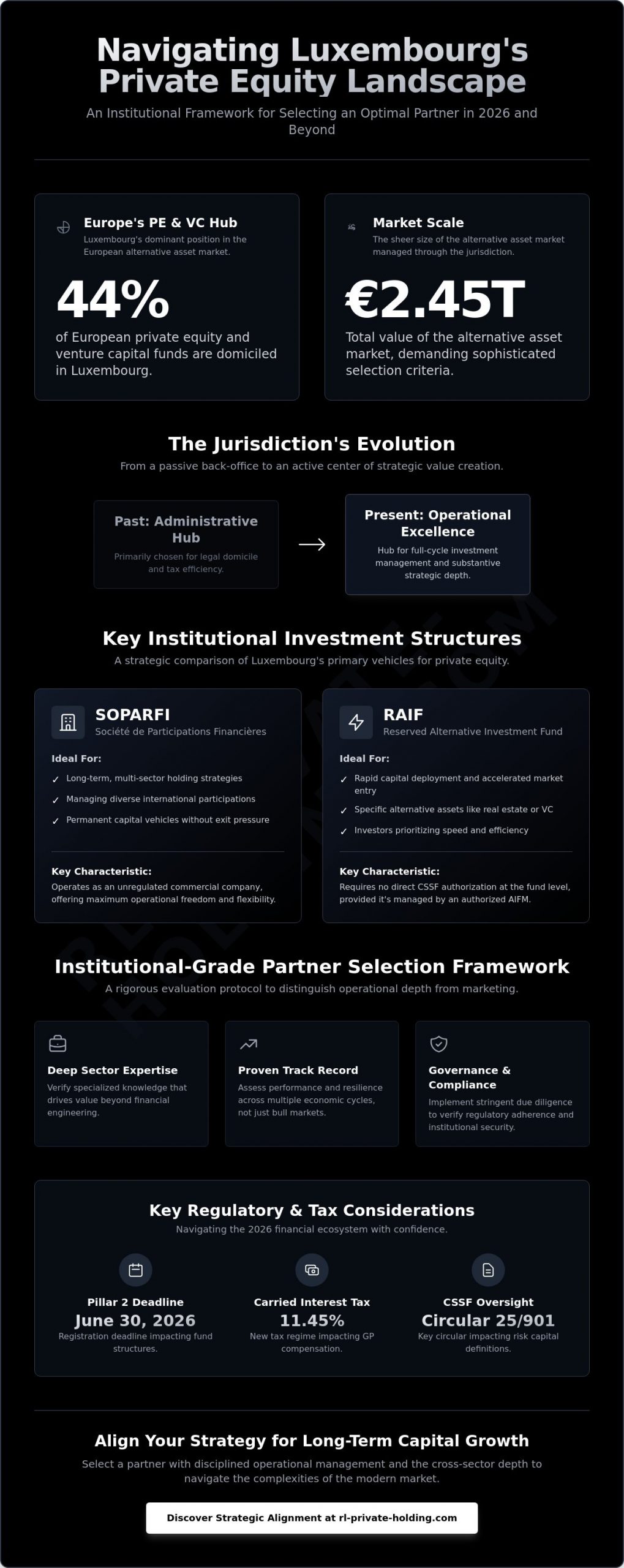
With 44% of European private equity and venture capital funds now domiciled in Luxembourg, the challenge for institutional allocators is no longer finding a partner, but distinguishing genuine operational depth from sophisticated marketing. You’ve likely found that the sheer scale of the €2.45 trillion alternative asset market makes selecting a high-performing private equity firm Luxembourg requires a level of scrutiny that traditional due diligence often misses. Between the June 30, 2026, Pillar 2 registration deadline and the complexities of the new 11.45% carried interest tax regime, the margin for error in fund selection has narrowed significantly.
This article provides an institutional-grade framework for evaluating and selecting the optimal partner within the current financial ecosystem. You’ll learn how to identify firms with specialized sector expertise that can ensure long-term capital preservation and growth. We’ll examine the impact of CSSF Circular 25/901 on risk capital definitions and provide a methodical approach to navigating the 2026 regulatory landscape with confidence.
Key Takeaways
- Analyze the transition of the Luxembourg jurisdiction from an administrative hub to a center of operational excellence, utilizing versatile structures such as SOPARFIs and RAIFs.
- Identify a private equity firm Luxembourg by applying a rigorous evaluation framework that prioritizes deep sector expertise and a proven track record across various economic cycles.
- Establish a comprehensive due diligence protocol that integrates stringent governance standards and verifies regulatory compliance to ensure institutional security.
- Evaluate the strategic benefits of an integrated holding company model for managing a diversified portfolio across venture capital, real estate, and private equity.
- Align institutional allocation strategies with partners who demonstrate long-term capital growth through disciplined operational management and cross-sector depth.
The Luxembourg Private Equity Ecosystem in 2026
Luxembourg has solidified its position as the primary global nexus for institutional capital. By 2026, the jurisdiction’s maturation is evident in its transition from a secondary administrative hub to a center of operational investment excellence. Identifying a reputable private equity firm Luxembourg involves assessing more than just the legal domicile. It requires an evaluation of the substantive presence and strategic depth of the management team. The local ecosystem now supports full-cycle investment management, from initial deal sourcing to active operational involvement in portfolio companies. This shift reflects a move toward substance over form, where the quality of the investment team is as critical as the tax efficiency of the structure itself.
Why Institutional Investors Prioritize Luxembourg
The political and economic stability of the Economy of Luxembourg remains a fundamental prerequisite for long-term private equity commitments. This stability is reinforced by a concentrated pool of specialized service providers and human capital dedicated to alternative assets. The efficiency of the AIFMD framework provides seamless passporting rights. It ensures that capital can be distributed globally with minimal friction. The Commission de Surveillance du Secteur Financier (CSSF) continues to play a pivotal role by maintaining rigorous oversight. This oversight upholds institutional trust and ensures that governance standards remain aligned with international expectations. Investors value this predictability when deploying capital into complex, multi-year strategies where regulatory certainty is paramount.
The Rise of Diversified Holding Structures
A significant market dynamic in 2026 is the increasing preference for diversified investment holding companies over traditional, fixed-life fund structures. These evergreen models offer a level of flexibility that rigid ten-year cycles can’t match. By utilizing a holding company structure, a private equity firm Luxembourg can manage multi-sector portfolios with a focus on long-term value creation. This approach avoids the pressure of artificial exit deadlines. It aligns the interests of the investment manager with those of the institutional allocator through permanent capital vehicles. These structures are particularly effective for managing assets across technology, real estate, and venture capital. They allow for a patient approach to capital appreciation that traditional funds often lack. This evolution reflects a broader market demand for stability and strategic longevity in asset management.
Evaluating Institutional-Grade Investment Structures
Selecting a private equity firm Luxembourg requires a precise understanding of the structural framework that governs capital deployment. The Luxembourgish legal landscape offers a variety of vehicles designed to meet specific institutional requirements, ranging from fully regulated funds to flexible holding companies. These structures are integral to Luxembourg’s Private Equity Ecosystem, providing the stability needed for cross-border investments. Choosing the correct vehicle is a strategic decision that affects tax transparency, treaty benefits, and the speed of market entry. Institutional allocators choosing a private equity firm Luxembourg must weigh these structural benefits against their specific risk profiles and liquidity needs.
SOPARFI vs. RAIF: A Strategic Comparison
The SOPARFI (Société de participations financières) and the RAIF (Reserved Alternative Investment Funds) represent two distinct approaches to asset management. A RAIF allows for accelerated market entry because it doesn’t require direct authorization from the CSSF at the fund level, provided it’s managed by an authorized Alternative Investment Fund Manager. This makes it suitable for investors who prioritize time-to-market for complex asset classes like real estate or venture capital. The SOPARFI structure serves as the cornerstone of Luxembourg holding companies by providing a robust framework for managing diverse international participations. While a RAIF operates under a specific regulatory regime, a SOPARFI functions as an unregulated commercial company, offering broader operational freedom for long-term equity holdings.
- SOPARFI: Ideal for long-term holding strategies and multi-sector participations.
- RAIF: Optimized for rapid deployment and specific alternative asset classes.
- SIF: Suitable for investors requiring direct regulatory oversight for specialized strategies.
The Strategic Advantage of Private Holding Companies
Institutional allocators are increasingly shifting toward private holding company models to escape the constraints of traditional closed-end fund lifecycles. This model reduces the friction often associated with capital calls by utilizing centralized treasury management. It allows for a more efficient reallocation of liquidity across a diversified portfolio without the need for constant fund-level distributions. Holding companies also provide enhanced discretion and bespoke governance, which are essential for high-stakes institutional partnerships. By establishing a stable Luxembourgish nexus, these entities facilitate seamless cross-border investments while maintaining high standards of tax transparency. Organizations seeking this level of structural sophistication often find that private equity investment management through a permanent capital vehicle offers superior alignment with their long-term growth objectives. This evergreen approach ensures that investment decisions are driven by value creation rather than artificial exit deadlines. It provides a methodical way to build a resilient portfolio across multiple economic cycles.
Key Criteria for Selecting a Private Equity Partner
The selection of a private equity firm Luxembourg must extend beyond a surface-level analysis of historical Internal Rate of Return (IRR). In a market where the Net Asset Value of alternative funds reached €2.45 trillion as of January 2026, the distinction between top-tier managers and the median performer is often found in their operational depth. A firm’s ability to navigate the complexities of the current fiscal environment, including the new 11.45% tax rate on contractual carried interest, is a critical indicator of its institutional maturity. Allocators should seek partners who maintain a substantial Luxembourg headquarters while managing a global operational footprint. This ensures that the firm isn’t just a legal entity, but a functioning center of investment excellence capable of managing the €1.702 billion average fund size seen in recent years.
Operational Expertise and Sector Specialization
Institutional partners should prioritize firms that demonstrate active value creation rather than relying solely on financial engineering. It’s essential to evaluate how a manager’s team utilizes “boots on the ground” to drive performance in specific sectors. For instance, a firm with integrated expertise in both venture capital funding and real estate asset management can often identify synergies that single-sector funds overlook. You should examine the investment team’s track record across multiple economic cycles to ensure their strategy remains resilient during periods of market volatility. The goal is to find a partner whose operational experience translates into tangible improvements at the portfolio company level, ensuring long-term capital growth.
Alignment of Interests and Fee Transparency
Transparency in fee structures is a non-negotiable requirement for institutional-grade allocations. You must look for a clear breakdown between management fees and performance-based incentives. It’s common to benchmark these against 2026 industry standards to ensure costs don’t erode net returns. “Skin in the game” remains the most reliable metric for alignment; therefore, the General Partner (GP) commitment should be a significant percentage of the total fund. Understanding the mechanics of hurdle rates and catch-up clauses is vital, particularly as the new tax regime for carried interest influences how incentives are structured. A disciplined private equity firm Luxembourg will provide a rigorous due diligence package that clarifies these points. This level of disclosure reflects a commitment to a professional, long-term partnership built on trust and objective performance metrics. By focusing on these criteria, allocators can secure a partner that prioritizes capital preservation and disciplined growth.
Due Diligence and Governance Standards
Establishing a rigorous due diligence protocol is essential when evaluating a private equity firm Luxembourg. By 2026, the complexity of the regulatory environment, characterized by the Pillar 2 registration deadline on June 30, demands a more granular assessment of a partner’s internal controls. Governance isn’t a secondary consideration; it is the bedrock of capital preservation. You must verify that the firm’s Anti-Money Laundering (AML) and Know Your Customer (KYC) frameworks exceed the minimum standards set by the CSSF. A robust internal risk management framework should demonstrate a clear path for identifying and mitigating operational risks before they impact the portfolio’s Net Asset Value. This methodical approach ensures that the firm’s internal discipline matches the gravity of institutional capital requirements.
The Institutional Due Diligence Checklist
A methodical review of a firm’s operational integrity begins with its financial history. You should analyze audited financial statements and AUM growth trajectories over a minimum five-year period to assess stability. Senior leadership stability is equally important. Succession planning must be documented to ensure that the firm’s strategic focus remains consistent through leadership transitions. Additionally, you’ll need to verify the credentials of all third-party service providers. This includes the reputation of the fund’s custodians, auditors, and legal counsel within the Luxembourg financial ecosystem. A reputable private equity firm Luxembourg will provide transparent access to these details during the evaluation process.
ESG Integration as a Fiduciary Duty
By 2026, Environmental, Social, and Governance (ESG) metrics are integrated directly into the fiduciary responsibilities of the investment manager. Luxembourg firms lead in SFDR compliance, moving beyond simple disclosures to active impact measurement. The 2026 budget’s increase in the carbon tax to €45 per tonne provides a concrete example of why ESG factors now influence long-term portfolio valuation. Governance protocols must also extend to the portfolio level. You should evaluate the firm’s approach to board-level representation in its holdings. This ensures that ESG standards are maintained across all business units. For allocators seeking a partner with established governance and a track record in private equity investment management, these standards provide a clear benchmark for institutional quality. This level of oversight is necessary to ensure that the investment strategy remains resilient against evolving global sustainability standards.
Strategic Alignment with RL Private Holding
RL Private Holding exemplifies the evolution of the private equity firm Luxembourg from a transactional entity to a disciplined investment holding company. The firm operates with a high degree of institutional gravity, focusing on long-term capital preservation and strategic growth. By maintaining a centralized base in Luxembourg, it leverages the jurisdiction’s stability to manage a global portfolio with precision. This model prioritizes structural integrity and transparent governance, ensuring that institutional allocators receive the clarity they require in a complex fiscal environment. It’s an approach that values stability and professional distance, providing a steady hand in the management of high-stakes investments.
A Diversified Approach to Capital Appreciation
The firm’s investment philosophy centers on a balanced allocation strategy that mitigates risk while capturing high-growth opportunities. RL Private Holding successfully integrates growth-oriented venture capital funding with stable, income-producing real estate asset management. This multi-sector approach allows for a resilient portfolio that can withstand market fluctuations across different economic cycles. The focus remains on long-term value creation rather than short-term gains, a principle that underpins its wealth management services. Institutional partners who value a methodical and disciplined approach to asset appreciation find this framework particularly effective for achieving their strategic objectives. It ensures that capital is deployed where it can achieve sustainable growth without unnecessary exposure to volatility.
The RL Private Holding Advantage
Sophisticated investors require more than standard fund structures; they need bespoke solutions that align with their specific risk profiles and governance standards. RL Private Holding provides this through its quiet authority and deep operational expertise in private equity investment management. The firm’s organizational framework is designed for transparency, with a clear focus on objective performance metrics and stable management fee structures. This disciplined global partner model ensures that every investment is backed by a steady hand and a clear plan for strategic focus. It’s a structure built for institutional permanence. For those seeking to align with a firm that embodies these principles, we invite you to Explore the RL Private Holding Portfolio. Institutional partnership inquiries are handled with the discretion and professionalism expected of an established presence in the global financial landscape.
Advancing Institutional Allocation Strategies for 2026
The 2026 financial landscape requires a decisive transition from traditional fund structures to more flexible, operationally focused investment models. Selecting the right private equity firm Luxembourg involves a rigorous evaluation of structural alignment, governance standards, and sector-specific depth. By prioritizing institutional-grade transparency and a diversified approach across technology and real estate, allocators can ensure long-term capital preservation in an increasingly complex regulatory environment. A disciplined approach to due diligence remains the most effective tool for identifying a partner capable of navigating these evolving market dynamics.
RL Private Holding offers a model of institutional permanence and global operational scale. The firm maintains a disciplined headquarters while managing a diversified portfolio with strict fee transparency and robust risk management. This framework supports sophisticated investors seeking a steady and worldly partner for high-stakes asset management. We invite you to Partner with RL Private Holding for Strategic Global Investments and secure a position within a resilient investment ecosystem built for the future. Establishing a partnership with a firm that values stability and professional distance is the first step toward achieving your strategic growth objectives.
Frequently Asked Questions
What makes Luxembourg the preferred jurisdiction for private equity firms?
Luxembourg is the premier choice for alternative assets because of its political stability and the robust regulatory framework provided by the CSSF. The jurisdiction domiciles 44% of European private equity funds and hosts 18 of the world’s 20 largest managers. This concentration of expertise ensures a deep pool of specialized service providers and human capital dedicated to global investment structures.
How are management fees typically structured in Luxembourg private equity?
Management fees are typically structured as a fixed annual percentage of committed capital combined with a performance-based carried interest component. As of January 2026, contractual carried interest is taxed at a reduced rate of 11.45% in Luxembourg. This fee model is designed to ensure transparency and align the long-term interests of the investment manager with those of the institutional allocator.
What is the difference between a private equity fund and an investment holding company?
A private equity fund typically operates with a fixed lifecycle and rigid exit deadlines, whereas an investment holding company functions as an evergreen vehicle. Holding companies provide superior flexibility for multi-sector portfolios and allow for centralized treasury management across various asset classes. This model is often preferred by a private equity firm Luxembourg seeking to prioritize long-term value creation over artificial fund timelines.
What regulatory oversight applies to private equity firms in Luxembourg?
The Commission de Surveillance du Secteur Financier (CSSF) provides the primary regulatory oversight for all financial entities. Recent updates, such as CSSF Circular 25/901 effective December 2025, have modernized the rules for SIFs and SICARs by clarifying risk capital definitions. Additionally, entities falling within the scope of Pillar 2 rules must complete their mandatory registration by the June 30, 2026, deadline.
How does a SOPARFI structure benefit institutional investors?
The SOPARFI structure offers institutional investors a versatile vehicle for managing international participations within a stable and predictable legal framework. It facilitates efficient cross-border investments and provides access to an extensive network of double tax treaties. This vehicle is a cornerstone for firms focused on private equity investment management and the consolidation of diverse global holdings.
What role does venture capital play in a diversified Luxembourgish portfolio?
Venture capital funding provides a high-growth component that balances more stable assets such as real estate. In the 2026 tax year, new credits for startup investments have further incentivized capital allocation toward early-stage companies with fewer than 50 staff. A well-constructed portfolio uses these growth-stage assets to drive overall capital appreciation alongside comprehensive wealth management services.
How can investors verify the track record of a Luxembourg private equity firm?
Investors verify a firm’s track record by reviewing audited financial statements and assessing performance across multiple economic cycles. It’s essential to examine the Net Asset Value (NAV) growth trajectories and the stability of the senior leadership team. A reputable private equity firm Luxembourg will provide a comprehensive due diligence package that includes third-party verification from recognized auditors and legal counsel.
What are the current ESG reporting requirements for Luxembourg investment firms in 2026?
ESG reporting requirements are governed by the Sustainable Finance Disclosure Regulation (SFDR) and local fiscal policies. The 2026 budget includes a carbon tax of €45 per tonne, which serves as a concrete metric for assessing environmental risk in portfolio valuations. Investment firms are now required to integrate these ESG factors into their fiduciary duties to ensure long-term resilience against evolving global sustainability standards.