

A higher target return does not necessarily indicate a better investment fit. In value-add vs opportunistic real estate investing, the distinction lies less in the label than in the work required to execute the business plan, the risks that could disrupt it, and the investor’s ability to respond. For investors in Luxembourg and beyond, those differences can shape how a real estate allocation complements a wider portfolio.
Value-add investments generally involve improving a property, while opportunistic investments often carry greater uncertainty. But broad categories can conceal very different plans, from lease-up and refurbishment to redevelopment or a change in use. Return expectations become more useful when considered alongside their drivers, including execution demands, financing assumptions, market exposure, and the time required to realise value.
This comparison explains how the strategies differ in business plan, risk, and operational intensity, then considers how each may align with portfolio objectives, risk capacity, and investment horizon. It also highlights the assumptions and due diligence questions that matter before committing capital. A disciplined real estate asset management approach can help investors assess a specific opportunity rather than rely on strategy labels or market stereotypes.
Key Takeaways
- In value-add vs opportunistic real estate investing, assess the actual business plan and execution burden rather than relying on the strategy label.
- Distinguish property-level challenges from financing, leasing, delivery, and market risks to understand what could impair the investment thesis.
- Compare each strategy with your investment horizon, liquidity needs, capacity to absorb losses, and available oversight resources.
- Test the link between purchase assumptions, operating milestones, capital requirements, and the intended exit before committing capital.
- Translate the chosen strategy into clear monitoring priorities, accountable execution, and timely decisions about capital and exit readiness.
Value-Add vs. Opportunistic Real Estate Investing: What the Labels Mean
The distinction in value-add vs opportunistic real estate investing is best understood through the work required to create value, not through the strategy name alone. These labels describe broad positions on a real estate risk spectrum. They help investors organise their analysis, but they don’t specify an asset’s condition, the exact business plan, or the likelihood of achieving its objectives. A foundational overview of real estate investing strategies places value-add and opportunistic approaches among categories commonly associated with different levels of financial risk.
Value-add plans generally focus on improving an existing asset; opportunistic plans usually depend on more extensive transformation and carry greater uncertainty around execution. This is a distinction in business-plan intensity, not a guarantee that one investment will be safer or perform better than another.
What makes a real estate investment value-add?
A value-add investment seeks to improve an asset’s performance through identifiable changes. The plan might include renovating outdated units, upgrading shared areas, improving leasing processes, repositioning a property for a different tenant profile, or refining day-to-day operations. These measures are intended to strengthen the property’s appeal, use, or income generation.
The investment thesis should connect each proposed change to a specific operating objective. For example, an owner might plan to renovate vacant apartments and improve leasing to attract tenants at rents supported by demand in that market. That plan depends on completing the work, controlling costs, and securing tenants. The renovation itself does not establish that net operating income or property value will rise.
Improvement potential is a hypothesis to test, not an assured outcome. Investors need to distinguish the asset’s current condition from the performance assumed in forecasts. That includes testing whether it can be repositioned as planned and whether demand will support the intended result.
What makes an investment opportunistic?
Opportunistic plans typically involve a more substantial change to an asset or its use. Examples include ground-up development, major redevelopment, acquiring a distressed property that requires extensive intervention, or undertaking a complex repositioning. The plan may depend on several linked steps before the property can generate the intended income or reach its planned exit condition.
This can make execution and market conditions especially consequential. Delays, construction challenges, changes in financing conditions, slower leasing, or weaker demand may affect both the capital required and the time needed to deliver the business plan. These are potential risk drivers, not inevitable outcomes. Their relevance depends on the specific asset, project structure, and assumptions.
Opportunistic is not a uniform description. A distressed acquisition with a defined repair plan differs materially from a development that depends on approvals, construction, and future leasing. Assess the sequence of work, dependencies, and downside if milestones are missed. The label provides a starting point; disciplined asset-level analysis determines what the investment actually entails.
How Business Plans and Risk Drivers Differ Between the Strategies
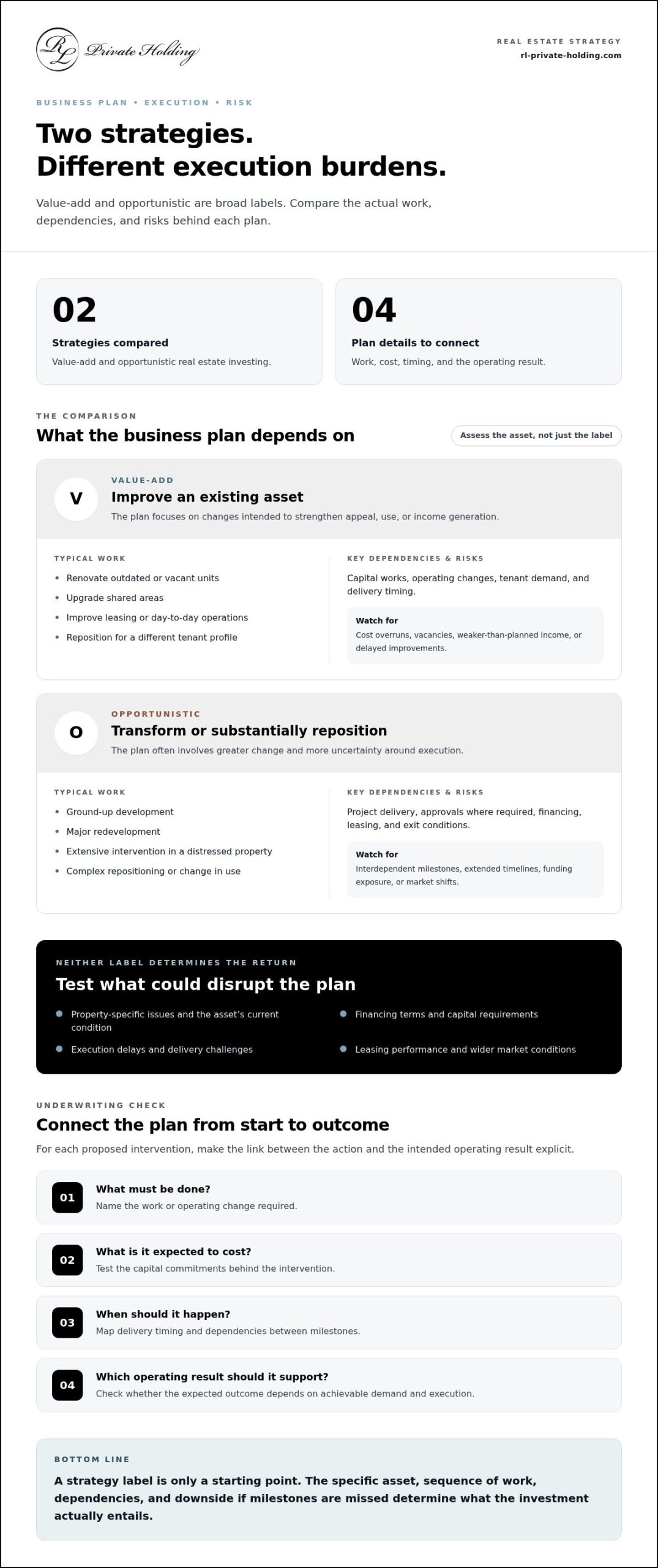
The practical difference between value-add and opportunistic real estate investing becomes clearer when each deal is examined as a sequence of costs, actions, and operating outcomes. Asset condition matters, but so do the scale of intervention, capital commitments, operating changes, and time needed to carry out the plan. A value-add business plan may involve a defined programme of improvements to an existing property. An opportunistic plan may depend on development, extensive redevelopment, or resolving multiple constraints before the asset can operate as intended.
Neither label determines the return. Results depend on underwriting assumptions and what is ultimately achieved. A forecast can be affected by property-specific issues, financing terms, execution delays, leasing performance, and wider market conditions. The comparison below identifies common distinctions, not fixed rules for every investment.
| Strategy | Typical plan | Main dependencies | Principal risks |
|---|---|---|---|
| Value-add | Improve an existing asset’s condition, leasing, or operations. | Capital works, operating changes, tenant demand, and delivery timing. | Cost overruns, vacancies, weaker-than-planned income, or delayed improvements. |
| Opportunistic | Develop, substantially redevelop, or reposition an asset with complex constraints. | Project delivery, approvals where required, financing, leasing, and exit conditions. | More interdependent milestones, extended timelines, funding exposure, and market shifts. |
Compare the investment plan, not just the risk label
For each proposed intervention, connect four items: what must be done, what it is expected to cost, when it should happen, and which operating result it is intended to support. Then map the dependencies. A plan to improve leasing, for instance, may rely on completing tenant improvements before a vacancy period extends or a target tenant becomes unavailable. A development plan may depend on approvals, construction progress, and future occupier demand.
Even a limited-sounding programme can carry material execution risk if its success depends on several steps happening in sequence. Review the schedule and funding needs against those dependencies rather than assuming that a smaller scope means straightforward delivery.
Trace the downside from assumptions to outcomes
Test how the investment responds if rental income is lower than forecast, completion is delayed, operating costs rise, or leasing takes longer. Consider each scenario separately and in combination, then identify which assumptions most affect cash flow and the intended exit. This helps reveal whether the plan has room to absorb setbacks or depends on ideal execution.
Leverage can magnify the effect of changes in income or asset value on the investor’s equity. Execution uncertainty and financing exposure compound downside risk when delays or weaker performance reduce cash flow while obligations remain.
Disciplined oversight connects these assumptions to capital decisions and operating milestones. Investors considering this connection can explore real estate asset management as part of a broader portfolio perspective.
Which Real Estate Strategy Fits Your Portfolio and Risk Capacity?
Strategy selection is a portfolio decision, not a ranking of investment labels. In value-add vs opportunistic real estate investing, the relevant question is whether the plan’s duration, potential capital demands, and execution risks fit the investor’s objectives and capacity. A strategy may appear attractive in isolation yet be unsuitable if it creates excessive concentration, ties up capital beyond the intended horizon, or requires oversight resources the investor cannot provide.
When value-add characteristics may align with portfolio needs
Value-add characteristics may suit investors who can assess a defined programme of asset-level changes and accept uncertainty around delivery and operating performance. The fit depends on more than the improvement plan: investors should consider whether they can monitor milestones through the holding period, respond to delays, and tolerate income that differs from expectations. Targeted improvements don’t make an investment inherently low risk or assure a particular outcome.
When opportunistic characteristics may demand greater capacity
Opportunistic plans may require capacity to absorb uncertainty across development or repositioning, financing, delivery, and market timing. Investors should consider whether they can bear a longer or less predictable path to realisation, and whether specialist oversight and continued access to capital are available if the plan changes. Concentrating too much portfolio exposure in one complex project can increase the effect of setbacks on overall objectives.
Before comparing opportunities, assess the portfolio across several dimensions:
- Investment horizon: Does the expected holding period align with when capital may be needed?
- Liquidity needs: Can the portfolio accommodate capital committed to an asset that may not be readily sold?
- Loss-bearing capacity: Could a weaker-than-planned outcome be absorbed without compromising broader financial objectives?
- Concentration: How much exposure would the investment add to a property type, market, or business plan already represented in the portfolio?
- Oversight resources: Is there sufficient capacity to monitor performance and respond to execution issues?
These considerations don’t produce a universal answer. The same strategy can have different implications depending on the specific asset and its place in a portfolio. A balanced assessment weighs potential advantages against corresponding constraints:
| Strategy | Potential portfolio advantages | Considerations and trade-offs |
|---|---|---|
| Value-add | A defined improvement plan may give investors identifiable milestones to monitor. | Progress and performance depend on delivery, leasing, operating changes, and market demand. |
| Opportunistic | A substantial transformation may provide a distinct route to changing an asset’s use or position. | Interdependent execution steps can require greater oversight, capital flexibility, and tolerance for uncertainty. |
For investors assessing opportunities in Luxembourg, portfolio fit also depends on how property-level oversight connects to wider investment objectives. This broader perspective is part of Real Estate Asset Management in the Luxembourg Market, where disciplined management links strategy with asset performance and portfolio considerations.
A Due Diligence Framework for Comparing Value-Add and Opportunistic Deals
Consistent due diligence makes value-add and opportunistic opportunities easier to compare on their actual assumptions rather than their labels. The central test is whether the purchase rationale connects to a deliverable operating plan and a credible exit. Use the same sequence for each opportunity, adapting the detail to the asset and the complexity of its business plan.
- Define the plan. Specify the work, operating changes, and intended outcome. Separate actions within the investment team’s control from dependencies such as approvals, contractors, tenant demand, or a sale.
- Test the assumptions. Review rental income, occupancy, capital expenditure, completion timing, and exit assumptions individually. Check that projected net operating income improvements follow from identified changes, rather than unsupported expectations.
- Assess the capital structure. Understand leverage, financing terms, refinancing exposure, capital-call provisions, and liquidity constraints. Consider how funding needs could change if costs rise or the schedule extends.
- Model downside. Compare base, downside, and delayed-execution cases. Apply consistent assumptions across opportunities so that differences reflect the plans and risks, not different modelling approaches.
- Review governance. Establish who makes key decisions, what reporting is expected, and how issues are escalated. Link oversight to the milestones that could change the investment thesis.
Test underwriting assumptions and milestones
For each forecast, ask what evidence supports it and what must happen for it to hold. Rental assumptions should align with the asset and leasing plan; occupancy should reflect the time needed to attract tenants; and capital expenditure should correspond to the specified work. For a projected income improvement, identify the operational change expected to produce it and when that result should become measurable.
Define decision points in advance. A missed completion milestone, weaker leasing progress, or rising costs may warrant revised forecasts or a change in execution. Recording the trigger, responsible decision-maker, and potential response makes assumptions testable throughout the holding period.
Assess financing, governance, and exit dependencies
Financing can shape how much time and flexibility a project has to deliver. Review when debt may mature, whether refinancing is assumed, and how additional capital would be handled. Then examine governance: decision rights, reporting cadence, and escalation processes should be clear enough to support timely responses when actual performance diverges from plan. Portfolio governance is also relevant to Private Equity Investment Management.
Finally, test the exit rationale under weaker market conditions and a delayed timetable. If the planned sale depends on specific operating milestones or buyer demand, consider what happens if either arrives later than forecast. The comparison in value-add vs opportunistic real estate investing is more meaningful when both opportunities are tested against the same downside and timing assumptions.
For a disciplined approach to investment oversight, explore RL Private Holding’s investment management perspective.
How Real Estate Asset Management Connects Strategy to Execution
A strategy label has limited value unless it informs decisions after an investment is made. Asset management translates the original thesis into operating priorities, assigned responsibilities, and review points. Whether a plan involves targeted improvements or a more extensive transformation, the focus is on whether the asset is progressing as intended and whether new information warrants a change in course.
This connection is central to value-add vs opportunistic real estate investing. The classification can help determine what to monitor, but it cannot replace ongoing assessment of milestones, operating performance, capital requirements, and exit readiness. A disciplined approach helps identify deviations and consider their implications for the asset and wider portfolio, without assuming that monitoring itself guarantees a particular result.
Turn the chosen strategy into an operating plan
Start with the investment thesis and translate it into measurable asset-level milestones. For a plan that includes renovations and leasing improvements, milestones might cover work completion, units made available, leasing progress, and changes in operating performance. A more complex transformation may require additional checkpoints tied to delivery stages and other critical dependencies. Each measure should relate directly to the intended outcome.
Consistent reporting can show whether actual leasing, costs, delivery timing, and operating assumptions remain aligned with the plan. It should also distinguish a temporary variance from a change that may weaken the thesis. If a milestone is missed, management can assess the cause, consider the effect on capital needs and timing, and decide whether to maintain or revise the plan. This creates a clear basis for decisions without promising results.
Consider strategy fit within a wider investment portfolio
Asset-level progress is only part of the assessment. Investors should view real estate exposure alongside liquidity needs, concentration, and other portfolio commitments. A property may be tracking its business plan yet still represent a greater share of portfolio risk than intended, or require capital when other commitments are competing for resources. Monitoring across the investment lifecycle helps connect asset performance with these broader considerations.
For investors considering wealth and investment decisions across a family office, Family Office Investment Strategies in Luxembourg provides related portfolio-level context. The relevance of that perspective is not limited to choosing between strategy labels. It also concerns how real estate commitments interact with other assets and long-term objectives.
RL Private Holding is headquartered in Luxembourg and manages a diversified global portfolio that includes real estate. The company provides real estate asset management, connecting this discussion to the practical importance of disciplined oversight while keeping individual investment decisions grounded in their own plans and portfolio context. Investors seeking a broader view of the firm’s approach can explore RL Private Holding.
Make Your Next Real Estate Decision More Deliberate
Turn your investment criteria into a practical review discipline. Before evaluating another opportunity, define the level of uncertainty your portfolio can accommodate, the oversight it can sustain, and the conditions that would prompt a change in direction. This gives future decisions a consistent reference point, even as individual assets and business plans differ.
The distinction in value-add vs opportunistic real estate investing matters most when it informs how capital is assessed and monitored over time. A clear investment framework can keep the original rationale connected to portfolio priorities while leaving room to respond thoughtfully when assumptions change.
RL Private Holding brings an investment-management perspective informed by real estate, asset management, and a diversified portfolio operating across global markets. Explore RL Private Holding to learn more about its approach to investment management.
Frequently Asked Questions
Is value-add real estate investing always lower risk than opportunistic investing?
No. A value-add label doesn’t ensure lower risk than an opportunistic one. A renovation plan can face substantial exposure if the property has hidden defects, tenant demand is uncertain, or the investment relies on borrowing. Compare the specific asset, execution steps, financing, and downside scenarios. For example, a focused improvement plan with uncertain leasing may carry more practical risk than a well-defined, carefully funded redevelopment.
Can a real estate investment combine value-add and opportunistic characteristics?
Yes. Strategies can overlap because classification depends on the full business plan, not a single feature. An existing building might need extensive redevelopment and a new operating model, combining asset improvements with more complex transformation. Describe the opportunity by its actual scope, dependencies, and uncertainties. For analysis, identify which parts resemble targeted operational improvement and which depend on major execution steps, then assess each risk separately.
How much does leverage affect the difference between these strategies?
Leverage can materially change an investment’s exposure, regardless of its label. Debt obligations remain even if leasing is slower or operating income falls, while a decline in asset value can have a larger effect on the investor’s equity. Compare debt maturity and refinancing assumptions against the business-plan timetable. A useful test is whether the investment can withstand a delay without relying on improved market conditions or new capital.
What happens if a value-add business plan misses its milestones?
A missed milestone should prompt a review of the cause and its effect on the investment thesis, not an automatic decision to continue or exit. If renovations finish late, for example, leasing and income targets may also need adjustment. Reforecast costs, cash flow, and timing; assess available capital and contractual constraints; then document who can approve a revised plan. Predefined decision thresholds help make responses consistent.
Do opportunistic real estate investments always involve development?
No. Development is one possible opportunistic approach, but it isn’t a requirement. An investment may also involve a distressed asset, substantial redevelopment, or a complex repositioning of an existing property. The defining consideration is the plan’s transformation and execution demands, not whether new buildings are constructed. Review the work required to achieve the intended operating position and what could prevent each critical step from being completed.
Which documents help compare value-add and opportunistic real estate opportunities?
Useful materials include the investment memorandum, current rent roll, historical operating statements, property-condition information, capital-expenditure schedule, development or renovation timeline, financing terms, and financial model. Review governance or investment documents for decision rights, reporting, and additional-capital provisions. Compare base, downside, and delayed cases using consistent assumptions. The documents should let you trace how purchase assumptions lead to operating milestones and, ultimately, the proposed exit rationale.