

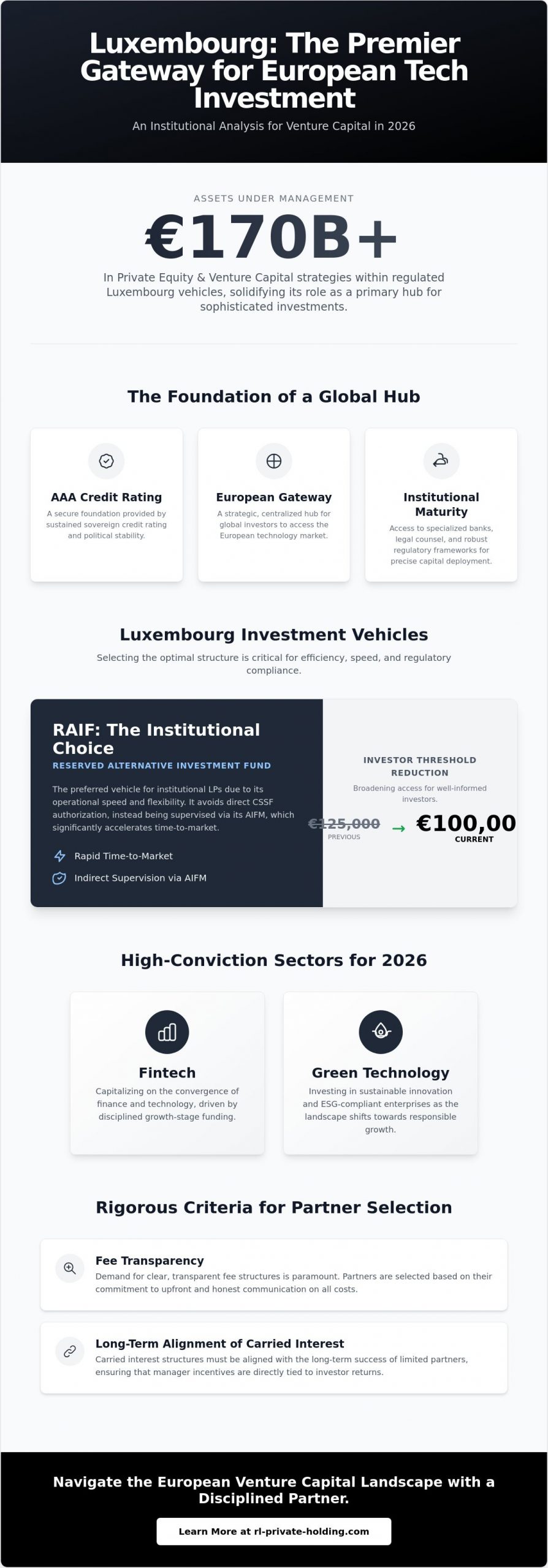
While global markets face volatility, Luxembourg alternative managers now oversee more than €170 billion in private equity and venture capital strategies within regulated vehicles. It’s a figure that underscores the jurisdiction’s role as the primary gateway for sophisticated technology investments in Europe. Many institutional allocators recognize that a successful venture capital Luxembourg strategy requires more than just capital; it demands a precise understanding of the country’s unique legal frameworks and its evolving tax environment.
You likely understand that managing cross-border regulatory complexity is the greatest challenge to achieving structural efficiency and tax transparency in the current market. This article offers a comprehensive institutional analysis of the Luxembourg ecosystem, detailing the structural advantages and strategic allocation methodologies necessary for growth in 2026. We examine the transition to the modernized carried interest tax regime, the benefits of the reduced €100,000 well-informed investor threshold, and the essential criteria for selecting a disciplined investment management partner.
Key Takeaways
- Analyze the institutional evolution of Luxembourg from a traditional fund center to a premier global technology destination supported by its sovereign credit rating.
- Evaluate the structural distinctions between the RAIF and the SICAR to select the most efficient vehicle for venture capital Luxembourg initiatives.
- Gain insight into the high-conviction sectors of 2026, including Fintech and Green Technology, as the landscape shifts toward disciplined growth-stage capital.
- Establish rigorous criteria for selecting management partners by focusing on fee transparency and the long-term alignment of carried interest structures.
- Understand the strategic advantages of a diversified holding company model in maintaining stability across technology and real estate asset classes.
The Evolution of Luxembourg as a Global Venture Capital Hub
Luxembourg has long been recognized as a central pillar of the European financial system. Its transition from a traditional UCITS fund center to a premier technology venture capital destination reflects a broader maturation of the local market. The Economy of Luxembourg is characterized by a sustained AAA credit rating and political stability, which provides a secure foundation for long-term institutional capital. As of 2026, the jurisdiction has successfully integrated with the global technology landscape, moving beyond early-stage speculation toward disciplined growth-stage investments.
Current market dynamics show a distinct convergence between private equity and venture capital Luxembourg strategies. Institutional portfolios now prioritize structural efficiency and tax transparency, especially with the 20% income tax credit for private individuals investing in eligible startups that became effective this year. This shift toward growth-stage technology is supported by a sophisticated ecosystem that understands the nuances of cross-border European investments. Investors are increasingly seeking disciplined partners who can navigate these complexities with a sober, factual approach. The integration with the broader European venture ecosystem hasn’t compromised the country’s global distribution capabilities. Instead, it’s strengthened them. By maintaining high-level financial and corporate standards, the jurisdiction attracts a diverse range of global capital seeking exposure to European innovation.
Institutional Gravity and Market Maturity
High-stakes operations require a level of infrastructure that few jurisdictions can match. The Luxembourg ecosystem provides access to specialized depositary banks and legal counsel experienced in alternative assets. In 2026, the focus remains on sustaining growth through robust regulatory frameworks and technological adaptation. This maturity ensures that capital is deployed with precision, adhering to the high formality and objective standards expected by global partners. The presence of these specialized service providers creates a sense of reliability and transparency for a venture capital Luxembourg management structure. It’s an environment where institutional gravity dictates the pace of progress.
The Cross-Border Advantage
The European passporting system remains a primary driver for distribution. Luxembourg acts as a strategic gateway for global investors entering the European technology market, offering a centralized hub for managing diverse geographic exposure. By utilizing established vehicles like the RAIF, managers can achieve a faster time-to-market while maintaining full compliance with the AIFMD II reform. This positioning is vital for institutional portfolios seeking to exploit the European landscape’s structural benefits without the friction often associated with fragmented markets. It’s a methodical approach to global investment structures that prioritizes clarity and structural integrity over marketing hyperbole.
Structural Advantages of Luxembourg Venture Capital Vehicles
The selection of an appropriate investment vehicle is a fundamental component of any venture capital Luxembourg strategy. While the jurisdiction is renowned for its diverse fund structures, the choice between them depends on the specific requirements for speed, regulatory oversight, and target asset classes. The Reserved Alternative Investment Fund (RAIF) and the Investment Company in Risk Capital (SICAR) represent the primary regulated options, while the Société de Participations Financières (SOPARFI) serves as the standard for unregulated holding companies.
The RAIF: Speed and Flexibility for Institutional LPs
The RAIF has become the preferred vehicle for institutional limited partners due to its operational flexibility. It doesn’t require direct authorization from the Commission de Surveillance du Secteur Financier (CSSF) for the fund itself, which significantly reduces the time-to-market. Instead, the fund is supervised through its appointed external Alternative Investment Fund Manager (AIFM). This indirect supervision maintains high institutional standards while allowing managers to deploy capital rapidly. Since the implementation of Act No. 8183, the minimum investment to qualify as a well-informed investor has been reduced from €125,000 to €100,000. This change has effectively broadened the pool of eligible participants for specialized investment funds.
SOPARFI: The Disciplined Holding Company Approach
A SOPARFI is a fully taxable commercial company that functions as a disciplined vehicle for direct technology and real estate asset management. It’s particularly effective for venture capital Luxembourg operations where the manager seeks to utilize the participation exemption regime. This regime provides a full exemption from corporate income tax on dividends and capital gains, provided the holding represents at least 10% of the share capital or has an acquisition cost of at least €1.2 million for dividends and €6 million for capital gains. For entities focused on long-term structural efficiency, understanding the Strategic Benefits of a Luxembourg SOPARFI Structure is essential. You might consider how these vehicles integrate with your broader wealth management services to ensure a well-ordered asset hierarchy.
The SICAR offers a specialized alternative for those focused exclusively on risk capital. Unlike other vehicles, the SICAR isn’t subject to risk-spreading requirements, allowing for highly concentrated portfolios in growth-stage technology. According to Luxembourg Venture Capital research, the ability to select from these varied structures provides the legal certainty required by global investors. Tax efficiency is further enhanced by Luxembourg’s network of over 80 double tax treaties, which optimize dividend distributions and protect against double taxation. This methodical approach to structuring ensures that the underlying principles of the investment remain transparent and secure.
Growth-Stage Technology Investments: The 2026 Landscape
By 2026, the venture capital Luxembourg ecosystem has moved toward a more methodical deployment of capital. The period of early-stage speculation has largely been replaced by a focus on growth-stage disciplined investment. This transition is a direct response to a mature interest rate environment where valuation methodologies emphasize fundamental performance over speculative potential. Institutional allocators now prioritize companies that demonstrate resilient unit economics and sustainable revenue growth, as these are the primary drivers of value at exit in the current market cycle.
Identifying high-conviction sectors requires a sober analysis of the European landscape. Fintech, SaaS, and Green Technology remain the primary areas of interest for institutional portfolios. While AI-driven entities continue to attract a significant portion of available funding, often at premium valuations, the broader market focuses on practical application and scalability. Balancing this innovation with institutional risk parameters is a core competency for any modern investment management partner. The 2026 fiscal landscape also introduces new variables, such as the 20% income tax credit for private individuals investing in eligible startups and an increase in pension contribution rates to 25.5%. These factors influence how managers evaluate the long-term operational costs and exit potential of their portfolio companies.
Technology Sector Specialization
Portfolio management in 2026 demands deep sector-specific expertise. It’s no longer sufficient to maintain a broad exposure to technology; managers must understand the underlying structural drivers of each vertical. Evaluating the scalability of European technology firms involves assessing their ability to penetrate global markets while navigating local regulatory nuances. You’ll find that The Role of Venture Capital in Growth-Stage Technology provides the necessary framework for understanding these sector-specific dynamics and how they relate to institutional growth.
Risk Mitigation in Technology Portfolios
Sophisticated investors utilize diversification strategies across different stages of the technology lifecycle to manage volatility. Secondary markets have transitioned into a mainstream liquidity option, providing a vital mechanism for portfolio rebalancing. The strategic exercise of pro-rata rights and the provision of follow-on funding are essential for protecting equity stakes and maintaining long-term value. Growth-stage technology in 2026 is defined as the investment phase focusing on companies with verified revenue models and established market presence that require capital to expand within a stabilized economic environment. This disciplined approach ensures that venture capital Luxembourg strategies remain resilient against broader market fluctuations.
Strategic Considerations for Venture Capital Allocation
Allocation of capital within the Luxembourg ecosystem requires a framework that prioritizes long-term stability and structural transparency. While traditional metrics such as Internal Rate of Return (IRR) and Total Value to Paid-In (TVPI) remain relevant, institutional investors in 2026 place greater emphasis on Distributed to Paid-In (DPI) ratios. This focus on realized liquidity reflects a broader market shift toward disciplined growth and exit execution. Effective venture capital Luxembourg allocation strategies must also integrate these high-growth assets with more stable holdings, such as real estate asset management or private equity, to mitigate the inherent volatility of the technology sector.
Due diligence protocols for institutional investors have become increasingly rigorous. You’ll find that evaluating a management partner involves a deep analysis of their operational infrastructure and their ability to navigate the AIFMD II regulatory environment. A well-ordered portfolio doesn’t just seek high returns; it seeks a structural alignment that protects capital during market contractions. This alignment is often achieved through a diversified holding company model that balances technology innovation with the tangible security of traditional asset classes.
Evaluating Management Fees and Incentives
Fee transparency is a cornerstone of institutional trust. In 2026, the modernized tax regime for carried interest distinguishes between contractual and equity-linked structures, influencing how performance-based incentives are taxed and distributed. It’s essential that the “hurdle rate” remains high enough to ensure the manager’s interests are strictly aligned with the investor’s long-term outcomes. For a detailed analysis of how these mechanisms function in a professional context, you may review our guide on Understanding Private Equity Fee & Incentive Structures. This methodical approach to compensation ensures that management remains focused on sustainable value creation rather than short-term gains.
The Importance of Disciplined Governance
Assessing the operational infrastructure of a venture capital holding company is a critical step in the due diligence process. The Board of Directors plays a central role in strategic oversight, providing the “steady hand” necessary for risk management in a global financial landscape. Institutional-grade allocation requires a checklist that covers everything from anti-money laundering (AML) compliance to the robustness of the external AIFM’s reporting systems. We invite you to evaluate our private equity investment management capabilities to understand how disciplined governance supports global portfolio growth. By maintaining high formality and professional distance, a management partner can ensure that strategic decisions are made with objective precision.
RL Private Holding: A Disciplined Approach to Venture Capital
RL Private Holding operates as a global investment holding company from its established base in Luxembourg. This strategic position allows for a disciplined approach to capital deployment that prioritizes structural permanence and long-term focus. Unlike traditional advisory firms, we function as a principal investor, managing a diversified portfolio that integrates venture capital Luxembourg strategies with private equity and real estate asset management. Our privately held structure ensures that strategic decisions remain insulated from short-term market volatility, allowing for a composed and objective perspective on value creation across the global financial landscape.
Partnering with institutional and private investors requires a level of professionalism and institutional gravity that we consistently maintain. We act as a steady hand in the background of major investments, focusing on the structural integrity of each deal rather than following speculative market trends. This philosophy of “quiet authority” has established RL Private Holding as a reliable global partner for those who value stability and professional distance in their investment management. By leveraging our sovereign-rated domicile, we provide a secure environment for sophisticated capital deployment in an increasingly complex European market.
Our Investment Methodology
The methodology at RL Private Holding focuses on identifying and scaling growth-stage technology businesses that have demonstrated verified revenue models. We apply the same level of rigor to technology ventures as we do to our real estate holdings, ensuring that every asset is evaluated within a well-ordered asset hierarchy. This integration of wealth management principles into the investment lifecycle ensures that capital is not merely deployed but managed with a focus on long-term preservation and growth. We remain committed to transparency and institutional-grade reporting standards, providing our partners with the clarity required for high-stakes decision-making.
Global Reach, Luxembourg Expertise
The Luxembourg financial center serves as a critical hub for managing our diverse global portfolio of businesses. Our presence in this jurisdiction provides access to a sophisticated ecosystem of legal and financial experts who support complex, cross-border venture capital Luxembourg operations. Investors can access comprehensive wealth management and private equity services through a single, authoritative partner. Our steady and methodical approach ensures that we remain a disciplined global partner, capable of navigating the nuances of the 2026 economic landscape with precision and internal discipline.
We invite you to Explore Strategic Venture Capital Opportunities with RL Private Holding to understand how our structural advantages and disciplined growth philosophy can support your institutional objectives. By focusing on the underlying principles of the business rather than industry buzzwords, we ensure that our partners receive the sophisticated service they expect from a premier holding company.
Advancing Institutional Objectives through Structural Excellence
The 2026 landscape for venture capital Luxembourg demands a transition from speculative approaches toward disciplined, structural frameworks. We’ve examined how the jurisdiction’s AAA stability and modernized tax regimes, including the updated carried interest rules, provide a secure foundation for institutional capital. Sophisticated allocators now prioritize vehicles like the RAIF and SOPARFI to achieve the transparency and efficiency required for growth-stage technology and private equity convergence. These structures ensure that investments are managed with the precision necessary for long-term value creation.
RL Private Holding remains committed to these principles of stability and professional distance. Headquartered in the world-leading Luxembourg financial center, we manage a global diversified portfolio with deep expertise across technology, real estate, and private equity. Our privately held structure allows us to maintain a steady hand in the background of major investments, ensuring that your strategic goals are met with objective precision. We invite you to Partner with RL Private Holding for Strategic Venture Capital Allocation. We look forward to supporting your long-term institutional growth within this evolving financial ecosystem.
Frequently Asked Questions
Why is Luxembourg considered the leading jurisdiction for venture capital in Europe?
Luxembourg is the leading jurisdiction due to its sovereign AAA credit rating and stable political environment. The country manages over €170 billion in private equity and venture capital assets through regulated vehicles. Its established ecosystem of specialized service providers and a robust legal framework provide the security required for high-stakes institutional operations in the global financial landscape.
What is the difference between a RAIF and a SOPARFI for venture capital investments?
A RAIF is a regulated investment fund that requires an external manager, while a SOPARFI is an unregulated commercial holding company. The RAIF offers a faster time-to-market because it doesn’t require direct CSSF approval. In contrast, the SOPARFI is a flexible vehicle for direct asset management that utilizes the participation exemption regime for tax efficiency on capital gains.
How do venture capital management fees typically work in Luxembourg?
Management fees in the Luxembourg market typically adhere to institutional standards that prioritize transparency and alignment. These fees cover the operational costs of the fund, including administration and regulatory compliance. Performance-based incentives are structured through carried interest, which, as of January 2026, is subject to a modernized tax regime that distinguishes between contractual and equity-linked income.
Can institutional investors access venture capital through a holding company structure?
Institutional investors frequently utilize a Luxembourg holding company, such as a SOPARFI, for direct venture capital Luxembourg allocations. This structure allows for a disciplined approach to managing a global portfolio of businesses. It provides a stable framework for integrating technology investments with other asset classes while maintaining a clear organizational hierarchy and structural integrity.
What are the regulatory requirements for setting up a venture capital fund in Luxembourg?
Setting up a fund involves adhering to the Alternative Investment Fund Managers Directive (AIFMD II) and specific national laws. While a RAIF doesn’t need prior CSSF authorization, it must appoint an authorized AIFM. Other vehicles, such as the SICAR, require direct supervision. All funds must comply with anti-money laundering (AML) protocols and maintain rigorous institutional reporting standards.
How does RL Private Holding manage risk within its technology venture portfolio?
RL Private Holding manages risk by focusing on growth-stage technology companies with verified revenue models and sustainable unit economics. We mitigate volatility through diversification across both the technology sector and real estate asset management. Our privately held structure ensures a long-term strategic focus, allowing us to act as a steady hand in the background of major global investments.
What is the minimum investment typically required for Luxembourg venture capital vehicles?
The minimum investment to qualify as a well-informed investor is €100,000. This threshold, reduced from €125,000 in July 2023, applies to specialized investment vehicles like the RAIF and SICAR. For private individuals investing in eligible startups, a new 20% income tax credit is available as of 2026 for investments starting at €10,000, provided specific holding requirements are met.
How does carried interest align the interests of managers and investors?
Carried interest ensures that management incentives are strictly linked to the realized success of the venture capital Luxembourg portfolio. By requiring a hurdle rate of return before performance fees are paid, this structure aligns the manager’s interests with the long-term outcomes of the investors. The 2026 tax modernization further clarifies the treatment of these earnings, reinforcing the jurisdiction’s commitment to professional transparency.