

The economic framework of a private fund is not merely a collection of administrative costs but a strategic governance tool designed to maintain institutional stability. Understanding the nuances of venture capital management fees and carried interest is essential for any limited partner seeking to evaluate the true alignment of a general partner’s incentives. While the industry has long relied on the traditional ‘2 and 20’ model, the increasing complexity of distribution waterfalls and the evolution of hurdle rates require a more sophisticated level of analysis than in previous market cycles.
It’s understandable that many institutional investors find the lack of transparency in fee evolution and the intricacies of catch-up provisions difficult to navigate. This reference guide provides a comprehensive analysis of the economic structures and performance incentives that govern modern venture capital and private equity funds. You’ll gain the technical knowledge required to benchmark assets under management fees and master the mechanics of various waterfall models. We will examine the current 2026 regulatory landscape, including the fundamental shifts in UK carried interest taxation and the specific holding period requirements under US Section 1061, to ensure your understanding reflects the most recent global standards.
Key Takeaways
- Analyze the dual-revenue model that balances operational stability with performance incentives to ensure long-term alignment between general and limited partners.
- Distinguish between fees calculated on committed capital versus invested capital to accurately benchmark the economic impact of venture capital management fees and carried interest.
- Identify the specific realization events and performance thresholds that dictate when carried interest is distributed to fund managers.
- Compare the structural differences between American-style and European-style distribution waterfalls to evaluate their respective impacts on capital recovery and liquidity.
- Implement institutional governance standards by utilizing ILPA reporting guidelines and leveraging the regulatory advantages of sophisticated fund jurisdictions.
The Fundamental Economics of Private Capital Management
The structural integrity of a private equity or venture fund depends on a dual-revenue architecture. This model distinguishes between the capital required to maintain daily operations and the incentives designed to drive long-term alpha. The relationship between venture capital management fees and carried interest represents a foundational contract between the General Partner (GP) and the Limited Partner (LP), ensuring that the firm remains solvent while the investment team remains focused on performance. This balance is critical for long-term institutional fund viability, as it aligns the operational needs of the manager with the wealth-preservation goals of the investor.
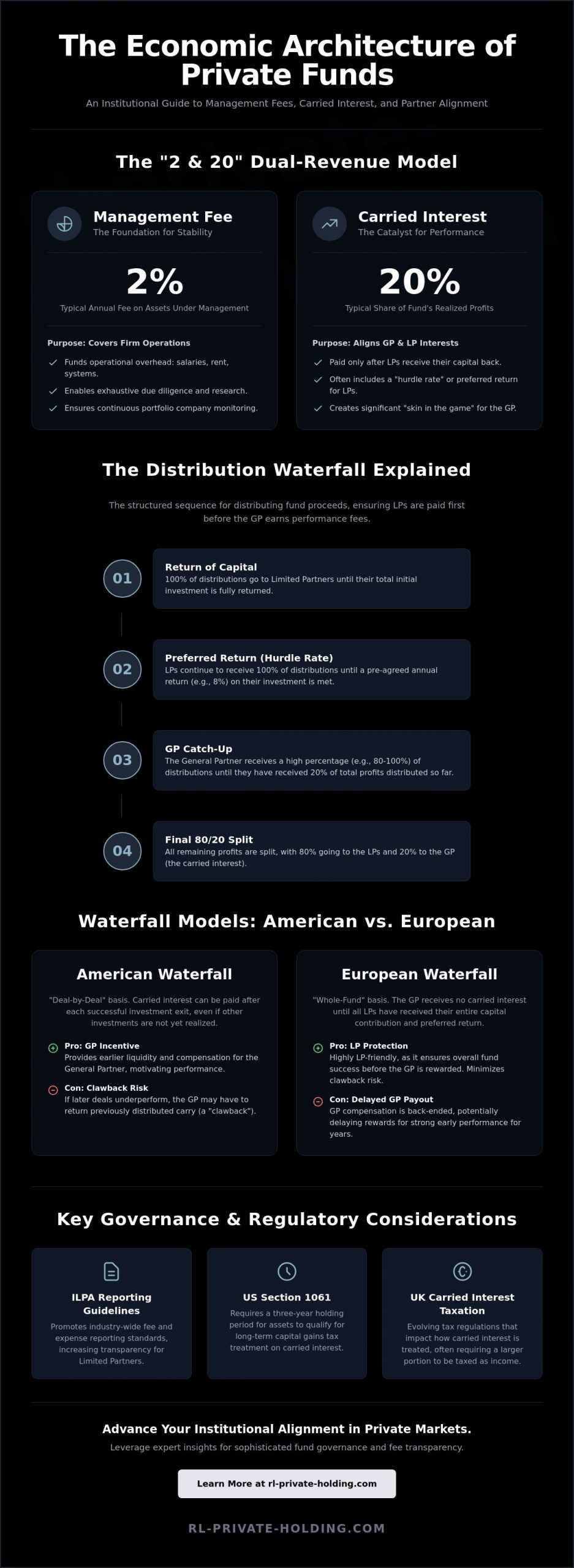
For decades, the “2 and 20” model has served as the global benchmark for this relationship. Under this framework, a 2% annual fee on assets under management covers the fund’s overhead, while a 20% share of profits provides the primary incentive for capital appreciation. Modern institutional standards have evolved, however. While top-tier funds often command higher premiums due to a “flight to quality,” others face increased pressure from LPs for tiered fee structures that better reflect the scale of the assets. These mechanics aren’t merely administrative details; they are the primary tools used to maintain a disciplined global partnership.
The Role of Management Fees in Firm Operations
Management fees are the lifeblood of a firm’s operational infrastructure. These funds provide the necessary liquidity to maintain a high-caliber investment team, conduct exhaustive due diligence, and provide ongoing portfolio monitoring. It’s vital to distinguish these fees from individual partner compensation. They are firm-level revenues intended to support a multi-year investment horizon. The predictable nature of venture capital management fees and carried interest calculations allows for long-term strategic planning at the firm level. Without this stable capital base, a firm cannot sustain the rigorous research and administrative oversight required to protect LP interests over a typical ten-year fund lifecycle.
Carried Interest as a Performance Catalyst
If management fees provide stability, Carried Interest serves as the engine of alignment. This performance fee represents a predetermined share of the fund’s realized profits, paid only after the LPs have received their initial capital and, in many cases, a preferred return. This mechanism ensures that the GP has significant “skin in the game.” Unlike traditional asset management, where fees may be untethered from outcomes, the venture capital model relies on this profit-sharing structure to differentiate high-performing managers from the broader market. It transforms the GP from a mere service provider into a disciplined partner whose financial success is directly proportional to the value created for the fund’s investors.
The Mechanics of Assets Under Management Fees
The calculation of management fees serves as the primary budgetary constraint for a fund’s operational lifespan. While the broader discussion of venture capital management fees and carried interest often focuses on profit sharing, the mechanics of the management fee itself determine a firm’s ability to execute its mandate. The industry standard remains approximately 2% of assets under management annually. This fee is paid to the fund managers regardless of performance to ensure that the fund can meet its daily operational obligations. A deep understanding of Venture Capital Fee Economics is necessary for limited partners to assess whether the management budget is appropriate for the fund’s stated strategy.
Institutional transparency often requires the implementation of fee offsets. These provisions ensure that any ancillary income the general partner receives, such as transaction or monitoring fees from portfolio companies, is credited back to the limited partners. This reduces the effective management fee and prevents the GP from benefiting twice from the same asset. Maintaining a disciplined approach to these mechanics is a hallmark of professional private equity investment management.
Fee Basis Evolution Across the Fund Lifecycle
The basis for calculating fees is not static. During the initial investment period, which typically lasts three to five years, fees are assessed on the total committed capital. This provides the resources needed to source and close new deals. Once the investment period concludes, the fund enters the harvest period. At this stage, the fee basis often shifts to net invested capital, which is the total capital deployed minus the cost basis of any realized or written-off investments. This transition, often accompanied by a percentage step-down, ensures that the GP remains focused on managing the remaining portfolio rather than simply collecting fees on a declining asset pool.
Budgeting for Operational Excellence
Management fees fund the essential institutional infrastructure of a firm. This budget must cover several critical areas:
- The salaries of the investment team and administrative staff.
- Rigorous due diligence processes and legal expenses.
- Compliance and reporting standards required by global regulators.
- Ongoing portfolio monitoring and value-creation initiatives.
There is a recognized risk known as the ‘zombie fund’ scenario. This occurs when the management fee remains high enough to sustain the firm’s operations even when the incentive to exit investments is low. To mitigate this, sophisticated LPs require fee structures that decline as the fund ages. This discipline ensures that the firm’s primary financial motivation remains the realization of profits through venture capital management fees and carried interest alignment.
Carried Interest: Aligning Performance with LP Objectives
The allocation of carried interest represents the most significant performance incentive within the private capital landscape. While management fees ensure the firm’s operational stability, the profit share serves as the primary mechanism for aligning the interests of the general partner with those of the limited partners. The industry standard for this performance fee remains 20% of the fund’s net profits. This threshold ensures that the investment team is compensated primarily for the delivery of alpha rather than the mere administration of assets. In a Harvard Business School analysis on financial industry growth, researchers highlight how these incentive structures have historically driven the expansion of the alternative asset class by attracting high-caliber talent to the private markets.
Realization events dictate the timing of these payments. Carried interest is typically distributed only after a fund has successfully exited an investment and returned the initial capital to its investors. In top-tier funds with exceptional track records, this threshold may occasionally rise to 30%, reflecting a premium for consistent outperformance. The technical interplay between venture capital management fees and carried interest ensures that the GP remains focused on high-quality exits rather than maintaining a large volume of underperforming assets. As of June 2026, the tax treatment of these distributions remains a critical consideration for global funds. In the United States, carried interest is taxed as a long-term capital gain at a maximum federal rate of 23.8% for assets held over three years. Conversely, the United Kingdom implemented a fundamental change on April 6, 2026, treating carried interest as income with an effective tax rate of approximately 34.1% for qualifying distributions.
The Preferred Return and Catch-up Clauses
A preferred return, or hurdle rate, acts as a protective threshold for the limited partner. In institutional private equity, an 8% hurdle is common. This requires the fund to achieve a minimum annual return for the LPs before the GP can begin to accrue carry. Once this hurdle is met, a catch-up clause typically allows the GP to receive a disproportionate share of the subsequent profits until their total profit share reaches the agreed 20%. This structure ensures the GP is rewarded for the total performance of the fund while prioritizing the investor’s baseline return. Asset classes with lower risk profiles may utilize a “hard” hurdle, where carry is only calculated on returns exceeding the threshold, whereas venture funds often use a “soft” hurdle that allows for a full catch-up.
Vesting and Allocation of Carry within the GP
Internal firm governance dictates how carry is distributed among the investment team. Senior partners generally receive the largest allocations, but modern firms increasingly use carry to incentivize junior professionals and ensure team continuity. These entitlements are almost always subject to vesting schedules, which typically span five to ten years. This longitudinal approach prevents premature departures and maintains a steady hand throughout the fund’s lifecycle. A disciplined firm will use these venture capital management fees and carried interest structures to build a stable, multi-generational institution that remains resilient through varying market cycles.
The distribution waterfall serves as the technical blueprint for the liquidation of fund assets. This contractual framework dictates the specific order in which proceeds are allocated among partners, effectively operationalizing the relationship between venture capital management fees and carried interest. Two primary structural models dominate the global landscape, each offering a distinct risk profile for limited partners. The choice between these models often reflects jurisdictional preferences and the competitive positioning of the fund manager.
In the United States, venture funds frequently utilize the American-style waterfall. This model operates on a deal-by-deal basis, allowing the general partner to receive carried interest as soon as an individual investment is exited at a profit, provided the capital for that specific asset is returned to the investors. While this accelerates liquidity for the investment team, it requires robust protective covenants to prevent the over-distribution of profits early in the fund’s lifecycle. Conversely, the European-style waterfall is widely considered more LP-friendly. In this whole-fund model, the general partner remains ineligible for carry until the limited partners have recovered their entire capital contribution across all investments, plus the agreed-upon preferred return.
For institutional investors seeking to optimize their exposure, understanding these mechanics is essential. You can explore our specialized private equity investment management services to see how these structures are applied in a professional context.
Whole-Fund vs. Deal-by-Deal Dynamics
The distinction between whole-fund and deal-by-deal dynamics is a primary point of negotiation in fund agreements. The American model is often justified in venture capital as a means to reward managers for early successes, which can be critical for firm scaling. However, this creates a risk where a GP might receive carry on early winners only to see the remaining portfolio underperform. The European model mitigates this risk by ensuring the fund is profitable in its entirety before any performance fees are paid. Institutional funds in Europe almost exclusively favor this whole-fund recovery to ensure maximum LP protection.
Clawbacks and GP Guarantees
To address the risks inherent in early distributions, sophisticated agreements include clawback provisions. A clawback is a contractual obligation requiring the general partner to return previously distributed carried interest if the fund’s final performance does not justify the total carry paid. Trigger events typically occur during the final liquidation of the fund. To secure these potential obligations, many funds utilize escrow accounts, where a portion of the GP’s carry is held until the fund is fully wound down. In some instances, senior partners may also provide personal guarantees to ensure the firm can meet its clawback liabilities, reinforcing the long-term discipline required in managing venture capital management fees and carried interest structures.
Institutional Governance and Fee Transparency in Global Markets
The evolution of institutional governance has fundamentally transformed how limited partners evaluate venture capital management fees and carried interest. In the current global landscape, transparency is no longer a secondary consideration; it’s a structural requirement for any top-tier fund. The Institutional Limited Partners Association (ILPA) has been instrumental in this shift, providing standardized reporting templates that allow for precise benchmarking across different asset classes. These guidelines ensure that every dollar allocated to management or distributed as profit is accounted for with granular detail. For a firm like RL Private Holding, adhering to these standards is a core component of maintaining institutional gravity and long-term trust with global partners.
Luxembourg remains the preeminent jurisdiction for sophisticated fund vehicles due to its robust regulatory framework and specialized structures like the Reserved Alternative Investment Fund (RAIF). This environment provides the clarity necessary for investors to assess the total cost of ownership without the ambiguity often found in less regulated markets. Our approach at RL Private Holding integrates these global standards into our private equity investment management protocols. This ensures that governance remains a steady hand in the background of every investment, providing a reliable framework for wealth preservation and growth.
Global Standards for Fee Disclosure
The move toward standardized fee reporting has reached a critical maturity in 2026. Institutional funds now utilize third-party verification for carry calculations to mitigate the risk of accounting errors or misaligned distributions. In Europe, the Alternative Investment Fund Managers Directive (AIFMD) has further codified these requirements, necessitating rigorous disclosure of all fund-level expenses. This regulatory pressure has led to the widespread adoption of digital auditing tools that provide LPs with real-time visibility into the fund’s economic health. These protocols ensure that the calculation of venture capital management fees and carried interest remains objective and verifiable throughout the fund’s lifecycle.
Strategic Allocation in a Global Context
Evaluating the total cost of ownership (TCO) is a prerequisite for successful private equity allocation. Beyond the headline ‘2 and 20’ figures, sophisticated investors must account for fund expenses, organizational costs, and the impact of various tax regimes. RL Private Holding manages diversified portfolios with institutional rigor, focusing on the underlying principles of discipline and strategic focus. Looking ahead, we see an increasing interest in performance-linked management fees, where a portion of the operational budget is tied to the achievement of specific milestones. This potential evolution suggests a future where the alignment between GP and LP is even more deeply integrated into the fund’s structural DNA.
Advancing Institutional Alignment in Private Markets
The sophisticated interplay of venture capital management fees and carried interest remains the cornerstone of the relationship between general and limited partners. By understanding the mechanics of distribution waterfalls and the necessity of transparent governance, institutional investors can better evaluate the true value of their private capital allocations. These structures are not merely administrative; they are the essential tools for ensuring that performance incentives are directly tethered to long-term capital appreciation and risk mitigation. A clear mastery of these mechanics allows for more effective benchmarking and a more disciplined approach to asset selection in a competitive global landscape.
As global markets continue to evolve, maintaining a rigorous approach to fund economics is paramount for sustainable growth. We invite you to explore RL Private Holding’s strategic approach to investment management. Our firm leverages Luxembourg-based institutional expertise and global portfolio diversification to deliver stability and clarity. We remain steadfast in our commitment to transparent governance and reporting standards, providing a reliable foundation for those who value professional distance and strategic focus. We look forward to supporting your long-term objectives with institutional gravity and precision.
Frequently Asked Questions
What is the standard ‘2 and 20’ fee structure in venture capital?
The ‘2 and 20’ model is a traditional fee arrangement consisting of a 2% annual management fee and a 20% carried interest allocation. The 2% fee provides the general partner with a stable operational budget to cover salaries and due diligence, while the 20% profit share serves as the primary performance incentive. This structure is designed to align the manager’s financial success with the delivery of significant returns for the investors.
How do assets under management fees differ from performance fees?
Assets under management fees are fixed charges intended to support the firm’s daily operations, whereas performance fees are contingent upon the fund’s profitability. Management fees are generally paid regardless of the fund’s performance to ensure institutional stability. In contrast, performance fees, or carried interest, are only distributed after the fund has met specific realization events and return thresholds defined in the partnership agreement.
What is a distribution waterfall in private equity?
A distribution waterfall is a contractual framework that dictates the precise order in which capital and profits are allocated between limited and general partners. It functions as a structured hierarchy, typically prioritizing the return of the investors’ initial capital and a preferred return before the general partner can access their share of the profits. This mechanism ensures a disciplined and transparent liquidation of fund assets.
How does a hurdle rate protect Limited Partners?
The hurdle rate, or preferred return, acts as a performance floor that the fund must exceed before the general partner is eligible for carried interest. It protects limited partners by ensuring they receive a minimum annual return, typically between 6% and 9%, on their contributed capital. This priority distribution ensures that the general partner’s performance incentives only trigger after a baseline level of investor profit is secured.
What happens if a fund manager receives too much carried interest?
If a general partner receives profit distributions that exceed their agreed-upon percentage of the fund’s total net gains, a clawback provision is activated. This requirement compels the manager to return the excess funds to the limited partners at the end of the fund’s lifecycle. It’s a critical governance tool that prevents the over-distribution of carry during the early stages of a fund’s liquidation.
Are management fees negotiable for large institutional investors?
Management fees are often subject to negotiation for institutional investors who provide significant capital commitments. Large-scale investors may secure reduced fee rates or tiered structures through side letters that reflect their strategic importance to the fund’s closing. These negotiations are a standard part of the institutional due diligence process and are used to optimize the total cost of ownership for the limited partner.
How is carried interest taxed in major financial hubs like Luxembourg?
In Luxembourg, carried interest is governed by a sophisticated regulatory framework that provides clarity for alternative investment fund managers. Qualifying individuals may benefit from a specialized tax regime where distributions are taxed at a reduced rate compared to ordinary income, provided the structure meets specific holding and organizational requirements. This clarity is a primary reason why the jurisdiction is favored for institutional fund vehicles.
What is the difference between committed capital and invested capital for fee purposes?
Committed capital is the total amount an investor has pledged to provide over the fund’s life, while invested capital is the portion that has been actively deployed into portfolio companies. The basis for venture capital management fees and carried interest typically shifts from committed capital during the investment period to net invested capital during the harvest period. This transition ensures the management fee remains proportional to the volume of assets currently being managed by the firm.