

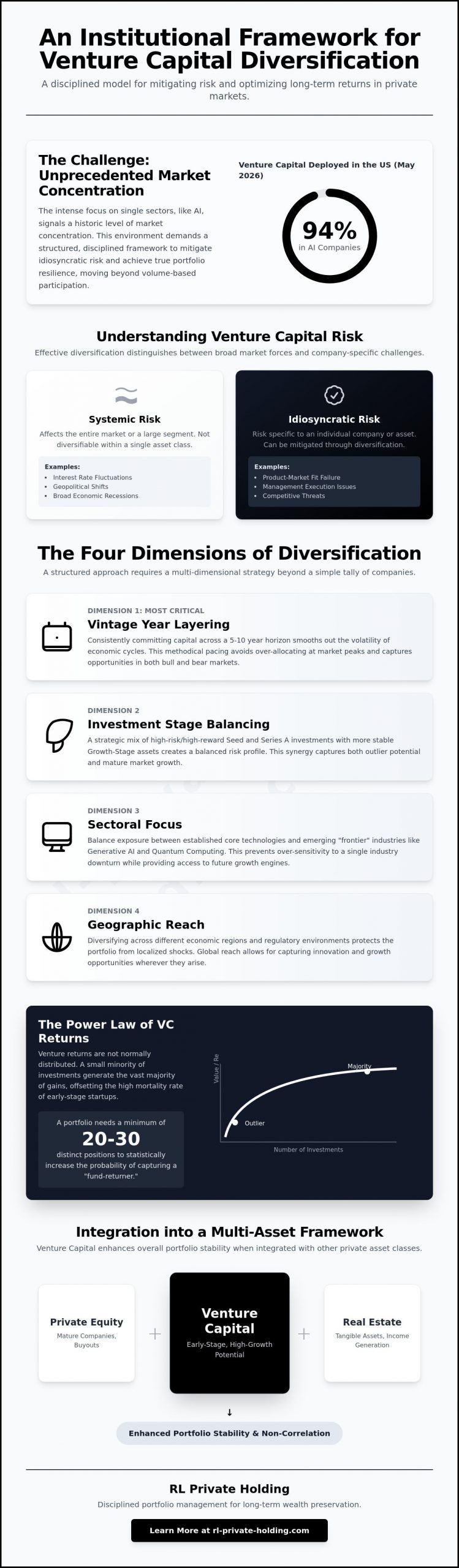
In May 2026, AI companies captured 94% of all US venture capital deployed, a figure that signals a historic level of market concentration. This intense focus on a single sector highlights the increasing complexity of achieving effective venture capital portfolio diversification. Institutional investors recognize that while the potential for high alpha is significant, the lack of transparency in private market valuations and the volatility of early-stage assets can threaten long-term wealth preservation. Achieving true non-correlation with public markets requires more than a broad collection of assets; it demands a deliberate, multi-dimensional strategy.
We understand that the current investment environment requires a shift from volume-based participation toward a structured, disciplined framework. This article serves as a comprehensive reference on mitigating idiosyncratic risk and optimizing long-term returns through rigorous venture capital diversification. We will outline a repeatable model for allocation that aligns sector exposure, investment stages, and vintage years. This approach ensures that capital deployment remains consistent with the standards of institutional risk management and professional asset oversight.
Key Takeaways
- Distinguish between systemic market volatility and idiosyncratic startup risk to build a more resilient institutional portfolio.
- Develop a robust framework for venture capital portfolio diversification by balancing sectoral exposure with a strategic mix of seed and growth-stage investments.
- Evaluate the critical threshold between broad diversification and strategic concentration to avoid the performance dilution associated with closet indexing.
- Integrate venture capital assets into a wider multi-asset framework alongside private equity and real estate to enhance overall portfolio stability.
- Understand the operational benefits of utilizing centralized holding structures to manage and preserve global private market assets effectively.
The Mechanics of Venture Capital Portfolio Diversification
Institutional investors approach venture capital not as a series of speculative bets, but as a structured component of a broader alternative asset strategy. The core objective of venture capital portfolio diversification is to decouple the performance of an individual investment from the overall health of the private equity allocation. While public markets are subject to systemic factors like interest rate fluctuations or geopolitical shifts, private early-stage companies are primarily defined by idiosyncratic risk. This is the risk specific to a single entity, such as product-market fit or management execution. By applying the principles of Modern Portfolio Theory, advisers can construct a framework where the failure of one firm doesn’t compromise the integrity of the total fund.
A mathematical approach to breadth is essential because venture returns don’t follow a standard bell curve. They are characterized by high variance and a lack of transparency in private market valuations. This makes non-correlation a vital tool for portfolio resilience. When venture assets are correctly integrated into a global multi-asset framework, they provide a source of returns that doesn’t move in lockstep with traditional bonds or equities, offering a steady hand during periods of public market instability.
Idiosyncratic Risk Mitigation
Venture returns follow a Power Law distribution, meaning a minority of investments generate the majority of total capital gains. Capturing these outliers requires a wide enough net to offset the high mortality rate inherent in seed and Series A stages. Research suggests that a portfolio must contain a minimum of 20 to 30 distinct positions to statistically increase the probability of including a “fund-returner.” This disciplined breadth provides a necessary hedge, ensuring that the total capital is not overly exposed to the binary outcomes common in emerging technology sectors.
VC vs. Public Equity Diversification
Public markets have become increasingly concentrated, with a small number of mega-cap technology firms driving the majority of index performance. This concentration limits the diversification benefits typically associated with public equities. In contrast, venture capital allows for exposure to “frontier” technologies, such as generative AI and quantum computing, long before they reach public indices. Global venture funding rose to over $512 billion in 2025, reflecting a sustained institutional appetite for these private opportunities. As the US venture capital market approaches a projected $1.46 trillion valuation by 2030, private assets offer a structural defense against the increasing concentration and systemic volatility of public indices.
Four Critical Dimensions of a Diversified VC Portfolio
Effective venture capital portfolio diversification extends beyond a simple tally of underlying companies. It requires a structured approach across four distinct axes: sectoral focus, investment stage, geographic reach, and vintage year. While many investors prioritize industry exposure, a truly institutional framework accounts for the temporal and structural nuances that define private market performance. Professional managers use these dimensions to ensure that a portfolio isn’t overly sensitive to localized economic shocks or specific industry downturns.
Vintage Year Diversification
Vintage year layering is perhaps the most critical, yet frequently overlooked, element of institutional strategy. The macroeconomic environment during a fund’s initial deployment years significantly dictates its ultimate return profile. For instance, capital deployed at the peak of a market cycle often faces compressed multiples upon exit, while “recession vintages” can benefit from lower entry valuations. By consistently committing capital across a 5 to 10 year horizon, investors smooth out the volatility of economic cycles. This methodical pacing prevents the risk of over-allocating during periods of exuberant market sentiment, ensuring a more stable role of alternatives in asset allocation. Consistent deployment allows an organization to capture opportunities in both bull and bear markets without attempting to time the entry point perfectly.
Sectoral and Stage Balancing
A balanced portfolio requires synergy between established sectors and frontier industries. While core technologies like B2B SaaS and Fintech provide predictable recurring revenue models, allocations to DeepTech or AI offer the potential for transformative growth. In May 2026, the US venture market saw $67.03 billion in funding, with AI capturing nearly 94% of that capital. This concentration underscores the need for a “barbell” strategy. This approach pairs the high-risk, high-reward profile of Seed-stage investments with the relative capital preservation of Growth-stage assets. Growth-stage firms typically possess proven unit economics and clearer paths to liquidity, acting as a stabilizer for the more volatile early-stage positions. For institutions seeking to refine their exposure, our expertise in Private Equity Investment Management provides the disciplined oversight necessary to manage these complex trade-offs. Geographic diversification further enhances this resilience by accessing innovation hubs in the US South and Midwest, which have seen increased investment activity recently. This multi-layered strategy ensures that the portfolio remains robust regardless of regional shifts in the global financial landscape.
The Concentration vs. Diversification Debate
The tension between high-conviction concentration and broad venture capital portfolio diversification remains a central theme for institutional allocators. While some General Partners (GPs) argue that concentrated portfolios maximize alpha by focusing capital on a few high-conviction “winners,” this approach introduces significant variance. Critics of broad diversification often point to the risk of “closet indexing,” where a portfolio becomes so expansive that it merely tracks market averages, diluting the unique returns that justify venture capital’s illiquidity. For a maturing fund, the “diversify then concentrate” model offers a strategic evolution. This strategy involves casting a wide net during the initial deployment phase and subsequently concentrating follow-on capital into the most promising performers. It balances the need for initial exposure with the pursuit of outsized returns as companies mature and prove their unit economics. Managing the trade-off between maximum alpha and capital preservation is a core function of disciplined asset management. With AI companies capturing 94% of US venture capital in May 2026, the risk of sector-specific concentration has never been higher, making a diversified approach even more vital for those seeking to avoid systemic traps.
The Limits of Concentration
Concentration creates a “single-point failure” risk that’s often unacceptable within an institutional framework. If a fund’s performance depends on one or two companies, any regulatory shift or management failure at those entities can devastate the internal rate of return (IRR). Highly concentrated portfolios exhibit extreme volatility. This complicates the long-term planning required for wealth preservation and predictable cash flows. Doubling down on winners is a sound tactic, but it must occur within the guardrails of portfolio integrity. This means ensuring that no single position exceeds a predetermined percentage of the total fund value. It prevents a scenario where a single late-stage valuation adjustment compromises the entire fund’s health. Professional oversight ensures that conviction doesn’t transform into reckless exposure.
Institutional Preferences for Breadth
Limited Partners (LPs) generally favor broader diversification because it aligns with their fiduciary responsibilities and long-term stability goals. Unlike individual managers who might seek a “home run” to establish a reputation, institutions prioritize steady, repeatable performance. Broad exposure enhances reporting transparency and provides a clearer view of sectoral trends without the noise of extreme idiosyncratic swings. It’s about building a resilient foundation that can withstand market cycles. Institutional gravity favors a disciplined, diversified approach because it mitigates the risk of total capital loss while still participating in the sector’s inherent growth. This preference reflects a commitment to professional asset management over speculative betting. It ensures that the venture allocation serves its role as a diversifier within a global multi-asset strategy.
Integrating VC into a Global Multi-Asset Framework
Venture capital is most effective when positioned as a high-growth component within a wider institutional framework. It functions alongside more stable asset classes to provide a balanced risk-return profile that preserves capital while capturing significant upside. Achieving optimal venture capital portfolio diversification requires a thorough understanding of how these private market assets interact with other global holdings. This integration allows for the disciplined management of different liquidity profiles, ensuring that the long-term, illiquid nature of venture investments is balanced by more predictable or income-generating assets.
Cross-Asset Diversification
Venture capital offers a distinct risk profile compared to Real Estate Asset Management, which typically prioritizes yield and capital preservation. While venture assets focus on transformative growth and high equity multiples, real estate provides a hedge against inflation and a source of consistent cash flow. Private equity investment management acts as a bridge between these two, offering exposure to established businesses with proven profitability and operational history. For institutional-grade portfolios, a strategic allocation of 5% to 15% in venture capital is often utilized to drive total return without compromising the fund’s overall stability. This weighting allows the portfolio to benefit from the Power Law returns discussed in previous sections while maintaining a secure foundation in tangible assets.
The Luxembourg Advantage
Centralizing global assets through a Luxembourg holding company, such as a SOPARFI (Société de Participations Financières), provides the structural efficiency required for complex cross-border venture investments. Luxembourg is recognized for its sophisticated financial ecosystem and rigorous regulatory standards, which align with the high transparency requirements of institutional investors. Utilizing this framework ensures that diversified holdings are managed under a single, compliant entity, facilitating efficient capital calls and distributions across different jurisdictions. The SOPARFI structure is particularly valued for its tax neutrality on qualified participations, which enhances the net returns of a diversified global portfolio. This centralized approach reduces administrative complexity and reinforces the governance of the entire investment structure.
For institutions seeking to optimize their cross-asset strategy and ensure long-term stability, our Wealth Management Services provide the structural expertise and disciplined oversight necessary to integrate venture capital into a broader wealth preservation plan.
RL Private Holding: Disciplined Portfolio Management
RL Private Holding operates with a philosophy of institutional gravity and strategic focus. Our approach to venture capital portfolio diversification is built upon the same rigorous standards we apply to our broader private equity and real estate holdings. We maintain a global perspective from our headquarters in Luxembourg, ensuring that every allocation is part of a well-ordered, long-term plan. This methodical discipline allows us to act as a steady hand in the background of significant investments. We provide the professional distance and stability that institutional partners value, functioning as a “silent giant” in the global financial landscape. Our firm doesn’t seek the spotlight; instead, we prioritize the preservation and growth of capital through disciplined, evidence-based frameworks.
Strategic Venture Capital Funding
Our provision of Venture Capital Funding is characterized by a focus on structural growth rather than fleeting market trends. We identify growth-stage technology investments that demonstrate resilience and long-term viability. This allows us to move beyond the speculative volatility often associated with the early-stage sector. This selection process is integrated into our wider Wealth Management Services, ensuring that venture exposure remains balanced within the client’s total wealth structure. By prioritizing sectors with clear operational fundamentals, we maintain a portfolio that is both diversified and strategically aligned with global economic shifts. We focus on businesses that show a clear path to profitability, avoiding the “growth at all costs” mentality that often leads to idiosyncratic failure. This approach ensures that our venture assets contribute to long-term wealth preservation rather than introducing unmanaged risk.
A Partner for Institutional Investors
We position ourselves as a disciplined partner for those who prioritize stability and exclusivity. Our methodical approach to asset management is reflected in our adherence to evolving regulatory standards. We closely monitor the June 2026 updates to qualified client thresholds and the proposed increases in Form PF filing requirements. This commitment to transparency and compliance ensures that our partners receive the institutional oversight necessary in a complex global landscape. We avoid the hyperbole of the broader market, focusing instead on the structural integrity of the businesses we manage. Our presence in Luxembourg allows us to leverage a sophisticated financial ecosystem, providing a secure and transparent base for global operations. This geographic advantage is central to our Private Equity Investment Management strategy, as it facilitates efficient capital deployment across international borders. We remain committed to the principles of institutional permanence and strategic focus. Explore our strategic approach to global investment management.
Advancing Institutional Resilience through Strategic Allocation
Adopting a multi-dimensional approach to venture capital portfolio diversification is a fundamental requirement for institutional investors seeking to mitigate idiosyncratic risk. By layering investments across sectors, stages, and vintage years, allocators can capture the outsized returns of the private markets while maintaining a disciplined risk profile. Integrating these assets into a global framework alongside private equity and real estate asset management further enhances the stability of the total portfolio. This synergy allows for a balanced exposure that addresses both transformative growth and capital preservation.
RL Private Holding remains committed to these principles of institutional gravity and long-term wealth preservation. Headquartered in Luxembourg, the premier European hub for institutional asset management, we manage a diversified global portfolio with a focus on professional governance and exclusive access. This structured methodology ensures that capital deployment remains aligned with the highest standards of global asset management. We prioritize a methodical, factual approach that serves the specific needs of sophisticated partners. Discover RL Private Holding’s Strategic Investment Framework. We look forward to supporting your long-term wealth preservation goals.
Frequently Asked Questions
What is the primary benefit of venture capital portfolio diversification for LPs?
The primary benefit is the mitigation of idiosyncratic risk, which prevents the failure of a single entity from compromising the integrity of the total fund. This strategy allows Limited Partners to capture high-alpha returns while maintaining a risk profile that aligns with fiduciary responsibilities and long-term wealth preservation goals. By spreading exposure, investors ensure that their capital isn’t overly dependent on the binary outcomes of individual startups.
How many startups should a diversified venture capital fund ideally hold?
A diversified fund should ideally hold between 20 and 30 distinct positions to statistically increase the probability of capturing outlier returns. This specific breadth is necessary because venture capital returns follow a Power Law distribution, where a small minority of companies generate the majority of total capital gains. Holding fewer positions significantly increases the risk of missing the “fund-returner” companies that define successful venture allocations.
Is geographic diversification necessary for a venture capital portfolio?
Geographic diversification is essential for accessing varied innovation hubs and reducing exposure to regional economic downturns. While traditional tech centers remain influential, emerging regions in the US South and Midwest have seen increased investment activity recently. Accessing these diverse markets provides a hedge against localized valuation bubbles and allows institutional investors to tap into a broader spectrum of global technological advancements.
How does vintage year diversification impact the risk profile of a VC allocation?
Vintage year diversification smooths out the volatility of economic cycles by spreading capital deployment over a 5 to 10 year horizon. This temporal layering prevents the risk of over-allocating during periods of peak market valuations, which often lead to compressed exit multiples. It ensures that the overall venture capital portfolio diversification strategy remains resilient, as capital is deployed across both bull and bear market environments.
What is the difference between diversification in public markets versus venture capital?
Public market diversification primarily tracks systemic trends, whereas venture capital focuses on mitigating entity-specific risks while accessing frontier technologies unavailable in public indices. Public markets have become increasingly concentrated in a small number of mega-cap firms, which limits their diversification benefits. In contrast, venture capital offers true non-correlation by investing in the underlying structural growth of private companies before they reach public maturity.
Can a portfolio be over-diversified in the venture capital asset class?
A portfolio can be over-diversified if it reaches a point of “closet indexing,” where the sheer number of holdings dilutes the potential for outsized alpha. This occurs when a portfolio becomes so broad that its performance merely tracks the market average, negating the benefits of active management. Professional managers avoid this by utilizing a “diversify then concentrate” model, which allows for broad initial exposure followed by high-conviction follow-on investments.
Why is Luxembourg a preferred jurisdiction for diversified investment holdings?
Luxembourg is preferred due to its sophisticated SOPARFI structure and rigorous regulatory standards that provide the transparency required by institutional investors. As the premier European hub for asset management, it offers tax neutrality and structural efficiencies for cross-border investments. These features are critical for managing the administrative and legal complexities of a global venture capital portfolio diversification strategy under a single, compliant entity.
How does RL Private Holding approach risk management in its venture capital investments?
RL Private Holding manages risk through a disciplined selection process that prioritizes businesses with structural growth and proven operational fundamentals. Our approach focuses on growth-stage investments that offer a more predictable risk-return profile than speculative early-stage bets. We maintain institutional-grade governance and professional distance, ensuring that venture capital exposure is always balanced within a broader multi-asset framework designed for long-term wealth preservation.