

A venture capital term sheet is usually non-binding, but signing one can make proposed terms difficult to renegotiate. A useful venture capital term sheet negotiation checklist looks beyond valuation to ownership, investor rights and clauses that are binding. The document summarises the main economic and governance terms before the detailed investment agreements are prepared.
It is understandable to focus first on the headline valuation: it helps frame the deal, but does not show the full effect on founder ownership or decision-making. This guide explains how valuation and dilution, board composition, liquidation preferences, vesting and related documents shape negotiations. It also clarifies how a term sheet differs from a letter of intent or memorandum of understanding, so you can assess what the document covers and what remains to be agreed.
Key Takeaways
- Compare pre-money and post-money valuation alongside the option pool to understand how the proposed investment affects founder ownership.
- Assess liquidation preference terms by considering how proceeds would be distributed at different exit values.
- Review board seats and approval rights together to see how investor protections may shape company decisions.
- Examine vesting start dates and acceleration provisions for their effect on founders’ equity after termination or a change of control.
- Distinguish binding clauses from non-binding proposals, and understand how a term sheet differs from a letter of intent or memorandum of understanding.
Valuation and dilution
Valuation sets the basis for an investor’s ownership, while the term sheet’s economic provisions determine how that ownership may change. Pro rata rights allow eligible investors to buy securities in a future financing, subject to the agreement’s conditions. Information rights specify company updates, and follow-on rights govern participation in later rounds.
Valuation and Economic Terms
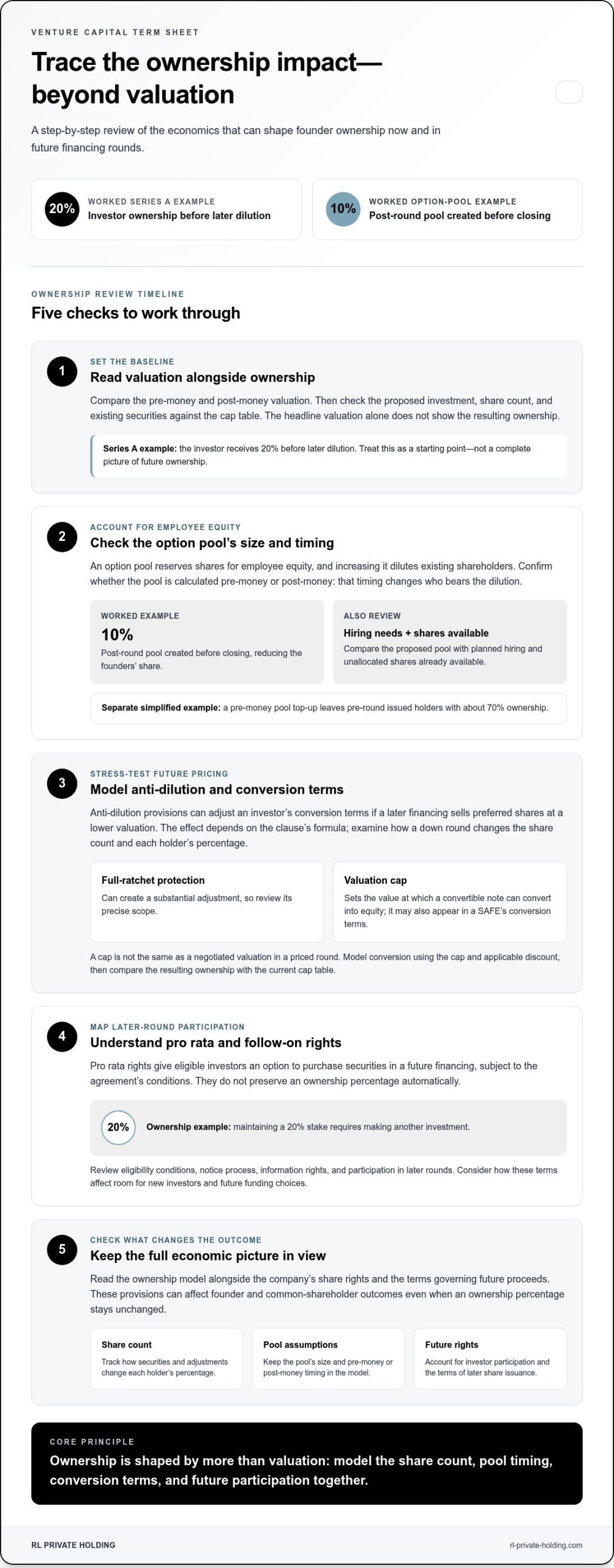
Valuation is the agreed measure of a company before or after funding, and it influences the investor’s percentage ownership. In a worked Series A example, the investor receives 20% before later dilution. Founders should read that percentage alongside the share count and other economic terms, because the headline valuation alone does not show the resulting ownership in the cap table.
Compare pre-money and post-money valuation, then model the ownership impact of the proposed investment and any existing securities. A term sheet may state both valuations before the formal investment agreement. This comparison helps founders assess whether the proposed funding, share issuance and option-pool assumptions produce the ownership outcome they expect.
Anti-Dilution Provisions and Valuation Caps
Anti-dilution provisions adjust an investor’s conversion terms if a later financing sells preferred shares at a lower valuation. The effect depends on the clause’s formula, so founders should examine how a down round changes the share count and each holder’s percentage. Full-ratchet protection can create a substantial adjustment, making its precise scope an important negotiation point.
A valuation cap sets the value at which a convertible note can convert into equity; it may also appear in a SAFE’s conversion terms. A cap is not the same as the company’s negotiated valuation in a priced round. Founders should model conversion using the cap and applicable discount, then compare the resulting ownership with the current cap table.
Option Pool Sizing
An option pool reserves shares for employee equity, and increasing it dilutes existing shareholders. The term sheet should specify whether the pool is calculated pre-money or post-money, since that timing changes who bears the dilution. In a worked example, a 10% post-round pool is created before closing, reducing the founders’ share of the company.
Review the proposed pool against planned hiring and the unallocated shares already available. In a simplified example, a pre-money pool top-up leaves pre-round issued holders with about 70% ownership. This demonstrates why the pool’s size and timing belong in valuation discussions, not just in later hiring plans.
Pro Rata and Follow-On Rights
Pro rata rights give eligible investors an option to purchase securities in a future financing, subject to the agreement’s conditions. Maintaining a 20% ownership stake requires making another investment; the right does not preserve that percentage automatically. Founders should assess how these provisions affect room for new investors and the company’s future funding choices.
Information rights specify what company information an investor receives and when, while follow-on investment rights address participation in later rounds. Read these rights alongside their eligibility conditions, notice process and relationship to future share issuance. Reviewing the clauses against the cap table can clarify which investors may participate and how ownership could shift.
What is a term sheet?
A venture capital term sheet is a short document outlining the main economic and governance terms of a proposed investment. Its liquidation preference can shape how proceeds are divided when a transaction closes.
In Luxembourg, the company’s legal form, transaction structure and final agreements affect how proposed terms are documented. Clearly separate any binding clauses, such as confidentiality or exclusivity, from non-binding commercial terms.
A term sheet commonly covers valuation, investment amount, ownership, investor rights, board composition and liquidation preference. It summarises points that may later appear in detailed agreements, including a shareholders’ agreement and articles of association. Parties can use it to identify open commercial issues before drafting those documents.
Liquidation Preferences and Participation
A liquidation preference determines the order in which investors receive proceeds from a liquidity event, such as a company sale. A 1x non-participating preference generally gives the investor a choice between receiving the preference or converting into common shares. That choice matters because the investor receives the option producing the greater return under the agreed terms.
Participating preferred shares work differently: the investor receives the preference first, then shares in the remaining proceeds. Compare this structure with non-participating terms across more than one exit scenario. The comparison shows how participation can affect common shareholders’ proceeds, even when the investor’s ownership percentage stays unchanged.
Exit Proceeds and Dividends
Exit proceeds are distributed according to the preference’s priority, participation terms, and the company’s share rights. A 2x or 3x preference entitles an investor to receive a multiple of the investment before other shareholders receive proceeds. Founders should model the distribution waterfall across low and high exit outcomes, not just the headline valuation.
Dividends are a separate economic term that may define an investor’s entitlement to distributions of net income. The term sheet should clarify whether dividends are cumulative, payable only when declared, or treated another way in the final documents. These provisions can change the amount available to common shareholders, so review them alongside the liquidation waterfall.
Typical Term Sheet Terms
A term sheet typically sets out the proposed funding, valuation, ownership, security type and investor protections. Governance terms may cover board seats, voting rights and approval matters, while economic terms address liquidation preference, dividends and anti-dilution provisions. Each clause can affect control or proceeds differently, so assess the full package rather than treating valuation as the only measure.
Term sheets are often non-binding, but the parties should identify binding clauses expressly. A stock purchase agreement later sets the final legal terms for a priced-round investment, while related documents may include a shareholders’ agreement and amended articles. A legal adviser can review how those documents implement the agreed transaction, especially when provisions appear in more than one place.
Board composition and investor control
Board composition, voting rights and investor protective provisions determine who can influence company decisions. Together, they can change founders’ practical control even when their ownership remains unchanged.
Board Composition and Governance
Board composition defines who participates in oversight and how seats are allocated among founders, investors and independent directors. The arrangement matters because board decisions can affect strategy, financing and senior appointments. A typical board after an initial equity financing has three members: one investor representative and two founders representing common stock.
A later financing may expand that structure. One Series A example uses five seats: two founders, one investor and two independent directors. Independent members can broaden the board’s expertise, but their appointment process and voting position also affect the balance between investor and founder representatives.
Board Seats and Investor Consent
A board seat gives an investor’s representative a role in board deliberations and votes, while consent rights can require approval for specified company actions. These provisions matter because a seat offers ongoing participation, whereas consent rights may apply even when the investor has no board majority.
Read the term sheet for the seat’s appointment, replacement and duration, then compare those terms with the proposed board size. For example, one investor seat on a three-person board carries different influence from one seat on a five-person board. The shareholders’ agreement and company articles should reflect the agreed structure.
Voting Rights and Protective Provisions
Voting rights determine how shareholders and directors approve decisions, while protective provisions give investors approval rights over defined matters. Together, they affect whether founders can act through ordinary board or shareholder processes or need additional investor consent.
Review each provision by decision type, not just by its label. A clause requiring investor approval for new share issues may affect future funding; one covering a sale may influence exit options. Identify the relevant voting body, approval threshold and class of shares entitled to vote in each case.
Investor Veto Rights
An investor veto right allows an investor or investor class to block specified actions, even without controlling the board. Its scope matters: a narrowly defined veto over fundamental changes differs from approval rights covering routine budgets, hiring or commercial decisions.
For each veto, define the action covered, the required consent and any limits or exceptions. A term sheet may require approval for company debt above a stated threshold; that threshold determines how much operating flexibility remains. Founders should align these rights with anticipated financing and operating decisions, then ensure the final documents state them consistently.
Founder vesting and acceleration
Founder vesting sets the period over which founders earn their shares back after a fundraising round. It can affect how much equity a departing founder retains and how the remaining founders continue operating the company. One example sets vesting at four years with a one-year cliff. The agreement should make clear how the schedule applies to each founder’s existing shares.
The start date deserves attention alongside the duration. If vesting restarts at closing, a founder who has already built the business may face a different outcome from one whose service is credited from an earlier date. Cooley advises founders to examine when vesting begins and whether it accelerates after termination without cause or a change of control. Those triggers can materially affect retained ownership.
A one-year cliff means the vesting schedule has an initial threshold before shares begin vesting under its terms. The example of a four-year schedule with a one-year cliff shows why founders should read the timing mechanics, not just the total period. Check the agreement for the vesting start date, the cliff’s effect and what happens to unvested shares if a founder leaves before or after that point.
Acceleration provisions address what happens to unvested shares after specified events. Single-trigger acceleration follows one event, such as a change of control; double-trigger acceleration requires a further event, such as termination without cause. The exact triggers and percentage of shares accelerated determine the result. Founders should distinguish a company sale from a sale followed by the loss of their role, since the agreement may treat those situations differently.
Terms founders commonly negotiate include the schedule’s start date, credit for prior service, the cliff and acceleration conditions. When founders have a prior working history, one suggested negotiation is reducing a one-year cliff to six months. This recognises work completed before the financing while preserving an ongoing vesting incentive. Founders should also establish whether everyone receives the same terms or whether schedules reflect different roles or joining dates.
Use this review sequence before accepting vesting language:
- Compare each founder’s start date and vesting schedule against the company’s records.
- Calculate how the cliff affects shares if departure occurs before or after its threshold.
- Read the treatment of unvested shares after resignation, termination without cause, and a change of control.
- Confirm whether acceleration requires one event or both a transaction and a qualifying termination.
A lawyer can compare the term sheet with the detailed shareholders’ agreement and related share documents. This review helps ensure the negotiated schedule, acceleration triggers and treatment of unvested shares remain consistent across the final agreements.
Term sheets compared with letters of intent and memoranda of understanding
A term sheet, letter of intent and memorandum of understanding can each record proposed deal terms, but their titles alone do not establish what is binding. For a startup seeking equity funding, the key distinction lies in the wording of each clause and the commitments the parties intend to make.
A venture capital term sheet sets out the principal economic and governance terms of a proposed investment. It can capture valuation, investment amount, ownership, investor rights and board arrangements before lawyers prepare detailed agreements. The document is generally non-binding on the investment itself, but signing may make commercial terms difficult to renegotiate. Parties should identify binding clauses separately.
A letter of intent, or LOI, commonly records a preliminary understanding of a transaction and the next steps towards definitive documents. A memorandum of understanding, or MOU, also records the parties’ shared intentions or proposed framework. Neither label automatically makes every clause non-binding. The signed text, its wording and the parties’ stated intent determine the effect of particular provisions.
Exclusivity illustrates why clause-level review matters. A no-shop clause can prevent a startup from soliciting or accepting investment from other parties during an agreed period. One term-sheet example uses a binding 30-day no-shop clause, while a separate example sets 60 days and recommends negotiating it down to 30-45 days. Founders should assess the period, scope, and any termination right before signing.
Confidentiality may also be binding even when the proposed investment terms are not. One example term sheet sets confidentiality for 12 months. An expiration date can require the other party to act by a stated time, even if the broader term sheet is non-binding. These clauses should name the parties covered and define what information or discussions fall within their scope.
Use this comparison when reviewing draft documents:
- Identify which provisions create obligations, including confidentiality and exclusivity.
- Compare the proposed investment terms with any earlier LOI or MOU.
- Record changes to valuation, equity, governance, and transaction timing.
- Confirm that final agreements reflect the terms the parties intend to carry forward.
After signing a term sheet, the process may continue through due diligence and preparation of binding investment documents, such as a stock purchase agreement. A startup-focused lawyer can review the final draft and check that binding clauses are clear before execution. To develop a disciplined approach to investment discussions, review your investment strategy.
RL Private Holding: Venture Capital Funding
RL Private Holding provides Venture Capital Funding for founders considering investment as part of their company’s growth strategy. After reviewing valuation, dilution, governance, vesting and binding clauses, founders can clarify the terms they seek and the capital their business requires.
An investment partner may be relevant when a company is assessing funding options or preparing to discuss a proposed investment. The broader ownership and financial context also matters, particularly when a founder is considering how new capital fits alongside existing assets and investment objectives.
RL Private Holding’s investment activities also include Private Equity Investment Management, Real Estate Asset Management and Wealth Management Services. Contact RL Private Holding to discuss Venture Capital Funding in the context of your business’s financing considerations.
Put Your Financing Priorities Into Practice
The next step is to turn your negotiation priorities into a clear financing strategy. Before advancing discussions, define the capital your company needs, the decisions it must retain and the terms that would make an investment workable. A considered venture capital term sheet negotiation checklist can help frame those priorities, but the wider question is whether external funding fits your company’s direction and ownership plans.
RL Private Holding offers Venture Capital Funding, alongside Private Equity Investment Management and Real Estate Asset Management. Founders assessing a potential investment can consider how funding aligns with the company’s objectives and broader capital requirements. A useful discussion starts with the business’s financing needs and investment context, rather than a predetermined outcome.
Contact RL Private Holding to discuss Venture Capital Funding and your company’s financing considerations. A clear view of your priorities provides a sound basis for the next conversation.
Frequently Asked Questions
What are the important issues?
The key issues are investment economics, governance rights, founder commitments, and closing conditions. A venture capital term sheet negotiation checklist helps founders organise these topics around the company’s financing needs and a 12-month runway forecast. Compare proposed funding with the ownership and control founders retain, then separate binding clauses from non-binding proposals. Ranking priorities helps keep discussions focused on the terms that shape the transaction as a whole.
Which term sheet provisions are legally binding and which are non-binding?
The document’s wording and governing law determine whether a provision binds the parties; its title alone does not settle the question. Investment economics are commonly non-binding proposals, while clauses covering confidentiality or exclusivity may be expressly binding. Look for clear language identifying each category, the parties covered and the clause’s duration or scope. Before signing, compare the term sheet with any letter of intent or memorandum already exchanged.
How should founders evaluate pre-money valuation, post-money valuation, and dilution?
Evaluate the proposed valuation by translating it into share ownership on a fully diluted cap table. Compare the pre-money figure with the post-money figure after adding the new investment, then include options, convertible securities and any pool expansion. A founder’s ownership can fall further if an option pool is created before closing. Model each proposed structure using consistent assumptions, so the comparison reflects actual share issuance rather than headline valuation alone.
How do liquidation preferences, participation, and seniority affect investor payouts?
These terms determine the order and method for distributing proceeds in a sale or other liquidity event. Seniority establishes which preferred class receives payment first; participation determines whether an investor also shares in the remaining proceeds after receiving its preference. Model a low-value exit and a stronger exit, then compare investor and common-holder distributions under each structure. This shows how a preference may affect proceeds when the sale value is limited.
What should founders negotiate in anti-dilution protection clauses?
Founders should focus on the adjustment formula, the financing events that trigger it and the securities it covers. A broad-based weighted-average adjustment generally responds differently to a down round than full-ratchet protection, which resets conversion terms to the lower share price. Review how the clause interacts with future fundraising, option grants and existing preferred shares. Test the formula against a potential lower-priced financing before accepting its wording.
What are standard vesting, founder reverse-vesting, and option-pool terms?
Founder reverse vesting generally means founders’ existing shares remain subject to a schedule under which unvested shares may be repurchased if service ends. One example uses four-year vesting with a one-year cliff; the agreement should specify the start date and treatment upon departure. Option-pool terms should state the reserved share amount and whether it is calculated before or after financing. Model the pool’s effect on founder ownership before agreeing.
What are common milestones, closing conditions, exclusivity periods, and no-shop clauses?
Milestones describe agreed business or financing objectives, while closing conditions set requirements that must be met before investment funds are released. A no-shop clause restricts the company from pursuing other financing during its stated exclusivity period. One practical negotiation position is to keep exclusivity at 30 days or less; define the clause’s start, scope, and any termination right. Keep these obligations distinct from non-binding investment terms.
What are common red flags and negotiation tactics when reviewing a VC term sheet?
Red flags include broad investor vetoes over routine operations, unclear dilution mechanics, uncapped participation, full-ratchet protection and long exclusivity without an exit mechanism. Use a venture capital term sheet negotiation checklist to identify priority issues and prepare a reasoned alternative for each, supported by the company’s funding needs and cap table. Cooley advises founders to focus negotiations on about three issues. Compare revisions with the original draft and have counsel review the final language before signing.