

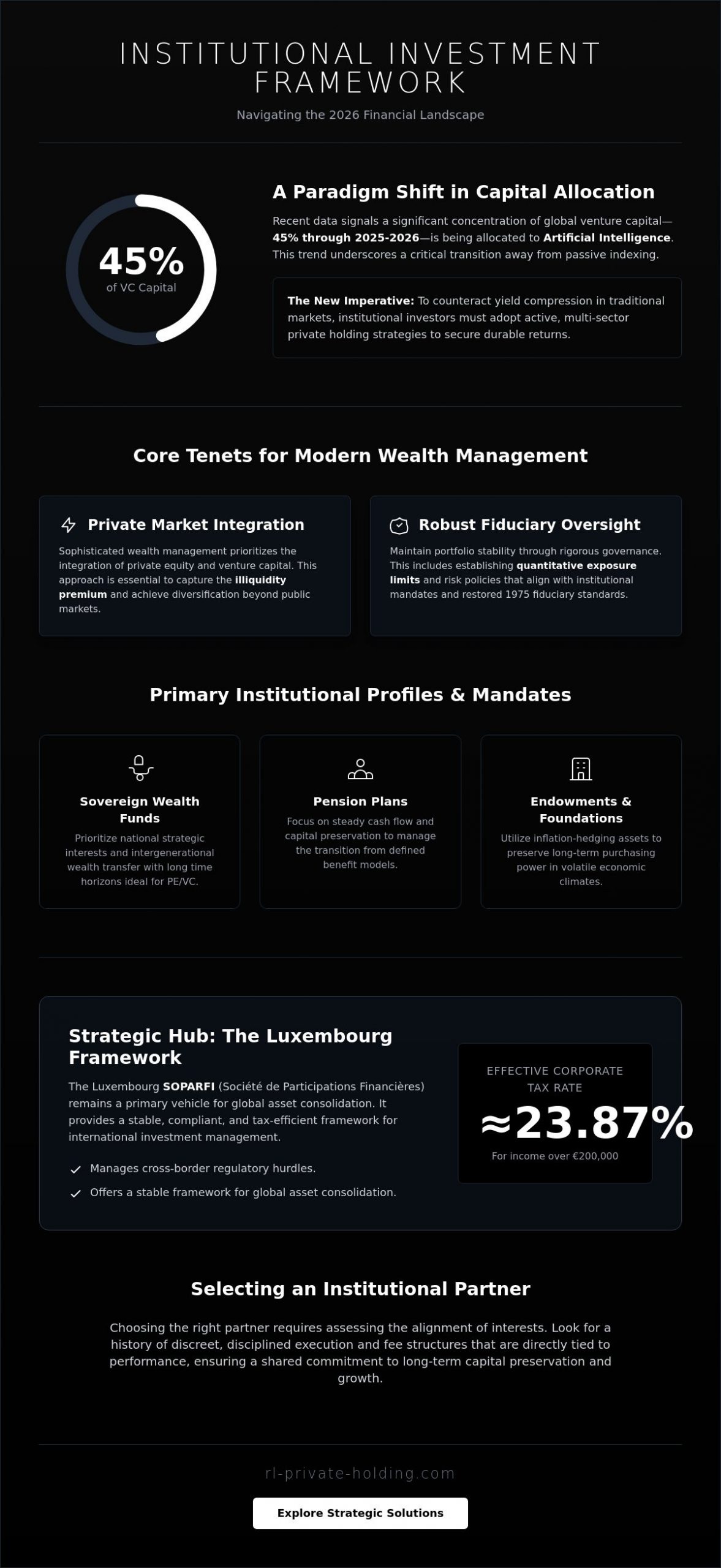
Recent data indicates that 45% of all venture capital investment throughout 2025 and 2026 has been allocated to artificial intelligence, signaling a significant concentration of global capital. Most institutional entities acknowledge that yield compression in traditional markets has made the search for durable returns increasingly complex. Effective wealth management for institutional investors now demands a rigorous integration of private market assets within highly disciplined holding structures. You likely recognize that maintaining portfolio stability requires more than simple diversification; it requires a strategic response to shifting global regulations and market bifurcation.
This resource provides a comprehensive framework for navigating the complexities of private equity, venture capital, and global asset management. We will address the practical implications of the restored 1975 fiduciary standards and the specific tax considerations in Luxembourg, where the effective corporate tax rate for income over €200,000 remains approximately 23.87%. This guide previews the governance models and risk oversight strategies necessary to manage illiquid allocations while ensuring long-term capital preservation. By establishing clear structures for cross-border investing, organizations can better manage the regulatory hurdles that define the current financial landscape.
Key Takeaways
- The 2026 institutional environment requires a transition from passive indexing toward active, multi-sector private holding strategies to address global market volatility.
- Sophisticated wealth management for institutional investors prioritizes the integration of private equity and venture capital to capture the illiquidity premium.
- Robust fiduciary oversight is maintained through the establishment of quantitative exposure limits and risk policies that align with specific institutional mandates.
- The Luxembourg SOPARFI remains a primary vehicle for global asset consolidation, offering a stable framework for international investment management and regulatory compliance.
- Selecting an institutional partner involves assessing the alignment of interests through performance-based fee structures and a history of discreet, disciplined execution.
The Evolving Universe of Institutional Wealth Management
The institutional investment landscape in 2026 is defined by a departure from the rigid asset buckets of previous decades. An Institutional Investor today operates within a global environment where passive indexing often fails to provide the required alpha. This reality has prompted a transition toward active, multi-sector private holding strategies. Modern wealth management for institutional investors centers on the ability to consolidate diverse assets into cohesive, manageable frameworks. It’s no longer enough to track an index. Success now requires a disciplined approach to private markets and a sophisticated understanding of global holding structures.
Stakeholder management remains a primary challenge for large scale entities. Decision makers must balance long term liabilities with immediate liquidity requirements. This equilibrium is difficult to maintain when traditional markets experience yield compression. Consequently, the role of the investment holding company has emerged as a centralizing force. These structures provide the structural integrity needed to manage diversified assets while maintaining clear governance and oversight.
Primary Institutional Profiles and Mandates
Sovereign Wealth Funds continue to prioritize national strategic interests and intergenerational wealth transfer. Their mandates often allow for longer time horizons, making them ideal candidates for venture capital and private equity allocations. Pension plans face a different set of pressures. They’re currently managing the complex transition from defined benefit models to diversified asset pools. This shift requires a focus on steady cash flow and capital preservation. Endowments and foundations remain focused on preserving purchasing power. They utilize inflation hedging assets to ensure their long term survival in a volatile economic climate.
Shifting Objectives in the 2026 Financial Landscape
Objective setting has moved toward total portfolio thinking rather than rigid bucket allocation. This approach ensures that every asset, whether it’s a real estate holding or a private equity stake, is evaluated for its contribution to the entire risk profile. Sustainability and governance aren’t just ethical considerations; they’re core components of institutional risk management. Furthermore, technological integration in reporting has become mandatory for global portfolios. It allows for precise asset tracking and real time data analysis across multiple jurisdictions. This level of transparency is essential for maintaining fiduciary standards in an increasingly complex regulatory environment. Organizations that fail to adopt these integrated strategies risk falling behind as the market bifurcates between high performing private assets and stagnant public indices.
Advanced Asset Allocation: Integrating Private Equity and Venture Capital
Institutional mandates possess a unique structural advantage: the capacity for capital permanence. This allows organizations to harvest the illiquidity premium, a return component unavailable to participants constrained by daily redemption requirements. Effective wealth management for institutional investors in 2026 centers on this fundamental ability to hold non-correlated private assets through varying market cycles. By integrating private equity and venture capital, portfolios achieve a level of diversification that public markets alone can’t provide. These allocations don’t just add risk; they fundamentally rebalance the return profile toward long term capital preservation and growth.
The strategic “why” behind these moves often relates to the board’s fiduciary responsibilities. Robust Risk Management and the Board of Directors oversight ensures that illiquid positions align with the institution’s liability profile. When managed with discipline, these assets serve as a hedge against the volatility inherent in traditional equity indices.
The Mechanics of Private Equity for Institutional Portfolios
Private equity has evolved into a primary driver of operational value creation. It’s no longer a matter of simple financial engineering or leverage. Modern wealth management for institutional investors focuses on firms that implement tangible improvements in revenue growth and operational efficiency. Direct investments remain attractive for those with the internal capacity to conduct deep due diligence, while fund-of-funds offer a diversified entry point for smaller endowments. Investors must account for the J-curve effect, where early year management fees and capital calls precede the realization of significant gains. Sector specialization is critical here; focusing on high quality assets in specific industries often yields better results than broad market exposure.
Venture Capital as a Strategic Growth Lever
Venture capital provides access to exponential growth in technology and healthcare. Data from 2025 and early 2026 shows that 45% of all venture capital investment was directed toward artificial intelligence, reflecting a massive shift in institutional innovation mandates. Accessing growth stage technology firms requires a disciplined approach to follow-on funding and risk mitigation. Diversified venture portfolios help manage the high failure rate of individual startups while capturing the outsized returns of global leaders. Organizations seeking to optimize these allocations often benefit from a sophisticated investment management partner that understands the nuances of the venture lifecycle. This strategic positioning allows institutions to participate in the value creation process long before these companies reach public markets.
Institutional Governance: Risk Assessment and Fiduciary Oversight
Establishing a defensible risk policy requires a transition from abstract goals to concrete, documented mandates. For those involved in wealth management for institutional investors, this documentation serves as the primary defense against volatility compounding. The restoration of the 1975 five-part test for fiduciary duties under ERISA, effective as of April 2026, has reinforced the necessity for clear, evidence-based decision making on a global scale. A well-structured policy defines the quantitative thresholds for every asset class. It ensures that illiquid allocations don’t exceed the organization’s capacity for long term capital preservation.
The Investment Committee acts as the steward of these principles. It operates on a fixed decision-making cadence to review performance and risk metrics with objective precision. Roles must be explicitly defined to ensure accountability, particularly when managing complex cross-border structures. Documenting every assumption behind a private equity or venture capital commitment is necessary for auditability. This transparency protects stakeholders and provides a clear trail for future oversight. It’s a methodical approach that reflects institutional gravity and disciplined management.
Risk Assessment Frameworks for Private Assets
Evaluating manager and operational risk is as vital as assessing market volatility. Private equity management fees, which averaged 1.82% inside the investment period as of March 15, 2026, according to Preqin data, must be factored into the net return expectations. Liquidity bucketing is a critical tool in this process. It ensures that the institution maintains sufficient funding paths for capital calls and operational needs without being forced to liquidate assets at a discount. Correlation analysis also helps wealth management for institutional investors identify how private holdings interact with public markets during periods of stress. This understanding prevents the unintended concentration of risk in specific sectors or geographies.
Monitoring and Rebalancing Strategies
Rules-based rebalancing prevents portfolio drift, especially during the selective recovery currently observed in private markets. It’s essential to identify the true drivers of ROI through detailed performance attribution. Insights from the 2024 Institutional Investor Survey suggest that governance remains a central pillar of investor confidence and long term success. Continuous due diligence ensures that manager performance remains aligned with the initial allocation thesis long after the capital is committed. Regular reviews of operational efficiency and revenue growth within portfolio companies help confirm that value creation is actually occurring as planned.
Strategic Investment Structures: The Luxembourg Holding Framework
Luxembourg has established itself as the premier jurisdiction for global asset consolidation. Its sophisticated legal framework provides the stability required for high-stakes wealth management for institutional investors. The country’s extensive tax treaty network minimizes double taxation, which directly impacts the net returns of cross-border portfolios. This environment is particularly conducive to the long term capital preservation goals of sovereign wealth funds and large scale endowments. By centralizing assets within a stable, highly regulated ecosystem, institutions can better manage the complexities of global market participation.
The regulatory environment in Luxembourg is characterized by a high degree of transparency and predictability. This structural integrity is a primary reason why global entities favor the jurisdiction for their alternative investment platforms. While the combined effective corporate tax rate in Luxembourg for income exceeding €200,000 is approximately 23.87% for fiscal year 2026, the availability of specific holding regimes provides the necessary efficiency for institutional mandates.
The Benefits of the SOPARFI Structure
The SOPARFI (Société de Participations Financières) remains the primary holding vehicle for institutional assets. It’s a fully taxable commercial company that benefits from the Luxembourg participation exemption regime. This regime allows for the tax-exempt receipt of dividends and capital gains from qualifying subsidiaries, provided specific holding periods and ownership thresholds are met. It offers significant flexibility in managing diversified global portfolios across multiple sectors. The SOPARFI is an essential component in private equity and real estate asset management, serving as a robust layer of structural protection between the investor and the underlying assets.
Alternative Investment Fund (AIF) Dynamics
For institutional managers requiring rapid market entry, the Reserved Alternative Investment Fund (RAIF) offers a streamlined path. The RAIF doesn’t require direct supervision from the CSSF, the Luxembourg financial regulator, which accelerates the launch process. However, it must be managed by an authorized Alternative Investment Fund Manager (AIFM). This governance model ensures strict compliance with the AIFM Directive while allowing for the efficient structuring of venture capital and real estate assets. Organizations seeking to optimize their global holding frameworks can evaluate private equity investment management options that leverage these sophisticated Luxembourgish structures to ensure portfolio stability and regulatory alignment.
Selecting an Institutional Partner: The RL Private Holding Perspective
Selecting a partner for wealth management for institutional investors demands a focus on discretion and long term alignment. Large scale organizations often require a level of confidentiality that retail banking structures don’t provide. RL Private Holding operates as a privately held entity, ensuring that sensitive mandates remain shielded from public market noise. This approach prioritizes the structural integrity of the portfolio over short term trends. It allows for the management of diverse assets, including venture capital funding and real estate asset management, through a single, centralized framework. By consolidating multi-sector expertise under one roof, the firm provides the quiet authority required for high stakes global investment.
Alignment of interests is achieved through performance based fee structures and carried interest. This model ensures that the partner’s incentives are directly linked to the success of the institutional mandate. By focusing on capital preservation and disciplined growth, the firm acts as a steady hand in the background of major global investments. The ability to manage technology, real estate, and private equity sectors within a unified structure simplifies the oversight process for boards and investment committees. It reduces the technical complexity often associated with multi-jurisdictional asset management and ensures that every allocation is held to the same rigorous standard of governance.
The “Silent Giant” Approach to Wealth Management
Prioritizing structural integrity is essential for long term stability. Market hype often leads to volatile allocations that don’t align with institutional liabilities. By maintaining professional distance, RL Private Holding offers a sober, factual perspective on asset performance. A diversified global portfolio, managed with institutional gravity, provides a buffer against the regional economic shifts previously discussed regarding the Luxembourg market. The firm’s global scale is matched by a methodical approach to risk management, focusing on institutional permanence rather than rapid disruption.
Next Steps for Institutional Allocation
Organizations should begin by evaluating current portfolio gaps in private market exposure. This involves a structural review of existing holding vehicles to ensure they’re optimized for the 2026 regulatory environment. Yield compression in traditional markets suggests that a transition toward more sophisticated private equity investment management is necessary for maintaining target returns. Those seeking to refine their global frameworks can contact RL Private Holding for a strategic consultation on institutional structures. Initiating a review of current asset management practices ensures that the portfolio remains resilient against future volatility and regulatory shifts.
Securing Institutional Longevity through Strategic Alignment
The 2026 investment landscape demands a departure from traditional indexing in favor of disciplined private market participation. Success in wealth management for institutional investors depends on the seamless integration of venture capital, private equity, and real estate within robust holding structures. By leveraging the regulatory stability of Luxembourg and establishing clear fiduciary oversight, organizations can navigate yield compression while maintaining long term capital preservation. It’s no longer sufficient to follow broad market trends; instead, institutions must prioritize structural integrity and professional discretion.
RL Private Holding provides the institutional gravity and multi-sector expertise required to manage these complex global mandates. As a privately held investment holding company, we prioritize structural stability over market volatility. Our focused approach ensures that your portfolio remains resilient against shifting global regulations and market bifurcation. Explore Strategic Institutional Wealth Management with RL Private Holding to refine your organization’s global holding framework. Establishing a disciplined partnership today ensures your institution is prepared for the challenges of the coming decade.
Frequently Asked Questions
What are the primary differences between retail and institutional wealth management?
Institutional wealth management focuses on matching long term liabilities with diversified asset pools rather than individual retirement goals. Unlike retail services, wealth management for institutional investors involves navigating complex regulatory frameworks and managing significant illiquid allocations. These mandates require a higher degree of structural integrity and professional discretion to handle large scale capital movements across multiple jurisdictions.
How much should institutional investors allocate to private equity in 2026?
Allocation levels depend on the specific liability profile and risk tolerance of the institution. In 2026, many organizations are increasing their exposure to private markets to capture the illiquidity premium as traditional markets face yield compression. This trend reflects a selective recovery where high quality assets are prioritized to ensure durable returns over extended horizons. It’s essential to balance these commitments against immediate liquidity needs.
What makes Luxembourg a preferred jurisdiction for institutional investment structures?
Luxembourg is preferred due to its established legal framework and extensive network of double tax treaties. The jurisdiction provides a stable and predictable environment for alternative investment funds and holding companies. This stability is essential for institutional investors who require a reliable base for consolidating global assets and managing cross border regulatory requirements. The presence of specialized service providers further supports this institutional gravity.
How do performance-based fees align the interests of institutional investors and managers?
Performance-based fees ensure that the manager’s financial incentives are directly tied to the achievement of the institution’s return targets. This structure discourages excessive risk taking for short term gains and prioritizes long term capital preservation. It creates a disciplined partnership where both parties are focused on the consistent generation of alpha. Such alignment is critical for maintaining trust in high stakes asset management.
What is the role of a SOPARFI in a global investment holding strategy?
A SOPARFI serves as a primary vehicle for consolidating global participations under a single, stable holding structure. It allows for the efficient management of dividends and capital gains through the Luxembourg participation exemption regime. This centralized force is particularly effective for managing diversified interests in private equity and real estate sectors. It provides the structural integrity needed to oversee a global multi-sector portfolio.
How can institutional investors manage the liquidity risks associated with venture capital?
Managing liquidity in venture capital requires the use of liquidity bucketing and strategic secondary market participation. Secondary markets have become an increasingly important source of liquidity for limited partners in 2026. By maintaining a portion of the portfolio in more liquid assets, institutions can meet capital calls without disrupting their long term growth strategy. This methodical approach prevents forced liquidations during market downturns.
What governance controls are essential for multi-sector private portfolios?
Essential controls include the setting of quantitative exposure limits and the establishment of clear decision making cadences. An investment committee must document all assumptions to ensure transparency and auditability for all stakeholders. These controls prevent volatility compounding and ensure that the portfolio remains aligned with the original institutional mandate. Regular reviews of manager performance help maintain a high standard of fiduciary oversight.
How does carried interest impact the net ROI for institutional investors?
Carried interest represents a share of the profits paid to the manager after the return of the initial capital and a preferred return. While it impacts the net ROI, it serves as a critical mechanism for aligning the manager’s performance with the investor’s success. It ensures that the manager is incentivized to maximize the value of the portfolio companies over the long term. This profit sharing model is a standard component of wealth management for institutional investors in private markets.