

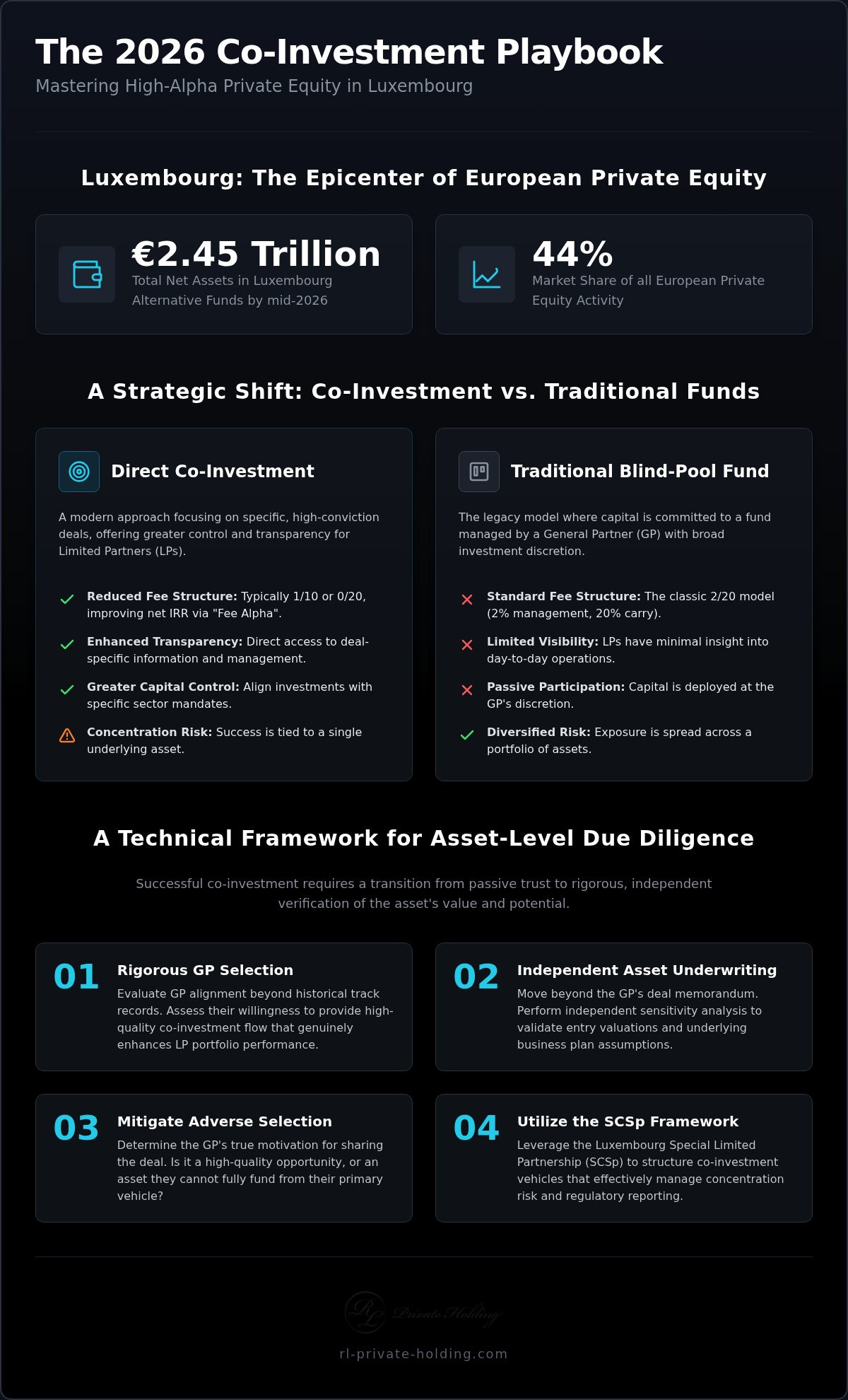
By mid-2026, the total net assets of alternative funds domiciled in Luxembourg reached €2.45 trillion, reflecting a market that now commands 44% of all European private equity activity. You’re likely aware that while direct co-investments offer a clear path to lower blended fee structures, success depends on the rigorous private equity fund manager selection criteria Luxembourg partners use to ensure GP alignment. Identifying deals that provide genuine sector alpha requires a transition from passive participation toward a technical evaluation of underlying assets within truncated due diligence windows.
This article delivers a comprehensive framework to master the sophisticated due diligence protocols required to identify and execute high-alpha co-investments. We examine the essential metrics for vetting deal-specific risk, particularly under the oversight of AIFMD II and the 2026 carried interest tax regime. You’ll gain a clear perspective on managing liquidity through the SCSp vehicle and applying the latest ESG Ratings Regulation to protect exit valuations in a disciplined global market. This methodical approach ensures that your capital is deployed with the precision and transparency required for long-term institutional stability.
Key Takeaways
- Understand the 2026 shift toward bespoke co-investment portfolios, which allows for greater transparency and reduced fee structures compared to traditional blind-pool fund commitments.
- Apply the technical private equity fund manager selection criteria Luxembourg institutional investors employ to ensure GP alignment and prevent the risk of adverse selection in deal flow.
- Master asset-level underwriting techniques that move beyond the GP’s deal memorandum to verify a target company’s competitive advantage and market leadership position.
- Utilize the Luxembourg Special Limited Partnership (SCSp) framework to structure co-investment vehicles that effectively manage concentration risk and regulatory reporting requirements.
The Evolution of Private Equity Co-Investment in 2026
The private equity landscape in 2026 is defined by a distinct move toward asset-specific transparency. An equity co-investment is defined as a minority investment made by limited partners (LPs) alongside a general partner (GP) in a specific target asset. This structure allows institutional investors to bypass the broad diversification of a traditional blind-pool fund in favor of concentrated exposure to high-conviction deals. As Luxembourg maintains its 44% share of all European private equity funds, the sophistication of these transactions has reached a new threshold. Institutional allocators now prioritize bespoke portfolios that align with specific sector mandates rather than relying on the generalist approach of the previous decade.
The “Fee Alpha” argument remains a primary driver for this strategic shift. By participating in co-investments, LPs can significantly improve their net internal rate of return (IRR) through a lower blended fee structure. These arrangements often feature a 0/20 model or a significantly reduced management fee, such as 1/10, compared to the standard 2/20 primary fund structure. This reduction in the total cost of capital is a critical component of modern private equity fund manager selection criteria Luxembourg investors utilize. It’s no longer sufficient to evaluate a manager’s historical track record alone; one must also assess their willingness to provide high-quality co-investment flow as a means of enhancing the LP’s overall portfolio performance.
Distinguishing between syndicated co-investments and direct co-sponsored deals is essential in the current market. Syndicated deals are typically offered to a wider group of LPs after the GP has secured the asset, whereas co-sponsored deals involve the LP earlier in the transaction process. The latter provides greater influence over deal terms and deeper due diligence access, though it requires a higher level of internal technical expertise to execute successfully.
The Strategic Rationale for Institutional Allocators
Institutional allocators utilize co-investments to exert greater control over capital deployment in specialized sectors like technology and real estate. By investing directly into a single asset, investors can shorten the J-curve effect that typically characterizes the early years of primary fund commitments. Additionally, these opportunities facilitate a disciplined knowledge transfer between the GP and the LP. This allows the investor to build internal direct-investment capabilities while benefiting from the GP’s operational expertise and the robust regulatory framework of the Luxembourg market.
Co-Investment vs. Traditional Primary Fund Commitments
The governance rights in a co-investment structure are notably different from those in a primary fund. While LPs in a fund have limited visibility into daily operations, co-investors often secure enhanced information rights and direct access to management teams. However, this transparency comes with increased concentration risk. The private equity fund manager selection criteria Luxembourg firms apply must therefore include a rigorous analysis of the GP’s ability to mitigate adverse selection. It’s essential to determine if a GP is sharing a deal because of its high quality or because they simply lack the capacity to fund the entire transaction from their primary vehicle.
A Technical Framework for Asset-Level Due Diligence
Successful co-investment execution requires a fundamental shift from passive trust to rigorous verification. While the initial stage of any allocation involves the standard private equity fund manager selection criteria Luxembourg institutional investors utilize, the asset-level phase demands independent underwriting. Relying solely on a GP’s deal memorandum is insufficient; an LP must perform its own sensitivity analysis to validate the entry valuation and the underlying assumptions of the business plan. This secondary layer of scrutiny is what separates high-alpha opportunities from those characterized by adverse selection. When selecting a private markets fund manager, it’s vital to assess their transparency in providing the granular data sets required for this level of independent review.
The Equity Story represents the fundamental core of any 2026 evaluation, serving as a precise narrative that links current operational capabilities to a predefined exit strategy. Within this framework, an investor must determine the target’s “Right to Win.” This involves a sober assessment of whether the company is a genuine market leader with a sustainable competitive advantage or a distressed play requiring significant operational restructuring. In the current economic climate, the focus remains on EBITDA quality, the reliability of cash flow conversion, and the asset’s debt serviceability under 2026 interest rate benchmarks. Investors should prioritize assets that demonstrate organic growth resilience over those that rely heavily on pro-forma adjustments or aggressive financial engineering.
Financial and Operational Integrity
A disciplined evaluation focuses on historical growth sustainability rather than speculative pro-forma projections. It’s essential to analyze the management team’s track record, specifically their performance in similar scaling or turnaround scenarios. A robust competitive moat is non-negotiable; we look for assets protected by:
- Significant intellectual property or proprietary technology.
- Strong network effects that increase in value as the user base expands.
- High regulatory barriers to entry that protect market share in the Eurozone.
Maintaining these rigorous due diligence protocols ensures that capital is only committed to assets with verified operational integrity.
The Exit Landscape and Realization Potential
Identifying the most likely buyer is a critical component of the 2026 investment thesis. The evaluation must consider whether the asset is positioned for an IPO, a secondary sale to a larger private equity sponsor, or a strategic acquisition by a corporate entity. We stress-test exit multiples against historical sector averages to ensure that the realization potential isn’t dependent on market exuberance. This conservative approach to forecasting protects the portfolio from the volatility often found in speculative exit routes.
Evaluating GP Alignment and Mitigating Adverse Selection
The central challenge in any co-investment transaction is understanding the GP’s motivation for sharing the opportunity. If an asset is truly exceptional, the general partner would typically prefer to retain the entire allocation within their primary fund. Fund concentration limits or transaction sizes exceeding the fund’s mandate often dictate the need for partners. However, a disciplined investor must verify these reasons through the private equity fund manager selection criteria Luxembourg institutions rely upon to ensure the GP isn’t offloading a marginal asset. This technical vetting process is essential to prevent adverse selection, where an LP is offered deals the GP has less conviction in.
A critical metric in this evaluation is the “Skin in the Game” test. We analyze the GP’s own capital commitment to the specific asset, looking for a significant personal stake from the fund’s partners. A substantial commitment indicates that the GP’s interests are structurally aligned with those of the co-investor. This analysis forms a cornerstone of sophisticated private equity investment management, ensuring that the value-creation plan is backed by genuine institutional conviction. The GP must demonstrate a clear operational roadmap that leverages their sector-specific expertise to drive the asset’s growth over the holding period.
The GP-LP Relationship Dynamics
Analyzing the GP’s history requires a comparison of their co-investment performance against their primary fund returns. Any significant discrepancy suggests a potential mismatch in underwriting standards or a lack of post-close operational focus on co-invested assets. Transparency remains a priority. We look for managers who maintain rigorous reporting standards and provide consistent communication throughout the investment lifecycle. A fair allocation policy is also necessary to ensure that high-quality deal flow is distributed equitably among all limited partners without favoritism.
Identifying Red Flags in Co-Investment Teasers
Certain indicators suggest a deal may carry underlying risks that the GP’s memorandum might downplay. Assets that have been shopped extensively to numerous LPs before reaching your desk often signal a lack of broader institutional interest. We also scrutinize the GP’s financial model for excessive leverage or aggressive add-back accounting that inflates the projected EBITDA. A mismatch between the asset’s risk profile and the GP’s core competency is another significant red flag. If a manager specialized in technology presents a distressed industrial turnaround, the execution risk increases significantly due to a lack of relevant operational experience.
Structural Considerations and Risk Management in Luxembourg
The technical architecture of a co-investment is as critical to its success as the underlying asset’s performance. In the 2026 market environment, the Luxembourg special limited partnership (SCSp) has solidified its position as the premier vehicle for structuring co-investment Special Purpose Vehicles (SPVs). Its contractual flexibility allows general partners to tailor governance and economic rights to the specific needs of the transaction while maintaining tax transparency. This structural efficiency is vital because the typical diligence window for a co-investment offer in 2026 is now constrained to a 2-4 week period, requiring a pre-established legal framework that can be deployed with institutional speed.
Managing concentration risk is a primary concern for sophisticated allocators moving beyond traditional fund structures. Disciplined investors often set hard caps on single-asset exposure, typically limiting any one co-investment to 5-10% of the total private equity sleeve. For smaller institutional allocators, Co-Investment Aggregator vehicles offer a solution by pooling capital from multiple LPs to meet the GP’s minimum ticket requirements. When applying the private equity fund manager selection criteria Luxembourg firms demand, the GP’s proficiency in managing these aggregator structures without diluting the LP’s information rights is a key differentiator.
Luxembourg as a Global Co-Investment Hub
Luxembourg’s dominance in the alternative investment space, holding a 44% share of all European private equity funds, stems from its regulatory certainty and the versatility of its toolkit. The combination of a SOPARFI for holding activities and the SCSp for fund-level operations provides a robust framework for cross-border deals. This environment offers tax neutrality and clarity under the 2026 carried interest regime, making it an ideal jurisdiction for integrating direct deals into a broader family office investment strategy. The ability to domicile both the primary fund and the co-investment SPV in the same jurisdiction simplifies reporting and compliance under AIFMD II.
Post-Investment Monitoring and Governance
Governance in a minority co-investment requires a delicate balance between active oversight and passive participation. While LPs rarely hold board seats, securing observer rights has become the industry standard for significant co-investors. This allows for real-time monitoring of KPI tracking protocols and ensures the GP adheres to the agreed-upon value-creation plan. Furthermore, investors must plan for follow-on capital requirements, particularly in growth-stage technology assets where subsequent funding rounds can lead to significant dilution if the LP lacks the liquidity to participate. Establishing a clear reporting cadence is essential to manage these capital calls and maintain portfolio stability.
For institutional partners seeking to optimize their allocation structures, we invite you to explore our private equity investment management services to ensure your co-investment strategy is executed with institutional-grade precision.
RL Private Holding: Institutional Excellence in Co-Investment
RL Private Holding operates as a disciplined partner for institutional and private investors seeking exposure to global private equity and venture capital markets. Our firm is built upon a foundation of quiet authority, where investment decisions are dictated by objective data rather than market sentiment. We understand that applying the private equity fund manager selection criteria Luxembourg requires more than a checklist; it demands a deep environmental understanding of jurisdictional nuances and asset-level technicalities. By maintaining a sober, factual approach to every transaction, we ensure that our partners benefit from a stable and transparent investment environment.
Our presence in Luxembourg allows for the seamless execution of sophisticated co-investment structures, such as the SCSp and SOPARFI vehicles. We navigate the complexities of AIFMD II and the latest tax regulations with precision, providing institutional investors with the regulatory certainty they require for long-term capital preservation. This local expertise is particularly valuable when managing the truncated due diligence windows characteristic of the 2026 market. We prioritize the structural integrity of every SPV, ensuring that governance rights and reporting cadences are established with institutional-grade rigor from the outset.
Sophisticated investors are invited to explore our direct and co-investment frameworks to understand how we facilitate high-conviction allocations. We remain a steady hand in the background of major investments, focusing on long-term strategic goals rather than short-term volatility. Our commitment to rigorous, fact-based investment evaluation ensures that every opportunity is vetted for genuine alpha potential and structural alignment with our partners’ mandates.
Our Approach to Venture Capital and Growth Equity
We focus our capital allocation on technology and real estate sectors that demonstrate high realization potential and clear competitive moats. Our methodology involves a thorough assessment of historical growth sustainability and EBITDA quality, as previously outlined in our technical framework. By integrating our sophisticated wealth management services with direct private equity exposure, we provide a holistic growth strategy that accounts for both liquidity needs and long-term alpha generation. This integrated approach allows for a more diversified portfolio that remains resilient across various market cycles.
Please contact RL Private Holding to initiate a confidential discussion regarding your institutional allocation requirements and how our disciplined due diligence protocols can support your investment objectives.
Advancing Institutional Co-Investment Strategies for 2026
The transition toward asset-specific transparency requires moving from passive fund participation to rigorous independent underwriting. Success in this landscape is defined by an investor’s ability to verify GP alignment and manage concentration risk through pre-established legal frameworks like the SCSp. By applying sophisticated private equity fund manager selection criteria Luxembourg investors can ensure that their capital is deployed into high-conviction deals that offer genuine sector alpha. This methodical approach protects the portfolio from the volatility of adverse selection while maximizing the benefits of lower blended fee structures.
RL Private Holding provides the global investment management expertise and specialized Luxembourg structural knowledge required to navigate these transaction complexities. Our firm maintains a diversified portfolio across technology and real estate sectors, reflecting a disciplined commitment to capital preservation and long-term growth. We invite sophisticated allocators to refine their direct investment protocols with a partner that prioritizes factual integrity and institutional stability. Explore Strategic Private Equity Management with RL Private Holding to secure your position in the evolving private equity market. It’s a strategic evolution that promises greater transparency and enhanced portfolio performance.
Frequently Asked Questions
What is the difference between a private equity co-investment and a direct investment?
A co-investment involves a limited partner investing alongside a general partner in a specific asset, whereas a direct investment is executed independently of a fund manager. Co-investors benefit from the GP’s sourcing and operational management. Direct investors must maintain their own internal deal teams and oversight capabilities to manage the asset throughout its lifecycle.
How much do private equity co-investments typically cost in terms of fees in 2026?
Industry standards in 2026 typically position co-investment fees at a 0/20 or 1/10 structure. This represents a significant reduction from the traditional 2/20 primary fund model. These reduced rates allow institutional allocators to achieve a lower blended fee across their total private equity portfolio, directly enhancing net returns.
Why do private equity firms offer co-investment opportunities to LPs?
Firms offer these opportunities primarily to manage fund concentration limits or to complete transactions that exceed their primary vehicle’s capital capacity. It also serves as a strategic tool to strengthen relationships with key institutional partners. By sharing deal flow, GPs can secure the necessary capital for larger acquisitions without relying on third-party financing.
What are the biggest risks associated with private equity co-investments?
The primary risks include adverse selection, where a GP might share a deal of lower quality, and concentration risk due to the single-asset nature of the investment. Shorter due diligence windows and limited governance rights also present challenges. Investors must have the technical expertise to independently verify the GP’s underwriting assumptions within a limited timeframe.
How long is the typical due diligence period for a co-investment deal?
The due diligence period for a co-investment is typically compressed into a window of two to four weeks. This requires investors to have established technical frameworks and rapid internal decision-making processes to meet the GP’s closing timeline. Delays in this process can result in the loss of the allocation to other interested partners.
Can individual investors participate in private equity co-investments in Luxembourg?
Individual participation is generally restricted to “well-informed” investors as defined by Luxembourg regulatory frameworks. These investors must meet specific wealth thresholds and demonstrate sufficient expertise to manage the risks associated with alternative assets. Most co-investment opportunities also require high minimum ticket sizes that favor institutional or ultra-high-net-worth allocators.
What is the role of a Luxembourg SCSp in co-investment structures?
The Special Limited Partnership (SCSp) provides a flexible, tax-transparent vehicle for structuring co-investment Special Purpose Vehicles. It is a core component of the private equity fund manager selection criteria Luxembourg allocators use to ensure structural efficiency. The SCSp allows for rapid setup and bespoke governance terms, making it ideal for the fast-paced co-investment market.
How do co-investments impact the overall IRR of a private equity portfolio?
Co-investments can enhance the net internal rate of return (IRR) by reducing the overall fee drag on the portfolio. They also help mitigate the J-curve effect by deploying capital into assets that are often closer to a realization event than those in a traditional blind-pool fund. This targeted exposure allows for more precise portfolio construction and improved capital efficiency.