

The most consequential negotiation in private equity isn’t the deal itself; it’s the agreement that governs every decision, distribution, and dispute before a single asset is acquired. Institutional investors who treat the limited partner agreement as a formality rather than a strategic instrument frequently discover its shortcomings at precisely the worst moment: during a key person departure, a fee dispute, or a contested exit. Negotiating key terms in a limited partner agreement has therefore evolved from a procedural exercise into a discipline of institutional self-preservation.
That instinct to focus narrowly on management fee reductions is understandable, and it reflects a legitimate concern about cost alignment. But fee economics represent only one dimension of a far more complex document. In 2026, the sophisticated LP understands that the governance architecture embedded within an LPA, covering consent rights, removal triggers, and distribution waterfall mechanics, is what determines whether an investment relationship endures on equitable terms or quietly erodes them.
This analysis provides a structured framework for institutional investors approaching LPA negotiations, with particular attention to economic provisions, protective governance mechanisms, and the structural considerations relevant to Luxembourg-domiciled fund vehicles. It is designed to identify where market standards currently sit and, critically, where meaningful negotiating leverage remains.
Key Takeaways
- Negotiating key terms in a limited partner agreement extends well beyond fee reductions — governance provisions, waterfall mechanics, and consent rights often carry greater long-term consequence for institutional investors.
- Key Person Provisions and LPAC composition are critical protective mechanisms that must be defined with precision before capital is committed, not revisited after a management disruption occurs.
- A disciplined negotiation strategy distinguishes between non-negotiable structural protections and secondary economic concessions, using side letters to address bespoke requirements without compromising the integrity of the main agreement.
- Luxembourg-domiciled fund vehicles, particularly the SCSp structure, offer a contractually flexible and institutionally recognized framework that supports robust GP/LP alignment across cross-border mandates.
- Understanding where market standards currently sit — and where genuine negotiating leverage remains — is what separates institutional investors who preserve their position from those who quietly cede it.
The Evolution of Limited Partner Agreements in the 2026 Landscape
The limited partner agreement has never been a static document. What began as a relatively standardized instrument for establishing the basic terms of a private fund relationship has evolved into one of the most consequential and contested legal frameworks in institutional finance. In 2026, the conditions that once permitted general partners to present near-identical agreements to successive investors have largely dissolved. Institutional capital allocators are better informed, more organizationally sophisticated, and considerably less tolerant of provisions that prioritize GP operational convenience over LP structural protection.
The Purpose of the Modern LPA
At its foundation, the LPA is a legally binding contract that defines the relationship between a general partner and the fund’s limited partners across every material dimension of the fund’s life. It establishes the limited partnership structure through which capital is pooled, deployed, and ultimately returned, while delineating the precise boundaries of GP authority and LP oversight. A well-constructed LPA balances the operational autonomy a general partner requires to execute an investment mandate with the fiduciary protections that institutional investors are legally and ethically obligated to maintain on behalf of their beneficiaries. It also governs fund longevity through clearly defined term limits, extension protocols, and the conditions under which those extensions may be exercised, provisions that carry significant practical consequence in an environment where exit timelines have extended materially.
Market Trends Driving Negotiation in 2026
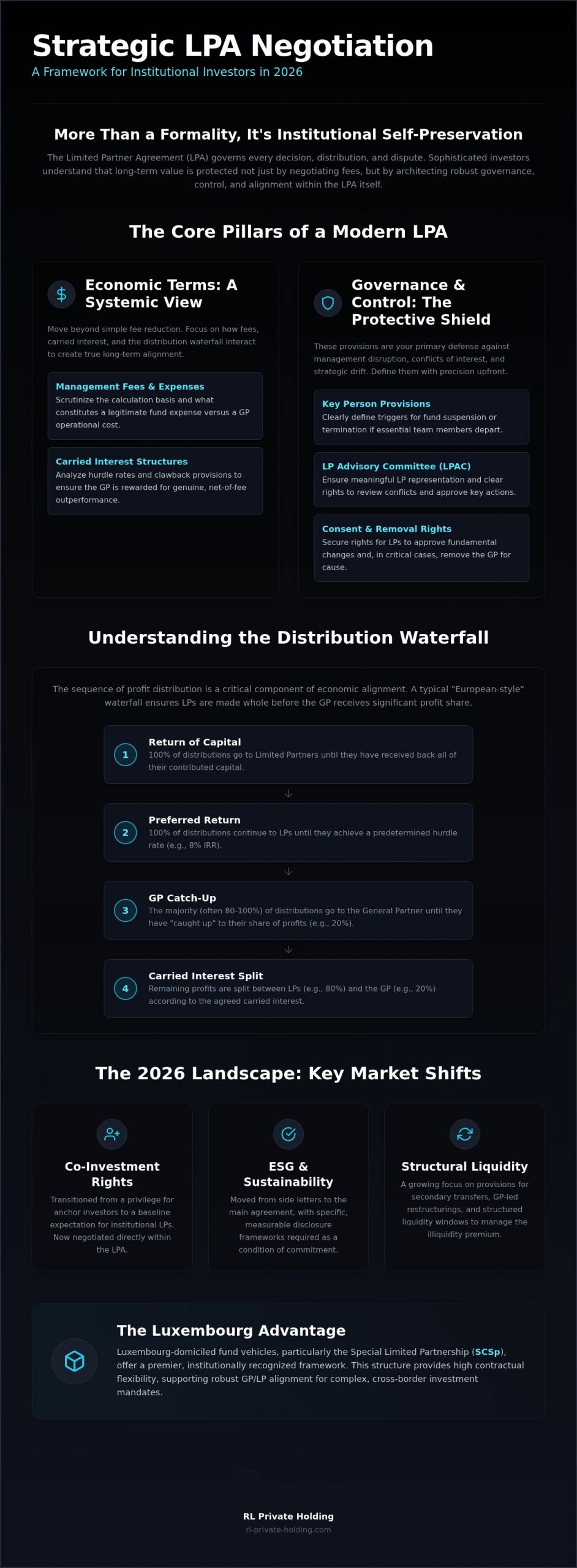
Three structural shifts are reshaping what negotiating key terms in a limited partner agreement actually requires in the current environment. First, co-investment rights have transitioned from a concession offered to anchor investors into a baseline expectation for institutional commitments of meaningful scale. LPs are seeking clearly defined co-investment frameworks within the LPA itself, not merely informal understandings subject to GP discretion at the time of each opportunity.
Second, ESG and sustainability reporting obligations have moved from supplementary side letter requests into the primary agreement. Pension funds, sovereign wealth vehicles, and endowments operating under regulatory or internal mandates now require specific, measurable disclosure frameworks as a condition of commitment, not an afterthought.
Third, liquidity has become a genuine structural concern. Where secondary market access was once considered an exceptional circumstance, a growing number of institutional investors are negotiating provisions that address secondary transfer rights, GP-led restructurings, and, in select cases, structured liquidity windows. These provisions reflect a durable change in how institutional capital views the illiquidity premium embedded in private market allocations.
The cumulative effect of these shifts is that standardization, long the default position of fund managers presenting first-draft agreements, is no longer an acceptable starting point for informed institutional investors.
Negotiating Economic Terms: Aligning Incentives for Long-Term ROI
Economic provisions sit at the center of every LPA negotiation, yet the instinct to treat them as a binary exercise in fee reduction consistently produces suboptimal outcomes. The real discipline lies in understanding how management fees, carried interest structures, and distribution waterfall mechanics interact across a fund’s full lifecycle. Negotiating key terms in a limited partner agreement at the economic level requires a systemic view, not a line-item one.
Management Fees and Operating Expenses
The conventional framing of management fees as a fixed percentage of committed capital obscures the considerable variation that exists in practice. Institutional investors with commitments of meaningful scale have well-established grounds to negotiate stepped reductions, whether structured as tiered fee breaks above defined commitment thresholds or as reduced rates that activate after the investment period closes and committed capital converts to deployed capital. Early closing incentives represent a separate negotiating lever: investors who anchor a fund’s first close frequently extract fee concessions that are unavailable to those who commit at final close.
The more consequential negotiation, however, concerns the boundary between fund expenses and GP overhead. Without precise definitional language, this boundary becomes permeable. Costs that reasonably belong to the general partner’s operating infrastructure, including deal sourcing travel, internal compliance functions, and back-office technology, can migrate into the fund expense category through loosely drafted provisions. Institutional investors should insist on an exhaustive enumerated list of permissible fund expenses, with a clear residual clause that assigns undefined costs to the GP.
Management fee offsets from monitoring fees, transaction fees, and director fees charged to portfolio companies represent a further area of negotiation. Market practice has moved toward full or near-full offset of such fees against the management fee, and any departure from that standard warrants explicit justification from the GP. Partial offset arrangements that allow the GP to retain a meaningful share of portfolio company fees materially affect net returns and should be evaluated accordingly.
Performance Incentives and the Waterfall
The choice between a whole-of-fund waterfall and a deal-by-deal structure is among the most consequential decisions an LP makes at the negotiating table. The whole-of-fund model, prevalent across European jurisdictions and increasingly the institutional standard in Luxembourg-domiciled vehicles, requires the GP to return all invested capital and the preferred return across the entire portfolio before carried interest distributions begin. The deal-by-deal model permits carry to flow on individual realized investments, exposing LPs to the risk of paying carried interest on early winners while later investments underperform.
In the current environment, the preferred return, or hurdle rate, warrants careful scrutiny. The appropriate benchmark reflects the risk-free rate environment and the specific asset class, and LPs should resist accepting a hurdle rate that has not been calibrated to current conditions rather than inherited from a prior fund vintage.
Two provisions protect LP capital once carry begins to flow. The GP catch-up clause determines how quickly the GP reaches its full carried interest entitlement after the hurdle is cleared; a 100% catch-up provision accelerates that process in ways that can disadvantage LPs in scenarios where fund performance is concentrated in a narrow window. The clawback mechanism, which obligates the GP to return excess carried interest distributions if the fund’s aggregate performance ultimately falls short of the hurdle, is equally critical. Clawback provisions are only as effective as their enforcement mechanics, and institutional investors should confirm that any clawback obligation is supported by an escrow arrangement or personal guarantee rather than a contractual promise contingent on GP solvency.
Investors seeking to structure these provisions with institutional precision across cross-border mandates will find that working with advisors experienced in Luxembourg fund architecture, where contractual flexibility and enforceability are well-established, provides a material advantage. Institutional private equity expertise of this kind ensures that economic provisions are structured to protect LP capital across the full duration of the fund relationship, not merely at the point of commitment.
Governance and Control: Protecting the Interests of the Limited Partner
Economic terms determine how returns are calculated and distributed. Governance provisions determine whether an LP retains any meaningful ability to influence outcomes when the relationship deteriorates. This distinction is fundamental, and it’s where many institutional investors discover, too late, that their negotiating priorities were misaligned. Negotiating key terms in a limited partner agreement at the governance level is not a secondary concern; it is the structural foundation upon which every economic protection ultimately rests.
Key Person and Team Stability
A Key Person provision operates as an automatic circuit breaker. When defined senior principals fall below a specified threshold of professional time commitment, the investment period suspends until LPs vote to reinstate it or elect to wind down the fund. The provision’s effectiveness depends entirely on how precisely it is drafted. Vague language around “substantially all” of a principal’s professional time has repeatedly proven inadequate in practice.
Institutional investors should negotiate for the following with specificity:
- Named key persons: The provision must identify specific individuals by name, not by title or role, with clear thresholds for what constitutes a qualifying departure or reduction in commitment.
- Time commitment percentages: A defined minimum percentage of professional time, typically no less than 80%, should be contractually required from each named principal during the investment period.
- Succession planning protocols: The LPA should establish a formal process for GP-proposed replacements, including LP consent rights over any substitution, rather than leaving succession to unilateral GP discretion.
- Cure periods: Any cure period following a Key Person event should be defined and limited, with LP voting rights activating automatically if the event is not remedied within the specified window.
Succession planning requirements deserve particular attention. A fund manager that cannot articulate an institutional continuity framework at the time of commitment is presenting a structural risk that no Key Person clause, however well-drafted, can fully mitigate.
The LPAC and Conflict Resolution
The Limited Partner Advisory Committee is frequently described as a conflict resolution mechanism. That framing understates its function. A properly constituted LPAC is the primary governance counterweight to GP authority across the fund’s life, with a remit that extends well beyond approving related-party transactions.
Representation matters as much as authority. An LPAC populated exclusively by the GP’s largest or most accommodating investors does not provide genuine oversight; it provides the procedural appearance of it. Institutional investors should negotiate for committee composition that reflects the diversity of the LP base, with seats allocated by commitment tier but not dominated by any single investor relationship. The LPAC’s authority should explicitly cover:
- Approval of affiliate transactions and conflicts of interest determinations
- Review of valuation methodologies and any material departures from them
- Consent rights over fund term extensions and material amendments to the LPA
- Oversight of GP removal proceedings, including the evidentiary standard for “for cause” determinations
On the question of GP removal, the distinction between “for cause” and “no fault” removal rights is consequential. For cause removal, triggered by fraud, gross negligence, or material breach, typically requires a lower LP consent threshold but demands documented evidence. No fault removal, which permits LPs to terminate the GP relationship without establishing misconduct, requires a higher supermajority threshold, often 75% or more of LP interests, but provides a critical remedy when the relationship has simply broken down irreparably.
Indemnification and exculpation provisions define the outer limits of GP liability, and they warrant careful review. Market practice permits GPs to seek indemnification from fund assets for actions taken in good faith; however, institutional investors should ensure that exculpation language does not extend to gross negligence or willful misconduct, and that indemnification is capped at a defined percentage of fund assets rather than left open-ended. These protections, when negotiated with precision, ensure that the governance framework embedded in the LPA functions as a genuine check on GP authority rather than a procedural formality. Negotiating key terms in a limited partner agreement at this level requires both legal precision and a clear-eyed understanding of where GP interests and LP interests are structurally misaligned.
A Tactical Framework for Strategic LPA Negotiation
Understanding which provisions matter is only half the discipline. The other half is knowing how to sequence a negotiation, where to hold firm, and where a strategic concession actually serves the institutional mandate better than an inflexible position. Negotiating key terms in a limited partner agreement is ultimately an exercise in prioritization under constraint, and the investors who approach it with a structured methodology consistently extract better outcomes than those who negotiate term by term without a governing framework.
Prioritization and Trade-offs
The first discipline is separating non-negotiable structural protections from secondary economic preferences. Governance provisions, particularly Key Person triggers, LPAC authority, and GP removal rights, should be treated as institutional floor conditions. No fee concession justifies accepting a governance framework that leaves an LP without recourse during a management disruption.
Within the economic tier, meaningful trade-offs do exist. An LP negotiating with a high-conviction manager in an oversubscribed fund may find that accepting a slightly elevated management fee in exchange for a reduced carried interest rate, or for clearly defined co-investment access rights, produces a superior net outcome across the fund’s life. The arithmetic of carry reduction typically outweighs fee reduction at scale, because carried interest is calculated on realized gains rather than committed capital.
Equally, there are circumstances where accepting a narrower information rights package is rational if the GP offers genuinely enhanced transparency through quarterly operational reporting or LPAC-level access to valuation methodology reviews. The key is that any such concession must be deliberate, documented, and mapped against the institution’s specific mandate, not made under time pressure at the close of a fundraise.
Identifying true deal-breakers in advance is what separates a disciplined negotiation from a reactive one. Institutional investors should establish internal approval criteria that define which provisions require board or investment committee sign-off before commitment, and which can be resolved at the legal team level. That internal clarity prevents late-stage concessions driven by organizational pressure rather than strategic logic.
The Strategic Use of Side Letters
Side letters are the appropriate instrument for requirements that are genuinely institution-specific: regulatory reporting obligations, tax treaty protections, sovereign immunity provisions, or ERISA-related restrictions that don’t apply to the broader LP base. Attempting to embed these requirements in the main LPA creates unnecessary friction and can disadvantage other investors through unintended precedent.
The Most Favoured Nation clause is among the most consequential provisions an LP can secure in a side letter. A well-drafted MFN clause entitles the LP to elect into any more favorable economic or governance terms granted to other investors in the same fund, subject to defined exclusions for commitment-size-based concessions. Without an MFN clause, an LP has no structural mechanism to ensure parity as the fund’s LP base evolves.
The discipline of side letter management cuts both ways. Institutional investors should resist the temptation to negotiate exhaustive bespoke provisions that serve marginal interests. Side letter proliferation creates administrative complexity for fund managers and, in some jurisdictions, can complicate the legal integrity of the fund structure itself. A focused side letter addressing genuine institutional requirements is more enforceable and more likely to be honored in practice than a document that attempts to relitigate the entire LPA through supplementary provisions.
Aligning this negotiation strategy with long-term private equity investment management objectives requires that each term negotiated be evaluated not only for its immediate protective value but for its compatibility with the institution’s portfolio construction goals, liquidity expectations, and reporting obligations across a ten-year or longer fund relationship. Institutions that approach LPA negotiations with that horizon in mind, rather than optimizing for closing speed, consistently preserve more of the structural protection the document is designed to provide. Explore institutional private equity frameworks built for that level of strategic discipline.
The Luxembourg Advantage: Structuring LPAs for Global Excellence
Jurisdiction selection is not a procedural footnote in fund formation. It is a strategic decision that determines the enforceability of every provision negotiated within the limited partner agreement, the tax efficiency of every distribution, and the institutional credibility of the fund vehicle across a global investor base. While Delaware retains its relevance for domestically focused mandates, institutional investors and fund managers operating across European and international capital markets have increasingly recognized Luxembourg as the structuring jurisdiction of choice. That recognition is not incidental; it reflects the substantive legal and regulatory advantages that Luxembourg’s framework provides.
Contractual Freedom in the SCSp
The Luxembourg special limited partnership, known as the SCSp, offers a degree of contractual flexibility that few comparable vehicles can match. Because the SCSp lacks separate legal personality, it achieves fiscal transparency by default: income flows directly to partners and is taxed at the investor level in accordance with each partner’s applicable jurisdiction, rather than at the fund vehicle itself. This structure is particularly advantageous for institutional investors operating under treaty-based tax frameworks, as it preserves access to bilateral treaty networks that would otherwise be unavailable through an opaque corporate vehicle.
Beyond tax transparency, the SCSp permits partners to customize voting rights, distribution priorities, and governance mechanisms with considerable latitude. Waterfall mechanics, carried interest thresholds, and LP consent triggers can be tailored well beyond what standardized templates accommodate. Luxembourg’s judicial system provides an additional layer of security: its courts have a well-established body of commercial jurisprudence and a reputation for enforcing contractual provisions as written, which is precisely the assurance institutional investors require when negotiating key terms in a limited partner agreement across multi-jurisdictional mandates.
The practical consequence is that an SCSp-based fund can incorporate the governance architecture described throughout this analysis, including LPAC authority, Key Person triggers, and clawback escrow arrangements, within a legal framework that treats those provisions as binding and enforceable instruments rather than aspirational language.
Institutional Partnership with RL Private Holding
RL Private Holding operates from Luxembourg as a disciplined hub for global private equity and venture capital activity, managing a diversified international portfolio with an emphasis on institutional-grade risk management and structural precision. For investors seeking to navigate complex fund structures, the firm brings direct expertise in Luxembourg investment architecture alongside a commitment to professional transparency that defines its approach to every mandate.
The firm’s orientation is one of quiet authority rather than promotional positioning. It does not pursue volume; it pursues alignment. Institutional investors engaged in negotiating key terms in a limited partner agreement across cross-border structures benefit from that discipline, because the quality of structuring advice at the formation stage determines the integrity of the investment relationship across the fund’s entire life. RL Private Holding’s private equity investment management framework reflects a long-term perspective on capital stewardship, one built for investors who measure success in decades rather than quarters.
The Strategic Imperative for Institutional Investors in 2026
Negotiating key terms in a limited partner agreement is, at its core, an act of institutional stewardship. The provisions secured before capital is committed determine the quality of protection available across a fund relationship that may span a decade or longer. Economic terms, governance architecture, and jurisdiction selection don’t operate in isolation; they function as an integrated system, and weakness in any one dimension compounds over time.
Three principles carry the most practical weight from this analysis. First, governance provisions are structural floors, not negotiating chips. Second, waterfall mechanics and clawback enforceability deserve as much attention as the headline management fee. Third, Luxembourg’s contractual framework provides institutional investors with a legally precise environment in which carefully negotiated provisions are treated as binding instruments.
Investors who approach these negotiations with clarity, discipline, and the right structural expertise consistently preserve more of what the document is designed to protect. RL Private Holding, headquartered in Luxembourg with a global mandate across private equity and venture capital, brings institutional-grade governance standards and deep structural expertise to every mandate it undertakes. Partner with RL Private Holding for sophisticated investment management and build fund relationships designed to endure.
Frequently Asked Questions About Negotiating Key Terms in a Limited Partner Agreement
What are the most commonly negotiated economic terms in an LPA?
The most frequently contested economic provisions include management fee rates and step-down schedules, carried interest percentages, the preferred return hurdle rate, and the scope of permissible fund expenses. Management fee offsets from portfolio company monitoring and transaction fees are also a consistent negotiating point, with market practice having shifted toward full or near-full offset arrangements.
Beyond the headline numbers, sophisticated institutional investors focus on the interaction between these provisions across the fund’s full lifecycle. A reduced carried interest rate, for example, typically produces greater net benefit at scale than an equivalent reduction in the management fee, because carry is calculated on realized gains rather than committed capital.
How do key person clauses protect Limited Partners from management risk?
A Key Person clause suspends the fund’s investment period automatically if named senior principals fall below a defined threshold of professional time commitment. This gives LPs a structural mechanism to halt further capital deployment when the team responsible for the investment mandate has materially changed, without requiring proof of misconduct.
The clause’s protective value depends entirely on drafting precision. Provisions that reference vague standards like “substantially all” professional time have historically proven difficult to enforce. Effective Key Person clauses name specific individuals, specify minimum time commitment percentages, define qualifying departure events, and establish LP voting rights that activate within a limited cure period if the event isn’t remedied.
What is the difference between a whole-of-fund and a deal-by-deal waterfall?
A whole-of-fund waterfall requires the GP to return all invested capital and the agreed preferred return across the entire portfolio before any carried interest is distributed. A deal-by-deal waterfall permits carry to flow on individual realized investments, meaning the GP can receive performance fees on early winners even if subsequent investments underperform or generate losses.
The whole-of-fund model is the institutional standard in European jurisdictions, including Luxembourg-domiciled vehicles, because it more closely aligns GP incentives with overall fund performance. The deal-by-deal structure creates a scenario where LPs may pay carry on a fund that ultimately fails to clear its hurdle in aggregate, which is why clawback provisions become especially critical in that context.
Why is Luxembourg a preferred jurisdiction for Limited Partnership Agreements?
Luxembourg’s legal framework, particularly through the SCSp structure, offers institutional investors a combination of contractual flexibility, fiscal transparency, and judicial enforceability that few comparable jurisdictions can match. The SCSp achieves tax transparency by default, allowing income to flow directly to partners and preserving access to bilateral tax treaty networks that opaque corporate vehicles would forfeit.
Luxembourg’s commercial courts have a well-established record of enforcing contractual provisions as written, which is a material consideration when negotiating key terms in a limited partner agreement across multi-jurisdictional mandates. The jurisdiction’s standing as a recognized institutional hub also facilitates capital raising from a broad international LP base, including pension funds, sovereign wealth vehicles, and endowments operating under diverse regulatory frameworks.
How do side letters differ from the main Limited Partnership Agreement?
Side letters are bilateral agreements between the GP and an individual LP that modify or supplement specific terms of the main LPA for that investor only. They’re the appropriate instrument for institution-specific requirements: regulatory reporting obligations, ERISA restrictions, tax treaty protections, or sovereign immunity provisions that don’t apply to the broader LP base and shouldn’t be embedded in the primary agreement.
The Most Favoured Nation clause is among the most valuable provisions an LP can secure in a side letter, as it entitles that investor to elect into any more favorable terms granted to other investors in the same fund. Institutional investors should keep side letters focused on genuine bespoke requirements; excessive side letter proliferation creates administrative complexity and can, in some jurisdictions, complicate the legal integrity of the fund structure itself.
What rights does a Limited Partner Advisory Committee (LPAC) typically hold?
An LPAC’s core authority covers the approval of conflicts of interest and related-party transactions, review of valuation methodologies, consent over material LPA amendments, and oversight of fund term extensions. In well-structured agreements, the LPAC also holds a defined role in GP removal proceedings, including establishing the evidentiary standard for “for cause” determinations.
The committee’s practical effectiveness depends as much on its composition as its formal authority. An LPAC populated exclusively by the GP’s largest or most accommodating investors functions as procedural cover rather than genuine oversight. Institutional investors negotiating LPAC representation should seek committee structures that reflect the diversity of the LP base, with clearly defined quorum requirements and documented decision-making protocols.
Can Limited Partners remove a General Partner without cause?
Yes, most institutional-grade LPAs include a no-fault removal right, though it typically requires a high supermajority threshold, often 75% or more of LP interests by commitment value. This provision allows LPs to terminate the GP relationship when it has broken down irreparably, without needing to establish fraud, gross negligence, or material breach as they would under a for-cause removal standard.
The practical challenge is coordinating the required LP majority, particularly in funds with a dispersed investor base or where anchor investors have strategic reasons to maintain the GP relationship. Institutional investors should confirm that the no-fault removal threshold is achievable given the fund’s LP composition, and that the provision specifies clear transition mechanics, including how fund assets are managed during any successor GP appointment process.
How has ESG reporting influenced LPA negotiations in 2026?
ESG and sustainability disclosure requirements have migrated from supplementary side letter requests into the primary LPA for many institutional investors. Pension funds, sovereign wealth vehicles, and endowments operating under regulatory or internal mandates now treat specific, measurable reporting frameworks as a condition of commitment rather than a post-signing accommodation.
The practical effect is that GPs who can’t articulate a defined ESG data collection and reporting methodology at the time of fundraising face a genuine structural disadvantage with institutional capital. LPs are negotiating for standardized disclosure formats, defined reporting frequencies, and, in some cases, audit rights over sustainability data. Vague commitments to “best efforts” ESG reporting no longer satisfy the expectations of institutional investors with formal stewardship obligations.